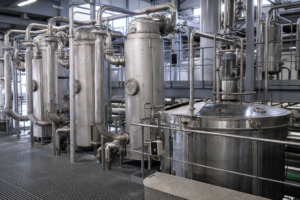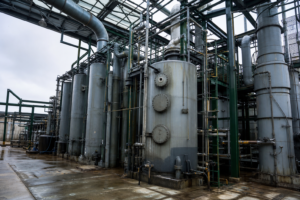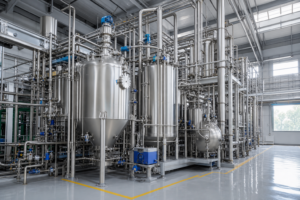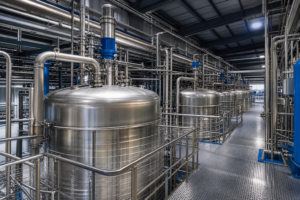
Evaporation, concentration and crystallization systems for chemical and agrochemical producers — covering flat-solubility inorganic salts (NaCl, (NH₄)₂SO₄, Na₂SO₄), temperature-sensitive organic acids, and high-COD pesticide / dye mother liquors with TDS from 2% to over 20%.
Feed composition swings by an order of magnitude across product changeovers; chloride from 0 to 30,000 mg/L, COD from <100 to >50,000 mg/L, and pH from strongly acidic to strongly alkaline — all on the same multi-purpose plant. Equipment must be specified against the worst credible envelope, not the nominal stream.
COD typically 10,000–80,000 mg/L with refractory organics (heterocyclics, surfactants, residual solvent). Biological treatment fails above ~3% TDS; direct crystallization yields organic-contaminated salt. Wet-air oxidation or Fenton upstream is usually required before thermal concentration.
At the NaCl–Na₂SO₄ eutectic (~17.5% Na₂SO₄ at 100°C) achievable salt purity caps near 92–95% regardless of crystallizer type. Selective separation into two sellable fractions requires the NaCl/Na₂SO₄ ratio to sit clearly outside the eutectic band — otherwise a hazardous mixed-salt waste is the only outcome.
Above ~200 mg/L Cl⁻ at evaporation temperature, 316L fails by pitting within months. Duplex 2205 covers Cl⁻ to ~1,000 mg/L; above 5,000 mg/L or in acidic service, titanium Grade 2 or Hastelloy C-276 is mandatory. Concentrated NaOH (>30%) above 80°C requires Nickel 200 or Ni-clad construction. Mis-selection surfaces as a through-wall leak within 6–18 months.
Campaign-mode chemical production swings TDS (2–25%), COD (<100 to >30,000 mg/L), pH (2–13) and trace metals (Fe, Cu, Ni) within one shift. Heat-transfer coefficients, scaling induction time and crystal PSD all shift with the campaign. Systems are designed around the worst credible envelope, not the average stream.
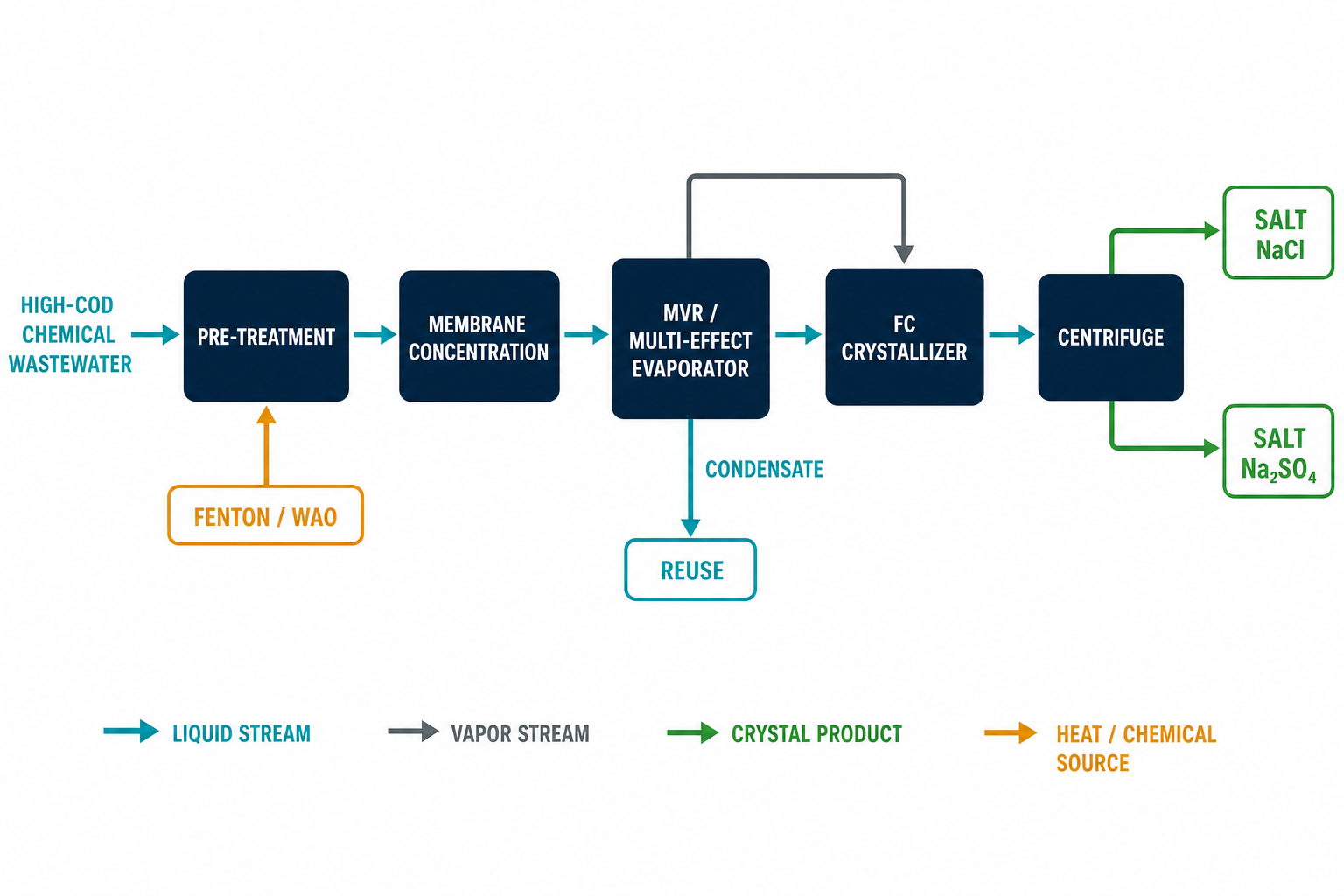
Indicative process flow for high-salinity chemical wastewater with mixed NaCl / Na₂SO₄ chemistry and residual COD load.
COD and hardness removal — wet-air oxidation or Fenton upstream for refractory organics, softening for scaling ions (Ca²⁺, Mg²⁺).
Membrane or softening pre-concentration delivering a 1–8% TDS lift before thermal concentration.
MVR (15–25 kWh per tonne water) or multi-effect (0.25–0.40 t steam per tonne water) evaporation approaching saturation.
Forced-circulation crystallization at tube velocity 2–3 m/s, heat exchanger ΔT ≤10°C to suppress wall scaling.
Centrifuge / pusher separates the crystal magma into salt cake and centrate.
Salt (NaCl / Na₂SO₄) routed to reuse or disposal; condensate recovered.
Simplified PFD for indicative routing only. Actual configuration depends on TDS profile, COD load, anion/cation balance, scaling tendency and site utilities. Mixed-salt separation feasibility requires laboratory solubility and impurity profiling.
Common feed streams encountered in chemical and agrochemical plants, with the technology route typically considered for first-pass screening.
| Chemical / Stream | Source / Context | Key Behavior | Typical Route | Material Focus |
|---|---|---|---|---|
| Ammonium sulfate (NH₄)₂SO₄ | Caprolactam by-product, coke-oven gas, rare earth precipitation | Solubility ~70 g/100 mL at 20°C, flat curve → evaporative; crystal target 1–3 mm (fertilizer grade) | DTB / FC | 316L |
| Adipic acid | Dicarboxylic acid production (KA oil oxidation) | Solubility rises ~10× from 20°C to 70°C; cooling-driven yield >80% | Cooling Crystallization | 316L |
| Sodium chloride NaCl | Chlor-alkali, ion-exchange resin regeneration | Solubility ~26 g/100 mL flat with temperature; scaling-prone as Ca / Mg co-crystallize | FC | Titanium (TA2) |
| Sodium sulfate Na₂SO₄ | Viscose, lithium battery by-product | Mirabilite / thenardite transition at 32.4°C complicates operation | DTB / FC | Duplex 2205 |
| Pesticide mother liquor | Dichlorvos, glyphosate, atrazine synthesis | COD 20,000–80,000 mg/L; NaCl 5–15%; refractory heterocyclics | FC + Pre-treatment | Titanium / Duplex |
| Dye & pigment wastewater | Reactive / disperse / vat dye production | COD 5,000–30,000 mg/L; color >1,000 Pt-Co; mixed NaCl + Na₂SO₄ | FC + AOP + ZLD | Titanium / Duplex |
Routes shown are for preliminary screening only. Final selection requires solubility data, impurity profiling, crystallization trials and project-specific engineering evaluation.
EvapCryst organizes its delivery capability around four solution categories. The chemical & agrochemical industry most often combines two or more.
Selection questions engineers ask before specifying a chemical or agrochemical system.
Begin with a full characterization: TDS, COD, anion/cation balance (Cl⁻, SO₄²⁻, Na⁺, NH₄⁺), trace heavy metals, pH, viscosity and scaling ions (Ca²⁺, Mg²⁺, SiO₂). TDS above ~5–8% typically indicates the membrane ceiling and the start of evaporative concentration; a COD/TDS ratio above ~0.3 signals pesticide or organic load requiring AOP pre-treatment; mixed-salt separation feasibility requires a NaCl–Na₂SO₄–H₂O phase-equilibrium study at the project’s actual brine composition. Skipping characterization is the single largest cause of failed ZLD projects.
Sometimes — it depends on the eutectic composition, COD content of the brine and target product purity. Selective crystallization can produce reusable-grade NaCl in favorable cases; Na₂SO₄ recovery is more sensitive to organics. Laboratory phase-equilibrium testing is required before any recovery claim.
Adipic acid solubility rises steeply with temperature, so cooling yields high crystal productivity without thermal degradation. Evaporative routes risk color formation and decomposition. This is a classic solubility-curve-driven technology choice.
Forced-circulation evaporators with tube velocity 2–3 m/s suppress wall scaling; heat exchanger ΔT is held ≤10°C to avoid skin-crystallization. Foaming is managed by oversized vapor-liquid separators (residence time ≥6 s), anti-foam dosing at 5–30 mg/L, and advanced oxidation pre-treatment to break surfactants. Each pesticide stream (dichlorvos vs. glyphosate vs. atrazine) requires its own pre-treatment trial — generic recipes fail because the refractory organics differ.
Send us your feed composition and target output. Within 2 business days you will receive a feasibility assessment, simplified PFD and indicative scope.
Send your feed characterization (TDS, COD, main salts, viscosity), throughput and product targets — we respond with a preliminary process route within two business days.