Energy-Efficient Retrofit & Decarbonization

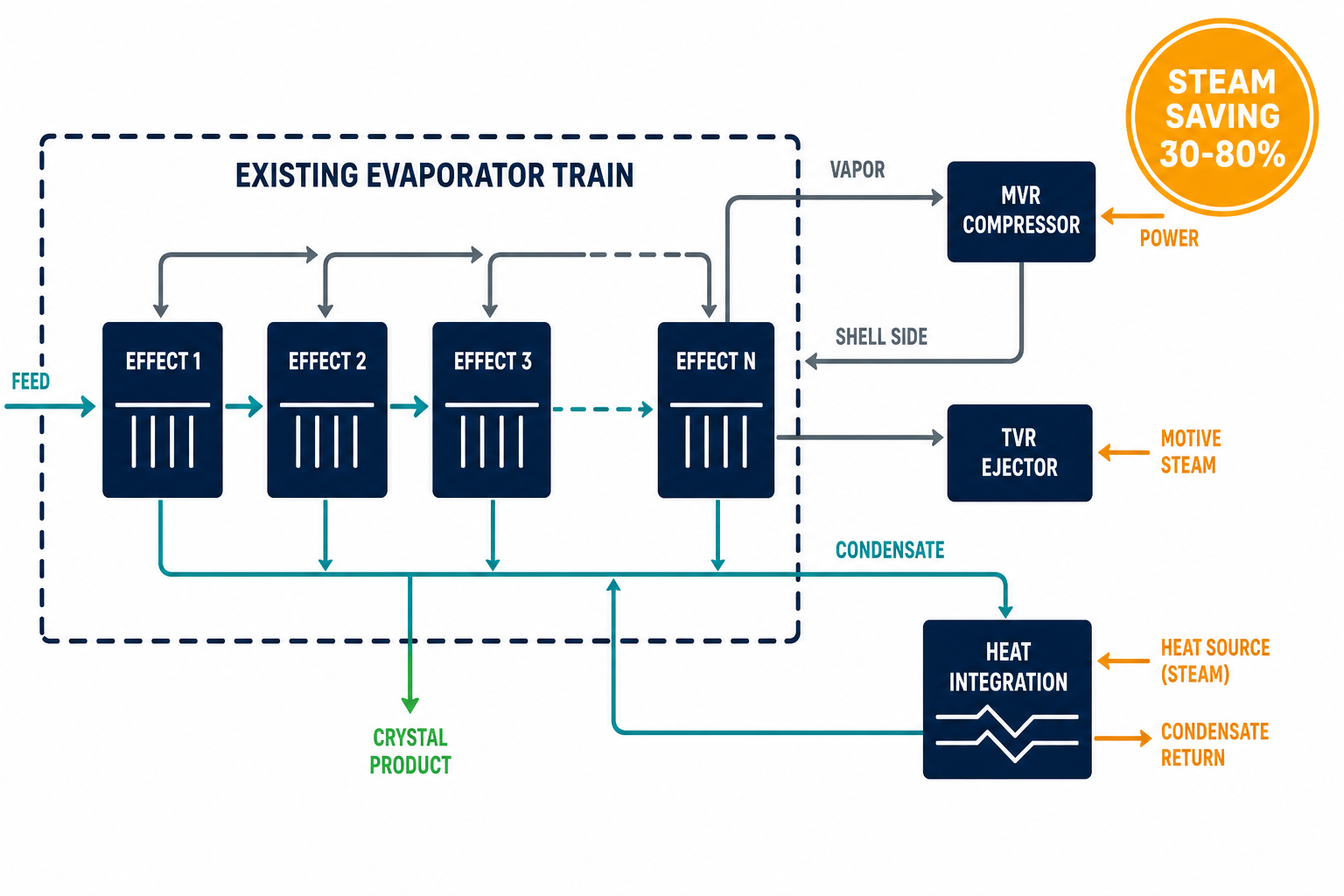
Reduce steam demand, debottleneck capacity and electrify thermal duty on existing evaporator trains — through MVR integration, TVR upgrade, heat recovery or adding an effect. Lower OpEx and Scope 1 emissions without full system replacement.

Why Retrofit

Why Plants Retrofit Aging Evaporators

Most evaporator fleets in operation today were built when steam was cheap and carbon was uncounted. Four pressures push plants to retrofit rather than replace.

PRESSURE 01Energy Cost

High Energy Cost

Aging single- or double-effect evaporators consume far more steam per ton of water evaporated than modern designs. Energy OpEx dominates total cost of ownership and erodes margin.

0.40–0.55 t steam / t watertypical consumption of aging single- or double-effect evaporators — at a 30–50 USD/t steam price and 8,000 operating hours per year
PRESSURE 02Steam Ceiling

Steam Header Capacity Ceiling

Plant expansion is often blocked by available steam header capacity at the boiler house. MVR shifts thermal duty from steam to electricity, freeing steam previously sent to the evaporator for other process uses.

15–25 kWh / t water · frees 60–80%typical MVR electricity duty, freeing 60–80% of the steam previously sent to the evaporator — depends on feed TDS, BPE and utility prices
PRESSURE 03Throughput

Throughput Bottleneck

Old evaporator heat-transfer area cannot keep up with expanded upstream capacity. Heat-integration upgrades, additional effect, or MVR retrofit can lift throughput without replacing the existing vessels.

20–40%typical throughput lift without replacing existing vessels — if material integrity and pump capacity allow
PRESSURE 04Carbon

Carbon Compliance & Scope 1 Reporting

Carbon pricing, emissions trading and mandatory Scope 1 reporting create direct financial pressure to cut steam demand. MVR electrification shifts combustion emissions from the boiler (Scope 1) to the grid (Scope 2).

EU ETS 70–100 EUR/t CO₂carbon price range incl. China ETS and CBAM on exports — net CO₂ reduction when grid factor is below ~0.6 t CO₂ / MWh
Methodology

The Retrofit Assessment Flow

Retrofit decisions are not made from a brochure. A structured five-step assessment identifies the right scope, the right technology and the right economic case — before commitment. Each step gates the next.

Simplified Flow — Retrofit Assessment
1

Condition Audit

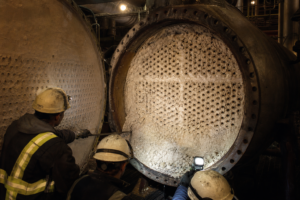
Inspect vessel material integrity (thickness, pitting, welds), heat-exchanger fouling resistance, pump curves, control architecture, current U-values.

2

Bottleneck ID

Steam economy test, vent-loss survey, condensate-flash recovery potential, insulation audit, vacuum-system capacity check.

3

Option Compare

Side-by-side evaluation of MVR retrofit, TVR ejector upgrade, heat integration, adding an effect, or hybrid routes — with CapEx, OpEx and risk profile per option.

4

Economic Case

Lifecycle cost, simple payback, IRR, carbon-reduction value at current and projected carbon price; sensitivity analysis on utility tariffs and operating hours.

5

Implementation

Phased installation planned around plant turnarounds, tie-in design, commissioning with old system on standby, performance verification against guarantee curve.

Retrofit Routes

Four Retrofit Routes

Four primary retrofit directions — each fits a different combination of existing condition, utility economics and capacity goal.

ROUTE 01MVR

MVR Integration

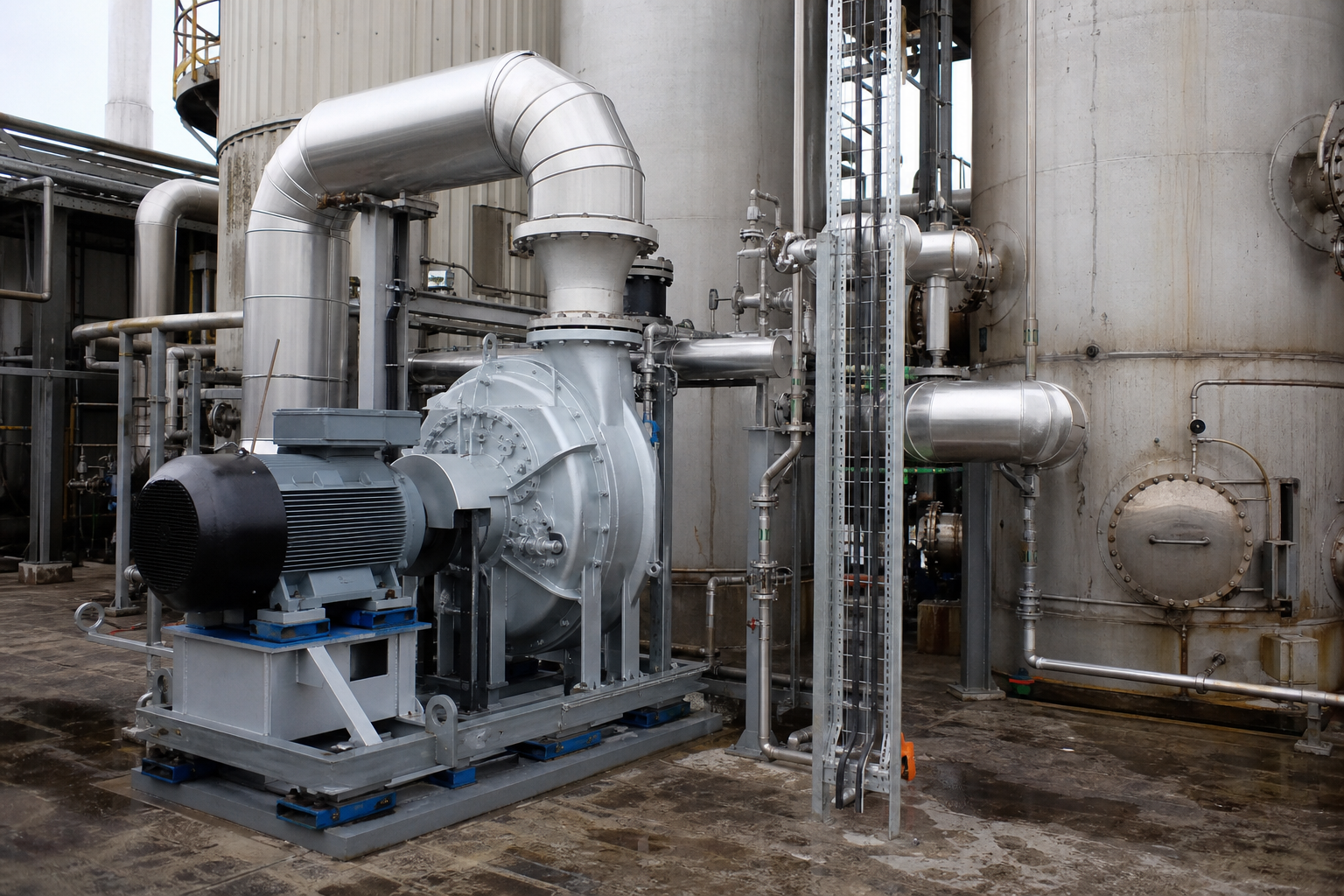
Add a single- or two-stage mechanical vapor recompression compressor to upgrade secondary vapor by 8–15 °C and reuse it as heating steam. Highest energy savings; highest CapEx; requires electrical headroom for the compressor motor (often 200–2,000 kW).

  • Best for: continuous-duty, stable-feed plants where steam > 25 USD/t and electricity < 0.10 USD/kWh
  • Reuse: existing effects, separators, pumps and heat exchangers in good condition
60–80%typical steam reduction vs. equivalent multi-effect — specific consumption typically 15–25 kWh / t water, against 0.25–0.40 t steam / t water for a triple-effect
ROUTE 02TVR

Thermal Vapor Recompression

Steam-jet thermocompressor (ejector) uses high-pressure motive steam to entrain and recompress part of the secondary vapor. No large electrical load; mature, low-maintenance technology. Lower energy savings than MVR but substantially lower CapEx (typically 10–20% the cost of an equivalent MVR compressor).

  • Best for: sites with medium-pressure motive steam (≥ 6 bar) available; intermittent operation or constrained electrical capacity
  • Reuse: most existing equipment; ejector is a compact bolt-on
30–50%typical steam reduction vs. equivalent effect count — depends on motive steam pressure and effect configuration
ROUTE 03Heat Integration

Heat Integration

Recover condensate-flash steam at the steam trap, preheat feed with hot product and condensate, integrate with site utility headers (cooling-water return, low-grade heat). Lower CapEx per GJ saved; cumulative and additive across multiple sub-projects.

  • Best for: low-budget phased upgrades and sites with multiple thermal streams
  • Reuse: existing configuration preserved; tie-ins fit existing turnarounds
5–15%typical overall steam cut — incremental and additive across multiple sub-projects
ROUTE 04Steam Economy

Add an Effect or Reconfigure

Add a fourth (or fifth) effect to an existing multi-effect train, or replace an over-specified forced-circulation stage with falling film on a clean stream. Steam economy improvement without MVR electrical load — preferred when the site is electricity-limited.

  • Best for: steam-available, electricity-limited sites with existing effect shells reusable
  • Reuse: existing effect shells, separators, vacuum system where pressure rating allows
~1/neach added effect cuts approximately 1/n of the current steam demand — crossover vs. MVR is project-specific and requires a sensitivity analysis
Interactive Tools

Retrofit Estimation Tools

Three tools to scope a retrofit case. All outputs are indicative — actual performance requires site-specific audit.

T2

Energy Comparison Tool

Compare energy consumption of your existing multi-effect system against an indicative MVR retrofit.

Indicative Output
  • Current annual steam cost: — USD/year
  • MVR annual electricity cost: — USD/year
  • Indicative annual savings: — USD/year
  • Steam reduction: — %
T3

Retrofit ROI Calculator

Estimate simple payback period for an MVR or TVR retrofit based on annual savings and indicative CapEx.

Indicative Output
  • Net annual savings: — USD/year
  • Simple payback: — years
  • 3-year IRR (indicative): — %
  • 5-year cumulative cash flow: — USD
Note: Excludes tax, depreciation, financing and incentive effects. Site audit required for verified numbers.
T5

Carbon Reduction Indicator

Indicative CO₂ reduction from electrifying thermal duty via MVR, based on grid emission factor and steam source. Useful for Scope 1 reduction planning.

MetricValueNotes
Steam CO₂ avoided— t/yearScope 1 reduction
Electricity CO₂ added— t/yearScope 2 increase
Net CO₂ reduction— t/yearNet climate benefit
Annual carbon value— USD/yearAt input carbon price
Values shown are typical ranges for preliminary screening. Actual energy savings, payback period and CO₂ reduction depend on current equipment condition (fouling, U-values, material integrity), utility tariffs (steam, electricity, cooling water), annual operating hours, feed composition and BPE, retrofit scope, and tie-in constraints. No blanket percentage guarantee is possible without a site-specific condition audit, heat-and-mass balance and economic modeling. Outputs are not a process, financial or environmental guarantee.
FAQ

Frequently Asked Questions

Honest answers on retrofit economics, scope and verification.

How much energy can an MVR retrofit actually save?+

There is no single number — it depends on your current configuration (single-, double- or triple-effect), BPE of the feed, operating hours, and the condition of existing heat exchangers. A typical triple-effect system consuming 0.35–0.40 t steam / t water can be retrofitted with MVR to consume 15–25 kWh electricity / t water, equivalent to roughly 60–80% steam cut. Actual savings require a heat-and-mass balance on your actual feed at the target concentration — BPE and ΔT compression ratio are the dominant variables.

Can I reuse my existing evaporator bodies and heat exchangers?+

In many cases yes — MVR retrofit typically reuses existing effects, separators, pumps, and heat exchangers where they pass the condition audit. The audit verifies (a) material thickness and pitting resistance, (b) pressure rating for the new operating envelope, (c) current U-value vs. design, and (d) fouling history. Where existing equipment is in good condition, retrofit CapEx is typically 30–60% lower than a greenfield install of equivalent capacity.

When is TVR preferable to MVR?+

TVR is preferable when (a) medium-pressure motive steam at ≥ 6 bar is available, (b) electrical capacity is limited or grid reliability is poor, (c) CapEx budget is constrained (TVR ejector is 10–20% the cost of an equivalent MVR compressor), or (d) the plant operates intermittently (MVR compressors prefer continuous duty to avoid thermal cycling fatigue). TVR has lower energy savings (30–50% steam cut) than MVR but also lower CapEx and no large electrical load — the right choice depends on site utility economics and operational profile.

How is carbon reduction verified?+

Carbon reduction is the difference between steam-related Scope 1 emissions avoided (Δsteam × steam CO₂ factor, typically 0.20–0.30 t CO₂ / t steam depending on boiler fuel) and electricity-related Scope 2 emissions added (Δelectricity × grid CO₂ factor, typically 0.30–0.65 t CO₂ / MWh depending on grid mix). Net CO₂ reduction is positive when the grid factor is low and the steam factor is high. Verification requires steam and electricity meter data before and after retrofit — EvapCryst recommends metering upgrades as part of the retrofit scope so reduction is auditable, not estimated.

What is the typical retrofit payback period?+

Payback depends on (a) annual operating hours (continuous 8,000 h/yr is fastest), (b) steam and electricity price spread, (c) retrofit CapEx, (d) scope of reused equipment, and (e) carbon price if you can monetize CO₂ reduction. Indicative ranges vary widely — from under 2 years for high-utilization plants in high-steam-price markets (> 40 USD/t), to 5+ years for intermittent operation or low steam prices. Use the ROI Calculator (T3) above for an initial estimate, then commission a site-specific audit before committing CapEx.

When does MVR beat adding an effect?+

MVR beats adding an effect once the marginal steam saving per added effect drops below the equivalent electrical cost of MVR. As a rule of thumb: for steam > 30 USD/t and electricity < 0.08 USD/kWh, MVR on a 3-effect typically wins on lifecycle cost against a 4- or 5-effect add-on. Adding an effect is preferred when (a) electricity is unavailable or unreliable, (b) steam is cheap waste heat, or (c) the existing effect shells and vacuum system have spare pressure rating. The crossover is project-specific and requires a sensitivity analysis.

Audit Your Existing System

Send us your current evaporator configuration (effect count, materials, year), steam and electricity consumption, annual operating hours, and feed composition. We will respond with a retrofit feasibility note, ranked options and indicative payback period within 2 business days.

Request a Proposal

Send your feed characterization (TDS, COD, main salts, viscosity), throughput and product targets — we respond with a preliminary process route within two business days.