
System components engineered for integration, not standalone catalog products. Seven equipment categories that together compose a complete evaporation and crystallization train — from feed preheating through mechanical vapor recompression, crystallization, solid-liquid separation and condensate recovery. Each module is honestly labeled by manufacturing scope and sized to your specific feed, capacity and quality targets.
Seven Equipment Categories
Each module plays a defined role in the process train. Selecting which modules apply to your project is a process-driven decision — start with the Technologies Hub.
The primary concentration workhorse upstream of crystallization. Liquid is partially vaporized by applying thermal energy — either through live steam (multi-effect), mechanical vapor recompression (MVR), or thermal vapor recompression (TVR). The objective is to raise concentration toward saturation without scaling, fouling or product degradation.
Configuration is selected by viscosity, fouling tendency and heat sensitivity: falling film for low-viscosity clean streams, forced-circulation (FC) for high-TDS, scaling or crystal-bearing liquors, and rising film for moderate-foaming duties.
Generates solid crystals from a supersaturated solution. The crystallizer configuration sets crystal mean size, PSD width and purity — and is selected by the supersaturation method (evaporative, cooling, vacuum cooling or reaction) together with the crystal growth configuration (FC, DTB or OSLO).
Forced-Circulation (FC) handles high-TDS, scaling-prone and viscous streams with tube velocities of 2–3 m/s. DTB produces classified coarse crystals (0.5–2 mm) via a draft tube and baffle-with-fines-removal. OSLO fluidized-bed grows the largest, purest crystals (1–5 mm) by maintaining very low supersaturation in a suspension bed.
The energy-reuse driver of MVR (Mechanical Vapor Recompression) systems. The compressor takes low-pressure secondary vapor evaporated from the process, raises its temperature and pressure, and returns it as heating steam to the same effect — cutting live steam demand by 80–95% at the cost of electrical energy.
Centrifugal compressors serve large capacities with moderate temperature lift; Roots (lobe) types serve smaller capacities with higher pressure ratio. Compressor selection is integrated by EvapCryst engineering but the unit is manufactured by a pre-qualified partner.
Recovered thermal energy is the largest operating-cost lever in any evaporation train. Heat exchangers preheat feed against condensate, recover inter-effect vapor heat, and reheat circulating liquor; vapor-liquid separators disengage entrained droplets from secondary vapor before it enters the next effect or the compressor.
Shell-and-tube dominates for pressure and fouling duties; plate types serve clean low-ΔP services; falling-film distributors ensure uniform wetting of evaporator tubes. Separators use tangential or centrifugal entry with demister pads for high-efficiency disengagement.
Lowers boiling point for heat-sensitive duties (food, fermentation, pharmaceuticals), enables evaporative cooling crystallization, and condenses secondary vapor so the vacuum can be maintained. Without condensation of the vapor, the vacuum pump would have to handle the full vapor load — impractical at scale.
Liquid-ring vacuum pumps and steam ejectors cover most industrial duties. Surface condensers keep process and cooling streams separated (recovering clean condensate); mixing (barometric) condensers mix vapor directly with cooling water at lower capital cost.
Converts the crystal slurry leaving the crystallizer into wet cake and clarified mother liquor. The mother liquor is typically recycled to the crystallizer (with a small purge to manage impurity build-up), while the wet cake moves to washing, drying and packaging.
Pusher centrifuges handle large continuous flows of medium-coarse crystals; peeler centrifuges serve batch duties with higher wash efficiency; belt and pressure filters cover slower-draining or finer solids. Selection is driven by crystal PSD from the crystallizer and the target residual moisture.
Closes the control loops on every unit operation in the plant — from feed flow and density, through steam pressure, vacuum level, crystal slurry density and mother-liquor recycle ratio. Architecture, programming, sequence logic and HMI are engineered by EvapCryst; hardware (PLC / DCS / instrumentation) is sourced from leading automation vendors.
Safety Instrumented Systems (SIS) implement interlocks, emergency shutdown and overpressure protection per the project’s SIL (Safety Integrity Level) assessment. Remote SCADA access enables first-line diagnostics and parameter optimization without site travel.
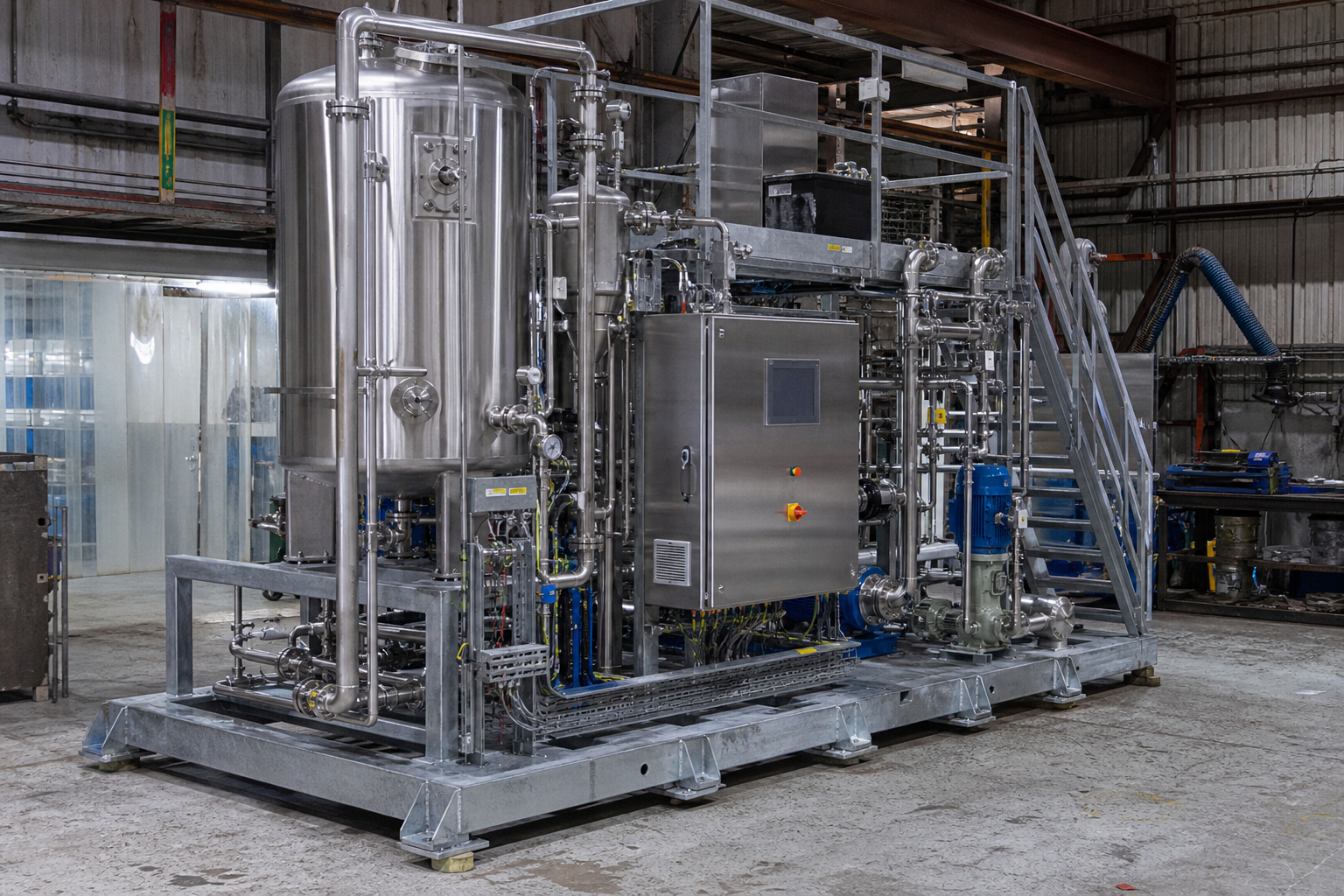
The seven modules above map onto one integrated skid: the MVR compressor, vacuum system, circulation pump and PLC control are packaged inside the same boundary, pre-assembled and pre-tested before dispatch.
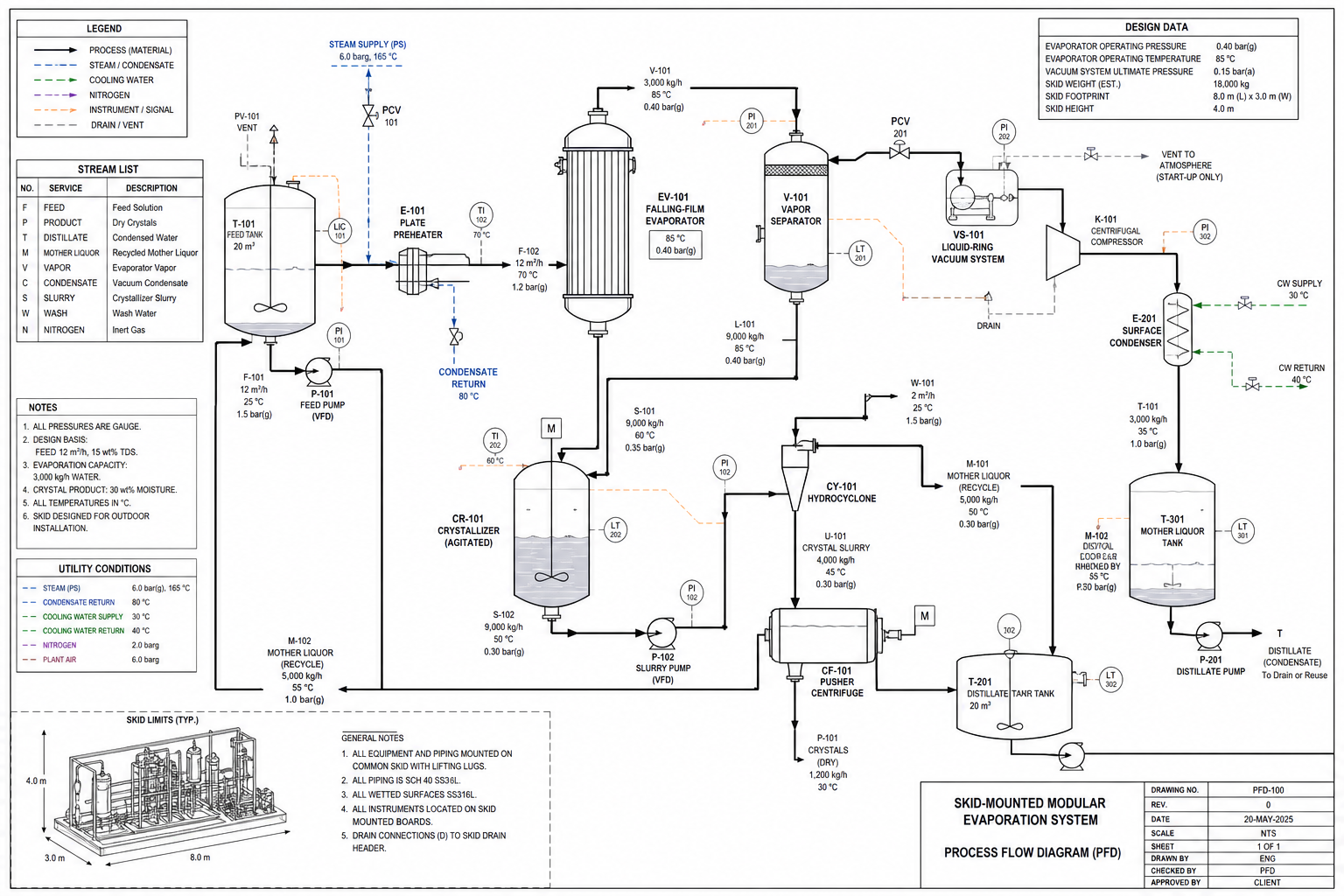
Manufacturing scope is labeled honestly on every module above. Where partner-supported equipment is integrated (vapor compressors, vacuum systems, solid-liquid separation), it is identified as such and qualified by EvapCryst engineering. No catalog pricing or stock levels are implied — every module is engineered-to-order.
Material Options
Material specification is driven by feed chemistry, chloride content, pH, temperature and purity targets. The matrix below shows typical selections — not a substitute for project-specific corrosion engineering.
| Material | Typical Duty | Chloride Resistance | Common Applications | Relative Cost |
|---|---|---|---|---|
| SS 304 | General-purpose, low-chloride streams (<100 ppm Cl⁻) | Limited | Food, fermentation, organic streams, clean condensate | Baseline |
| SS 316L | Moderate chloride (<1,000 ppm Cl⁻), mildly acidic streams | Good | Chemical, fertilizers, amino acids, organic salts | +15–25% |
| Duplex (2205 / 2507) | High chloride (>1,000 ppm), stress-corrosion cracking risk | Excellent | Seawater, brine concentration, ZLD wastewater | +60–100% |
| Titanium (Gr.2 / Gr.7) | Severe chloride (saturated brine), oxidizing media | Excellent | NaCl crystallization, brine concentration, salt plant duties | +200–400% |
| Hastelloy (C-276 / C-22) | Strong acids (HCl, H₂SO₄), reducing media, HF service | Excellent | Hydrometallurgy, battery precursors, titanium dioxide wastewater | +400–800% |
| Carbon Steel + Coating | Low-corrosion utility duties (non-process side only) | Coating-dependent | Cooling water headers, vapor ducts, utility condensers | −20% |
Material selection must be confirmed by corrosion testing on the actual feed matrix. Indicative cost deltas are relative to SS 304 baseline and vary with market conditions. Material applies across all seven equipment categories — it is not re-stated on every module.
Manufacturing Boundaries
Honest labeling of manufacturing scope — so you know exactly where EvapCryst engineering ends and partner collaboration begins. This boundary is stated once here, not re-stated on every module above.
Engineered, fabricated, pressure-tested and factory-accepted under EvapCryst quality control — full accountability.
Selected from pre-qualified partner manufacturers, integrated and commissioned by EvapCryst engineering — we remain your single point of accountability.
Architecture, programming, sequence logic and HMI built by EvapCryst — with hardware sourced from leading automation vendors.
Boundaries exist for engineering honesty, not for diffusing responsibility. For every project, EvapCryst is the single accountable integrator across all three scopes — from feed assessment to commissioning.
Send us your feed composition, throughput and product targets. Our engineers will define which modules apply, specify materials and sizing, and deliver an indicative system architecture within 2 business days.
Send your feed characterization (TDS, COD, main salts, viscosity), throughput and product targets — we respond with a preliminary process route within two business days.