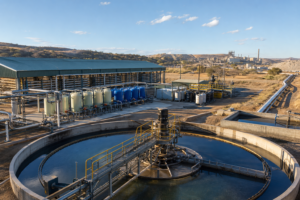
Process Liquid Concentration & Product Crystallization

Concentrate process liquors and grow product crystals under engineered control of supersaturation, particle size distribution (PSD), purity and yield — across inorganic salts (battery-grade Li₂CO₃ / LiOH, fertilizer-grade (NH₄)₂SO₄), organic acids (adipic, oxalic), and fermentation products (amino acids, MSG, citric acid).

Process Drivers

What Decides the Right Process Route

Product crystallization is not one technology. Five independent variables must combine to specify a route — collapse them and you risk purity, yield or operability.

VARIABLE 01Solubility Behavior

Solubility Behavior

NaCl-style flat solubility, adipic-acid-style strongly-rising solubility, Li₂CO₃-style inverse solubility, or thermally sensitive curves like lysine — the slope and sign of ds*/dT dictates evaporative, cooling, vacuum cooling or reaction crystallization as the supersaturation route.

VARIABLE 02Thermal Sensitivity

Thermal Sensitivity

Decomposition, color body formation or activity loss at elevated temperature (common to amino acids, organic acids, API intermediates) caps the operating temperature and forces vacuum-cooling or low-temperature evaporative routes with residence time kept below the degradation threshold.

VARIABLE 03Operability

Viscosity & Scaling Tendency

~50 cPviscosity above this at operating temperature cuts falling-film heat-transfer coefficient by 30–50%; tube-wall scaling tendency in sulfate / carbonate / silicate systems forces forced-circulation (2–3 m/s tube velocity) over falling film — both shape pre-concentration strategy
VARIABLE 04Quality Spec

Target PSD, Morphology & Purity

D50 5–10 μm → 1–3 mmofftake spec span — battery-grade Li₂CO₃ D50 5–10 μm vs. fertilizer-grade (NH₄)₂SO₄ 1–3 mm; morphology (needles vs. prisms) and purity (> 99.5% for battery) together drive the choice of FC (0.2–0.8 mm), DTB (0.5–2 mm) or OSLO (1–5 mm)
VARIABLE 05Contamination Risk

Impurity & Co-Crystallization Risk

Co-crystallization of K⁺ / Na⁺ / Ca²⁺ impurities, mother-liquor occlusion within crystals, and surface adsorption threaten product grade. Impurity profiling (ICP, IC) at expected concentration determines seeding, wash-liquor strategy and purge ratio.

Process Chain

The Concentration → Crystallization Chain

Pre-concentration, supersaturation method and crystal growth configuration are orthogonal decisions. They combine — they are not alternatives.

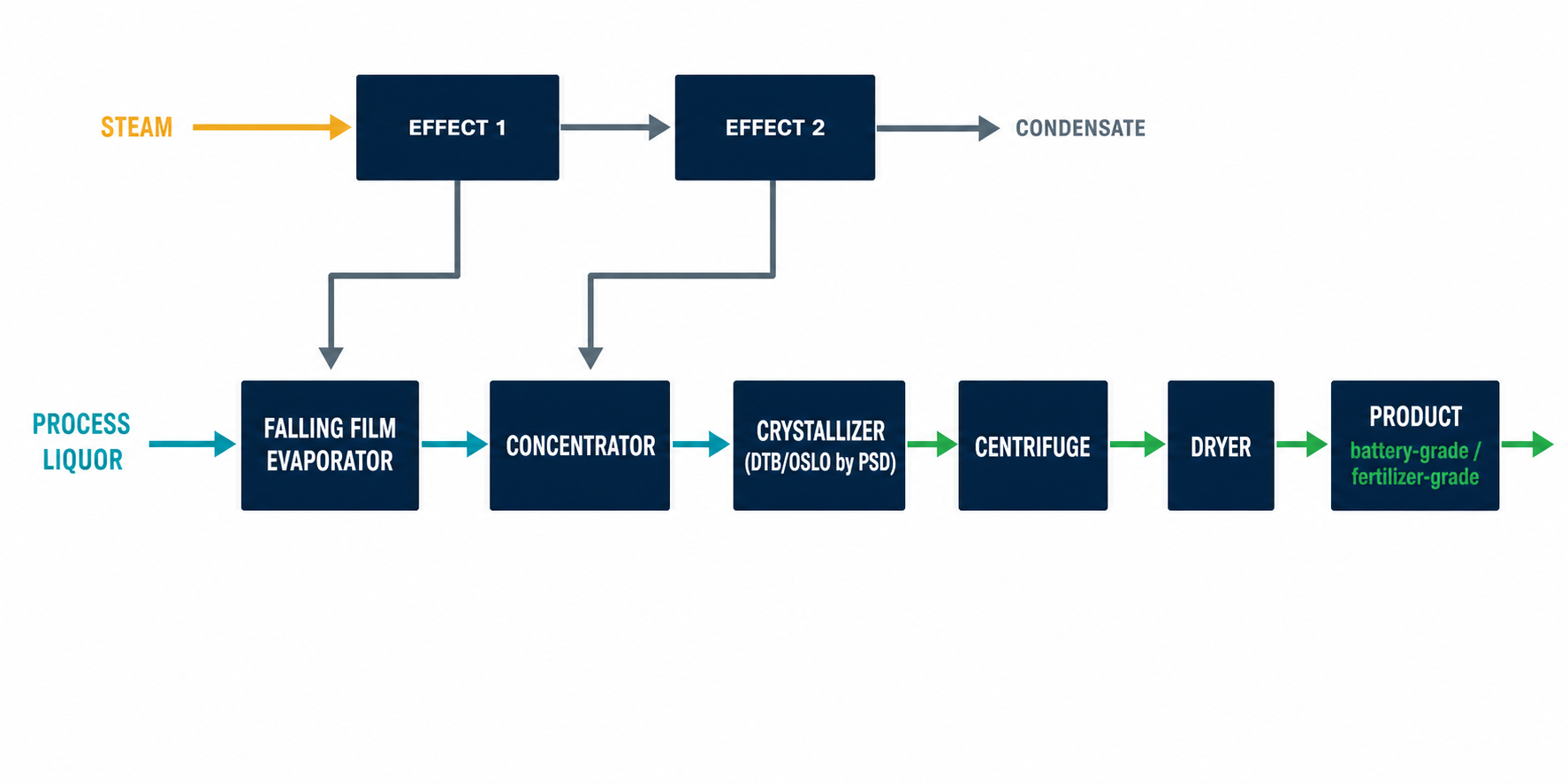
Simplified Process Flow Diagram

Pre-concentration → Supersaturation → Crystal growth → Solid-liquid separation → Washing → Drying

Each stage is configured from your liquor’s solubility behavior, thermal limits, impurity profile and target PSD — never from a catalog.

01

Pre-concentration

Falling-film evaporation for clean low-viscosity feeds (MVR or multi-effect); forced-circulation for fouling, viscous or seed-bearing liquors. Target: approach saturation within the metastable zone.

02

Supersaturation Generation

Evaporative (NaCl, (NH₄)₂SO₄), cooling (adipic acid, PTA), vacuum cooling (lysine, MSG, citric) or reaction (LiFePO₄ precursor) — selected from the slope and sign of ds*/dT.

03

Crystal Growth Configuration

Forced-Circulation (0.2–0.8 mm), DTB (0.5–2 mm) or OSLO fluidized-bed (1–5 mm) — orthogonal to supersaturation method, prioritizes reliability, PSD or crystal quality respectively.

04

Separation & Washing

Pusher, peeler or scroll centrifuge with engineered wash stage to displace mother liquor and reduce impurity occlusion; wash-liquor quantity tuned to purity target.

05

Drying

Fluid-bed, conical or rotary dryer matched to crystal morphology, thermal limit and target moisture (typically < 0.5% free moisture for fertilizer-grade; < 0.1% for battery-grade).

06

Mother Liquor Routing

Recycle to crystallizer, purge to control impurity accumulation, or secondary crystallization for residual product recovery — links to Solution S3.

Feed Chemistry

Featured Chemical Pages

Each chemical has its own solubility behavior, impurity profile and crystallization route. These dedicated pages translate the chemistry into equipment selection.

Li₂CO₃Inverse Solubility

Lithium Carbonate

Battery-grade Li₂CO₃ (D50 5–10 μm, > 99.5%) requires hot evaporative DTB crystallization above 90 °C. Inverse solubility (solubility drops as T rises) drives surface scaling — material (titanium / Duplex 2205) and configuration must be matched.

(NH₄)₂SO₄Flat Solubility

Ammonium Sulfate

By-product of caprolactam, coke-oven gas and rare-earth extraction. Flat solubility requires evaporative DTB crystallization to deliver fertilizer-grade 1–3 mm prills; mother-liquor purge controls organic build-up.

C₆H₁₀O₄Temp-Dependent

Adipic Acid

Solubility rises from ~2 g/L at 20 °C to ~160 g/L at 90 °C — cooling crystallization is the natural route. DTB with controlled cooling profile (≤ 5–8 °C/h) protects crystal morphology and avoids fine-formation spikes.

C₆H₁₄N₂O₂Thermally Sensitive

Amino Acids (Lysine / MSG / Citric)

Vacuum-cooling crystallization at 35–55 °C avoids decomposition and color body formation. Hygienic 316L / duplex construction, residence time kept under 2 hours, metastable-zone width mapped before specifying seed strategy.

LiOH·H₂OStrong Alkalinity

Lithium Hydroxide Monohydrate

Battery-grade LiOH·H₂O (> 56.5% LiOH, Na < 0.003%) uses vacuum-cooling crystallization followed by centrifugation and drying. Nickel-clad or specialty alloy construction resists strong alkalinity and chloride traces.

C₃H₈NO₃PHigh COD + Salts

Pesticide Mother Liquor

Glyphosate, dichlorvos, atrazine and similar generate high-COD (10–50 g/L) mixed-salt mother liquors with surfactant-driven foaming. Forced-circulation evaporator + advanced oxidation upstream for engineering reliability.

Selection

Configuration Selection Matrix

Three crystal growth configurations — each prioritizes a different outcome. Selection is orthogonal to the supersaturation method.

ConfigurationPriorityParticle SizeBest ForLimitation
Forced-Circulation (FC)Engineering reliability0.2–0.8 mm, broad distributionHigh-viscosity, scaling, high-TDS, fouling-prone feeds; ZLD crystallization on mixed saltsBroad PSD; not optimal for narrow size distribution or large single crystals
DTB (Draft Tube Baffle)Product quality0.5–2 mm, narrow distributionFertilizer-grade (NH₄)₂SO₄, KCl, urea, battery salts requiring consistent PSDNot for severe scaling or heavy fouling; higher CapEx than FC
Oslo (Fluidized-Bed)Crystal quality1–5 mm, large high-purity crystalsBattery-grade NiSO₄ / CoSO₄, high-purity inorganic salts, large crystal productsLower throughput per unit volume; sensitive to feed changes and seed balance
Cooling CrystallizerThermal-Sensitive / PolymorphControlled by cooling profile (≤ 5–8 °C / step)Adipic acid, PTA, boron compounds, intermediates with strongly temperature-dependent solubilityLimited to solubility curves that respond to cooling; cooling medium required

Typical ranges for preliminary screening — final selection requires lab solubility, metastable-zone and impurity profiling.

Values shown are typical ranges for preliminary screening. Final configuration selection requires laboratory solubility and metastable-zone data, impurity profiling at expected concentration, and bench-scale crystallization trials. Supersaturation method and crystal growth configuration are orthogonal decisions; do not collapse them into a single "crystallizer type" choice. Outputs are not a process guarantee.
Interactive Screening

Selection & Sizing Tools

Use these tools for preliminary screening. Output is indicative only — actual process selection requires laboratory test work.

T4Crystallizer Selection Matrix

Enter your material’s solubility behavior and operational priorities. The matrix maps inputs to recommended supersaturation method + crystal growth configuration.

Indicative Recommendation
  • Supersaturation method:
  • Crystal growth configuration:
  • Material of construction:
  • Preliminary screening only — lab trials required
FCReliability for difficult streams
DTBNarrow PSD, easy centrifugation
OsloLarge crystals, high purity
CoolingPolymorph / thermal sensitive
T1Pre-concentration Duty Estimator

Estimate the evaporation duty required to concentrate your process liquor before the crystallization stage.

Crystal size distribution, purity, polymorph and yield depend on solubility behavior, metastable-zone width, impurity profile at expected concentration, seeding strategy, cooling / evaporation ramp, and downstream washing. Final configuration selection requires lab / pilot crystallization trials on the actual liquor. Outputs are not a process guarantee.
FAQ

Frequently Asked Questions

Selection questions that engineers ask before committing to a crystallization route.

Why is supersaturation method separate from crystal growth configuration?+

Because they are orthogonal. Supersaturation method (evaporative, cooling, vacuum cooling, reaction) describes how you create the supersaturation that drives nucleation and growth. Crystal growth configuration (FC, DTB, OSLO) describes how you manage the suspension, classify the crystals and control PSD inside the vessel. A DTB can use evaporative, cooling or vacuum-cooling supersaturation — the two decisions are independent. Conflating them is the most common source of misselection in this field.

When should I choose DTB over FC?+

Choose DTB when product quality — narrow PSD (CV < 40%) and easy centrifugation — is the priority, and the feed is clean enough not to scale or foul the baffle / draft tube. Choose FC when the priority is engineering reliability under scaling, fouling, high-TDS, high-viscosity or composition-swing conditions. Fertilizer-grade (NH₄)₂SO₄, KCl and urea typically favor DTB; mixed-salt ZLD and difficult-stream crystallization favor FC.

How do you handle thermally sensitive products?+

Vacuum-cooling crystallization operates at 35–55 °C, using flash evaporation of water to provide both cooling and supersaturation. This avoids the high tube-wall temperatures of indirect cooling (which can cause incrustation and thermal decomposition) and shortens the high-temperature exposure window. Combined with short residence time, hygienic 316L or duplex construction, and tight metastable-zone-width control, vacuum cooling is the standard route for lysine, MSG, citric acid, and many API intermediates.

Why does Li₂CO₃ use hot crystallization?+

Lithium carbonate has inverse solubility — its solubility drops from ~13 g/L at 20 °C to ~7 g/L at 100 °C. Hot evaporative DTB crystallization above 90 °C exploits this property to precipitate battery-grade Li₂CO₃. The same inverse solubility drives wall-scaling risk, because the hottest surface in the system (the heat-transfer tube wall) is where solubility is lowest — which is why titanium / Duplex 2205 construction and tight ΔT control across the heater are mandatory.

What is the metastable zone and why does it matter?+

The metastable zone is the concentration–temperature window between the saturation line and the spontaneous-nucleation line. Inside the zone, existing crystals grow but few new nuclei form — giving controlled PSD. Outside it, spontaneous nucleation floods the magma with fines and broadens PSD. Lab measurement of metastable-zone width (typically via polythermal method) is required before specifying operating ΔC, cooling ramp or evaporation rate for any quality-critical crystallization.

Ready to Specify Your Crystallization System?

Share your solubility data, target purity and PSD, throughput and feed composition. We will respond with a supersaturation method + crystal growth configuration recommendation, indicative sizing and material selection within 2 business days.

Request a Proposal

Send your feed characterization (TDS, COD, main salts, viscosity), throughput and product targets — we respond with a preliminary process route within two business days.