Pharmaceuticals & Fine Chemicals

Vacuum evaporation (40–80°C, 30–200 mbar abs) and crystallization systems for API production, solvent recovery (MeOH / EtOH / DCM / THF / toluene) and fine-chemical purification — GMP-grade SS316L construction (Ra ≤ 0.4–0.8 µm), CIP / SIP design, polymorph control and documentation (3.1B, IQ/OQ) aligned with FDA / EMA / NMPA audit expectations.

Phase 2 — In Preparation · Prototype
industries pharma
Process Challenges

Why Pharmaceutical Crystallization Is Different

Pharma combines thermal sensitivity, polymorph control, GMP documentation and a solvent diversity few other industries face. The crystallizer is not just a unit operation — it defines the API’s physical form and the regulatory submission.

DRIVER 01Thermal-Sensitive

Thermally Sensitive APIs

Many APIs degrade, racemize or discolor at atmospheric boiling. Vacuum evaporation preserves thermal stability — the temperature ceiling is a process specification, not an engineering preference.

  • Degradation, racemization and color formation accelerate at atmospheric boiling
  • Ceiling set by API thermal data: DSC, TGA, forced-degradation study
40–80°C · 30–200 mbar abstypical vacuum evaporation envelope — many API classes report D&B > 0.1 at 420 nm within 8 h at 100°C, so the low-temperature envelope is mandatory, not optional
DRIVER 02Polymorph-Critical

Polymorph & Crystal Habit Control

APIs frequently exhibit polymorphism — supersaturation profile, cooling ramp, seeding, residence time and agitation define which form you ship.

  • Carbamazepine: 4 known forms · sulfathiazole: 5 · ritonavir: 2, with drastically different bioavailability
  • These are process-engineering decisions, fixed in the pilot phase by DoE study
0.1–0.5°C/min · 1–5 wt%typical controlled cooling ramp and seed loading — the operating envelope is fixed by the customer’s process development, never assumed by the equipment vendor
DRIVER 03GMP-Regulated

GMP Compliance & Audit Trail

Documentation is part of the deliverable, not a side task — from material certification to FAT protocol.

  • Material certificates 3.1B EN 10204; welder qualifications to ASME IX or equivalent
  • Hygienic design: slope-for-drainage ≥ 3°, no dead legs > 3D, sanitary clamp / ASME-BPE connections
  • Instrument calibration traceable to NIST / NPL
Ra ≤ 0.4–0.8 µmproduct-contact surface finish, measured and documented — ≤ 0.4 µm polish typical for final API contact; full baseline in the GMP table below
DRIVER 04Yield / Recovery

Diverse, Flammable Solvents — Recovery Duty

Methanol, ethanol, DCM CH₂Cl₂, toluene, THF and solvent mixtures each bring their own material, vacuum, recovery and explosion-proofing requirements. A “standard” pharmaceutical crystallizer does not exist — the solvent defines the engineering, and the mother liquor defines the yield.

  • Solvent defines materials, vacuum system and explosion-proofing scope
  • Azeotrope behavior governs the recovery column design
  • Residual product in mother liquor is the yield lever (Solution 03)
> 99.5%target solvent recovery on MeOH / EtOH mother-liquor recycle — achievable level depends on the solvent system and azeotrope-breaking strategy
Typical Streams

Typical Applications in Pharmaceuticals & Fine Chemicals

Common feed streams in pharmaceutical and fine chemical production, with the technology route typically considered for first-pass screening.

APP 01Polymorph-Critical

API Crystallization

Final-step API isolation — polymorph-critical, thermally limited, PSD-specified.

  • Thermal sensitivity above 60–80°C for many APIs
  • Route: vacuum + cooling crystallization with seeding
  • SS316L product contact, Ra ≤ 0.4 µm polish for final API surfaces
D50 50–300 µmtypical target PSD for isolated API — set by downstream filtration, drying and dissolution specification, per product
APP 02Purity-Spec

Intermediates & Fine Chemical Crystallization

Specialty intermediates and agro actives — purity and PSD specification without API-level GMP documentation scope.

  • Purity > 99% typical product specification
  • Route: DTB / FC crystallizer by solubility behavior
  • SS316L / Hastelloy by solvent and chloride profile
D50 100–500 µm · Cv < 35%typical PSD and uniformity targets for fine-chemical grades — confirmed per chemical system in bench trials
APP 03Yield / Recovery

Solvent Recovery from Mother Liquors

Mother-liquor distillation and solvent recycle — water–organic separation governed by azeotrope behavior.

  • Azeotropes: MeOH / acetone / water systems; DCM–water
  • Route: vacuum evaporator / distillation column
  • SS316L / Hastelloy C-276 for chlorinated duty
> 99.5% recoverytarget for MeOH / EtOH mother-liquor recycle — final figure depends on solvent mixture and azeotrope-breaking strategy
APP 04Compliance-Driven

Pharmaceutical Wastewater ZLD

Process effluent and equipment wash water — high-COD, low-TDS profile with residual solvent and trace API.

  • Trace API at µg/L levels — destruction or recovery route ahead of the brine train
  • Solvent stripping pre-treatment; mixed-solvent saline streams routed to brine crystallization
  • Route: pre-treat + ZLD; Hastelloy / Titanium by chloride profile
COD 5,000–30,000 mg/Ltypical high-COD / low-TDS pharma effluent profile — pre-treatment and ZLD configuration confirmed by feed characterization
Process Route

API Crystallization Methods & Indicative Route

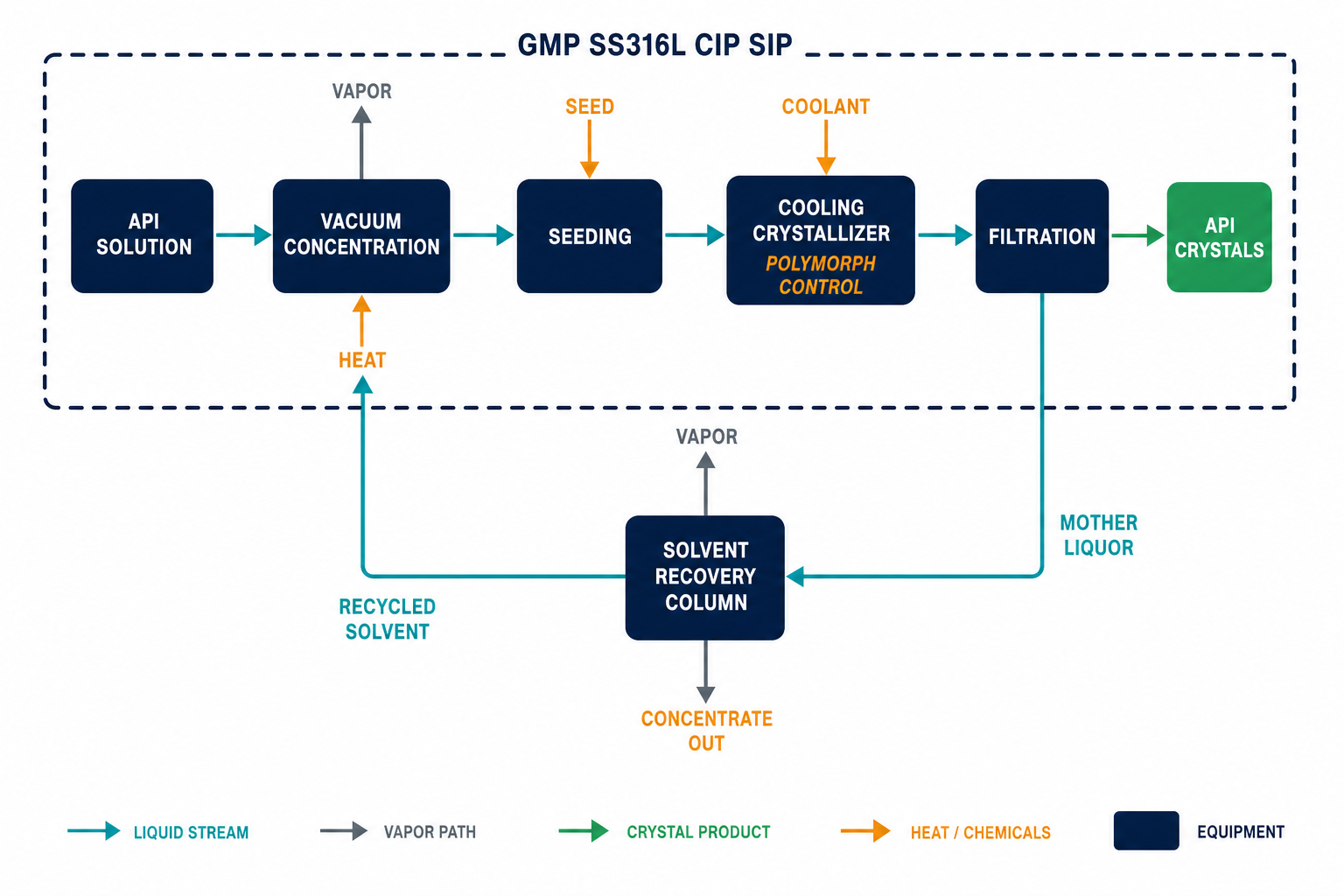
Four supersaturation-generation methods cover most API isolation duties. The indicative flow below shows where solvent recovery plugs in.

Cooling crystallization For moderate solubility–temperature slope — controlled ramp 0.1–0.5°C/min with 1–5 wt% seeding of the target form
supersaturation ▸ temperature →
Anti-solvent crystallization Where solubility falls sharply on anti-solvent dosing — addition rate and mixing define the supersaturation profile
supersaturation ▸ composition →
Vacuum (flash) cooling crystallization Adiabatic evaporative cooling — volatile-solvent systems and thermal-sensitive APIs, inside the 40–80°C / 30–200 mbar abs envelope
supersaturation ▸ evaporation →
Reactive crystallization API formed in situ by reaction — rapid supersaturation generation demands reactant-mixing control
supersaturation ▸ reaction →
API solution5–30% API in solvent Vacuum concentration40–80°C · 30–200 mbar Seeding1–5 wt% of target form Cooling crystallizerpolymorph control Filtration / centrifugationAPI crystals out Mother liquorto recovery column Recycled solvent+ concentrate out

Simplified PFD for indicative routing only. Polymorph control requires dedicated design-of-experiments (DoE) in the pilot phase. Solvent recovery column design depends on the solvent mixture and azeotrope behavior. Mother-liquor concentrate goes to incineration or further recovery, per project.

Polymorph Strategy

Crystal Form Control Strategy

The crystallizer is engineered to reproduce a verified process envelope — never to invent one.

01

Polymorph Screening

Customer-side DoE: carbamazepine 4 forms, sulfathiazole 5, ritonavir 2 — form selection is project-specific, with no universal default.

02

Envelope Definition

Supersaturation kept within the metastable zone — typically 0.5–2× solubility gap, measured per API–solvent system.

03

Seeding & Cooling Curve

1–5 wt% seeds of the target form, seed PSD 10–50 µm, controlled ramp 0.1–0.5°C/min.

04

Scale-Up & PAT

Agitation tip speed 1–3 m/s, residence time and impurity profile; PAT monitoring of the batch trajectory at commercial scale.

Labile zone — spontaneous nucleation · avoid supersolubility curve ↑
Metastable zone — the seed window
Seed here · 1–5 wt% of target form
solubility curve ↑
Undersaturated — crystals dissolve

Schematic, not to scale. Concentration / supersaturation increases upward; the metastable zone sits between the solubility and supersolubility curves. Metastable zone width is API- and solvent-specific (typical operating envelope 0.5–2× solubility gap) and is measured per system during process development.

No universal polymorph guarantee. Crystal form outcomes require project-level screening and DoE study — without a verified DoE, polymorph claims are speculative. EvapCryst engineers equipment that reproduces the recipe at commercial scale; we do not invent polymorph recipes.

GMP Baseline

GMP Compliance Baseline

Equipment-level compliance engineering built in from day one — these constraints cannot be added later.

Compliance ElementEvapCryst BaselineNotes & Conditions
Product-contact materialSS316L baseline3.1B EN 10204 certificates; full material traceability; Hastelloy C-276 for chlorinated solvent duty
Surface finishRa ≤ 0.4–0.8 µmProduct-contact surfaces, measured and documented; ≤ 0.4 µm polish typical for final API contact
Hygienic designSlope ≥ 3° · no dead legs > 3DFull drainability; sanitary clamp / ASME-BPE connections throughout
CIPSpray balls / rotating jetsCoverage verified by riboflavin test; typical cleaning circuit 2% NaOH at 70°C + rinse
SIP121–134°C clean steam · 1.5–2.5 barPressure-rated construction, sanitary venting and condensate management
WeldingWelder quals to ASME IX or equivalentWeld records retained in the documentation package
DocumentationDQ / IQ / OQ outline + FAT protocol & reportCalibration traceable to NIST / NPL; PQ coordinated with the customer’s validation team

Documentation scope is defined per project and per target market (FDA / EMA / NMPA).

Scope boundary: EvapCryst provides equipment-level GMP compliance support only. Drug Master File (DMF) submissions and pharmaceutical regulatory filings remain the responsibility of the pharmaceutical manufacturer.

Materials

Materials Selection by Solvent System

The solvent — not the equipment catalog — picks the metallurgy. Chloride-bearing streams escalate from SS316L immediately.

MAT 01Baseline

Aqueous & Alcohol Systems

MeOH / EtOH / THF / toluene and water-based API duties.

  • SS316L baseline for product contact
  • Ra ≤ 0.4 µm polish for final API contact
  • 3.1B EN 10204 material traceability
MAT 02Chlorinated

Chlorinated Solvents (DCM)

Dichloromethane CH₂Cl₂ — extraction solvent and mother-liquor duty.

  • Aggressive Cl⁻ → Hastelloy C-276
  • DCM–water azeotrope shapes the recovery design
  • Regulated: VOC / Montreal Protocol handling
MAT 03ZLD Duty

Saline Effluents & ZLD Brine

Pharmaceutical wastewater and mixed-solvent saline streams downstream of stripping.

  • Hastelloy / Titanium by chloride profile
  • Escalation confirmed by corrosion coupon testing in the scoping phase
  • Trace-API pre-treatment ahead of the brine train
FAQ

Frequently Asked Questions

What GMP documentation does EvapCryst provide with pharmaceutical crystallizers?+

Standard GMP package includes: material certificates (3.1B EN 10204), weld records and welder qualifications, surface-finish measurement (Ra ≤ 0.4–0.8 µm for product-contact surfaces), pressure-test reports, slope-for-drainage verification, instrument calibration records, FAT protocol and report, and an equipment IQ/OQ outline. Full pharma commissioning (PQ) support is coordinated with the customer’s validation team. Documentation scope is defined per project and per target market (FDA / EMA / NMPA).

How do you control polymorph during crystallizer design?+

Polymorph control is decided at the process level — supersaturation profile (within metastable zone, typically 0.5–2× solubility gap), cooling ramp (0.1–0.5°C/min), seeding strategy (1–5 wt% of target form, seed PSD 10–50 µm), residence time, agitation intensity (tip speed 1–3 m/s) and impurity profile. The crystallizer is engineered to deliver the process envelope defined in the customer’s process development (DoE study). We do not invent polymorph recipes; we engineer equipment that reproduces the recipe at commercial scale. Without a verified DoE, polymorph claims are speculative.

Why is vacuum evaporation used instead of atmospheric evaporation for APIs?+

API thermal degradation, racemization, color formation and impurity generation accelerate at atmospheric boiling (D&B > 0.1 at 420 nm within 8 h at 100°C for many APIs). Vacuum evaporation at 40–80°C and 30–200 mbar abs preserves product stability; the operating temperature is a process specification driven by API thermal data (DSC, TGA, forced-degradation study), not an engineering preference. Vacuum system selection follows duty: liquid ring pump for 50–200 mbar, dry screw for 1–50 mbar, steam ejector for very low pressure with high vapor load.

How is CIP/SIP integrated into pharmaceutical crystallizer design?+

CIP requires spray balls or rotating jets covering all product-contact surfaces (coverage verified by riboflavin test), paired with cleaning-solution supply (typically 2% NaOH at 70°C + rinse), recovery and rinse circuits. SIP requires pressure-rated construction for 121–134°C clean steam at 1.5–2.5 bar, sanitary venting and condensate management. Both require slope-for-drainage (≥ 3° on all wetted surfaces), no dead legs longer than 3D, and sanitary clamp or ASME-BPE connections. These are engineering constraints from day one — they cannot be added later.

Discuss Your Pharmaceutical or Fine Chemical Project

Send us your API solvent system, thermal sensitivity, target polymorph and GMP documentation scope. Within two business days you will receive a feasibility assessment, simplified PFD and indicative scope.

Request a Proposal

Send your feed characterization (TDS, COD, main salts, viscosity), throughput and product targets — we respond with a preliminary process route within two business days.