EvapCryst logo

Mother Liquor Recovery & Product Yield Optimization

Engineer mother-liquor loops that maximize product recovery through controlled recycle, secondary crystallization and purge optimization — while keeping impurity accumulation, product purity and PSD within specification across continuous and batch operation.

Mother liquor evaporation and salt crystallization solution
The Core Decision

When to Recycle, Purge or Further Crystallize

Mother liquor is rarely waste. It carries dissolved product, trace impurities and a chemistry that determines whether it should return to the crystallizer, leave the loop as purge, or feed a secondary recovery stage.

PATHWAY 01Recycle

Recycle Pathway

When feed impurities are benign and accumulation kinetics are slow, mother liquor returns to the crystallizer to recover dissolved product. Steady-state impurity level is set by the purge ratio.

60–70% → 90–95%single-pass vs recycle-loop overall yield — achievable when feed impurities are benign and accumulation kinetics are slow
PATHWAY 02Purge

Purge Optimization

When impurities accumulate toward a quality limit, a controlled purge stream removes them — but every purge carries dissolved product at the mother-liquor concentration. The trade-off between yield loss and purity gain is the central optimization problem.

>10 ppm · Hazen 50typical quality limits (heavy metal / color body) that trigger purge — thresholds are product-spec-specific
PATHWAY 03Secondary

Secondary Crystallization

When valuable product remains dissolved in the purge (lithium salts, (NH₄)₂SO₄, nickel sulfate), a secondary crystallizer — often cooling or vacuum-cooling — recovers residual product before disposal. Payback is fastest for high-value streams.

~10 g/Ldissolved product above which secondary crystallization is typically considered — payback depends on product value and purge flow
PATHWAY 04Impurity Control

Impurity Accumulation

Each recycle pass concentrates trace impurities (K⁺, Na⁺, Ca²⁺, organics, color bodies) until the steady-state defined by purge flow. Mass balance around the loop, online monitoring (density, conductivity, ICP, UV-254 for organics) and dynamic purge control replace fixed-ratio operation.

15–30%product-loss cut from dynamic purge control vs fixed-ratio operation — depends on impurity profile and online monitoring coverage
Process Architecture

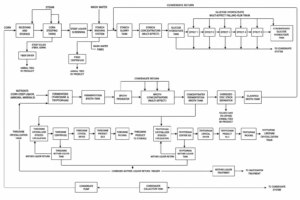
The Mother Liquor Loop

A mother liquor loop is not a single unit operation. It is a system of crystallization, separation, washing, recycle and purge — balanced around mass balance, yield and product purity.

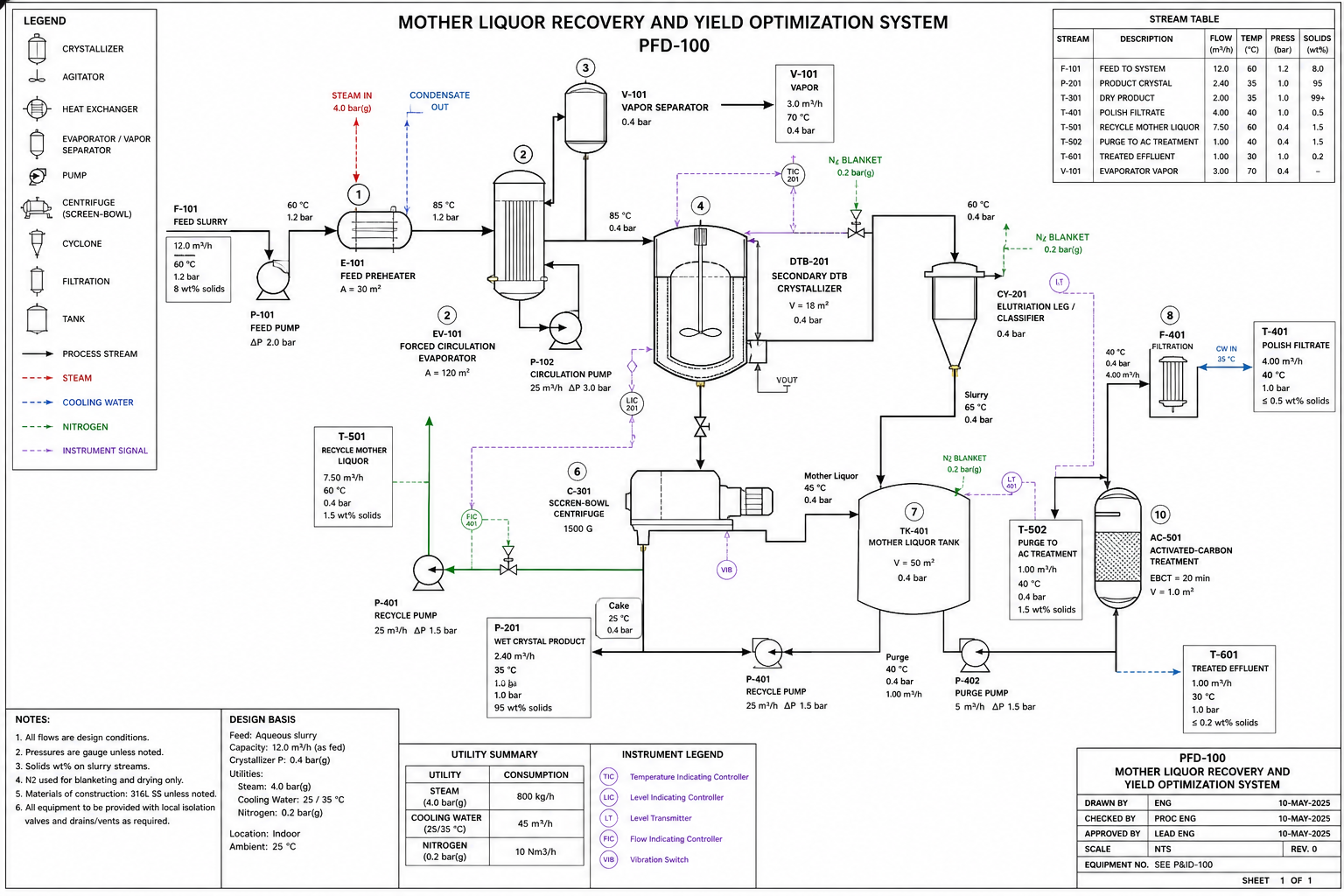
Simplified PFD — Mother Liquor Loop
Mother liquor recovery process flow diagram: DTB crystallizer with elutriation leg, screen-bowl centrifuge, activated-carbon treatment and recycle loop
1

Primary Crystallization

Main crystallizer (FC, DTB or OSLO depending on product spec) produces primary crystals from fresh feed and recycled mother liquor combined at the feed tank.

2

Separation

Pusher, peeler or scroll centrifuge dewaters the crystal magma; mother-liquor centrate carries dissolved product at saturation plus accumulated impurities.

3

Washing

Wash liquor (clean water or saturated brine) displaces mother liquor from the crystal cake to reduce impurity entrainment; wash-liquor consumption tuned to the purity spec.

4

Recycle Decision

Mass balance on the loop, combined with impurity concentration measurement, sets the recycle ratio vs. purge flow that holds steady-state impurity below the product-quality limit.

5

Secondary Crystallization

Optional recovery stage — typically cooling or vacuum-cooling at lower temperature than the primary crystallizer — extracts residual product from the purge stream before disposal.

6

Purge & Disposal

Sized purge flow carries accumulated impurities out of the loop. Post-treatment (advanced oxidation, evaporation-to-dryness, or hazardous landfill) depends on the purge composition.

Chemical Systems

Recovery Routes by Chemical System

Different chemistries create different mother liquor challenges. The recovery route, purge strategy and integration with the main crystallizer depend on what is in the liquor.

SYSTEM 01(NH₄)₂SO₄

Ammonium Sulfate Mother Liquor

By-product mother liquors from caprolactam, coke-oven gas and rare-earth extraction. Carry soluble sulfate salts plus trace organics, heavy metals and color bodies that accumulate over multiple passes.

  • Recycle to DTB or FC for fertilizer-grade (NH₄)₂SO₄
  • Purge flow sized against organic / heavy-metal limit
  • Yield optimized around purge ratio vs. purity target
SYSTEM 02Li⁺

Lithium Salt Mother Liquor

Spodumene sulfate-process leachate, salt-lake brine and LIB black-mass leachate generate lithium-bearing mother liquors (Li₂CO₃, LiOH, Li₂SO₄) with recovery values of thousands USD per ton.

  • Secondary crystallization for residual Li₂CO₃ / LiOH
  • Na₂SO₄ co-product recovery from sulfate route
  • Tight K / Na / Ca / Mg impurity control for battery-grade spec
SYSTEM 03Organics

Fermentation & Pharmaceutical Mother Liquor

Amino-acid, organic-acid and API-intermediate mother liquors carry thermally sensitive organics, color bodies (UV-254), biologically active impurities, and often residual solvents that complicate recycle.

  • Vacuum-cooling crystallization for thermal sensitivity
  • Polishing (activated carbon, ion exchange) and decolorization between stages
  • Solvent recovery integrated where applicable

Frequently Asked Questions

Honest answers on mother liquor recycling, purge and yield.

How much product is typically lost in mother liquor purge?+

Product loss per pass equals mother-liquor TDS × purge ratio × solubility-at-purge-conditions. For a (NH₄)₂SO₄ system at saturation ~45% w/w, purge ratio 5%, the loss is roughly 2.25% of the dissolved throughput per pass. Recycle lifts cumulative yield from a single-pass 60–70% to 90–95%; secondary crystallization on the purge can lift the residual recovery further. The actual figure requires a project-specific mass balance on the actual mother liquor.

How do you control impurity accumulation in a recycle loop?+

Impurity accumulation is governed by mass balance: impurities enter with the feed and leave through purge, product entrainment or side reactions. The purge ratio is sized to hold steady-state impurity concentration (C_ss) below the threshold that affects product quality. Online monitoring — density for concentration, conductivity for ionic load, ICP for metals, UV-254 for organics — allows dynamic purge control that follows actual composition rather than fixed ratios, cutting product loss by 15–30% vs. fixed-ratio operation.

When does secondary crystallization pay back?+

Secondary crystallization is justified when dissolved-product value in the purge exceeds recovery-equipment CapEx amortization plus OpEx within an acceptable payback window (typically < 3 years). For high-value products (lithium salts at > 8000 USD/t, pharmaceutical intermediates at > 20,000 USD/t), the threshold dissolved concentration that justifies recovery can be as low as 1–5 g/L. For low-value bulk salts (NaCl at 30–60 USD/t), the threshold may not be reached — direct purge disposal is then the right answer.

How does washing affect yield?+

Washing displaces mother liquor from the crystal cake, reducing impurity entrainment (each 1% residual mother liquor can carry 10–100 ppm of impurity into the product). But wash liquor dissolves a small amount of product, slightly reducing yield. Wash-liquor quantity (typically 0.1–0.5 kg per kg crystal), wash temperature, and displacement efficiency (single-stage vs. counter-current) determine the net effect. This is why washing strategy is engineered alongside the purge strategy — not chosen in isolation.

How do you size the purge ratio for a recycle loop?+

For a conservative estimate, the steady-state impurity concentration in a recycle loop with no impurity removal reactions is C_ss = C_feed × (1 + recycle ratio / purge ratio). Sizing starts from the impurity limit set by the product spec, then solves for purge ratio, then verifies that the resulting product loss is acceptable. Online analyzers allow the design purge ratio to be trimmed in operation. Lab measurement of the actual impurity profile is required before sizing — typical design purge ratios range from 1–2% for clean feeds to 5–10% for high-impurity by-product streams.

Preliminary screening:  T3 · ROI Calculator →

Discuss Your Mother Liquor Loop

Send us your mother-liquor composition (TDS, dissolved product, impurity profile, organics), current purge ratio and product purity target. We will respond with a recovery route, indicative yield improvement and purge-optimization plan within 2 business days.

Request a Proposal

Send your feed characterization (TDS, COD, main salts, viscosity), throughput and product targets — we respond with a preliminary process route within two business days.