Industrial Park Integrated Wastewater ZLD: Treatment Train and Design Rules
Four-stage industrial park wastewater ZLD: MBR+RO membrane recovery and MVR evaporation-crystallization, with a coal-chemical park case meeting GB 31570-2015.
Engineered ZLD and selective recovery for complex industrial effluents — COD 5,000–80,000 mg/L, TDS 1–25%, heavy metals (Cr, Ni, Cu, Zn, As) in the 1–500 mg/L range, with chelants, surfactants and refractory organics that defeat conventional biological or membrane treatment.
Complex wastewater combines two or more complicating factors — high COD with high TDS, heavy metals with organics, or chelants that defeat precipitation. Conventional single-technology approaches fail.
Organic load combined with salinity: biology fails above ~3% TDS (osmotic stress), and membranes fail above ~1,000 mg/L COD (fouling). Thermal concentration after AOP pre-treatment becomes the only viable path to ZLD.
Toxic at mg/L levels, regulated tightly, and capable of contaminating recovered salt to hazardous-waste classification. Pre-evaporator precipitation (sulfide at pH 8–9, hydroxide at pH 9–10) to <0.5 mg/L total is usually mandatory.
Refractory to biological treatment: heterocyclics, solvents, surfactants, polymers. Advanced oxidation is often the only effective pre-treatment.
Surfactants, solvents, chelants and complexing agents that bind metals and defeat standard precipitation. Stream-specific sequencing is required.

Four-stage industrial park wastewater ZLD: MBR+RO membrane recovery and MVR evaporation-crystallization, with a coal-chemical park case meeting GB 31570-2015.

Engineering guide to multi-effect evaporation systems: steam economy by effect count, evaporator configuration selection, salt-driven design constraints, and ZLD integration for high-salinity industrial streams.

Catalytic decomposition destroys N2O from adipic acid nitric-oxidation off-gas (GWP roughly 270x CO2), while MVR evaporation-crystallization handles acidic mother liquor – crystallization difficulties, treatment routes, and plant integration.

Evaporation-crystallization treatment for fluoride wastewater: why lime precipitation stalls at CaF2 solubility, HF-specific materials (graphite, PTFE), and fluosilicate product recovery with ~90% hazardous waste reduction.

MVR evaporation closes livestock farm manure and flush water to zero liquid discharge: struvite control, ammonia stripping, NPK concentrate to organic fertilizer and condensate reused for barn flushing.

Digestate liquor treatment: solids removal, ammonia methods matched to N concentration (stripping >2000 mg/L, steam stripping >20000 mg/L), SWRO at 1200 psi to 80% recovery, UHP RO to 140,000 mg/L,
Complex wastewater typically arrives at EvapCryst only after biological, membrane and chemical treatment have been exhausted. Understanding where they fail defines where thermal ZLD begins.
We do not begin with equipment. We begin with stream characterization, segregation strategy and pre-treatment sequencing — then specify the evaporator and crystallizer around the resulting envelope.
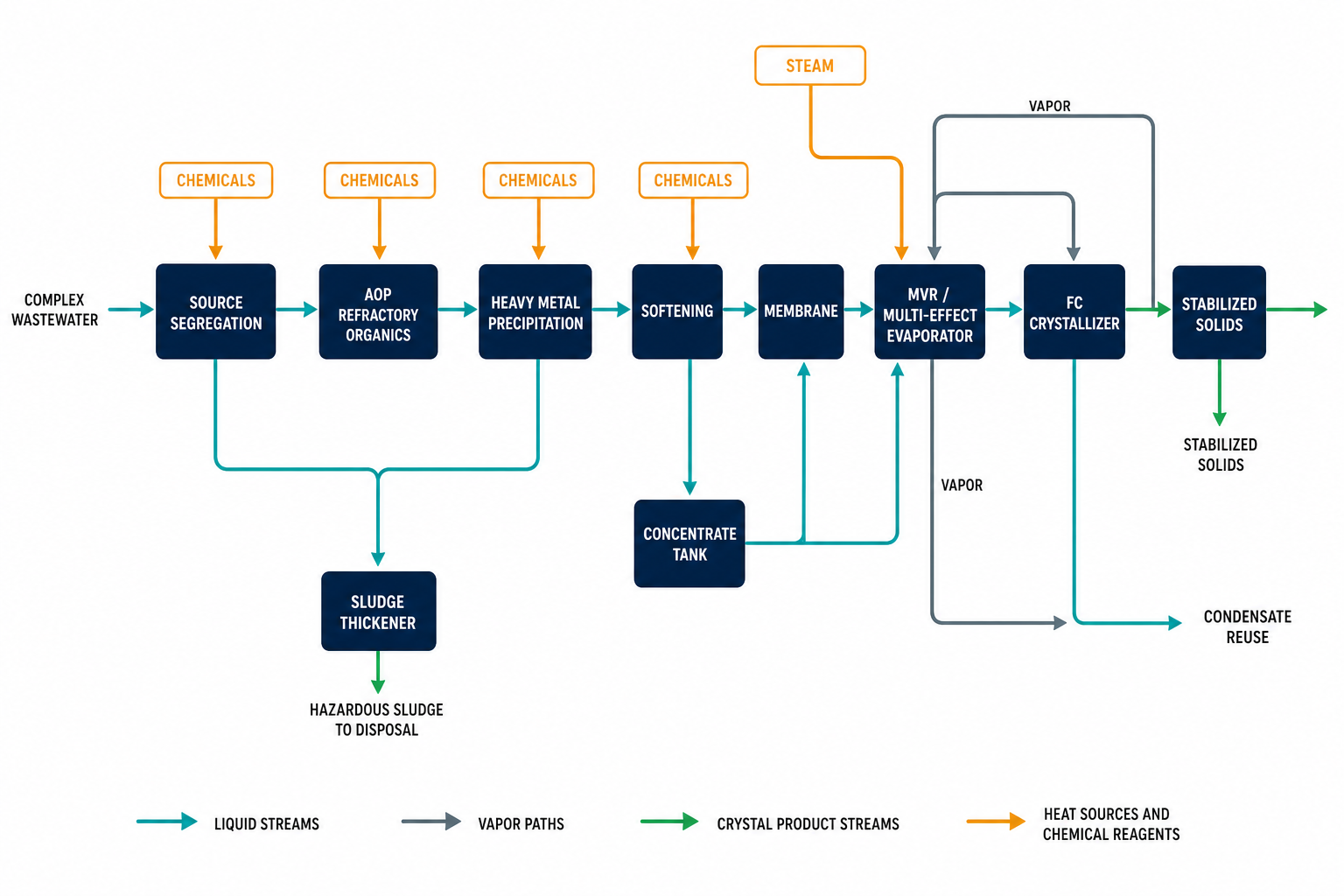
Splitting high-strength, heavy-metal or high-COD side streams at source unlocks simpler, cheaper downstream treatment than combined treatment of a mixed effluent.
Ozone, Fenton, wet-air oxidation or UV-based AOP break refractory organics before the brine concentrator, protecting heat transfer surfaces and recovered salt purity.
Sulfide, hydroxide or co-precipitation routes remove Cr, Ni, Cu, Zn, As and Hg before evaporation — preventing both equipment corrosion and salt contamination.
Forced-circulation crystallization concentrates the brine to a recoverable or disposable solid. Hazardous solids are stabilized for compliant landfill.
A generalized ZLD chain for complex wastewater: source segregation → advanced oxidation of refractory organics → heavy metal precipitation → softening → membrane or direct pre-concentration → evaporator (MVR or multi-effect) → forced-circulation crystallizer → solids stabilization → condensate recovery.
Cr(VI) (10–500 mg/L), Ni / Cu / Zn (10–200 mg/L), cyanide (5–100 mg/L), EDTA / NTA chelated metals. Requires Cr(VI)→Cr(III) reduction (bisulfite at pH 2–3), cyanide oxidation (hypochlorite at pH >10), sulfide precipitation and stream-specific handling before ZLD.
COD 2,000–20,000 mg/L (variable with landfill age); NH₃-N 500–3,000 mg/L; Cl⁻ 1,000–10,000 mg/L; trace heavy metals (Pb, Cd, As). The pre-treatment train must be robust to seasonal and age-driven swings; biological treatment + AOP + ammonia stripping precede evaporative ZLD.
High (NH₄)₂SO₄, trace metals, complexing agents. Ammonium sulfate recovery and magnesium removal drive the process selection.
NaOH 2–15%; sulfides 1,000–30,000 mg/L; naphthenates, mercaptans, COD 10,000–100,000 mg/L. Neutralization to pH 8–9, wet-air oxidation at 150–260°C for sulfides, and wax / naphthenate handling precede evaporative concentration.
Complex streams corrode as well as foul. Material choice follows the chloride, pH and organic profile of your feed — verified against the operating envelope, never assumed.
EvapCryst honestly defines its scope. Complex industrial wastewater means industrial process streams amenable to thermal concentration and crystallization — everything else belongs to a different engineering discipline, and we say so up front.
Industrial process wastewater amenable to thermal + crystallization treatment
Referred to qualified partners — different disciplines, different regulations
For streams outside our scope, we will refer you to qualified partners. EvapCryst focuses on industrial process wastewater amenable to thermal concentration, crystallization and selective recovery. Honest scoping protects both the client and the project outcome.
The primary solution for complex industrial wastewater requiring evaporative ZLD.
Shared ZLD methodology with mixed-salt separation for high-COD, high-TDS streams.
Complex wastewater requires laboratory assessment before any process commitment.
References for electroplating and landfill-leachate ZLD are available on request — include them in your proposal inquiry.
If two or more of the following apply — COD >5,000 mg/L, TDS >3%, heavy metals above discharge limits (Cr, Ni, Cu, Zn, As, Hg), refractory organics (heterocyclics, surfactants), mixed solvents, or chelants (EDTA, NTA, citrate) — your wastewater is complex. Conventional biological treatment alone is unlikely to achieve compliance; pre-treatment + thermal ZLD is typically required.
Our expertise is thermal concentration and crystallization of industrial process streams. Incineration, secured landfill, radioactive waste and municipal sewage require different engineering disciplines, different regulatory frameworks and different operating cultures. We refer out rather than over-extend.
Sometimes. Value-bearing metals (Cu, Ni, Co, Zn) at sufficient concentration (>100 mg/L for Cu, Ni) can be precipitated as sulfides or hydroxides and recovered for refining. Hazardous metals (Cr, As, Hg, Cd) typically require stabilization with ferric co-precipitation or cement for compliant landfill at $80–300 per tonne. The economics depend on metal value, concentration and recovery purity targets.
Complex wastewater varies by an order of magnitude across parameters that determine technology selection (COD, Cl⁻, heavy metals, scaling ions). No responsible manufacturer will commit to a process route without laboratory characterization. Skipping this step is the single largest cause of failed ZLD projects.
Send us your wastewater characterization, throughput and compliance mandate. Within 2 business days you will receive a feasibility note and indicative ZLD route.
Send your feed characterization (TDS, COD, main salts, viscosity), throughput and product targets — we respond with a preliminary process route within two business days.