EvapCryst logo

Battery Materials & Hydrometallurgy

From battery-grade lithium salts (Li₂CO₃, LiOH·H₂O) to Ni / Co / Mn sulfate crystallization and LIB black-mass hydrometallurgy — engineered for >99.5% purity, ppm-level impurity ceilings (Na, Fe, Ca, Mg) and the inverse-solubility behavior that defines Li₂CO₃ crystallizer selection.

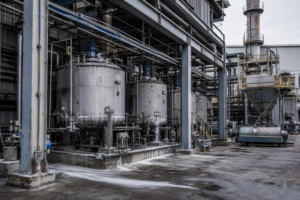
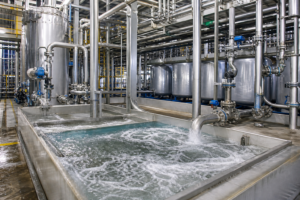
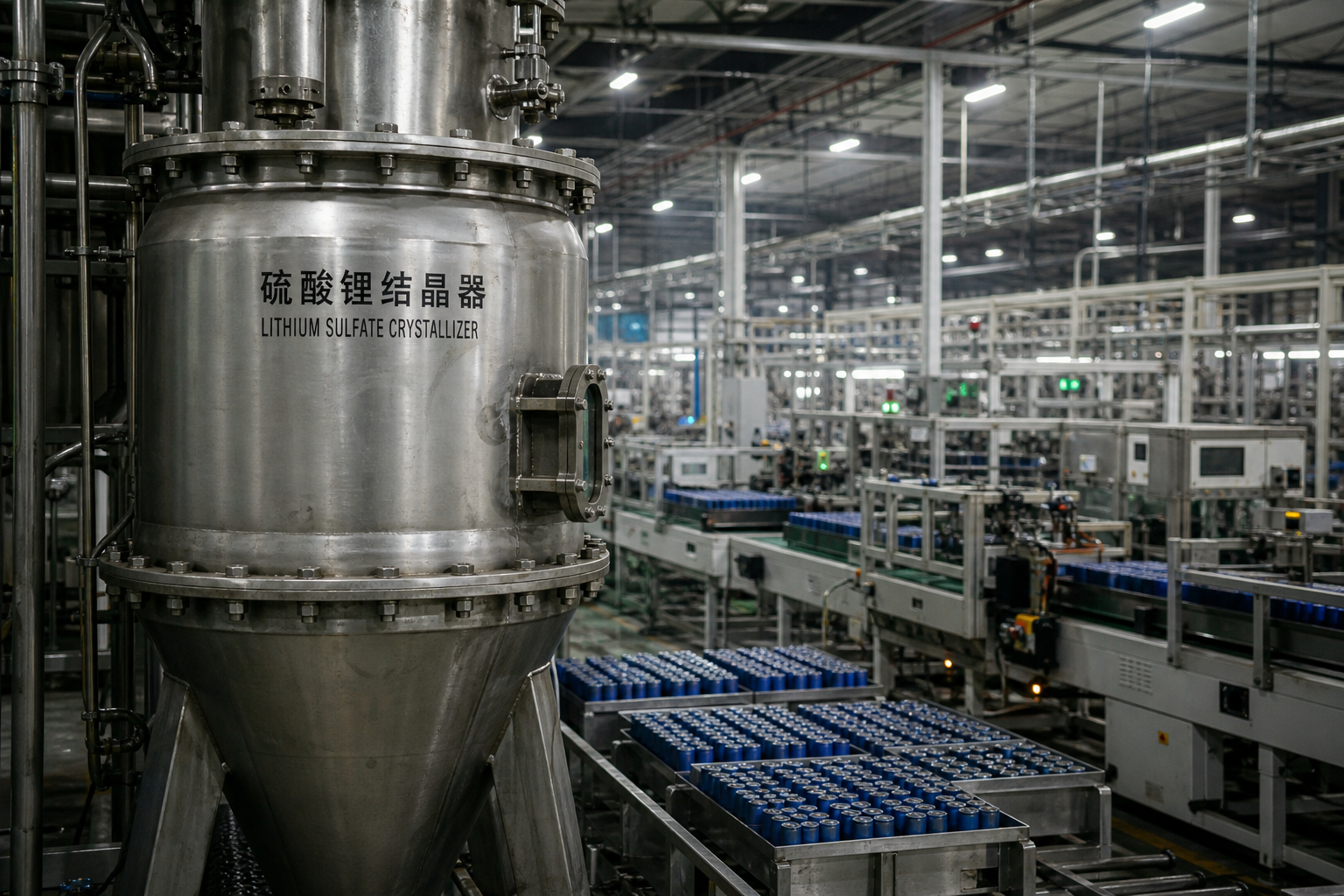
Battery materials production line for lithium salts and cathode precursors
Industry Challenges

Battery Material Crystallization Challenges

Battery-grade production imposes purity, corrosion and crystal-size constraints that ordinary evaporation equipment cannot meet. These four constraints define every design decision on this page.

CHALLENGE 01Purity

Battery-Grade Purity Targets

Cell manufacturers demand >99.5% product purity with magnetic-metal and alkali-metal ceilings measured in ppm — Na, Fe, Ca, Mg, Cu each <10 ppm for Li₂CO₃, and Na <20 ppm, Fe <10 ppm for LiOH·H₂O. This constrains materials, wash design and mother-liquor purge strategy from day one.

CHALLENGE 02Solubility

Inverse Solubility of Li₂CO₃

Li₂CO₃ solubility falls from ~1.54 g/100 mL at 0 °C to ~0.72 g/100 mL at 100 °C — the opposite of ~95% of other industrial salts. Crystallization therefore runs hot (80–95 °C), where the lowest solubility coincides with the highest scaling risk on heat-transfer surfaces.

CHALLENGE 03Corrosion

Strong Alkalinity of LiOH

Concentrated LiOH (>10%) attacks 316L stainless steel, especially above 60 °C — demanding nickel alloys for wetted parts and careful control of chloride traces carried in from spodumene or brine feeds.

CHALLENGE 04PSD

Crystal Size & Morphology for Cathode Use

Battery-grade NiSO₄ / CoSO₄ / MnSO₄ for precursor synthesis targets D50 of 200–500 μm with narrow PSD (Cv < 40%); tap density ≥1.2 g/cm³. Fluidized-bed (Oslo) crystallizers operating at 0.02–0.05 m/s, residence 4–24 h, are selected where DTB (1–2 m/s) cannot reach the size target.

Feedstock Routes

Where Lithium Recovery Streams Come From

Every lithium stream starts as ore chemistry or recycling chemistry. The route to battery-grade product runs through concentration, impurity removal and crystallization stages that we configure around your feed.

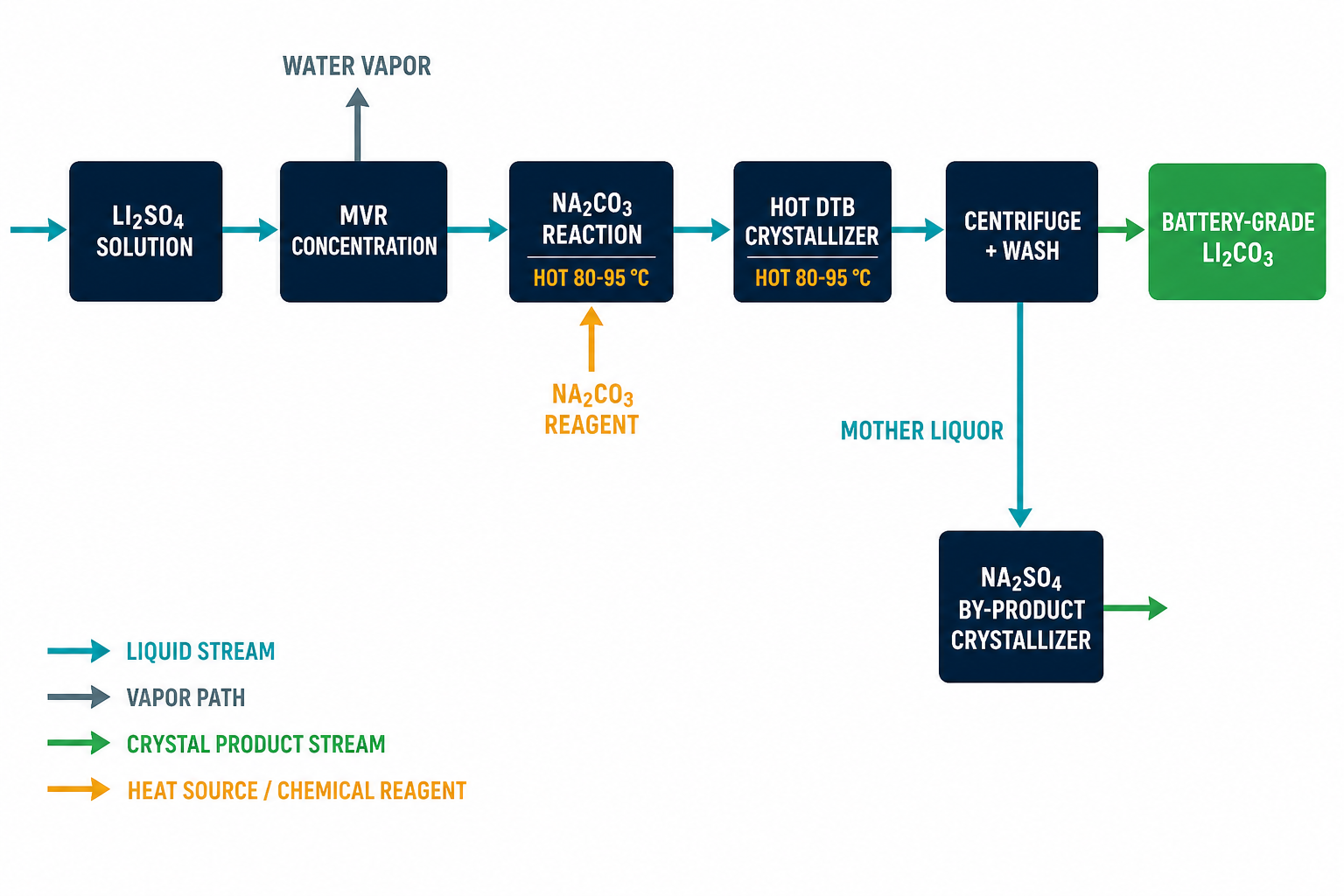
Simplified Process Flow Diagram

Indicative sulfate-route flowsheet — each block is configured from your feed assay, impurity profile and target crystal spec.

An indicative sulfate-route lithium carbonate flowsheet: Li₂SO₄ solution (40–60 g/L Li⁺, from spodumene roasting or LIB leachate) → MVR concentration to ~25–35 g/L Li⁺ → Na₂CO₃ reaction at 80–95 °C → hot DTB crystallization (residence 4–8 h, target crystal 100–200 μm) → centrifuge + hot deionized water wash → battery-grade Li₂CO₃. Mother liquor Na₂SO₄ recovery by FC or DTB crystallization as a by-product.

Product Screening

Typical Products & Indicative Routes

Five product classes dominate battery-material crystallization. Each row links solubility behavior, key challenge, indicative route and material of construction.

ProductSolubility BehaviorKey ChallengeTypical RouteMaterial
Li₂CO₃ (battery grade)Inverse solubility (1.54 → 0.72 g/100 mL, 0 → 100 °C)Hot crystallization at 80–95 °C; Na ceiling <10 ppmHot DTB Continuous316L
LiOH·H₂O~12.8 g/100 mL at 20 °C; strong alkalinityMonohydrate control; intergranular corrosion of SSVacuum Cooling / FCNi-200 / Ni-clad
Battery-grade NiSO₄ / CoSO₄ / MnSO₄Rising solubility; target D50 200–500 μmNarrow PSD (Cv < 40%); tap density ≥1.2 g/cm³Oslo Fluidized-Bed316L / Duplex
Ternary precursor wastewaterMixed sulfate + NH₄⁺ (Na + Ni + Co + Mn)Sulfate purge; ammonia recovery; ZLD mandateFC + ZLDDuplex 2205
LIB black mass leachateAcidic (pH 1–3); multi-metal (Li + Ni + Co + Mn + Al + Cu)SX raffinate Na₂SO₄ evaporation, ~15–25% TDSMVR ConcentrationTitanium / Duplex

Preliminary screening only. Battery-grade product specifications vary by cell chemistry and customer. Final configuration requires laboratory solubility data, impurity profiling, crystallization trials and project-specific engineering evaluation.

Process Integration

Hydrometallurgical Process Integration

Evaporation and crystallization stages must integrate cleanly with leaching, extraction and precursor synthesis — not sit as isolated islands at the end of the flowsheet.

INTEGRATION 01Leachate

Leachate Concentration & Acid Recovery

MVR concentration of sulfuric-acid leachate ahead of impurity removal — recovering acid value and reducing neutralization reagent consumption before lithium precipitation.

INTEGRATION 02Raffinate

SX Raffinate Evaporation

Solvent-extraction raffinate carries Li⁺ with Na₂SO₄ at 15–25% TDS; forced-circulation MVR evaporation concentrates lithium for carbonate conversion while crystallizing sulfate as a by-product.

INTEGRATION 03Co-product

By-product Na₂SO₄ Crystallization

Sulfate-route lithium plants generate sodium sulfate at scale; FC or DTB crystallization produces sellable Na₂SO₄ (detergent / viscose grade) instead of hazardous mixed-salt disposal.

INTEGRATION 04Mother Liquor

Ternary Precursor Mother Liquor

NCM/NCA precursor synthesis discharges mixed Ni/Co/Mn sulfate mother liquors with ammonia; evaporation-to-dryness or fractional crystallization closes the water loop and recovers metal value.

Materials

Material Selection for Battery Streams

Chloride, alkalinity and acidity each move the material ladder. Selection is driven by the actual feed assay at operating temperature — not by catalog default.

MATERIAL 01Mild Lithium Salts

316L — Lithium Salts (Mild)

Economical for neutral Li₂SO₄ / Li₂CO₃ slurries at <80 °C with chloride <200 mg/L — the baseline for sulfate-route concentrators and carbonate wash circuits.

MATERIAL 02Chloride Service

Titanium / Duplex — Chloride Service

Salt-lake brines and chloride-route feeds: Duplex 2205 for Cl⁻ <1,000 mg/L; Titanium (TA2) where Cl⁻ >5,000 mg/L or acidic chloride — verified by coupon testing at your temperature.

MATERIAL 03Strong Alkalinity

Nickel-Clad — Strong Alkalinity (LiOH)

Concentrated LiOH service above 60 °C attacks stainless steel; Ni-200 or nickel-clad plate/shell construction for evaporator, crystallizer and piping wetted parts.

MATERIAL 04Acidic Leachate

Specialty Alloys — Acidic Leachate

Black-mass leachate at pH 1–3 with chloride traces: titanium or Hastelloy on wetted parts, PTFE-lined piping at low temperature, and corrosion allowance justified by coupon data.

Frequently Asked Questions

Honest answers on battery-material crystallization and hydrometallurgical integration.

Why does Li₂CO₃ crystallize differently from most salts?+

Because its solubility falls as temperature rises — from ~1.54 g/100 mL at 0 °C to ~0.72 g/100 mL at 100 °C. Most salts dissolve more at higher temperature; Li₂CO₃ dissolves less. That reverses the usual logic of cooling crystallization: instead of cooling to grow crystals, you operate hot (80–95 °C) where solubility is lowest. The consequence is that scaling concentrates on the hottest surface — the heat-transfer wall — which is why Li₂CO₃ crystallizers need tight ΔT control, generous circulation rates and careful heater design.

What crystal size does cathode precursor production need?+

Battery-grade NiSO₄ / CoSO₄ / MnSO₄ typically targets D50 200–500 μm with Cv < 40% and tap density ≥1.2 g/cm³ so the precursor co-precipitation reactor receives consistent dissolution kinetics. Oslo fluidized-bed crystallizers — 0.02–0.05 m/s fluidization velocity, 4–24 h residence — deliver the size and sphericity; DTB is chosen at 1–2 m/s circulation when 100–300 μm is acceptable and throughput dominates.

How is lithium recovered from LIB black mass?+

Recycled black mass is leached in sulfuric acid (often with H₂O₂) at pH 1–3, dissolving Li, Ni, Co, Mn along with Al and Cu impurities. After impurity removal and solvent extraction of Ni/Co/Mn, the raffinate carries lithium with Na₂SO₄ at 15–25% TDS. MVR concentration followed by Na₂CO₃ precipitation (or Li₂CO₃ crystallization after further purification) recovers battery-grade lithium carbonate; the sulfate stream is crystallized as a sellable by-product. Each site’s flowsheet differs by feed assay and target purity.

Can existing lithium plants be retrofitted with MVR?+

Yes — retrofits are one of the most common projects in this industry. Aging triple-effect evaporator trains are replaced or supplemented by MVR units (typically 200–1,500 kW per MVR unit), cutting energy consumption from 0.25–0.40 t steam per tonne water to 15–25 kWh per tonne water where electricity prices permit. Feasibility depends on available electrical headroom, boiling-point elevation of the liquor and the condition of existing vessels — a site audit establishes which effects to keep, convert or retire.

Discuss Your Battery Material Project

Send us your target product specification, feed composition and throughput. Within 2 business days you will receive a feasibility assessment and indicative technology route.

Request a Proposal

Send your feed characterization (TDS, COD, main salts, viscosity), throughput and product targets — we respond with a preliminary process route within two business days.