Power, Steel & Flue-Gas Desulfurization

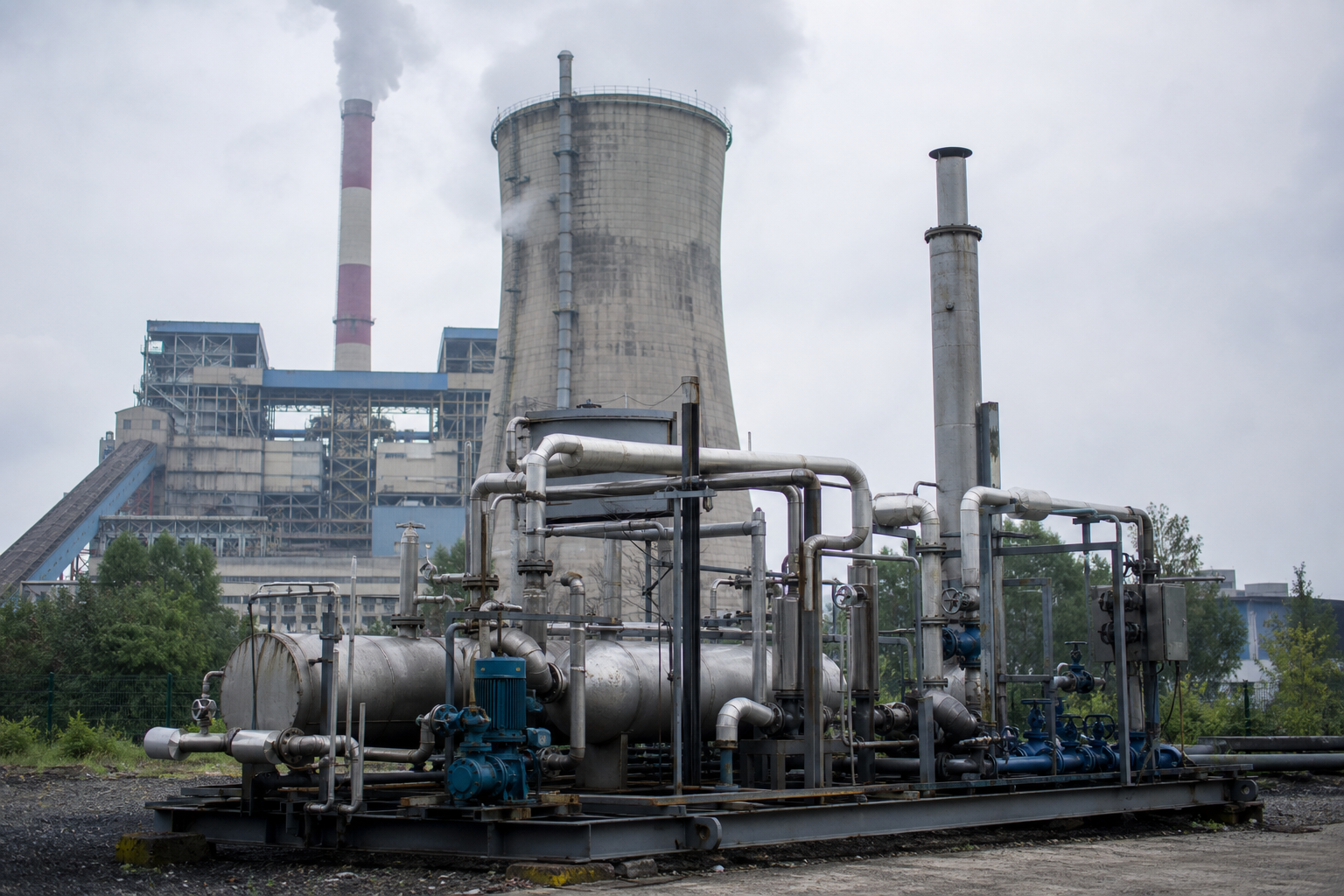
High-chloride (10,000–30,000 mg/L), high-suspension (TSS 1–10%), trace-heavy-metal (Hg, Se, As) wastewater from coal-fired power, steel sintering and FGD bleed streams — engineered for ZLD compliance with pre-treatment that actually handles Hg <1 µg/L and Se <50 µg/L discharge limits.

Phase 2 — In Preparation. This industry page enters production as case evidence accumulates.
industries fgd
Process Challenges

What Makes FGD & Power-Plant Wastewater Hard

These streams sit at the intersection of chloride attack, suspended-solids loading, trace heavy-metal compliance and the zero-liquid-discharge mandate. The challenge is rarely the evaporator — it is the pre-treatment that decides whether the evaporator survives.

CHALLENGE 01Material & Chemistry

High Chloride Attack & Sulfite Chemistry

FGD purge water chlorides are set by the coal, and the scrubber loop adds unoxidized sulfite carryover — a reducing-acid combination that eats standard alloys.

  • Cl⁻ 10,000–30,000 mg/L in FGD purge water — driven by coal chlorine content of 0.01–0.3 wt%
  • 316L fails by pitting in months at these levels; its safe envelope is <200 mg/L Cl⁻ at evaporation temperature
  • Unoxidized SO₃²⁻ carryover from the absorber loop complicates pre-treatment chemistry ahead of evaporation
BPE 3–8 °Cat 15,000–30,000 mg/L Cl⁻ — boiling-point elevation narrows MVR’s effective ΔT; above ~15,000 mg/L Cl⁻ multi-effect becomes competitive
CHALLENGE 02TSS-Limited

High Suspended Solids

Gypsum carryover, fly ash and unreacted limestone turn the evaporator feed into an abrasive slurry unless solids are removed first.

  • TSS of 1–10% (10,000–100,000 mg/L) — gypsum (CaSO₄·2H₂O), fly ash, unreacted limestone
  • Clarification, hydrocycloning and filter press are the system’s survival mechanism — not optional extras
<1,000 mg/LTSS target to the evaporator after clarification and hydrocycloning
CHALLENGE 03Trace Metals

Mercury, Selenium & Coal-Trace Metals

Coal-trace Hg and Se report to the purge stream together with associated species (As, B) — and are regulated at the µg/L level, orders of magnitude below their inlet concentrations.

  • Coal-trace Hg 0.05–10 mg/L and Se 0.1–5 mg/L report to FGD purge water
  • US ELG: Hg <1.0 µg/L, Se <10–18 µg/L at discharge
  • Hg speciation: particulate HgS 30–60%, ionic Hg²⁺ 10–40%, organomercury 5–20%
  • Removal must sit upstream — the crystallizer does not remove Hg or Se
Fe : Se = 10–20 : 1ferrihydrite adsorption for Se(IV) at pH 4–6; Se(VI) requires prior reduction
CHALLENGE 04Compliance-Driven

ZLD Mandate & the Salt Route

Thermal power and steel sintering plants in many regions operate under ZLD or near-ZLD wastewater mandates — the system must produce reuse-grade condensate and a managed salt / solids stream, with no liquid discharge to surface water.

  • Mixed NaCl / CaSO₄ / heavy-metal-bearing salt is in the majority of cases stabilized and landfilled as solid waste
  • Saleable-grade salt only when upstream separation yields a clean NaCl stream free of sulfate and heavy metals
  • Do not assume salt sales offset operating cost without verified pilot data
0 liquid dischargeto surface water under ZLD mandates — reuse-grade condensate plus a managed solids stream instead
Typical Applications

Typical Streams & Application Map

Common feed streams in power, steel and FGD wastewater, with the technology route typically considered for first-pass screening.

Chemical / StreamSource & ContextKey BehaviorTypical RouteMaterial Focus
FGD purge waterWet limestone FGD bleed, coal-fired powerCl⁻ 10,000–30,000 mg/L · TSS 1–5% · Hg 0.05–5 µg/L · Se 0.1–2 mg/LPretreat + MVR + FCTitanium / Hastelloy
Power plant circulating blowdownCooling tower bleed, water-softening residueTDS 1–3% · Ca²⁺ 500–1,500 mg/L · Mg²⁺ 100–500 mg/L — scale-proneSoftening + MVRDuplex 2205
Steel sintering FGD wastewaterSinter machine de-SOx bleed (limestone / seawater)SO₄²⁻ 2,000–15,000 mg/L · Fe / Zn / Pb 10–500 mg/L · pH 2–5Pretreat + CrystallizationDuplex / Titanium
Coke-oven wastewater concentrateCoking plant ammonia stripper bottom — see Coal Chemical & MiningCOD 2,000–10,000 mg/L · CN⁻ 5–50 mg/L · phenol 100–500 mg/LPre-treat + MVRTitanium / Duplex
Desulfurization brineSeawater FGD, soda-ash FGD bleedNaCl 15–30 g/L · Na₂SO₄ 3–10 g/L · Mg²⁺ traceMVR + FCTitanium
Boiler blowdown concentrateHigh-pressure boiler continuous blowdownTDS <1% · SiO₂ 50–200 mg/L — scale-proneMulti-Effect316L

Related steel-plant streams — cold-rolling pickling rinsewater and direct-reduced-iron (DRI) scrubber water — are covered under Coal Chemical & Mining.

Routes shown are for preliminary screening only. Mercury and selenium removal requires dedicated precipitation pilot testing on a representative sample. Final material selection is confirmed by coupon testing at operating temperature.

Pre-Treatment Strategy

Four Steps That Decide Everything Downstream

The evaporator only sees what pre-treatment lets through. This is the canonical conditioning sequence for high-chloride, high-TSS, Hg/Se-bearing FGD feed.

01

Coagulation, Flocculation & TSS Removal

Clarifier + hydrocyclone + filter press take out gypsum, fly ash and limestone solids. Target <1,000 mg/L TSS to the evaporator.

02

Lime–Soda Softening

Calcium and magnesium hardness down to <20 mg/L by lime-soda dosing — protecting heat-transfer surfaces from sulfate and carbonate scale.

03

Sulfide Precipitation for Hg & Se

TMT-15 (or NaHS) at 1.5–3× stoichiometric dose at pH 5–7; ferrihydrite adsorption polishes Se(IV) — always upstream of the evaporator.

04

Ion-Exchange Polishing

Final hardness and trace-metal trim on the softened feed — the last line of protection before MVR / multi-effect duty.

Softening and heavy-metal precipitation chemistry require site-specific jar testing on a representative sample. The crystallizer does not remove Hg or Se — both must be removed before the evaporator.

Process Route

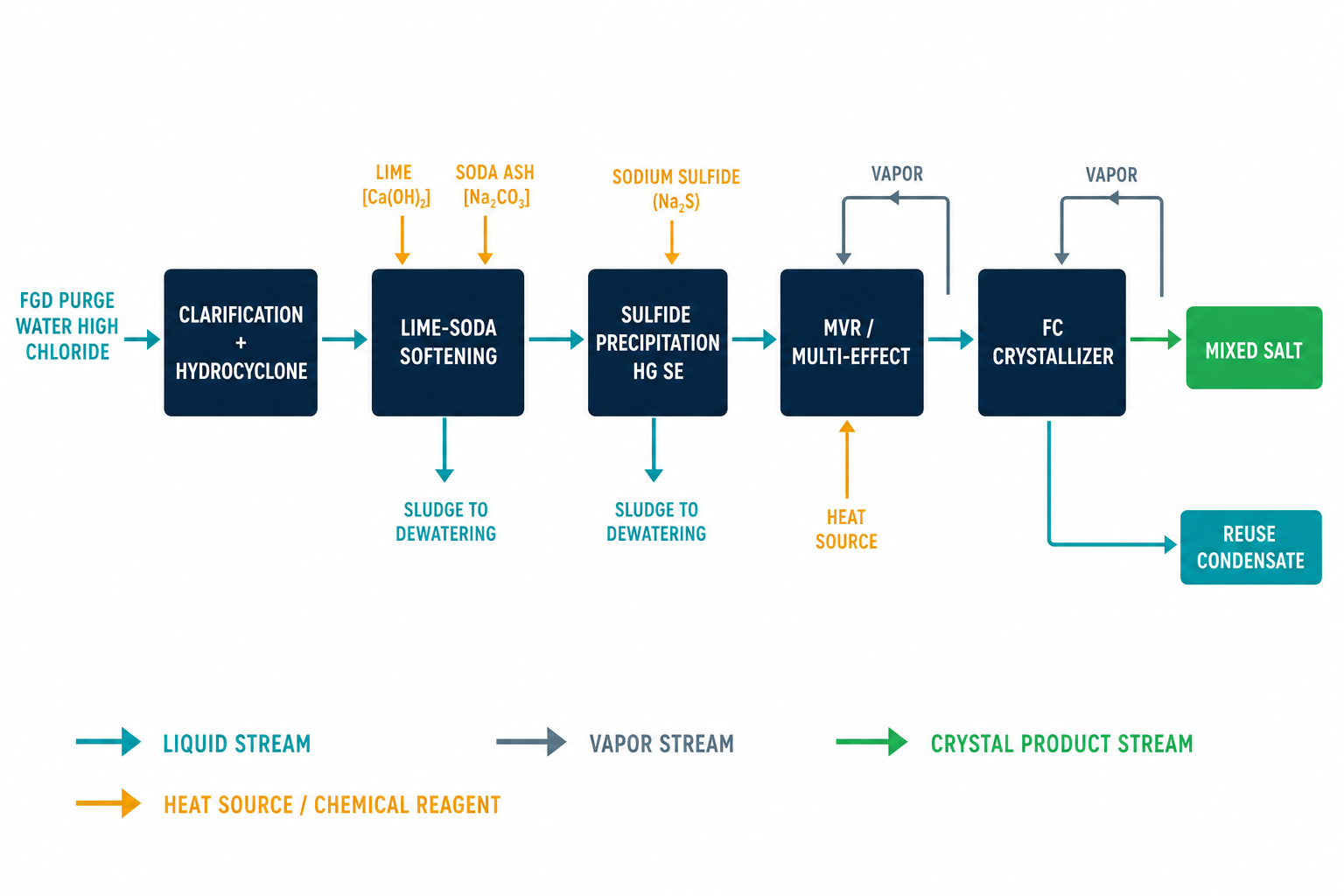
FGD & Power-Plant Wastewater ZLD Route

Indicative process flow for FGD purge water with high chloride, gypsum TSS and trace Hg / Se — from bleed stream to managed salt and reuse condensate.

Feed

FGD Purge Water

Cl⁻ 10,000–30,000 mg/L · TSS 1–10%

Feed Conditioning

Clarification & Hydrocyclone

TSS down to <1,000 mg/L

Pre-Treatment

Lime-Soda Softening

Ca²⁺ / Mg²⁺ <20 mg/L

Pre-Treatment

Sulfide Precipitation (Hg · Se)

TMT-15 + ferrihydrite

Evaporation

MVR / Multi-Effect

15–25 kWh/t water — or 0.25–0.40 t steam/t

Crystallization

FC Crystallizer

Mixed-salt slurry

Product

Salt + Reuse Condensate

Managed solids · reuse-grade water

Wastewater & feed conditioning Softening & sulfide precipitation MVR / multi-effect duty FC crystallization & salt product
ROUTE AFC Crystallization

Forced-Circulation Crystallization

The workhorse closing stage for scaling, high-TDS FGD brines — high liquid circulation velocity suppresses wall scaling while mixed salt is produced as a free-flowing solid.

ROUTE BMVR + FC

MVR Concentration + FC Crystallizer

Electric-driven concentration ahead of crystallization — strongest where power is available and steam is dear. Watch the BPE penalty at the top of the chloride range.

ROUTE CMulti-Effect + Falling Film

Multi-Effect with Falling-Film Pre-Concentration

Falling-film (tube) effects on clarified, softened feed, finishing in FC — competitive above ~15,000 mg/L Cl⁻ when low-pressure steam ($15–25/t) is available from the power plant itself.

ROUTE DSalt Classification

Salt Classification & Separation

NaCl vs Na₂SO₄ / CaSO₄ split when a sellable clean-salt route is pursued instead of landfill — additional process complexity, justified only with verified pilot data.

Simplified PFD for indicative routing only. Actual configuration depends on chloride load, TSS profile, regulatory Hg / Se limits and site utility availability. Softening and heavy-metal precipitation chemistry require site-specific jar testing.

Material Selection

High-Chloride Material Selection

Chloride exposure — not TDS — picks the alloy. Map your stream to the material envelope before any evaporator geometry is discussed.

Chloride ExposureTypical ServiceMaterialSelection Logic & Watch-Outs
<200 mg/L Cl⁻ at evaporation temperatureMild streams — boiler blowdown concentrate (TDS <1%, SiO₂ 50–200 mg/L)316LSafe envelope only — pitting begins beyond it; three orders of magnitude below FGD chloride levels
~1,000 mg/L Cl⁻Moderate streams — power-plant circulating blowdown (TDS 1–3%, Ca²⁺ 500–1,500 mg/L)Duplex 2205Handles moderate Cl⁻ but fails under high Cl⁻ combined with low pH
10,000–30,000 mg/L Cl⁻ — coal Cl 0.01–0.3 wt%FGD brine — FGD purge water, seawater / soda-ash FGD bleedTitanium Grade 2The workhorse material for FGD evaporator duty
SO₄²⁻ 2,000–15,000 mg/L · pH 2–5 — sulfate-richSteel sintering FGD wastewater (Fe / Zn / Pb 10–500 mg/L)Duplex / TitaniumSulfate-rich service shifts the choice; heavy metals removed upstream
>30,000 mg/L Cl⁻ + low pH + oxidizing species (Fe³⁺, Cu²⁺)Most aggressive FGD brinesHastelloy C-276Reserved for the harshest combination — a cost driver, not a default

Final material selection is confirmed by coupon testing at operating temperature — never from a table alone.

FAQ

Frequently Asked Questions

Why is chloride the dominant material-selection driver in FGD streams?+

FGD purge water chlorides typically sit at 10,000–30,000 mg/L — three orders of magnitude above 316L’s safe operating envelope (<200 mg/L at evaporation T). Duplex 2205 handles moderate Cl⁻ (~1,000 mg/L) but fails under high Cl⁻ plus low pH; titanium Grade 2 is the workhorse material for FGD evaporator duty. Hastelloy C-276 is reserved for the most aggressive combinations of Cl⁻ >30,000 mg/L, low pH and oxidizing species (Fe³⁺, Cu²⁺).

How is mercury removed from FGD wastewater before ZLD?+

Mercury in FGD purge is typically present as particulate HgS (30–60%), ionic Hg²⁺ (10–40%) and a small organomercury fraction (5–20%). Standard treatment is dedicated sulfide precipitation (TMT-15 at 1.5–3× stoichiometric dose, pH 5–7) combined with ferric co-precipitation and polythiocarbonate polishing. Selenium is harder — Se(IV) is removed by ferrihydrite adsorption at pH 4–6 (Fe / Se mass ratio 10:1–20:1); Se(VI) requires prior reduction. Both must be removed before the evaporator; the crystallizer does not remove them.

Can the mixed salt from FGD ZLD be sold or must it be landfilled?+

In the majority of cases the mixed NaCl / CaSO₄ / heavy-metal-bearing salt from FGD ZLD must be managed as a solid waste — typically stabilized and landfilled in a compliant facility. Saleable-grade salt is achievable only when upstream separation produces a clean NaCl stream free of sulfate and heavy metals, which requires additional process complexity. Do not assume salt sales offset operating cost without verified pilot data.

How does high chloride affect the choice between MVR and multi-effect?+

High chloride raises boiling-point elevation (BPE 3–8°C at 15,000–30,000 mg/L Cl⁻) and narrows MVR’s effective ΔT. For FGD purge above ~15,000 mg/L Cl⁻ with significant concentration factor, multi-effect with motive steam (0.25–0.40 t steam per tonne water) often becomes competitive — particularly when low-pressure steam is available from the power plant itself at $15–25/t. The choice is project-specific and driven by a full energy balance including compressor electricity ($0.05–0.10/kWh) vs. steam cost.

Discuss Your Power, Steel or FGD Project

Send us your feed analysis (Cl⁻, TSS, Hg, Se, TDS) and regulatory limits. Within 2 business days you will receive a feasibility assessment, simplified PFD and indicative scope.

Request a Proposal

Send your feed characterization (TDS, COD, main salts, viscosity), throughput and product targets — we respond with a preliminary process route within two business days.