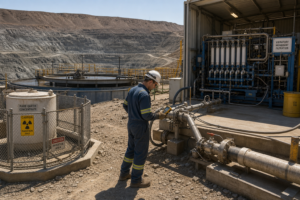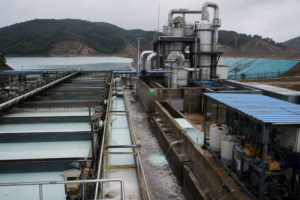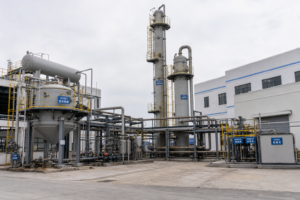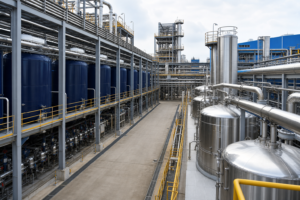
Rare Earth & Non-Ferrous Metals

Engineered evaporation, concentration and crystallization for rare earth extraction (bastnäsite / monazite leachate, (NH₄)₂SO₄ recovery, RECl₃ concentration), non-ferrous smelting wastewater (Cu / Zn / Ni / Co, trace As / Sb) and heavy-metal-bearing streams — with material selection that survives 5,000–30,000 mg/L chloride and acidic service.

Typical StreamsTypical StreamsCu/Zn/Ni/Co smelting wastewater · Rare earth extraction solutions · Heavy metal sulfates · Ammonium salt by-productsCommon RoutesCommon RoutesMVR + FC · Vacuum Crystallization · Multi-effect + Cooling
Phase 2 — In Preparation. This industry page enters production as case evidence accumulates. Every performance figure on this page carries its operating condition.
industries rare earth
Process Challenges

Why Rare Earth & Non-Ferrous Streams Are Difficult

High-value metal recovery, aggressive corrosion profiles and complex impurity systems combine to make these streams among the most engineering-intensive in the industry.

CHALLENGE 01Recovery Value

High Metal Recovery Value

Cu ($6–9/kg), Ni ($15–22/kg), Co ($30–50/kg), rare earth oxides (Nd₂O₃ $50–150/kg, Dy₂O₃ $200–600/kg) carry significant unit value.

  • Yield losses to tailings or mother-liquor purge translate directly to revenue leakage
  • Recovery strategy is an economic decision, not just a compliance one
Co $30–50/kgcobalt unit value — Ni $15–22/kg, Cu $6–9/kg, Nd₂O₃ $50–150/kg, Dy₂O₃ $200–600/kg; recovery economics are metal-price dependent
CHALLENGE 02Material & Chemistry

Aggressive Corrosion from Chloride & Acid

Chloride-rich RECl₃ leach solutions (Cl⁻ 5,000–30,000 mg/L), sulfate pickling streams (pH 1–2) and acidified extraction circuits (pH <1) drive corrosion rates that defeat 316L within weeks.

  • Titanium Grade 2 (Cl⁻ to 30,000 mg/L), Hastelloy C-276 (acidic + chloride), and Duplex 2205 (moderate Cl⁻) are commonly required
  • Selection errors surface as through-wall leaks within months
Cl⁻ 5,000–30,000 mg/Lin RECl₃ leach solutions — 316L fails within weeks; pickling pH 1–2 and extraction circuits pH <1 raise the bar further
CHALLENGE 03Impurity Systems

Complex Impurity Systems

Rare earth streams carry co-extracted Fe³⁺ (1–10 g/L), Al³⁺ (0.5–5 g/L), Ca²⁺ / Mg²⁺ (0.5–3 g/L), residual extractants (P204 / P507 / P350 at 50–500 mg/L) and buffered sulfate / chloride backgrounds.

  • Fe / Al precipitation upstream plus extractant removal define product purity far more than the crystallizer type itself
Extractant 50–500 mg/LP204 / P507 / P350 residual — alongside Fe³⁺ 1–10 g/L, Al³⁺ 0.5–5 g/L, Ca²⁺/Mg²⁺ 0.5–3 g/L co-extracted backgrounds
CHALLENGE 04Feed Variability

Variable Feed Across Smelting Campaigns

Non-ferrous smelters run campaign-mode operation: feed ore changes, copper concentrate grade swings, and rare earth batches shift composition.

  • The system must tolerate the worst credible envelope, not the nominal stream
Campaign modefeed ore, concentrate grade and batch composition all swing — design envelope must cover the worst credible case
Typical Applications

Where EvapCryst Engages in This Industry

Four application families — from extraction liquor concentration to smelting wastewater ZLD and battery-precursor salt crystallization.

APPLY 01Extraction Liquor

Rare Earth Extraction Liquor Concentration

Stream characteristics after SX (solvent extraction) raffinate — concentration before precipitation / crystallization.

  • RECl₃ 100–400 g/L; Cl⁻ 50–150 g/L — titanium / Hastelloy duty
  • Fe³⁺ / Al³⁺ removal ahead of the evaporator defines product purity
APPLY 02ZLD

Cu / Zn / Ni / Co Smelting Wastewater ZLD

Acid mine drainage and smelter scrubber blowdown — heavy-metal-bearing brine management.

  • Cu²⁺ 1–20 g/L; H₂SO₄ 5–50 g/L; As 10–500 mg/L; Sb 5–100 mg/L
  • Heavy-metal precipitation upstream, MVR concentration, FC crystallization
APPLY 03Product Salt

Cobalt Hydroxide / Cobalt Sulfate Crystallization

Battery-precursor grade CoSO₄·7H₂O — morphology and purity control for cathode use.

  • Ni²⁺ 20–90 g/L; Co²⁺ 1–10 g/L; Mg²⁺ 5–30 g/L in HPAL leach streams
  • DTB for narrow PSD; purity set by upstream separation, not the crystallizer alone
APPLY 04By-product

Ammonium Sulfate By-product from Rare Earth Precipitation

Rare earth precipitation with (NH₄)₂SO₄ / NH₄HCO₃ — linkage to S2 ammonium sulfate crystallization know-how.

  • (NH₄)₂SO₄ 20–40%; NH₄Cl 10–20%; recoverable
  • DTB / FC routes on 316L / Duplex service
Stream Reference

Typical Chemicals & Stream Types

Common feed streams in rare earth and non-ferrous metallurgy, with the technology route typically considered for first-pass screening.

Chemical / StreamSource & ContextKey BehaviorTypical RouteMaterial Focus
Copper smelting wastewaterCu concentrate smelting, electrorefining bleedCu²⁺ 1–20 g/L; H₂SO₄ 5–50 g/L; As 10–500 mg/L; Sb 5–100 mg/LMVR + FCDuplex 2205
Zinc / Cadmium sulfateHydrometallurgical Zn refining (roast-leach-electrowin), Cd recoveryZn²⁺ 30–150 g/L; Cd²⁺ 0.1–5 g/L; Cl⁻ <500 mg/LDTB / Cooling316L / Duplex
Nickel / Cobalt sulfate / chlorideLaterite HPAL leach, battery precursor streams — see Battery Materials & HydrometallurgyNi²⁺ 20–90 g/L; Co²⁺ 1–10 g/L; Mg²⁺ 5–30 g/LMVR + CrystallizationHastelloy / Ti
Rare earth chloride solutionBastnäsite / monazite HCl leach, extraction raffinateRECl₃ 100–400 g/L; Cl⁻ 50–150 g/L; Fe³⁺ / Al³⁺ traceVacuum + FCTitanium / Hastelloy
Rare earth sulfate solutionSulfuric acid bake leach (monazite), separation circuitsRE₂(SO₄)₃ 30–150 g/L; pH 1–3; Fe³⁺ 1–10 g/LMVR + CoolingDuplex 2205
Ammonium salt by-productRare earth precipitation with (NH₄)₂SO₄ / NH₄HCO₃(NH₄)₂SO₄ 20–40%; NH₄Cl 10–20%; recoverableDTB / FC316L / Duplex

Routes shown are for preliminary screening only. Final selection requires solubility data, trace metal profile, extractant residual analysis and project-specific engineering evaluation.

Process Route

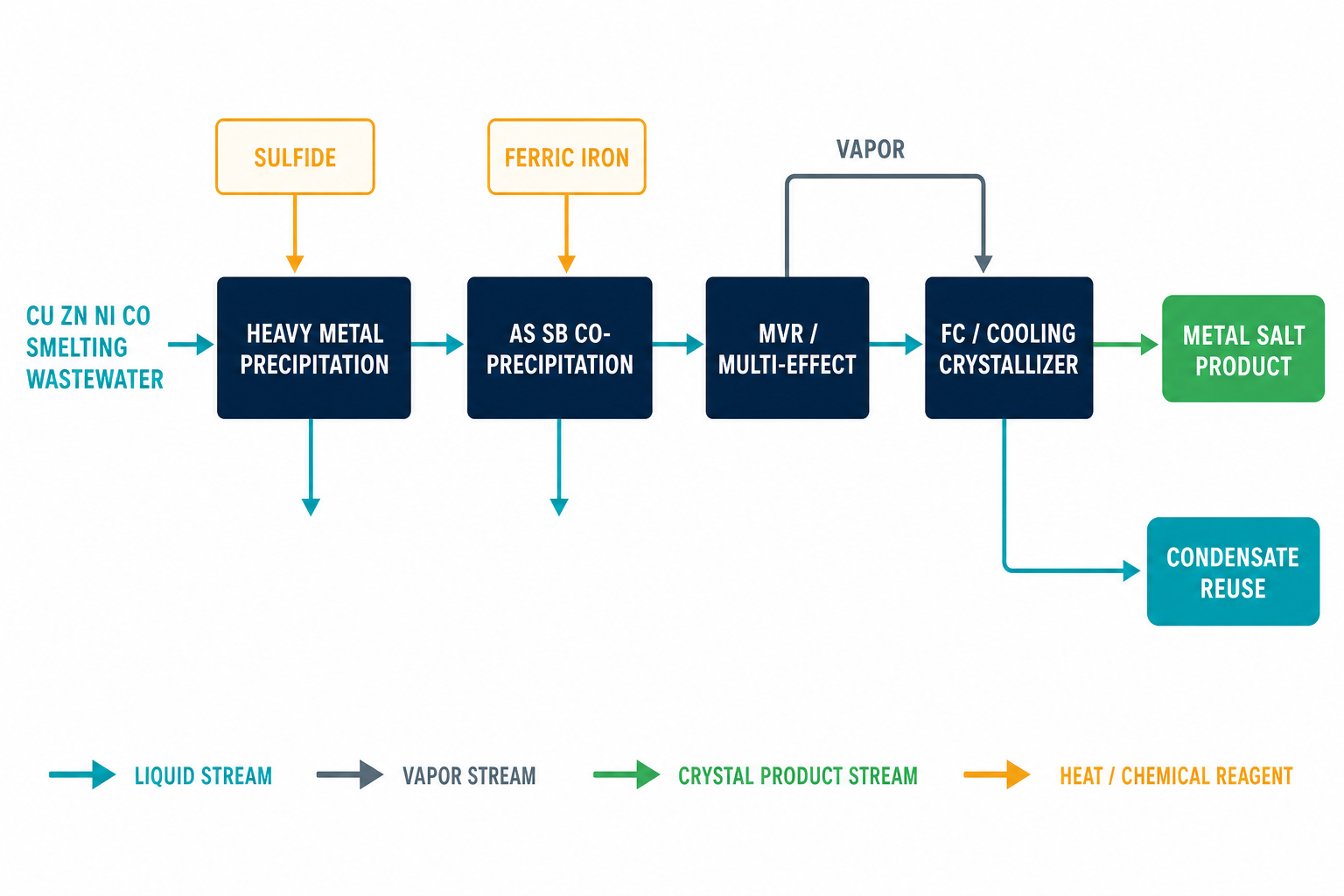
Rare Earth & Non-Ferrous ZLD + Metal Salt Recovery

Indicative process flow for smelting wastewater with mixed heavy metals, residual acidity and ZLD requirement.

Feed

Smelting Wastewater

Cu / Zn / Ni / Co · trace As / Sb

Pre-Treatment

Heavy Metal Precipitation

Sulfide pH 8–9 · hydroxide pH 9–10

Pre-Treatment

As / Sb Co-precipitation

Ferric iron · pH adjustment

Evaporation

MVR / Multi-Effect

15–25 kWh/t — or 0.25–0.40 t steam/t

Crystallization

FC / Cooling Crystallizer

Tube velocity 2–3 m/s

Product

Metal Salt + Reuse Condensate

Metal sulfate / chloride · reuse water

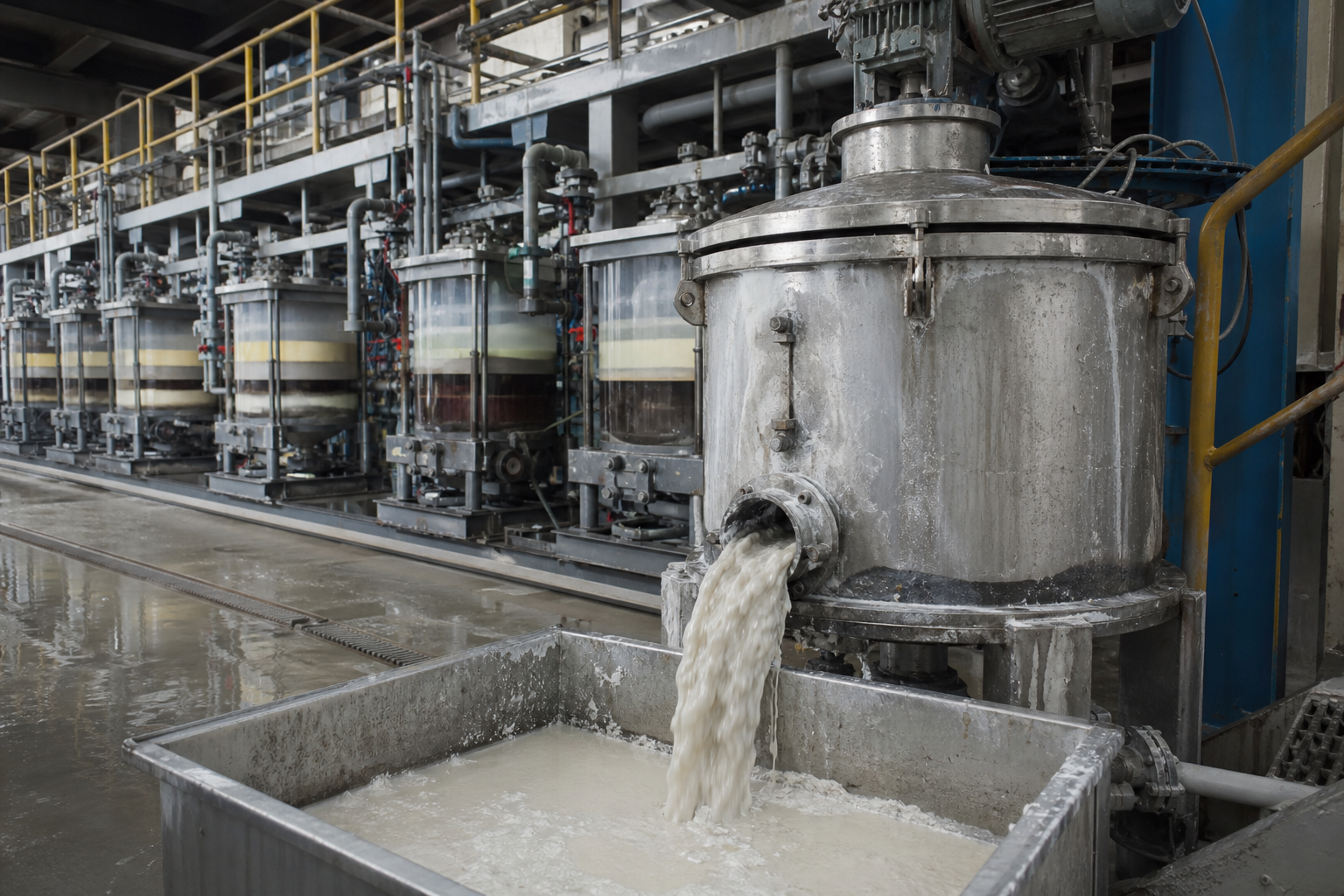
Smelting wastewater feed Heavy-metal pre-treatment MVR / multi-effect duty Crystallization & metal salt product

The canonical sequence for non-ferrous smelting wastewater: heavy-metal pre-treatment (sulfide at pH 8–9, hydroxide at pH 9–10) → As / Sb co-precipitation with ferric iron → pH adjustment → MVR (15–25 kWh per tonne water) or multi-effect (0.25–0.40 t steam per tonne water) concentration → forced-circulation (tube velocity 2–3 m/s) or cooling crystallization for metal-salt recovery → condensate reuse.

Simplified PFD for indicative routing only. Actual configuration depends on metal speciation, chloride/sulfate ratio, extractant residual, scaling tendency and target product purity. Heavy metal precipitation feasibility requires laboratory verification.

Process Integration

Integration with Hydrometallurgical Flowsheets

Evaporation and crystallization sit inside the hydromet circuit — not beside it. Four integration points decide the plant water and salt balance.

01

Leachate Concentration & Acid Recovery

Concentrate leach liquor ahead of downstream separation — acid values returned to the leach circuit.

02

SX Raffinate Evaporation

Extraction raffinate carries residual extractant and acid — evaporated for volume reduction and salt recovery.

03

Precipitation Mother Liquor Management

Rare earth precipitation liquors recycle or purge — the loop is engineered against impurity accumulation.

04

By-product Salt Crystallization

Na₂SO₄ / (NH₄)₂SO₄ by-product salts crystallized for sale or managed disposal.

Material Selection

Corrosion-Driven Material Selection

Chloride, acidity and oxidizing metal ions — not TDS — pick the alloy in this industry. Map the stream first; discuss geometry second.

Stream / ExposureTypical ServiceMaterialSelection Logic & Watch-Outs
Cl⁻ above ~5,000 mg/L — RECl₃ leach circuitsRare earth chloride solution (RECl₃ 100–400 g/L, Cl⁻ 50–150 g/L)Titanium (TA2)Workhorse for RECl₃ circuits — Cl⁻ to 30,000 mg/L; 316L is excluded by pitting above ~200 mg/L at evaporation temperature
pH <2 acidic + chloride + oxidizing speciesAcidified extraction circuits (pH <1), acidic heavy-metal brinesSpecialty alloys (Hastelloy C-276, corrosion allowance)Acidic + chloride service defeats Duplex; confirm by coupon testing at actual T, pH and metal-ion matrix
SO₄²⁻-rich · pH 1–3Rare earth sulfate solution (RE₂(SO₄)₃ 30–150 g/L), Cu smelting wastewaterDuplex 2205Adequate below ~1,000 mg/L Cl⁻ at moderate T; fails under high Cl⁻ combined with low pH
Mild ammonium sulfate serviceAmmonium salt by-product ((NH₄)₂SO₄ / NH₄HCO₃ precipitation liquors)316LSafe envelope only for Cl⁻ <~200 mg/L at evaporation temperature — verify chloride background before committing

Final selection must be confirmed by coupon testing at actual operating T, pH and metal-ion matrix — never from a table alone.

Technology Routes

Two Orthogonal Decisions, Not One Equipment Choice

Energy reuse and evaporation duty are one decision; crystal growth configuration (FC / DTB / Oslo) is a separate, orthogonal one. Real systems combine them.

ROUTE AMVR + FC

MVR Concentration + FC Crystallization

Electric-driven concentration ahead of forced-circulation crystallization — the default wastewater ZLD route for smelting streams.

ROUTE BDTB

DTB Crystallization

Battery-grade CoSO₄ and metal-salt duty where narrow particle size distribution and easy centrifugation are the product priority.

ROUTE COslo

Oslo Fluidized-Bed Crystallization

Large crystals, high purity — for high-purity metal salts where crystal quality outweighs throughput intensity.

ROUTE DFC / Multi-Effect

Forced-Circulation & Multi-Effect

FC for scaling, high-TDS smelting brines; multi-effect where smelter LP steam is available and power is dear.

Energy reuse (MVR / multi-effect) and crystal growth configuration (FC / DTB / Oslo) are orthogonal dimensions. Route selection depends on metal valence, chloride content, sulfate/chloride ratio and target product grade → Preliminary screening only — final configuration requires laboratory test work and pilot crystallization trials
Economics

Heavy Metal Recovery vs. Disposal Economics

Whether a stream is an asset or a liability depends on its metal value, hazard classification and the local discharge alternative.

CASE 01Recovery Route

Value-Bearing Salts (Co / Ni / Cu)

Metal value justifies crystallization complexity — CuSO₄·5H₂O (target >99% main content, Fe <100 ppm, free H₂SO₄ <0.2%) and NiSO₄·6H₂O (target >98.5%) are marketable products.

Co $30–50/kghigh-value Co / Ni / Cu streams take the recovery route — product-grade commitment requires a verified impurity profile (Fe, Ca, Cl⁻, free acid, extractant residual)
CASE 02Stabilization Route

Hazardous Salts (Cr / As-bearing)

Where metal value does not carry recovery economics, the salt is stabilized for compliant disposal — not forced into a saleable grade.

As <0.5 mg/L · Sb <0.5 mg/Ltypical evaporator inlet limits after upstream As / Sb removal (sulfide precipitation, Fe/As co-precipitation) — EvapCryst does not evaporate As-bearing streams through crystallizer duty without verified upstream removal
CASE 03ZLD vs Compliant Discharge

The Economic Threshold

ZLD is not automatically the answer. The threshold between ZLD and compliant discharge sits where metal recovery revenue plus avoided disposal cost crosses the energy and CapEx cost of the thermal route — a per-project calculation driven by metal prices, discharge limits and utility costs.

Per-project balanceMVR 15–25 kWh/t water vs multi-effect 0.25–0.40 t steam/t; electricity $0.04–0.08/kWh vs LP steam $15–25/t; BPE 5–15°C on concentrated metal sulfates narrows MVR’s ΔT — the selection is rarely obvious and requires a per-project energy balance
FAQ

Frequently Asked Questions

How do chloride levels drive material selection in rare earth streams?+

Chloride concentration above ~200 mg/L at evaporation temperature excludes 316L by pitting. Below ~1,000 mg/L at moderate T, Duplex 2205 is usually adequate. Above ~5,000 mg/L or in acidic service (pH <2), Titanium Grade 2 (workhorse for RECl₃ circuits) or Hastelloy C-276 (acidic + oxidizing) is required. Final selection must be confirmed by coupon testing at actual operating T, pH and metal-ion matrix.

Can copper or nickel be recovered as a sellable sulfate salt?+

Yes, in favorable conditions. Copper sulfate pentahydrate (CuSO₄·5H₂O, target >99% main content, Fe <100 ppm, free H₂SO₄ <0.2%) and nickel sulfate hexahydrate (NiSO₄·6H₂O, target >98.5%) are marketable products. The crystallizer produces the salt; upstream precipitation and solvent-extraction stages define its purity. We will not commit to product-grade salt recovery without a verified impurity profile of your feed (Fe, Ca, Cl⁻, free acid, extractant residual).

What’s the difference between MVR and multi-effect for smelting wastewater?+

MVR (15–25 kWh per tonne water) uses electrical energy to recompress vapor and is favored where electricity is cheap ($0.04–0.08/kWh) or steam is expensive; multi-effect (0.25–0.40 t steam per tonne water) uses motive steam and is favored where low-pressure steam is available from the smelter (at $15–25/t). For high-boiling-point-elevation streams typical of concentrated metal sulfates (BPE 5–15°C), MVR’s effective ΔT advantage narrows — the selection is rarely obvious and requires a per-project energy balance.

How do you handle arsenic and antimony trace contamination in copper smelter streams?+

Arsenic and antimony must be removed upstream of the evaporator — typically by sulfide precipitation (NaHS or TMT-15 at pH 4–5), co-precipitation with ferric iron (Fe / As molar ratio 4:1–8:1 producing scorodite or ferrihydrite-As), or dedicated As-removal circuits (lime softening + ferric sulfate). Inlet limit to the evaporator is typically <0.5 mg/L As and <0.5 mg/L Sb. EvapCryst does not propose to evaporate As-bearing streams through crystallizer duty without verified upstream As removal.

Discuss Your Rare Earth or Non-Ferrous Project

Send us your feed composition, metal speciation and target output. Within 2 business days you will receive a feasibility assessment, simplified PFD and indicative scope.

Request a Proposal

Send your feed characterization (TDS, COD, main salts, viscosity), throughput and product targets — we respond with a preliminary process route within two business days.