Cooling Crystallization
Heat removal lowers solubility and deposits product with low energy input — the route for salts whose solubility rises steeply with temperature: adipic acid, boric acid, potassium nitrate, PTA, xylitol. The temperature differential across the cooling surface is held low to avoid nucleation bursts.
Four Numbers That Define the Route
Reference ranges under typical operating conditions — the applicability of every number is conditional on the solubility curve of your salt.
Heat Out, Solubility Down, Crystals In
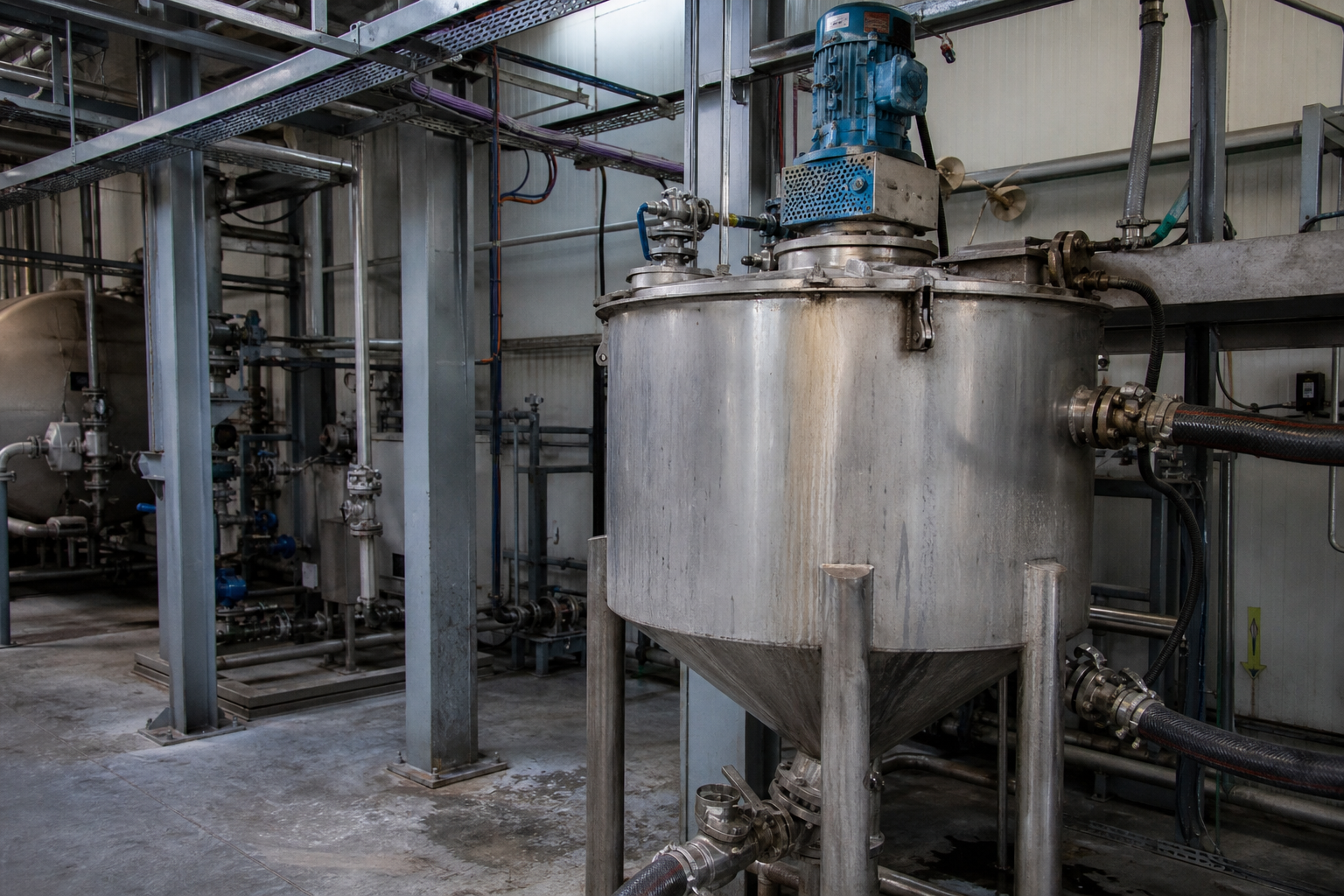
Heat is removed through a cooling surface — jacket, coil or external exchanger. As temperature falls, solubility drops and the liquor crosses saturation; growth proceeds on suspended crystals.
Simplified Cooling Crystallization Flow Diagram
Hot saturated feed → Crystallizer (cooling surface / external exchanger) → Slurry → Solid-liquid separation → Crystals + cold mother liquor
The cooling-surface ΔT is the critical design variable: too large a ΔT spikes local supersaturation at the wall, producing fines and scale.
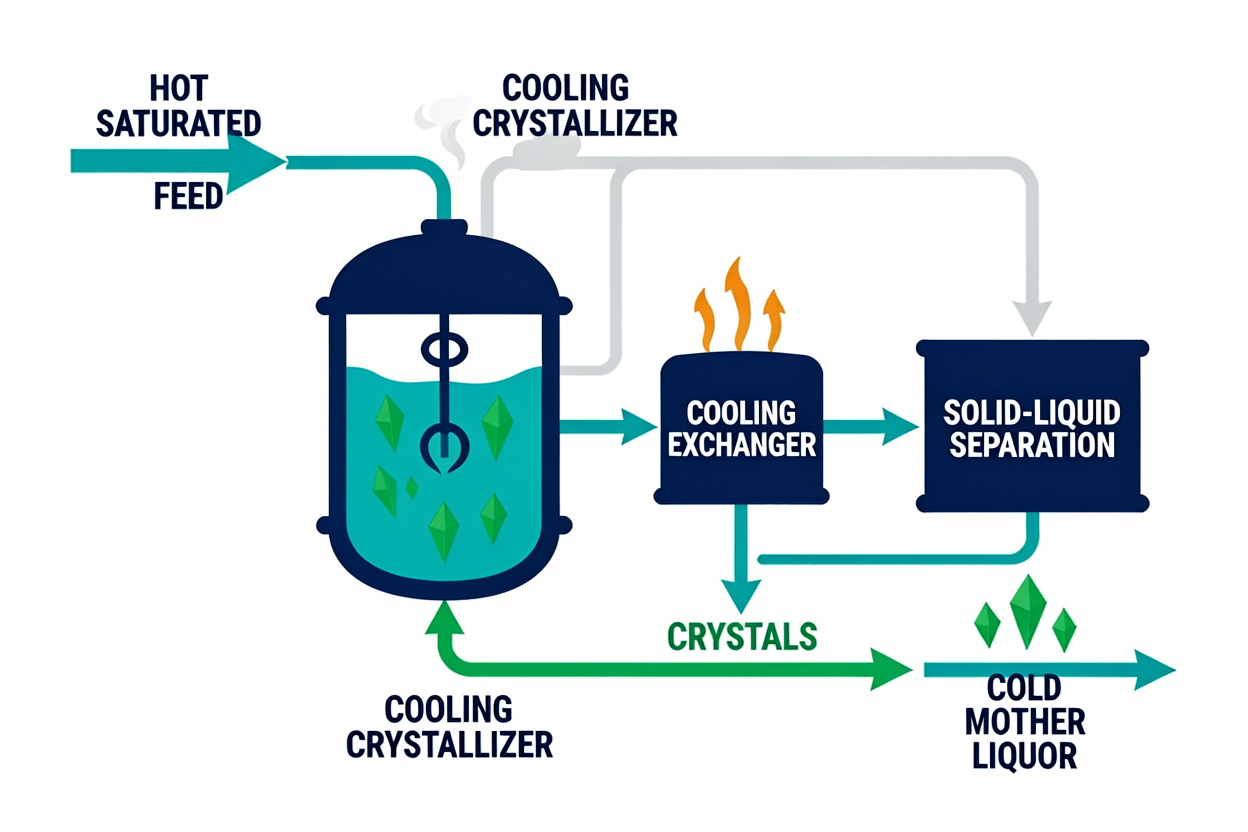
Hot Saturated Feed
Feed arrives at or near saturation — pre-concentrated by evaporation where the process needs it (a staged hybrid).
Controlled Heat Removal
Coolant — cooling water, chilled water or chilled brine — removes heat through jacket, coil or external exchanger.
Supersaturation & Growth
Falling temperature drops solubility; the driving force is spent on crystal growth, with the surface ΔT held at ≤5–8 °C per stage.
Separation & Liquor Return
Crystals discharge to centrifuge or filter; mother liquor recycles or purges for impurity control.
Cooling vs. Evaporative — Read the Solubility Curve First
The two classic routes divided along the solubility curve, the thermal sensitivity of the product, and whether recoverable condensate matters.
| Comparison | Cooling Crystallization | Evaporative Crystallization |
|---|---|---|
| Driving force | Temperature drops → solubility falls → supersaturation | Solvent removed → concentration rises → supersaturation |
| Heat / energy input | Mainly cooling capacity; no evaporation duty for the crystallization step | Usually needs steam, electricity or a heat pump for evaporation duty |
| Best suited for | Steeply temperature-dependent solubility; heat-sensitive products; avoiding evaporation load | Salts whose solubility changes little with temperature; water-minimization duty |
| Typical applications | Fine chemicals, organic acids, pharmaceutical intermediates — adipic acid, boric acid, PTA | NaCl, Na₂SO₄, mixed-salt waste brines, mother-liquor end-of-pipe treatment |
| System outputs | Crystals + mother liquor — no large recoverable condensate stream | Crystals + condensate + mother liquor |
| Typical pairing | Cooling surface or vacuum system + DTB / Oslo or agitated vessel | MVR / multi-effect + FC / DTB / Oslo body |
Route mapping from the crystallizer-type technical reference. If the solubility curve is only moderately temperature-sensitive, a staged evaporation-then-cooling hybrid often beats either single method on yield, energy and PSD.
Surface Cooling vs. Vacuum (Flash) Cooling
Both exploit temperature-dependent solubility — the difference is how heat leaves the system, and that decides which streams each variant tolerates.
Where Cooling Is the Standard Route
Chemical systems with strongly temperature-dependent solubility, from the selection matrix.
| Chemical | Recommended route | Why |
|---|---|---|
| Adipic acid | Cooling crystallization | Solubility rises strongly with temperature — the reference case for the route |
| Boric acid / potassium nitrate / ferrous sulfate | Cooling crystallization | Steep solubility curves reward heat removal over water removal |
| PTA (purified terephthalic acid) | DTB / cooling crystallization | Large-capacity continuous duty; cooling plus classified growth |
| Xylitol / sugar alcohols | Cooling crystallization | Food-grade thermal sensitivity with steep solubility behavior |
| Lysine / MSG / citric acid | Vacuum cooling crystallization | Thermal-sensitive bio-products take the flash route — no cooling surface |
Chemical-route mapping from the crystallizer-type technical reference; final selection requires solubility data, impurity profiling and crystallization trials.
Cooling crystallization is a Dimension C supersaturation method — it pairs with any Dimension D growth configuration (DTB, Oslo or agitated vessels are the typical carriers). Crystal size distribution, purity and yield depend on the solubility curve, cooling profile, seeding strategy and impurity profile. All figures are indicative ranges for preliminary screening, not a process guarantee.
Cooling Crystallization Questions We Answer Most
Recurring questions from engineers weighing cooling against the alternatives.
Because supersaturation is generated at the coldest point — the wall. A large surface ΔT spikes local supersaturation, causing nucleation bursts, fines and wall incrustation. Staged cooling with small per-stage ΔT keeps the driving force inside the growth regime.
When the liquor would foul a cooling surface, or when the product is thermal-sensitive. Vacuum cooling flashes part of the water adiabatically — cooling happens in the bulk with no surface to foul. The trade is vacuum-system and condensation duty. See Vacuum Cooling Crystallization.
Not as a rule — the outputs are crystals and mother liquor. If condensate recovery matters (ZLD duty), the evaporative route is the one that produces recoverable condensate.
Yes — DTB and Oslo bodies carry continuous cooling crystallization at fertilizer and fine-chemical scale; agitated vessels cover batch and specialty duty. The method constrains neither mode.
Screening a Cooling Route?
Send us solubility data (or ask us to test it), feed composition and target PSD. We will return a preliminary cooling vs. evaporative vs. vacuum-cooling screening — not a brochure.