Vacuum Cooling Crystallization
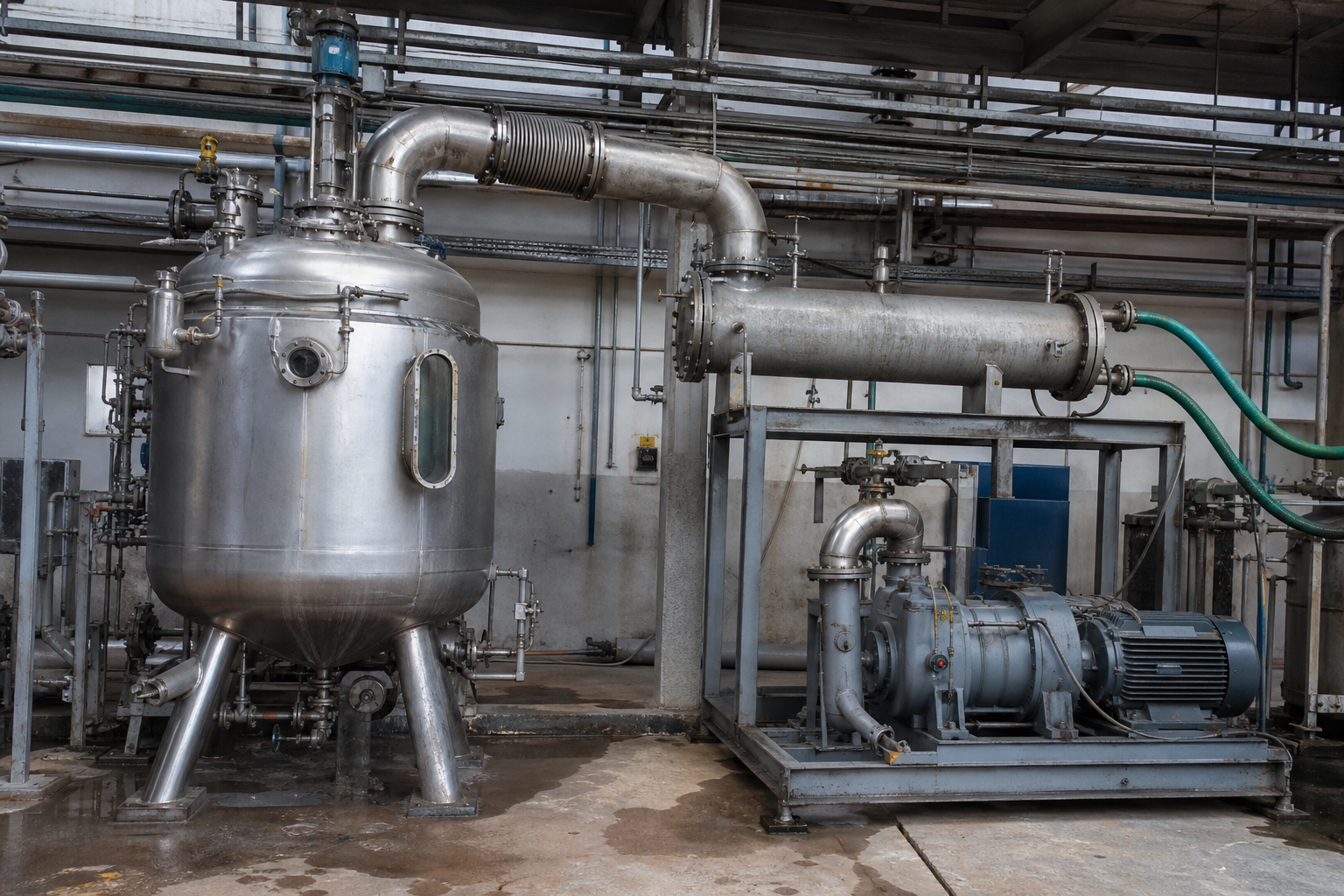
The liquor flashes into a vessel at reduced pressure: part of the water evaporates, taking its latent heat from the bulk and cooling it rapidly — with no cooling surface to foul. The standard route for thermal-sensitive bio-products: lysine, MSG, citric acid and amino acids.
Four Facts That Frame the Route
Adiabatic flash cooling with a double effect — evaporation and cooling happen at the same time.
Flash Under Vacuum, Cool in the Bulk
The vessel operates at a pressure set by the target temperature: the liquor's own water flashes, and the vapor is condensed externally by the vacuum system. Cooling rate and temperature are controlled by pressure — not by a heat-transfer surface.
Simplified Vacuum Cooling Flow Diagram
Hot saturated feed → Vacuum crystallizer (flash) → Vapor → Condenser + vacuum system → cold slurry → Solid-liquid separation
The flashed vapor carries the latent heat away; the vacuum and condensation system is the real energy consumer behind the 'cooling'.

Pressure Set-Point
The vessel pressure fixes the equilibrium temperature — the control variable for the cooling profile.
Adiabatic Flash
Part of the water evaporates instantly; its latent heat comes from the bulk liquor, which cools rapidly without any surface.
Vapor Handling
The vacuum system (with condenser) removes and condenses the flashed vapor — sizing this duty is the main engineering cost of the route.
Growth & Discharge
Supersaturation from the double effect (concentration + solubility drop) is spent on crystal growth; slurry discharges to separation.
Vacuum Cooling Is Not Automatically Cheaper
A common misconception deserves a direct correction: low temperature does not mean low energy. The route trades surface cooling for flash and condensation duty.
| Claim vs. reality | What actually happens |
|---|---|
| 'Flash cooling is free cooling' | The flashed vapor must be condensed — the vacuum system and condenser carry the duty that a cooling surface would otherwise carry |
| 'No cooling surface means no energy cost' | Cooling-water or chilled-water duty moves to the condenser; the vacuum pump or ejector adds standing power or steam demand |
| Where the route genuinely wins | Rapid bulk cooling, no high-temperature residence, no wall incrustation — exactly what thermal-sensitive and fouling-prone systems need |
The advantage of vacuum cooling is thermal, not thermodynamic: fast cooling, low temperature, no fouling surface. Budget the vacuum and condensation duty accordingly.
Vacuum Cooling vs. Surface Cooling
Both exploit temperature-dependent solubility — the heat-removal route decides which streams each variant tolerates.
Which Body Carries the Method
Vacuum cooling is a Dimension C method — a vacuum-cooling system can be built on a DTB body or on an agitated vessel, chosen by PSD target and duty.
Vacuum cooling is a Dimension C supersaturation method, orthogonal to the Dimension D growth configuration. Crystal quality and yield depend on the solubility curve, the pressure-vs-temperature profile, seeding strategy and impurity behavior. Vacuum-system sizing and condensation duty must be engineered per project. All figures are indicative ranges for preliminary screening, not a process guarantee.
Vacuum Cooling Questions We Answer Most
Recurring questions from engineers screening the flash route for thermal-sensitive products.
Both exploit temperature-dependent solubility, but the heat-removal route differs. Cooling crystallization removes heat through a surface — jacket, coil or external exchanger — with the ΔT held ≤5–8 °C per stage. Vacuum cooling flashes the liquor adiabatically into a vacuum vessel: part of the water evaporates, taking latent heat from the bulk, so there is no cooling surface to foul.
Not automatically. The flashed vapor still has to be condensed, and the vacuum system adds pump power or ejector steam. The genuine advantages are rapid bulk cooling, no high-temperature residence and no fouling surface — thermal benefits for heat-sensitive systems, not free energy.
Typically 35–55 °C for lysine, MSG, citric acid and amino-acid systems — the vessel pressure sets the temperature. The exact band for your product is fixed by its solubility curve and thermal-sensitivity limit.
Either. A vacuum-cooling system can be built on a DTB body (continuous, narrow PSD) or on an agitated vessel (batch, specialty duty) — the supersaturation method and the growth configuration are orthogonal decisions.
Screening a Vacuum Cooling Route?
Send us the product system, thermal-sensitivity limits and feed conditions. We will return a preliminary vacuum vs. surface cooling screening with an indicative configuration — not a brochure.