Reaction Crystallization
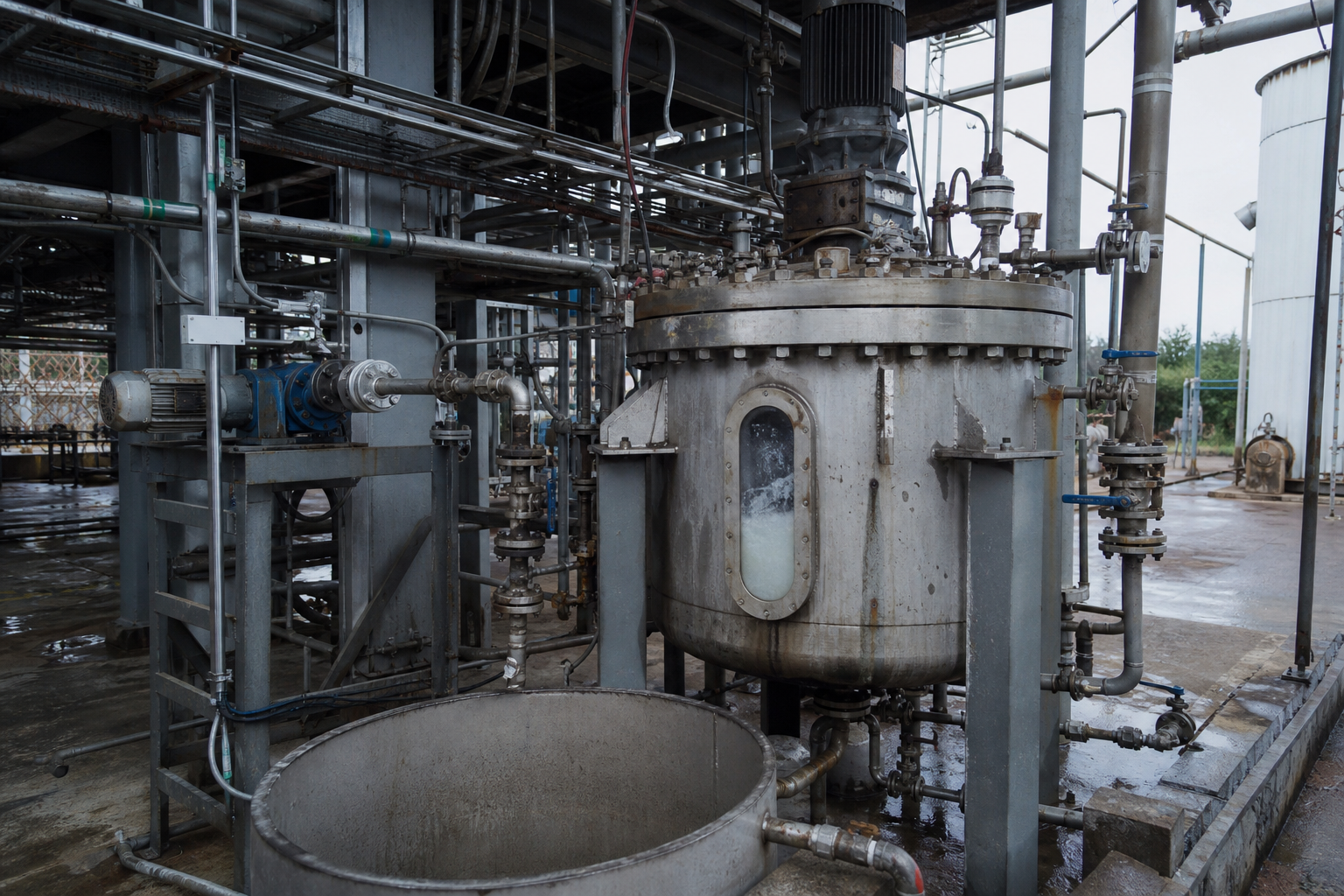
Two reagents combine to form a sparingly soluble salt that precipitates directly — supersaturation is generated by the reaction itself, at the reagent interface. Li₂SO₄ + Na₂CO₃ → Li₂CO₃↓ for battery-grade lithium carbonate; iron phosphate from Fe/PO₄ sources for battery precursors.
Four Facts That Frame the Route
The only Dimension C method where supersaturation is created by chemistry instead of by temperature or water removal.
Precipitate at the Interface, Grow Downstream
The reaction creates the supersaturated species directly; the engineering problem moves from heat management to reagent dosing and mixing control.
Simplified Reaction Crystallization Flow Diagram
Reagent A + Reagent B → Reaction / precipitation zone → Slurry → Growth / aging vessel (agitated or DTB) → Solid-liquid separation → Product + mother liquor
Supersaturation appears where the reagents meet — mixing design and stoichiometry are the process control levers.

Reagent Contact
Reagents are dosed into a controlled mixing zone — local supersaturation at the interface sets the nucleation environment.
Precipitation
The sparingly soluble product forms and precipitates directly — e.g. Li₂CO₃ from Li₂SO₄ + Na₂CO₃.
Growth & Aging
A downstream agitated or DTB vessel lets particles grow and mature under controlled supersaturation.
Separation & Washing
Centrifuge or filter plus washing removes mother liquor and residual reagents — critical for battery-grade purity.
What Controls Particle Size
Because supersaturation appears at the reagent interface, PSD control is chemical and hydraulic — stoichiometry, mixing, and the growth stage that follows.
| Control lever | What it governs | Consequence if wrong |
|---|---|---|
| Reagent stoichiometry | Supersaturation profile through the reaction zone | Off-stoichiometric dosing shifts nucleation bursts and impurity incorporation |
| Mixing intensity | How fast reagents intermix — the local environment where crystals nucleate | Poor mixing creates hot spots of supersaturation: fines, broad PSD, batch-to-batch drift |
| Downstream growth vessel | Aging and growth after precipitation — usually agitated or DTB | Skipping the growth stage leaves precipitate-sized fines that fail downstream handling |
| Reaction + cooling staging | Reaction crystallization followed by cooling — the documented pattern for iron phosphate | Single-stage operation loses the PSD tightness battery precursors demand |
Iron-phosphate type systems run reaction crystallization plus cooling with strictly controlled particle-size distribution — the staged pattern from the crystallizer-type technical reference.
Which Body Carries the Method
Reaction crystallization is a Dimension C method — the precipitation stage and the growth stage may sit in different vessels.
Reaction crystallization is a Dimension C supersaturation method, orthogonal to the Dimension D growth configuration. Polymorphism, PSD and purity outcomes depend on the solvent system, reagent purity, mixing environment and operating trajectory — TBD: system-specific kinetic and residence data are required before any PSD guarantee. All statements are for preliminary screening, not a process guarantee.
Reaction Crystallization Questions We Answer Most
Recurring questions from engineers screening a precipitation route.
Supersaturation is generated by chemistry instead of by removing water or heat. The product forms because it is sparingly soluble the moment the reagents combine — so the process levers are reagent stoichiometry and mixing, not temperature or evaporation rate.
Lithium carbonate is sparingly soluble and its solubility falls with temperature — precipitating it from Li₂SO₄ and Na₂CO₃ is the direct route to battery-grade product, with a downstream growth stage (typically DTB) finishing the particle quality. The full plant combines this with multi-effect concentration and falling-film evaporation upstream.
Yes, but not from the precipitation step alone. PSD tightness comes from controlled stoichiometry and mixing plus a dedicated growth/aging vessel — for iron-phosphate battery precursors the documented pattern is reaction crystallization followed by cooling with strictly controlled particle-size distribution.
It carries the soluble by-products (e.g. Na₂SO₄ from the Li₂CO₄ reaction) and unreacted reagents — mother-liquor management and by-product crystallization are part of the flowsheet, not an afterthought. See Mother Liquor Recovery.
Screening a Reaction Route?
Send us the target product, reagent system and purity specification. We will return a preliminary reaction-crystallization screening with an indicative staged configuration — not a brochure.