EvapCryst logo

Coal Chemical & Mining

Engineered ZLD and mixed-salt separation for coal chemical, coking and mining operations — designed for TDS 1–25%, COD 500–50,000 mg/L, refractory organics (phenols, SCN⁻, heterocyclics) and the NaCl–Na₂SO₄ eutectic that defines salt-splitting feasibility.

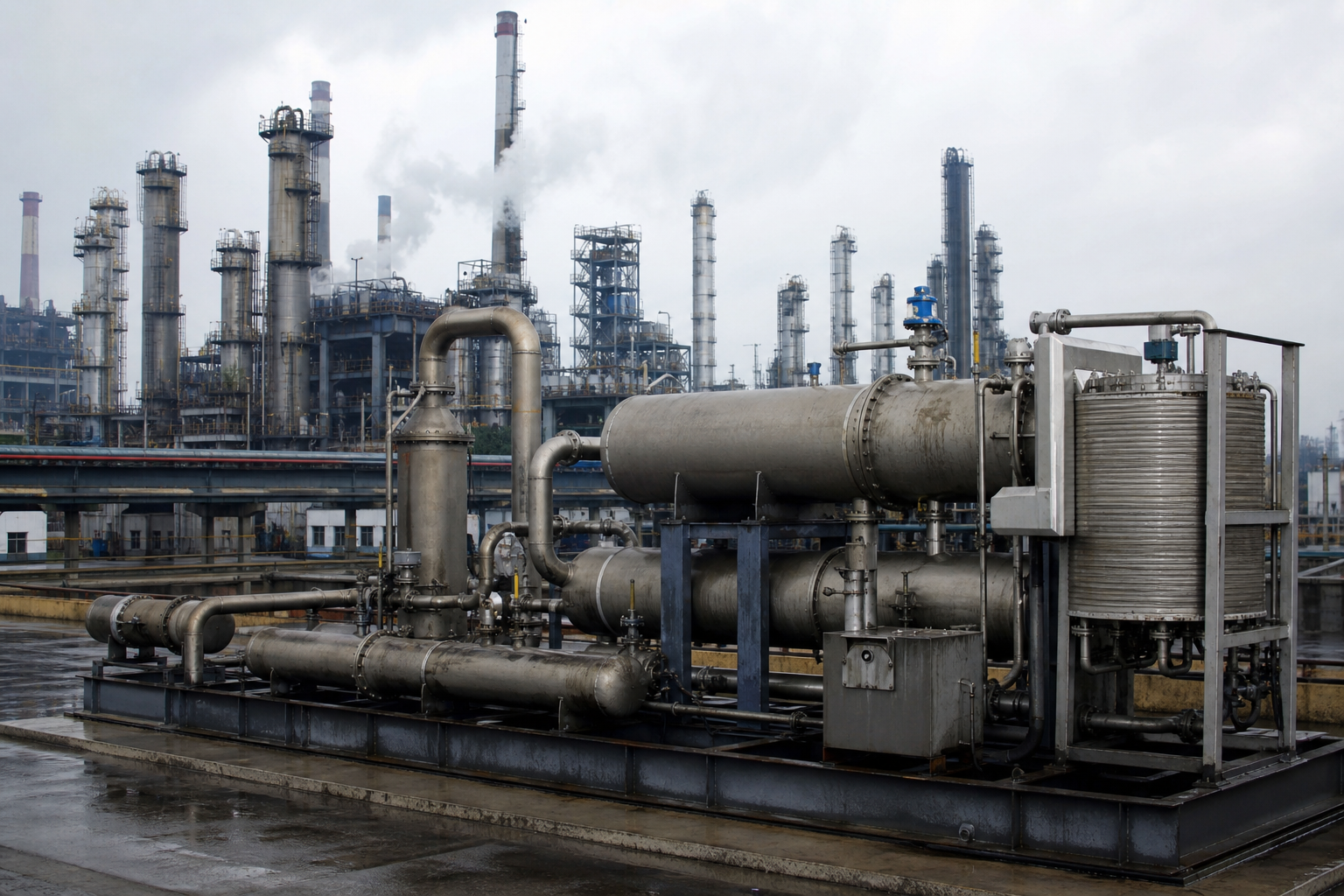
Coal chemical plant high-salinity wastewater zero liquid discharge system
Wastewater Profile

Coal Chemical Wastewater Characteristics

Coal chemical and mining wastewater combine TDS 1–25%, refractory organics (phenols 200–2,000 mg/L, SCN⁻ 100–500 mg/L, heterocyclics), NH₃-N 50–4,000 mg/L and trace heavy metals in ways few other industries must handle simultaneously.

STREAM 01Compliance / ZLD

Coking Wastewater

COD 2,000–10,000 mg/L; phenols 200–2,000 mg/L; NH₃-N 100–1,500 mg/L; SCN⁻ 100–500 mg/L; cyanide 5–50 mg/L. Solvent extraction + biological treatment removes organics, but the residual brine purge still requires evaporative ZLD for compliance.

~2–5% TDSresidual brine purge after solvent extraction + biological treatment — mixed NaCl + Na₂SO₄, still requires evaporative ZLD for compliance
STREAM 02Compliance / ZLD

Coal-Gasification Wastewater

NH₃-N 200–4,000 mg/L; organics (formate, acetate, aromatics); TDS 1–5% in the raw effluent. After ammonia stripping and biological treatment, the residual brine sits in the awkward middle band — too high for membrane, too low for direct crystallization without pre-concentration.

1–3% TDSresidual brine after ammonia stripping (typically <50 mg/L NH₃-N residual) and biological treatment — too high for membrane, too dilute for direct crystallization
STREAM 03Compliance / ZLD

CTL / CTO Saline Effluent

Coal-to-liquids and coal-to-olefins plants produce high-salinity effluent with trace organics (alcohols, ketones) and chloride-to-sulfate ratios that shift with coal feedstock. ZLD with mixed-salt separation is increasingly the default mandate in China under GB 31571 and downstream permits.

5–25% TDSCTL/CTO effluent with trace organics (alcohols, ketones); the chloride-to-sulfate ratio shifts with the coal feedstock
STREAM 04Yield / Salt Value

Mixed NaCl + Na₂SO₄ + Trace Organics

At the NaCl–Na₂SO₄ eutectic, achievable single-salt purity caps out well below reusable grade. COD >1,000 mg/L post-treatment usually forces hazardous-waste classification. The salt matrix determines whether ZLD produces two sellable fractions or a hazardous mixed-salt waste — a swing of $50–150 per tonne in net operating cost.

92–95%achievable single-salt purity at the NaCl–Na₂SO₄ eutectic; COD >1,000 mg/L post-treatment usually forces hazardous-waste classification
Process Route

The ZLD + Salt Separation Process Chain

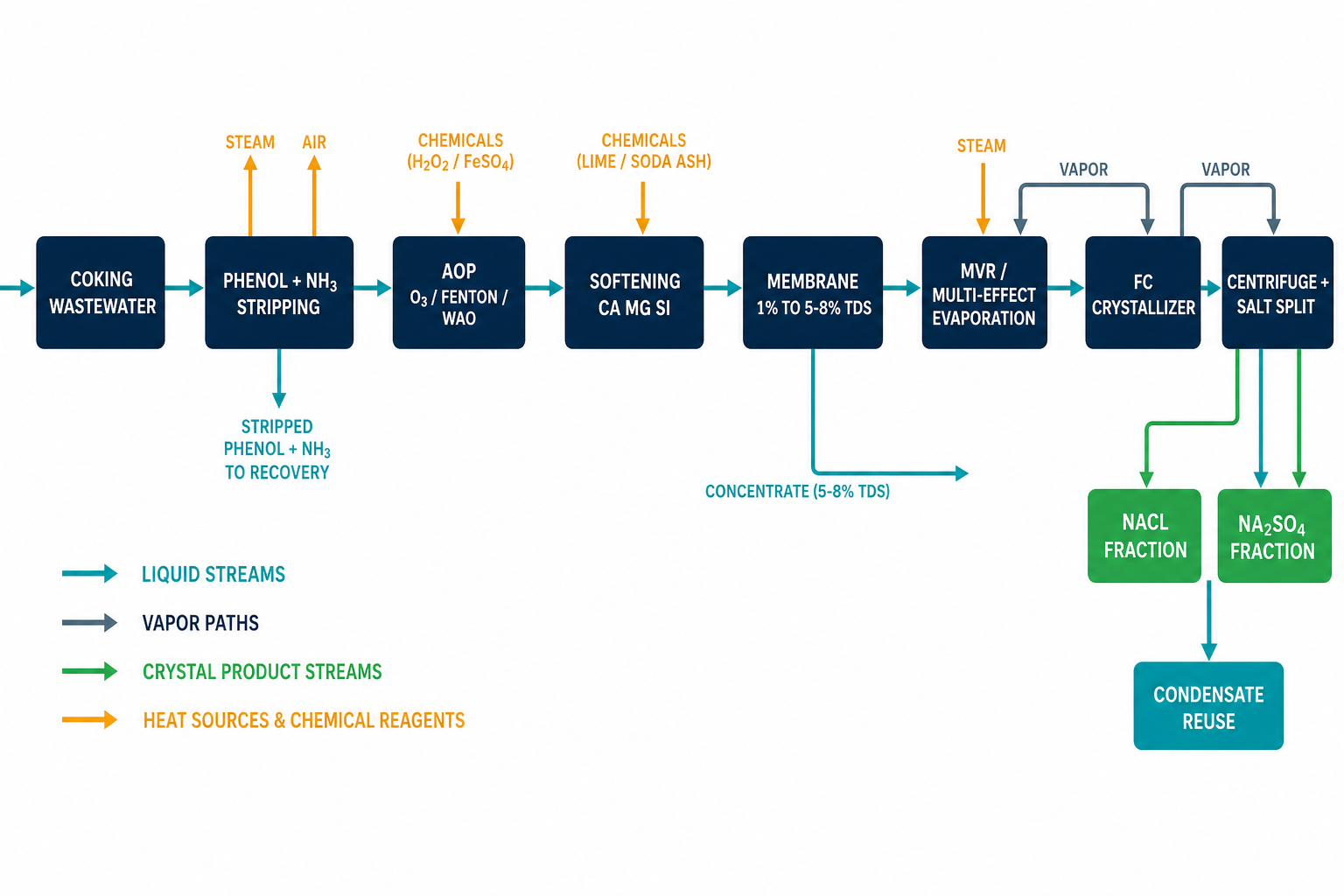
Indicative flowsheet for coal chemical wastewater ZLD with selective NaCl / Na₂SO₄ separation.

The canonical sequence: phenol + NH₃ stripping → advanced oxidation of refractory organics (O₃ / Fenton / WAO) → softening (Ca / Mg / Si removal) → membrane pre-concentration (1% → 5–8% TDS) → MVR (15–25 kWh per tonne water evaporated, depending on feed TDS and boiling-point rise) or multi-effect (0.25–0.40 t steam per tonne water, depending on effect count and boiling-point rise) or a hybrid of both → forced-circulation crystallizer (tube velocity 2–3 m/s to keep suspended solids moving) → selective salt separation → condensate reuse.

Simplified PFD for indicative routing only. Mixed-salt separation feasibility depends on the NaCl–Na₂SO₄–H₂O phase behavior, residual COD content and target salt purity. Selective separation requires laboratory phase-equilibrium testing.

Pre-treatment

Pre-treatment Strategy

Coal chemical ZLD success is decided upstream of the crystallizer. Without robust pre-treatment, even the best crystallizer fouls within weeks.

STEP 01

Phenol & Ammonia Removal

Diisopropyl ether or methyl isobutyl ketone extraction for phenols (target <50 mg/L residual); free-ammonia and fixed-ammonia stripping at elevated pH and temperature (target <15–50 mg/L NH₃-N). These protect downstream biological and evaporator stages from organic load and pH swings.

STEP 02

Advanced Oxidation

Ozone (2–5 g O₃ per g COD removed), Fenton (Fe²⁺ / H₂O₂ at pH 3–4) or wet-air oxidation (200–320°C, 5–20 MPa) breaks SCN⁻, heterocyclics and refractory aromatics that survive biological treatment before they reach the brine concentrator. Selection depends on residual COD target and flow.

STEP 03

Softening & Silica Removal

Lime-soda cold or hot softening takes Ca²⁺ to <20 mg/L and Mg²⁺ to <5 mg/L; ion-exchange polishing drops hardness to <1 mg/L. Silica is limited to <150 mg/L (or lower at high recovery) by Mg(OH)₂ co-precipitation or antiscalant dosing. These prevent CaSO₄ / CaCO₃ / Mg(OH)₂ scaling in membrane and evaporator stages.

STEP 04

Membrane Pre-concentration

ED, HERO (High-Efficiency Reverse Osmosis) or DTRO / SPRO lifts brine from ~1% to 5–8% TDS, reducing the evaporator duty by 5–10×. Subject to scaling envelope (CaSO₄, silica) and COD / antiscalant limits — pilot testing is mandatory before commitment.

Salt Separation

The Mixed-Salt Separation Challenge

Mixed NaCl + Na₂SO₄ systems are the defining engineering problem of coal chemical ZLD. Selective separation changes project economics entirely.

Stream ScenarioComposition DriverSeparation FeasibilityOutcome
NaCl-dominantCl⁻ / SO₄²⁻ molar ratio > 5; COD <500 mg/LFavorableReusable-grade NaCl (>97%) + mixed salt purge
Na₂SO₄-dominantSO₄²⁻ / Cl⁻ molar ratio > 3; COD <500 mg/LFavorableSellable Na₂SO₄ (>95%) + NaCl purge
Near-eutecticBalanced NaCl / Na₂SO₄; ~17.5% Na₂SO₄ at 100°CMarginalTwo salt fractions, 85–92% purity max
High residual CODCOD >1,000 mg/L post-treatmentDifficultHazardous mixed salt disposal at $80–200/t

Separation feasibility requires laboratory phase-equilibrium testing at the project’s actual brine composition. Purity targets and reuse classification depend on local regulatory acceptance.

Mining Applications

Mining Wastewater Applications

Evaporative concentration, brine management and crystallization for mine water closure — beyond the coal chemical plant fence line.

Mine Drainage

Acid or neutral mine drainage carries metals (Fe, Mn, Zn, Cu) plus sulfate and TDS. Neutralization brine often needs evaporative ZLD.

Mineral Processing Water

Flotation, leaching and dewatering circuits accumulate salts and reagent residues. Closed-loop concentration prevents discharge.

AMD Neutralization Brine

Lime neutralization of acid mine drainage produces a high-TDS, high-sulfate brine that often requires forced-circulation crystallization for stable disposal.

Heap Leach & SX/EW Streams

Copper, uranium and gold heap-leach circuits generate bleed streams needing evaporative concentration and crystallization for salt management.

Frequently Asked Questions

Straight answers on mixed-salt economics, MVR vs multi-effect selection, stream differences and membrane limits.

Why do mixed-salt systems complicate ZLD?+

Mixed NaCl + Na₂SO₄ does not crystallize cleanly — at the NaCl–Na₂SO₄–H₂O eutectic (~17.5% Na₂SO₄ at 100°C) co-crystallization is unavoidable and single-salt purity caps near 92–95%. Without separation, the mixed salt is usually classified as hazardous industrial waste at $80–200 per tonne disposal cost. Selective crystallization outside the eutectic band can produce two sellable or reusable fractions; near-eutectic brines cannot be economically split.

When is MVR preferable to multi-effect in coal chemical ZLD?+

MVR (15–25 kWh per tonne water) typically wins when electricity is cheap relative to steam, when low-pressure steam is scarce, or when the plant has a decarbonization mandate. Multi-effect (0.25–0.40 t steam per tonne water) remains attractive where low-pressure steam is abundant (e.g., on a coal chemical site with by-product steam at <$20/t). Many projects now specify a hybrid (multi-effect + MVR) configuration for optimal lifecycle cost.

How is coking wastewater different from coal-gasification wastewater?+

Coking wastewater is dominated by phenols, NH₃-N and SCN⁻ from coal carbonization. Gasification wastewater carries NH₃-N, organics and dissolved salts from partial oxidation. Both need pre-treatment before evaporative ZLD, but the pre-treatment trains differ — solvent extraction for coking, stripping for gasification.

Can membrane pre-concentration always be used?+

No. Membrane pre-concentration is limited by scaling (CaSO₄ at Ksp >0.2 g/100 mL, silica above ~150 mg/L at neutral pH), fouling (organics, antiscalant residuals) and osmotic pressure (above ~80 bar for HERO). High-COD (>1,000 mg/L) or high-hardness streams may require softening and AOP before membranes are viable. Site-specific pilot testing (6–12 weeks minimum) is mandatory before commitment.

Discuss Your Coal Chemical or Mining Project

Send us your wastewater composition, throughput and discharge mandate. Within two business days you will receive a feasibility assessment and an indicative ZLD route.

Request a Proposal

Send your feed characterization (TDS, COD, main salts, viscosity), throughput and product targets — we respond with a preliminary process route within two business days.