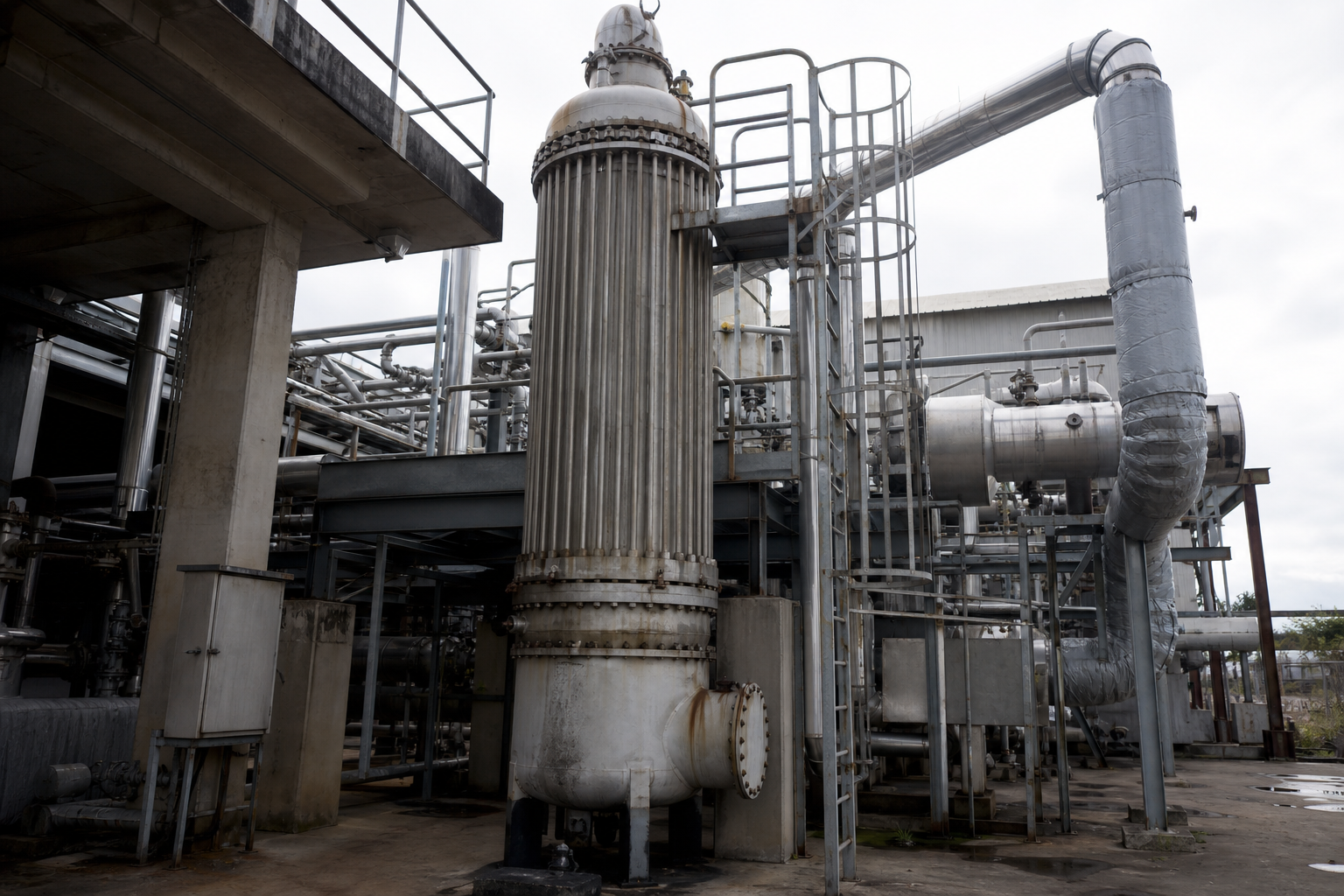
Liquid is distributed over the top of vertical tubes and falls as a thin film under gravity, with vaporization at the film surface. The highest heat-transfer coefficient of any evaporator configuration and only seconds of residence time — the standard choice for clean, low-viscosity, heat-sensitive feeds.
Reference ranges under typical operating conditions — where your project lands inside each range depends on feed viscosity, fouling tendency and distribution quality.
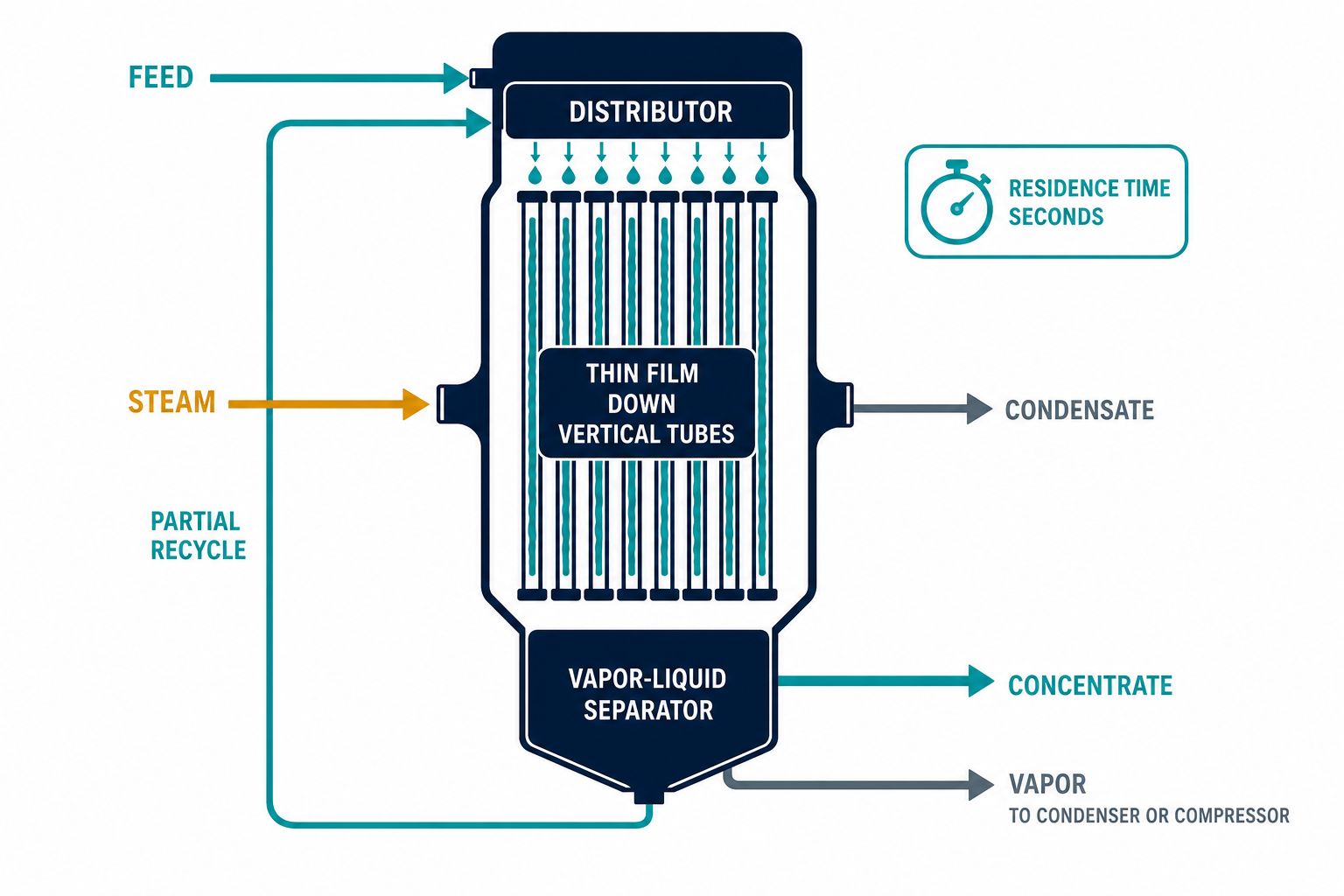
A thin film descends the inner wall of vertical tubes; vaporization happens at the film surface, not in a boiling bulk — no hydrostatic head, no bulk boiling, minimal temperature difference across the film.
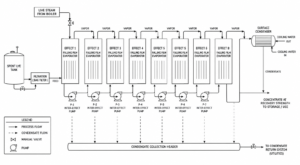
The vapor leaving the separator is routed by the Dimension A decision — recompressed in an MVR train or cascaded in multi-effect service. Falling film constrains neither.
Feed is evenly distributed across the tube sheet at the top — every tube must stay fully wetted. Distribution failure is the root cause of most falling-film fouling problems.
The film descends by gravity while steam condenses on the shell side. Vaporization occurs at the free film surface; the liquid never reaches bulk boiling.
Concentrate and vapor leave the bottom of the tubes into a separator body that disengages entrained droplets before the vapor is condensed or recompressed.
Part of the concentrate is typically recycled to the distributor to maintain the minimum wetting rate per tube — the ratio is a project-specific design variable.
Clean feeds, low viscosity, heat-sensitive products — and duty positions where short residence time protects quality.
Clarified fermentation broth, sugar juice and dairy-type feeds concentrate with only seconds of thermal exposure — the standard configuration for sanitary and thermal-sensitive duty. See Food, Fermentation & Bioprocessing.
Where the feed is clean at the front end but scaling or crystallizing at the back end, falling film takes the low/medium-concentration stage and forced-circulation finishes — a documented cascade pattern.
Mercerizing weak lye and similar clean alkaline streams are concentrated in falling-film service for reuse in the process loop — see Textile & Dyeing for the caustic-recovery application.
Falling film is sensitive to fouling and to uneven distribution at high viscosity. On scaling-prone, high-TDS or crystallizing feeds, a falling-film distributor would foul within hours.
Falling film is a Dimension B process configuration: how the liquid meets the heat-transfer surface. It combines freely with any Dimension A energy strategy (MVR, multi-effect, TVR) and is independent of the crystallization dimensions (C and D). A common complete plant is MVR (A) + Falling Film (B) for clean pre-concentration, feeding an Evaporative (C) + FC (D) crystallization back end. All figures on this page are indicative ranges for preliminary screening — final selection requires feed characterization, fouling assessment and heat-and-mass-balance engineering.
Recurring questions from engineers weighing falling film against forced-circulation.
Because vaporization happens at the free surface of a very thin film — heat passes through millimetres of liquid rather than a boiling boundary layer or a dense circulating bulk. Typical coefficients of 1,500–3,000 W/m²·K on clean, low-viscosity feeds translate into less heat-transfer area per tonne of evaporation than any other configuration.
Not as the crystallizing stage. On high-TDS, scaling-prone or crystal-bearing feeds the distributor and tube wall foul within hours. The standard answer is forced-circulation evaporation at 2–3 m/s tube-side velocity. The documented compromise for feeds that start clean and finish dirty is a cascade: falling film up to medium concentration, forced-circulation for the crystallizing final stage.
Yes — configuration and energy strategy are orthogonal decisions. Falling film is a common Dimension B body inside an MVR (Dimension A) train, provided the feed's boiling point elevation stays inside the compressor's lift envelope. See MVR Evaporation.
Distribution failure. If any tube runs partially dry, the dry wall overheats, product degrades and fouling starts — availability collapses from a design detail, not from the principle. Distributor design, minimum wetting rate and the partial recirculation ratio are the make-or-break variables, and they are feed-specific.
Send us feed analysis (viscosity, fouling tendency, TDS profile) and throughput. We will return a preliminary falling-film vs. forced-circulation screening with an indicative configuration — not a brochure.
Send your feed characterization (TDS, COD, main salts, viscosity), throughput and product targets — we respond with a preliminary process route within two business days.