Vanillin Production: Concentration & Drying Solutions
Integrated vanillin concentration, crystallization and closed-loop nitrogen drying systems for solvent-wet, heat-sensitive aroma chemicals – with 5,000 TPA reference practice.
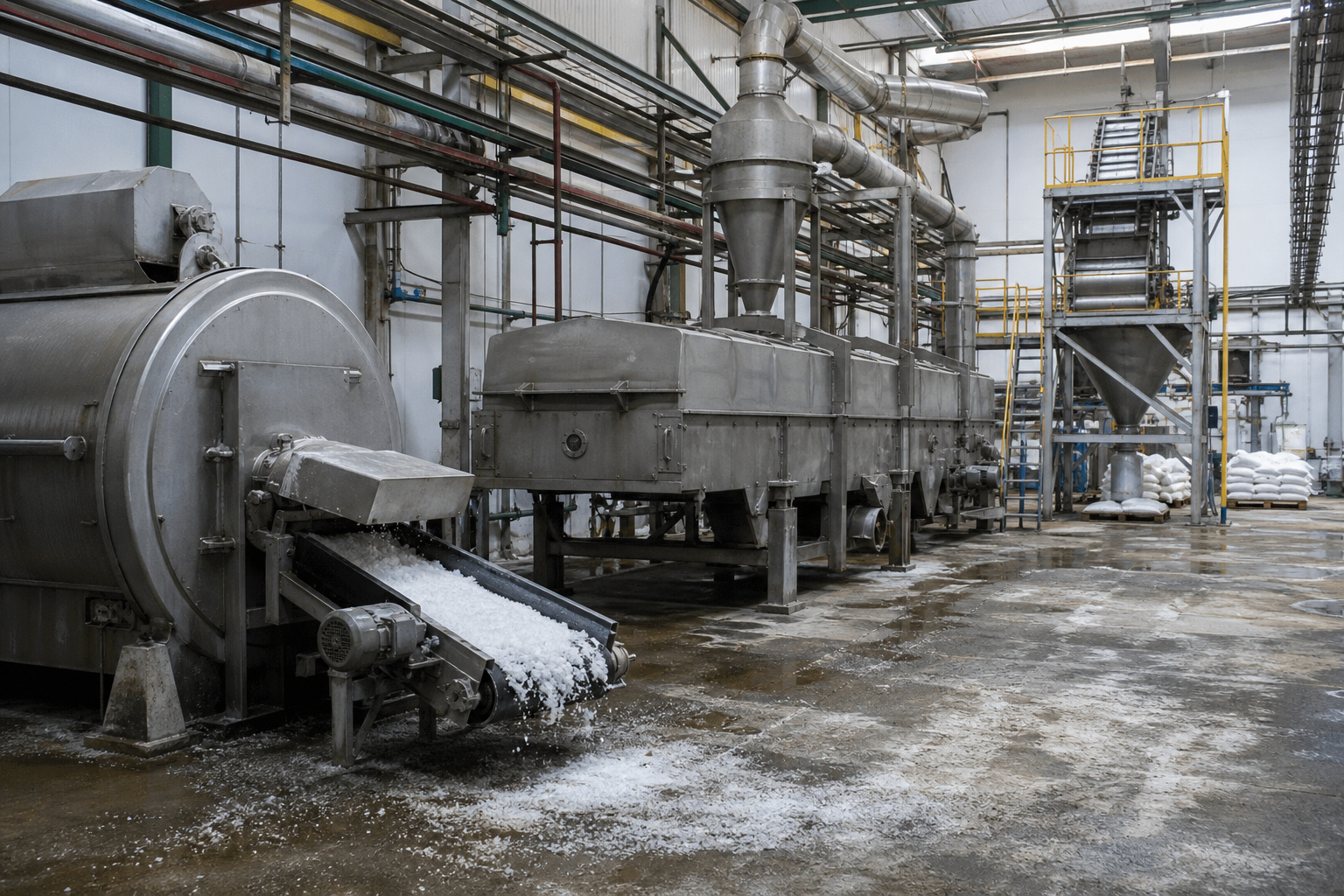
The line that turns wet crystal into bagged product: centrifuge dewatering, drying, screening, conditioning and packing — engineered as one train downstream of your evaporative crystallizer, sized from 10 t/d pilots to 1,000 t/d plants.
Reference ranges from published salt-plant and dryer data on NaCl and inorganic salt systems.
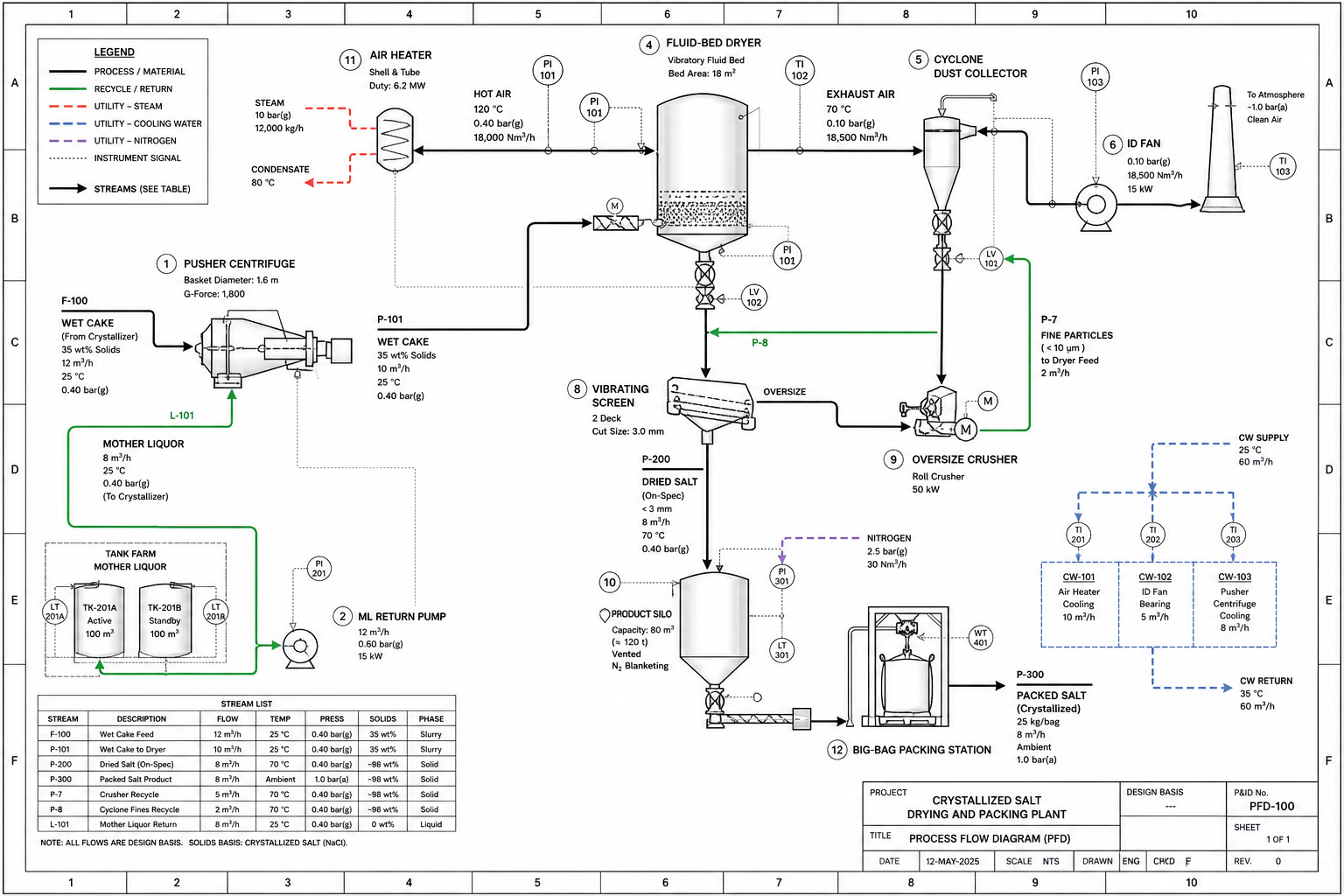
One continuous train: dewater, dry, screen, condition, pack — with mother liquor and dust loops closed back into the system.
Crystallizer discharge → Pusher / peeler centrifuge (3–5% cake moisture) → Fluid bed / flash / rotary dryer → Multi-deck vibrating screen → Conditioning (iodine / anti-caking) → Silo → Bagging (1–50 kg / 1 t)
Mother liquor returns to the crystallizer; dryer exhaust passes a cyclone / dust collector; oversize recirculates through a crusher — nothing leaves the line except packed product and clean air.
A complete salt line runs 20–26 major equipment items; what is core and what is optional depends on feed and product grade.
Aggregated from published supplier data on salt, crystal and slurry drying equipment — indicative ranges for preliminary sizing, not a process guarantee.
| Line Section | Parameter | Range / Rating | Condition |
|---|---|---|---|
| Whole line | Salt refining & packing capacity | 3–30 t/h | industrial salt refining lines, SS304/316L construction, 380/480 V |
| Full plant capacity | 10–1,000 t/d | crushing-to-packing salt plants, installation area 200–3,000 m² | |
| Product purity / moisture | ≥99.0–99.5% NaCl · ≤0.3–0.8% H₂O | after washing, centrifuging and drying | |
| Dewatering — pusher centrifuges | Model range | HR400–HR1000 | 5 models; two-stage pusher, continuous, wash & mother liquor separated |
| Basket / speed / g-factor | 337–920 mm · 650–2,200 r/min · 236–1,145 | outer basket; separation factor | |
| Throughput & drive | up to 20 t/h · 11–55 kW | HR630 on sea salt; push stroke 40–50 mm at 30–80 /min | |
| Feed suitability | >0.08 mm · >40% solids | crystal size and slurry concentration | |
| Dewatering — peeler centrifuges | Model ranges | PPCC 600–1,600 mm · PPCS 21–1,923 L | 7 wall-through / 8 siphon models, batch, PLC + VFD |
| Load & speed & power | 26–2,400 kg · 950–2,600 r/min · 15–200 kW | PPCS siphon series; +40–60% capacity vs. plain horizontal | |
| Pharma execution | cGMP | nitrogen blanketing, CIP, hygienic wall-through design | |
| Drying — fluid bed & rotary | Salt discharge moisture | ≤0.3–0.8% | vibrating fluid bed or rotary dryer after 3–5% cake |
| Tube-bundle dryer series | 400–1,600 m² · 2.5–4.5 kgH₂O/m²h · 30–160 kW | 10 models (MGZG400–1600), 7–11 r/min, indirect steam heated | |
| Drying — flash (airflow) | Residence time | 0.5–3 s | instant low-temperature drying — no decomposition / discoloration |
| Energy & execution | −30% vs. tray oven · 304/316L polished | direct gas–solid heat transfer; GMP food / pharma contact surfaces | |
| Drying — ZLD side-trains | Disc-film (MVR) dryers | 80–90% thermal efficiency · ≤1% residue H₂O | energy −45% vs. conventional; slurry to powder in one step |
| Vacuum low-temp / rake dryers | 32–45 °C · 15–90% feed H₂O | rake auto-reverses every 5–8 min; for heat-sensitive, scaling feeds | |
| Slurry / drum dryers | 2–4 up to 50 gal/h | ZLD end-of-train dewatering of evaporator bottoms & concentrated slurry | |
| Screening & packing | Screening | multi-deck vibrating | grade separation with oversize return to crusher |
| Packing | 150 g–1 t | retail sachets, 1–50 kg bags, 1-tonne bulk bags |

Ranges aggregate published specifications from multiple equipment suppliers (salt line contractors, centrifuge and dryer manufacturers, ZLD system builders); figures are indicative for screening and must be verified against your feed, crystal size distribution and utility set.
The dryer is the energy center of the line — pick it by crystal size, heat sensitivity and tonnage, not by catalog.
| Dryer Type | Residence / Heat | Best For | Watch-outs |
|---|---|---|---|
| Vibrating fluid bed | minutes · hot air | Washed salt, inorganic crystals after centrifuge — the default for 3–30 t/h salt lines | needs pre-dewatered feed; dust collection required |
| Flash (airflow) | 0.5–3 s · low temp | Heat-sensitive organics: starch, glucose, pharma intermediates, organic salts | feed must be dispersible, non-sticky, fine |
| Rotary / tube-bundle | indirect steam heat | High tonnage, granular feeds; tube-bundle to 1,600 m² area, low wear | larger footprint; crystal attrition in rotary drums |
| Disc-film (MVR) | continuous · mechanical vapor recompression | ZLD mother liquor & residues to ≤1% moisture, −45% energy | for slurry / waste duty, not product salt |
| Vacuum rake / low-temp | batch · 32–45 °C | Oxidation- and scaling-prone, high-value batches (15–90% feed moisture) | batch logic; smaller throughput per unit |
Temperature and residence figures follow published dryer data for the listed duties; final selection needs your crystal breakage test and heat-sensitivity data.
Published salt-plant layouts scale the same process train across three installation-area classes.
Anonymized configurations reconstructed from published supplier project data.
Engineering guides on dryer and centrifuge selection, salt refining and ZLD-end drying.
This line starts where crystallization ends — see the trains that feed it.
This page aggregates published supplier specifications and project data (salt plant contractors, centrifuge and dryer manufacturers, ZLD system builders) into an engineering screening view. All names are withheld; configurations are described generically. Figures are indicative ranges for preliminary line sizing — final selection requires your feed analysis, crystal size distribution, moisture targets and site utilities.
Recurring questions from engineers specifying the downstream line.
On salt and crystal lines, almost always. Mechanical dewatering to 3–5% cake moisture (2–2.5% optimized) in a pusher or peeler centrifuge removes water at a fraction of the thermal cost of drying — skipping it substantially raises the dryer’s evaporation duty and fuel bill.
Washed inorganic salt at 3–30 t/h is standard vibrating-fluid-bed territory. Flash dryers suit heat-sensitive organic crystals (0.5–3 s residence, no discoloration); rotary and tube-bundle dryers carry high tonnage with indirect steam heat and low attrition — tube-bundle units reach 1,600 m² of heat area.
≤0.3–0.8% residual moisture is the published range for fluid-bed / rotary salt lines; refined washing plants report 0.3–0.5%. For ZLD mixed-salt residues, disc-film dryers reach ≤1% — handleable, landfill-free solids.
Yes — 304/316L polished contact surfaces with GMP executions, iodine / anti-caking dosing, metal detection and magnetic separation. Peeler centrifuges ship in cGMP wall-through execution with nitrogen blanketing and CIP.
Published lines bag from 150 g retail sachets through 1–50 kg industrial bags to 1-tonne bulk bags, fed from a common screening-and-silo section with PLC interlocks and remote diagnostics.
Washing runs with saturated brine in countercurrent so the brine dissolves no additional NaCl; published lines hold total NaCl loss under 10% across washing, centrifuging, drying and screening.

Integrated vanillin concentration, crystallization and closed-loop nitrogen drying systems for solvent-wet, heat-sensitive aroma chemicals – with 5,000 TPA reference practice.

Plant protein and biological feed processing solutions: MVR falling film concentration of fermentation broths and protein liquors at 60-80C, viscosity and foaming control, and integration with spray and fluid-bed drying.

Fluid bed dryers dominate salt and crystal drying — halving drying time — while ANFD closed three-in-one units handle toxic and high-value products. This guide covers FBD components, the seven-step

Integrated thin stillage evaporation, DDGS drying and condensate-to-biogas solutions for ethanol plants – process chain, MVR vs multi-effect selection and the numbers that decide operating cost.

How to treat and recycle mother liquor from MVR, multi-effect and low-temperature evaporators: formation mechanism, why generic dryers fail, scraped-surface vacuum crystallization to dry salt at ≤15% moisture with 70-90%

Lecithin concentration and drying solutions from degumming to thin-film vacuum drying – capacities 3-150 t/d, four product grades, food-grade specs and the viscosity challenges that decide equipment design.
Send us the crystal size distribution, cake moisture, target final moisture, capacity and packing format. We will return a dryer-selection and line layout with indicative equipment list — not a brochure.
Send your feed characterization (TDS, COD, main salts, viscosity), throughput and product targets — we respond with a preliminary process route within two business days.