Oslo — Fluidized-Bed Crystallizer

Crystal quality first. Supersaturated liquor flows up through a fluidized bed of crystals at very low velocity; crystals grow slowly in suspension and classify themselves by size. The largest crystals of any configuration — 1–5 mm, very uniform — earned on feeds with verified stability.

At a Glance

Four Numbers That Define Oslo

Reference ranges under typical operating conditions on inorganic salt systems.

Crystal Size (d50)
1.0–5.0 mm
large, very uniform — the largest product of any standard configuration, classified naturally by fluidization
Fluidization Velocity
0.02–0.05 m/s
extremely low upward velocity through the bed — the crystals stay suspended in a gentle classification field
Supersaturation Limit
≤1–2 g/L
sub-metastable zone throughout the bed — exceeding it triggers spontaneous nucleation, fines and bed cementation
Crystal Residence Time
Long
hours to tens of hours — the price and the mechanism of large-crystal growth
Working Principle

Grow Slowly in a Suspended Bed

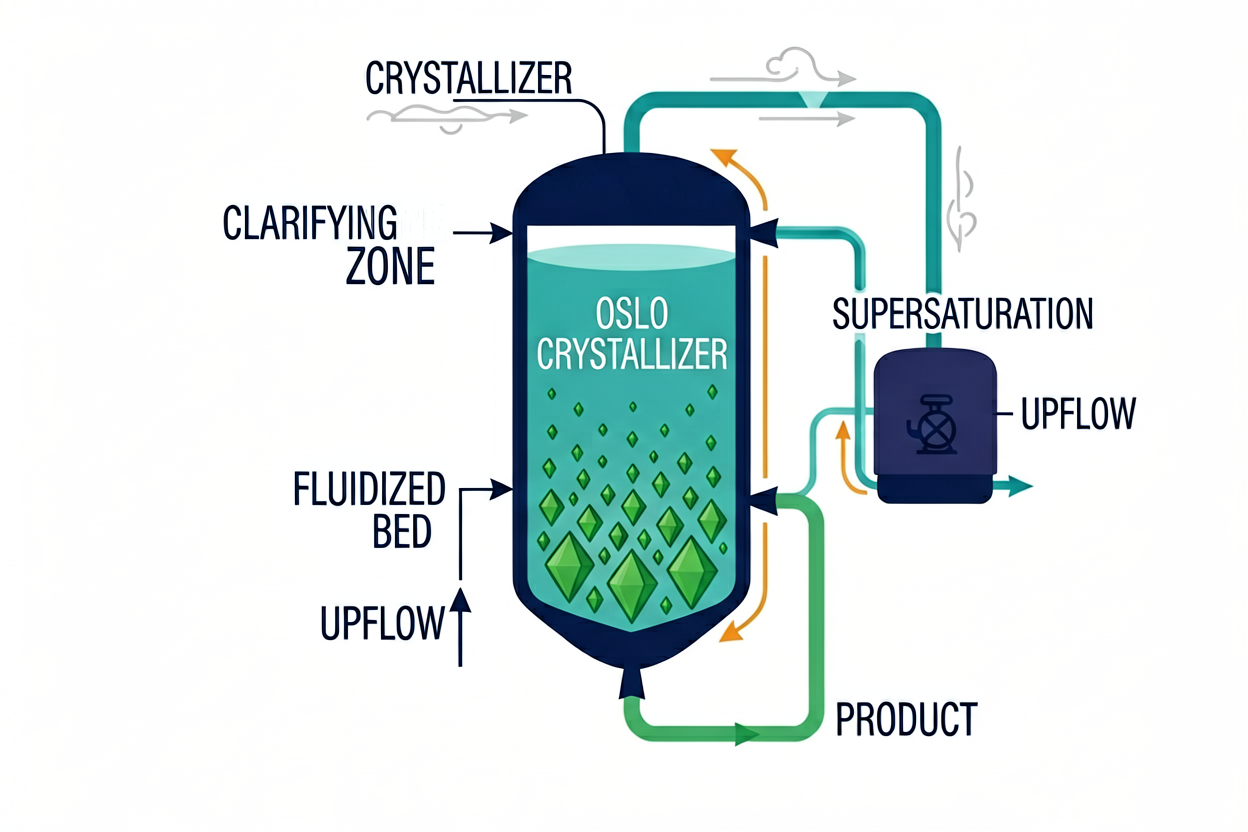
Supersaturation is generated externally and fed gently through the bed; the crystal population grades itself from fines at the top to product at the bottom.

Simplified Oslo Flow Diagram

Liquor → External supersaturation generation (Dimension C method) → Upflow through fluidized crystal bed (0.02–0.05 m/s) → Classified growth → Large product drawn from bed bottom → Clarified mother liquor overhead

The bed is the classifier: small crystals ride high, grown crystals sink to the discharge zone — no mechanical classification hardware.

01

External Supersaturation

The driving force is generated outside the bed — by evaporation or cooling per the plant's Dimension C method — and kept at ≤1–2 g/L.

02

Fluidized Bed

Liquor rises through the bed at 0.02–0.05 m/s; crystals remain suspended and grade by size.

03

Slow Classified Growth

Crystals spend hours to tens of hours in the bed, growing large and uniform with very low fines.

04

Classified Discharge

The largest crystals concentrate at the bottom of the bed and are drawn off as product; clarified liquor leaves overhead.

The Hard Constraint

Why Supersaturation Must Stay at ≤1–2 g/L

The fluidized bed holds the entire crystal population inside the metastable zone — that single constraint explains both what Oslo delivers and what it cannot tolerate.

ConditionWhat happens in the bed
Driving force ≤1–2 g/LAll growth occurs on existing bed crystals — large, uniform product with very low fines
Driving force above ~1–2 g/LSpontaneous nucleation fires inside the bed: new fines appear, classification degrades, and the bed can cement
Unstable or fouling-prone feedFeed excursions spike supersaturation — Oslo earns its higher CapEx only on feeds with verified stability

This is why Oslo is specified for value-bearing, well-characterized systems — battery-grade sulfates, electronic-grade salts — and not for uncertain liquors: the failure mode is structural, not gradual.

Configuration Selection

FC vs. DTB vs. Oslo

Three vessel configurations, three priorities: FC puts engineering reliability first, DTB puts product quality first, Oslo puts crystal quality first.

ParameterFCDTBOslo (this page)
Selection priorityEngineering reliabilityProduct quality (narrow PSD)Crystal quality (large, pure)
Typical crystal size0.2–0.8 mm — moderate, wide distribution0.5–2.0 mm — larger, controlled1.0–5.0 mm — large, very uniform
Fines removalNone standard — no internal classificationYes — classified-fines removal loop (elutriation zone)Natural — classification by fluidization
Circulation velocity2–3 m/s external loop1–2 m/s internal draft tube0.02–0.05 m/s fluidization upward velocity
Supersaturation toleranceHigh — recirculation dilutesMedium — controlled by draft-tube velocityLow — ≤1–2 g/L to avoid spontaneous nucleation
Best forHigh-salinity, scaling-prone, mixed-salt systems: NaCl, Na₂SO₄, ZLD mixed saltsFertilizer (NH₄)₂SO₄, KCl, battery-grade Li₂CO₃ precursor, organic acidsBattery-grade NiSO₄ / CoSO₄ / MnSO₄, pharma intermediates, electronic-grade salts
Residence timeMedium (hours)Medium (hours)Long (tens of hours)

d50 ranges reflect typical operating distributions on inorganic salt systems; actual PSD depends on residence time, bed management and the driving-force profile.

Positioning & Evidence

Oslo is a Dimension D crystal growth configuration, pairing with any Dimension C supersaturation method that can deliver its output gently and at ≤1–2 g/L driving force. The selection logic is explicit: crystal quality first — large particles, narrow distribution — with the acknowledged costs of higher CapEx, long crystal residence and sensitivity to feed stability. All figures are indicative ranges for preliminary screening, not a process guarantee.

FAQ · Engineering Answers

Oslo Crystallizer Questions We Answer Most

Recurring questions from engineers choosing a growth configuration.

QWhy does Oslo need such low supersaturation — ≤1–2 g/L?

The fluidized bed holds the entire crystal population inside the metastable zone. Above roughly 1–2 g/L of driving force, spontaneous nucleation fires inside the bed: new fines appear, the classification that produces those 1–5 mm crystals degrades, and the bed can cement.

QWhy does Oslo cost more than FC or DTB?

Long crystal residence means a large vessel per tonne of product, and the feed must be characterized well enough to hold the sub-metastable driving force continuously. You pay for size and certainty — which is why the configuration pencils out on value-bearing salts.

QCan Oslo handle wastewater ZLD duty?

Not usually. ZLD mixed-salt brines are scaling-prone and composition-variable — exactly the feed instability Oslo cannot tolerate. FC bodies carry that duty; Oslo is reserved for product crystallization on stable liquors.

QHow do I choose between Oslo and DTB for battery-grade sulfates?

Both reach battery-grade purity. Oslo delivers 1–5 mm with very low fines and long residence; DTB delivers 0.5–2 mm with classified-fines removal at higher throughput per vessel. If crystal size and downstream handling of large crystals dominate, Oslo; if capacity and centrifuge throughput dominate, DTB.

Screening an Oslo Configuration?

Send us the chemical system, solubility data, target PSD and purity. We will return a preliminary Oslo vs. DTB vs. FC screening with indicative crystal size — not a brochure.

Request a Proposal

Send your feed characterization (TDS, COD, main salts, viscosity), throughput and product targets — we respond with a preliminary process route within two business days.