EvapCryst logo

High-Complexity Wastewater

Engineered ZLD and selective recovery for complex industrial effluents — COD 5,000–80,000 mg/L, TDS 1–25%, heavy metals (Cr, Ni, Cu, Zn, As) in the 1–500 mg/L range, with chelants, surfactants and refractory organics that defeat conventional biological or membrane treatment.

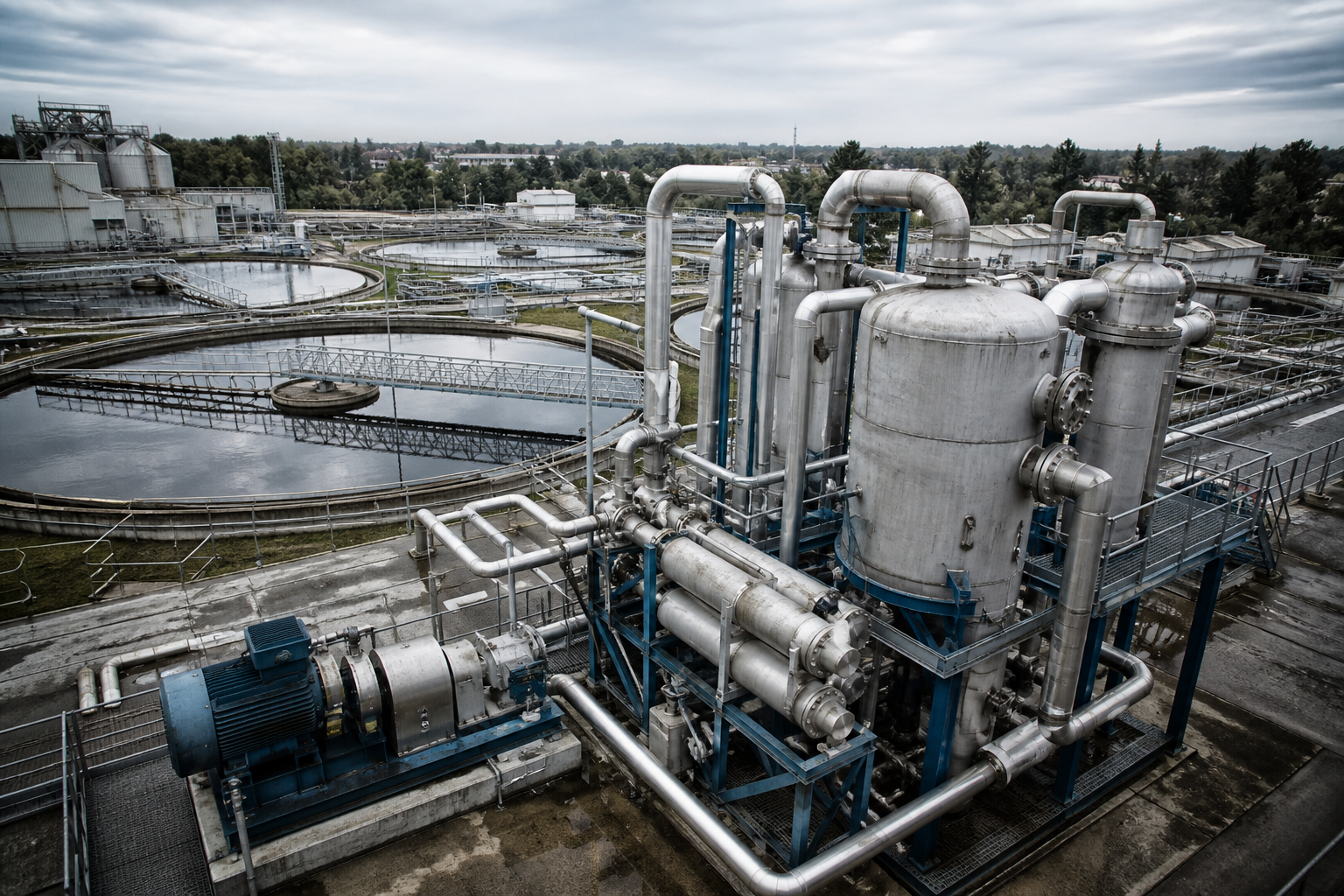
Industrial wastewater treatment facility with tanks, piping and circular clarifiers
Why “Complex”

What Makes Wastewater "Complex"

Complex wastewater combines two or more complicating factors — high COD with high TDS, heavy metals with organics, or chelants that defeat precipitation. Conventional single-technology approaches fail.

FACTOR 01High COD

High COD / TDS Ratio

Organic load combined with salinity: biology fails above ~3% TDS (osmotic stress), and membranes fail above ~1,000 mg/L COD (fouling). Thermal concentration after AOP pre-treatment becomes the only viable path to ZLD.

COD 5k–80k mg/Loccurring alongside TDS 2–25% — the combined organic + salinity load that defeats single-technology treatment
FACTOR 02Heavy Metals

Heavy Metals (Cr / Ni / Cu / Zn / As)

Toxic at mg/L levels, regulated tightly, and capable of contaminating recovered salt to hazardous-waste classification. Pre-evaporator precipitation (sulfide at pH 8–9, hydroxide at pH 9–10) to <0.5 mg/L total is usually mandatory.

0.05–1.0 mg/Ltypical discharge limits for Cr⁶⁺, As and Hg — driving mandatory pre-evaporator metal removal
FACTOR 03Recalcitrant Organics

Recalcitrant Organics

Refractory to biological treatment: heterocyclics, solvents, surfactants, polymers. Advanced oxidation is often the only effective pre-treatment.

AOP requiredozone, Fenton, wet-air or UV-based oxidation ahead of the brine concentrator — biological routes alone do not degrade these species
FACTOR 04Mixed Chemistry

Mixed Chemistry

Surfactants, solvents, chelants and complexing agents that bind metals and defeat standard precipitation. Stream-specific sequencing is required.

EDTA · NTA · citratechelants that keep metals in solution — de-complexing and sequencing steps are designed per stream
EvapCryst Approach

The EvapCryst Approach to Complex Streams

We do not begin with equipment. We begin with stream characterization, segregation strategy and pre-treatment sequencing — then specify the evaporator and crystallizer around the resulting envelope.

01

Source Segregation

Splitting high-strength, heavy-metal or high-COD side streams at source unlocks simpler, cheaper downstream treatment than combined treatment of a mixed effluent.

02

Advanced Oxidation

Ozone, Fenton, wet-air oxidation or UV-based AOP break refractory organics before the brine concentrator, protecting heat transfer surfaces and recovered salt purity.

03

Heavy Metal Precipitation

Sulfide, hydroxide or co-precipitation routes remove Cr, Ni, Cu, Zn, As and Hg before evaporation — preventing both equipment corrosion and salt contamination.

04

Crystallization & Solids Stabilization

Forced-circulation crystallization concentrates the brine to a recoverable or disposable solid. Hazardous solids are stabilized for compliant landfill.

Process Route

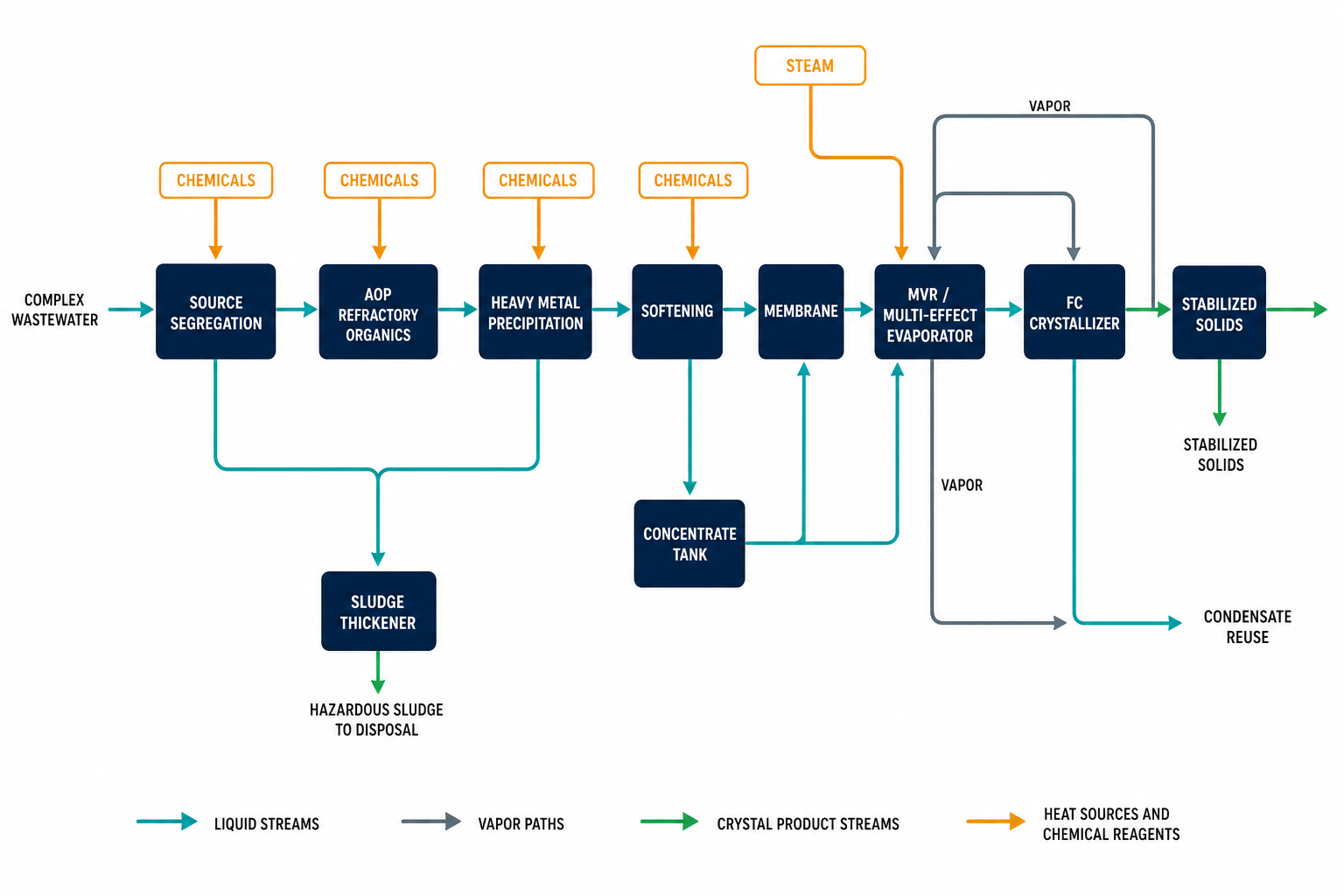
Indicative ZLD Process Chain for Complex Wastewater

A generalized ZLD chain for complex wastewater: source segregation → advanced oxidation of refractory organics → heavy metal precipitation → softening → membrane or direct pre-concentration → evaporator (MVR or multi-effect) → forced-circulation crystallizer → solids stabilization → condensate recovery.

Complex
wastewater
→
Source
segregation
→
AOP
refractory organics
→
Heavy metal
precipitation
→
Softening
→
Membrane
where viable
→
MVR / multi-effect
evaporator
→
FC
crystallizer
→
Solids recovery /
stabilized disposal
→
Condensate
reuse
Stream Types

Common Complex Stream Types

STREAM 01Heavy Metals

Electroplating & Surface Treatment

Cr(VI) (10–500 mg/L), Ni / Cu / Zn (10–200 mg/L), cyanide (5–100 mg/L), EDTA / NTA chelated metals. Requires Cr(VI)→Cr(III) reduction (bisulfite at pH 2–3), cyanide oxidation (hypochlorite at pH >10), sulfide precipitation and stream-specific handling before ZLD.

Cr(VI) 10–500 mg/Lwith Ni / Cu / Zn at 10–200 mg/L and cyanide at 5–100 mg/L — reduction, oxidation and precipitation all precede ZLD
STREAM 02High COD

Landfill & Fly Ash Leachate

COD 2,000–20,000 mg/L (variable with landfill age); NH₃-N 500–3,000 mg/L; Cl⁻ 1,000–10,000 mg/L; trace heavy metals (Pb, Cd, As). The pre-treatment train must be robust to seasonal and age-driven swings; biological treatment + AOP + ammonia stripping precede evaporative ZLD.

COD 2k–20k mg/Lvariable with landfill age, alongside NH₃-N 500–3,000 mg/L and Cl⁻ 1,000–10,000 mg/L
STREAM 03Mixed Chemistry

Rare Earth Extraction Wastewater

High (NH₄)₂SO₄, trace metals, complexing agents. Ammonium sulfate recovery and magnesium removal drive the process selection.

(NH₄)₂SO₄ recoveryammonium sulfate recovery and magnesium removal are the decisions that drive process selection
STREAM 04Recalcitrant Organics

Refinery Spent Caustic

NaOH 2–15%; sulfides 1,000–30,000 mg/L; naphthenates, mercaptans, COD 10,000–100,000 mg/L. Neutralization to pH 8–9, wet-air oxidation at 150–260°C for sulfides, and wax / naphthenate handling precede evaporative concentration.

COD 10k–100k mg/Lwith NaOH 2–15% and sulfides 1,000–30,000 mg/L — wet-air oxidation at 150–260°C precedes concentration
Honest Scope

What We Do Not Cover

EvapCryst honestly defines its scope. Complex industrial wastewater means industrial process streams amenable to thermal concentration and crystallization — everything else belongs to a different engineering discipline, and we say so up front.

In Scope

Industrial process wastewater amenable to thermal + crystallization treatment

  • ✓High-COD (5,000–80,000 mg/L) combined with high-TDS (1–25%) process streams
  • ✓Heavy-metal-bearing streams (Cr, Ni, Cu, Zn, As, Hg) with pre-evaporator precipitation
  • ✓Electroplating & surface treatment, landfill & fly ash leachate
  • ✓Rare earth extraction wastewater and refinery spent caustic
  • ✓Selective recovery where economics allow — salts and value metals

Out of Scope

Referred to qualified partners — different disciplines, different regulations

  • ✕Hazardous waste incineration
  • ✕Secured landfill engineering
  • ✕Radioactive waste management
  • ✕Domestic / municipal sewage
  • ✕Active pharmaceutical ingredient destruction
  • ✕Biological nutrient removal (BNR)

For streams outside our scope, we will refer you to qualified partners. EvapCryst focuses on industrial process wastewater amenable to thermal concentration, crystallization and selective recovery. Honest scoping protects both the client and the project outcome.

Frequently Asked Questions

How do I know if my wastewater is “complex”?+

If two or more of the following apply — COD >5,000 mg/L, TDS >3%, heavy metals above discharge limits (Cr, Ni, Cu, Zn, As, Hg), refractory organics (heterocyclics, surfactants), mixed solvents, or chelants (EDTA, NTA, citrate) — your wastewater is complex. Conventional biological treatment alone is unlikely to achieve compliance; pre-treatment + thermal ZLD is typically required.

Why does EvapCryst exclude hazardous waste incineration and landfill?+

Our expertise is thermal concentration and crystallization of industrial process streams. Incineration, secured landfill, radioactive waste and municipal sewage require different engineering disciplines, different regulatory frameworks and different operating cultures. We refer out rather than over-extend.

Can heavy metals be recovered rather than disposed of?+

Sometimes. Value-bearing metals (Cu, Ni, Co, Zn) at sufficient concentration (>100 mg/L for Cu, Ni) can be precipitated as sulfides or hydroxides and recovered for refining. Hazardous metals (Cr, As, Hg, Cd) typically require stabilization with ferric co-precipitation or cement for compliant landfill at $80–300 per tonne. The economics depend on metal value, concentration and recovery purity targets.

Why is feed assessment mandatory before specifying a system?+

Complex wastewater varies by an order of magnitude across parameters that determine technology selection (COD, Cl⁻, heavy metals, scaling ions). No responsible manufacturer will commit to a process route without laboratory characterization. Skipping this step is the single largest cause of failed ZLD projects.

Discuss Your Complex Wastewater Project

Send us your wastewater characterization, throughput and compliance mandate. Within 2 business days you will receive a feasibility note and indicative ZLD route.

Request a Proposal

Send your feed characterization (TDS, COD, main salts, viscosity), throughput and product targets — we respond with a preliminary process route within two business days.