Project Parameters
| Parameter | Value |
|---|---|
| Process route | MVR evaporation crystallization driven by centrifugal vapor recompressor |
| Industry | Chemical and lithium-line wastewater, ammonium sulfate crystallization (China) |
| Feed type & key components | Ammonium sulfate wastewater: (NH4)2SO4-dominant brine from chemical/quench scrubbing service |
| Evaporation capacity | 32 t/h |
| Construction materials | SS316L baseline with higher alloys at compressor inlet conditions (indicative) |
Representative process configuration compiled from published industry project data. Indicative values, not a process guarantee.
Project Description
Every MVR plant is an evaporator wrapped around a compressor, and above roughly the ten-ton-per-hour mark the compressor is no longer an accessory — it is the machine the plant is built around. The reference configuration is a 32 t/h ammonium sulfate evaporation crystallization service in China in which the centrifugal steam recompressor is the headline equipment: the duty is large enough that compressor selection — type, drive and operating envelope — decides both the capital budget and the specific energy the plant will live with for decades.
Ammonium sulfate is the workhorse salt of chemical wastewater: scrubbers, crystallizations and lithium-line quenches all discharge it, and it crystallizes well. At 32 t/h the evaporation duty is in the range where a single centrifugal machine can carry the whole train’s vapor flow — which is precisely why this case is told from the compressor outward.
Process Technology
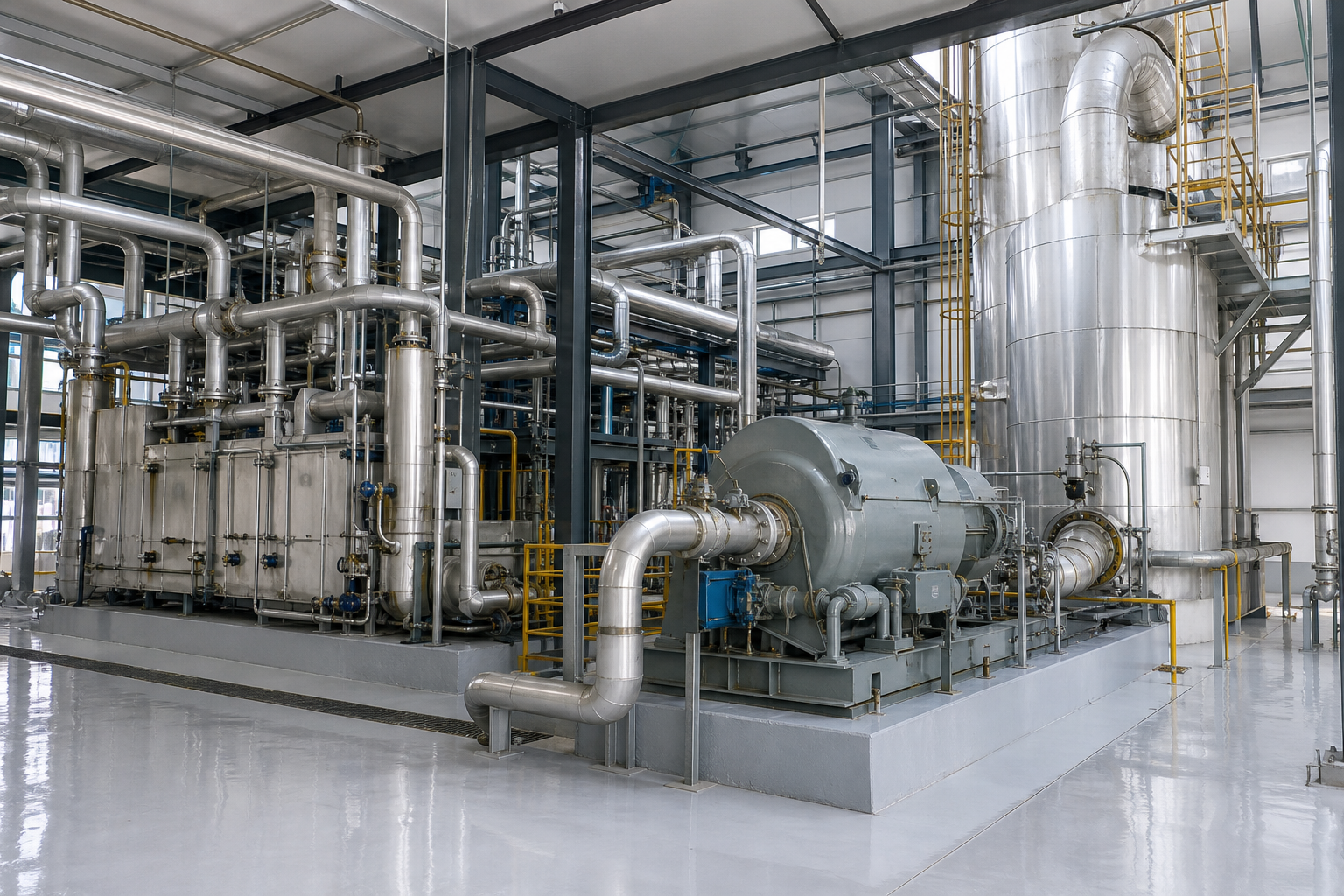
The evaporator side is conventional wisdom for this salt: forced circulation through the heat exchanger circuit, boiling under vacuum, crystallization relieved on suspended crystal rather than on surfaces. Ammonium sulfate’s crystallization chemistry is forgiving of velocity and unforgiving of stagnation, so the pumped loop carries the duty the same way it does across the industry’s (NH4)2SO4 fleet — the same architecture published for tenfold smaller and several-fold larger plants alike.
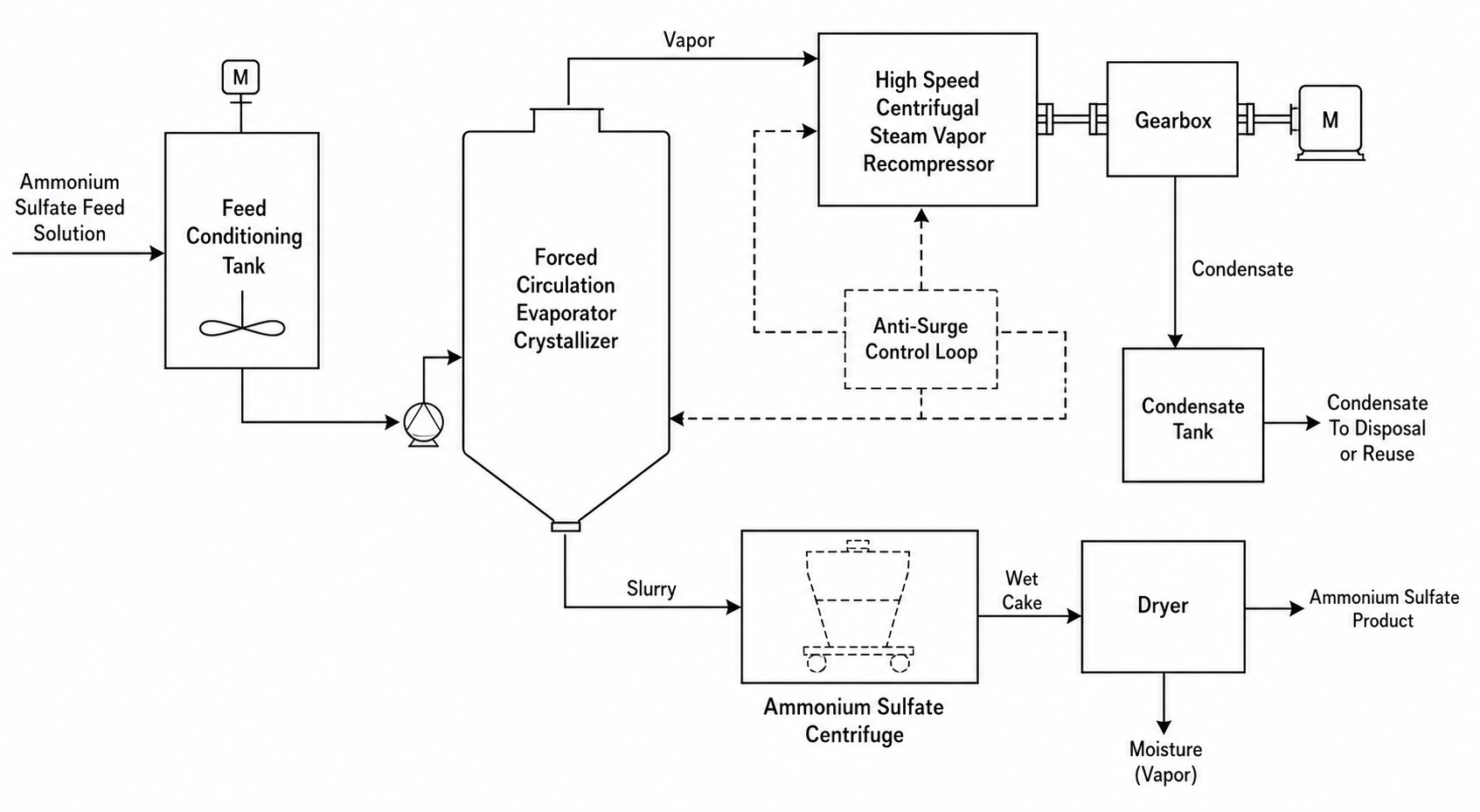
The centrifugal recompressor is where this plant differs from its smaller siblings. At low vapor flows, roots-type or side-channel machines can serve; at 32 t/h the vapor volume demands a dynamic compressor — an impeller machine in which the vapor gains velocity and recovers as pressure, handling an order of magnitude more flow per machine than positive displacement designs. The centrifugal machine runs at high speed on a speed-increasing gearbox or direct high-speed motor drive, delivering the few-degrees temperature lift that an MVR evaporator needs across its heat exchanger with a compression ratio chosen for the boiling elevation of ammonium sulfate liquor.
That last phrase is the engineering core: boiling point elevation. Ammonium sulfate solutions boil a handful of degrees above pure water at the same pressure, and the compressor must supply lift enough to cover that elevation plus the exchanger’s temperature approach, no more — every unnecessary degree of lift is electricity spent for nothing. Centrifugal machines on this duty are selected, staged and geared to sit exactly on that requirement line, and their operating map — flow against head against speed — is what lets the plant turn down without surging or losing efficiency.
Salt leaves the crystallizer as slurry, centrifuged to dewatered ammonium sulfate with offtake into fertilizer or industrial channels; mother liquor returns to the train. Condensate returns hot and clean to the host process. Comparable published configurations in the same ammonium sulfate segment run from a few tons per hour on wastewater duty to 82 t/h on ternary-precursor sodium sulfate lines, all on the same compressor-led architecture.
Equipment Configuration
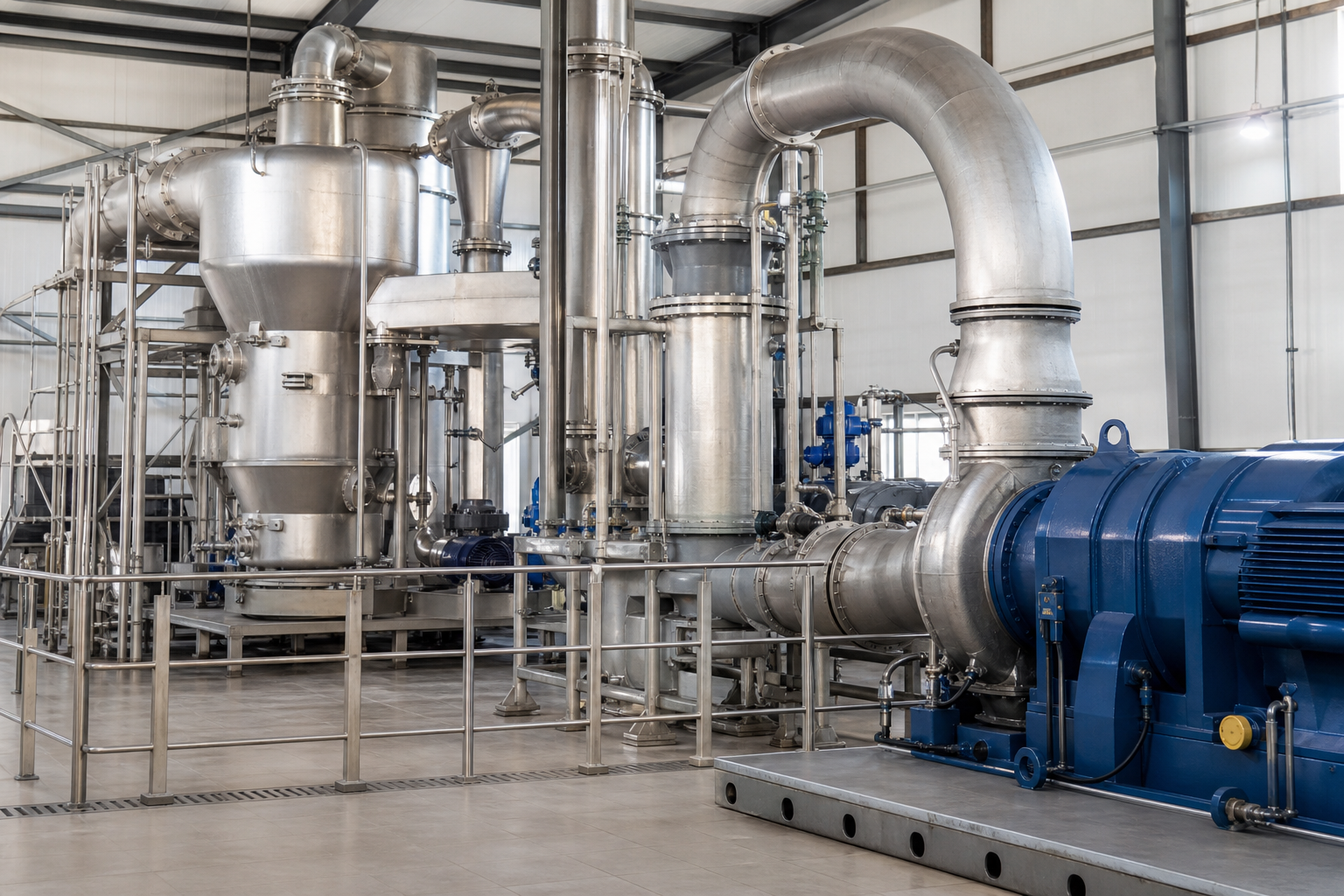
One set of the following equipment is typical for this duty:
- Feed equalization and chemical conditioning of the sulfate stream
- Forced-circulation MVR evaporator crystallizer train
- Centrifugal steam recompressor with speed-increasing or high-speed motor drive
- Anti-surge and turndown control on the compressor loop
- Centrifuge and drying interface for ammonium sulfate product
- Mother-liquor return and purge; condensate recovery; DCS control
Performance & Outcome
Compiled from published industry project data, indicative: 32 t/h compressor-led MVR trains of this class crystallize ammonium sulfate from wastewater on electrically driven recompression, with machine selection pinning specific energy to the boiling-point-elevation requirement. Product grade and lift duty are quoted per liquor chemistry.
Simplified PFD
The simplified process flow diagram above shows the forced-circulation evaporator crystallizer, the centrifugal vapor recompressor on its vapor loop, product centrifuging and mother-liquor return.