
Project Parameters
| Parameter | Value |
|---|---|
| Process route | MVR evaporation concentration + fractional crystallization of Li2SO4 / Na2SO4 |
| Industry | Lithium battery recycling hydrometallurgy (China) |
| Feed type & key components | Mixed solution from recycled lithium battery streams: lithium sulfate values with sodium sulfate burden |
| Evaporation capacity | 10 t/h |
| Construction materials | SS316L wetted parts baseline for sulfate service (indicative) |
Representative process configuration compiled from published industry project data. Indicative values, not a process guarantee.
Project Description
Black mass recycling in China has industrialized around a sulfate flowsheet: leach in acid, recover the nickel and cobalt, and what remains is a lithium sulfate solution carrying a sodium sulfate load imported by the process chemistry itself — neutralization, purification and sodium-based precipitations all leave their counter-ion behind. The mixed liquor is simultaneously the recycling plant’s lithium bank account and its salt problem, and the two sulfates in it do not separate by wishing.
The reference configuration is a 10 t/h MVR evaporation crystallization train taking that mixed lithium-sodium sulfate solution and fractionating it: lithium concentrated toward the battery materials chain, sodium removed as a crystallized by-product. The train is the recovery endgame of the recycling flowsheet — where the lithium that survived leaching and purification finally gets separated from the salt it arrived with.
Process Technology

The two sulfates have usefully different crystallization personalities. Sodium sulfate crystallizes readily — eagerly, as Glauber’s salt when the liquor is cold, as anhydrite-mirabilite behavior governs the hot end — while lithium sulfate’s solubility is comparatively flat and it stays dissolved through conditions that drop sodium sulfate out of solution. The train exploits the difference: MVR evaporation concentrates the mixed liquor to a sodium sulfate saturation point, crystallization removes Na2SO4 as a dewatered by-product, and the mother liquor — now proportionally richer in lithium — carries the values forward.
The MVR drive runs the concentration on electricity: secondary vapor compressed and recycled as heating medium, no continuous live steam, the standard economics for a mid-size train inside a recycling plant that meters its energy per ton of black mass processed. Forced circulation through the crystallizing sections keeps the sulfate slurry moving and the heat transfer surfaces swept.
The sodium sulfate fraction centrifuges off as a dewatered by-product with industrial off-take where local markets accept it; in the reference class of plant it is a product line, not a waste line. The lithium-enriched mother liquor advances to the precipitation or further concentration stages of the battery-materials chain, closing the lithium loop that the whole recycling flowsheet exists to close. Condensate from the train returns to the plant’s washing and leaching duties.
Published configurations across the battery recycling segment run this same sulfate-fractionation service at capacities from 10 t/h upward, alongside dedicated lithium-sodium mixed solution trains at 25 t/h and sodium sulfate concentration duties at 82 t/h on ternary precursor lines — one architecture across the segment’s capacity range.
Equipment Configuration

One set of the following equipment is typical for this duty:
- Mixed sulfate solution receiving and chemical conditioning
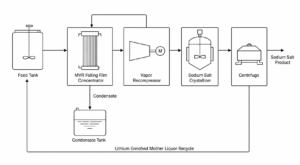
- MVR evaporation concentration train with mechanical vapor recompressor
- Sodium sulfate crystallizer with lithium-rich mother liquor advance
- Centrifuge for Na2SO4 by-product dewatering and off-take
- Mother-liquor routing to lithium recovery; purge management
- Condensate recovery to leaching and washing; DCS control of the split
Performance & Outcome
Compiled from published industry project data, indicative: 10 t/h trains of this class fractionate mixed lithium-sodium sulfate liquors from battery recycling, crystallizing sodium sulfate as by-product and advancing lithium-rich mother liquor to the battery materials chain on electrically driven MVR energy. Lithium yield and split purity are quoted per feed matrix.
Simplified PFD
The simplified process flow diagram above shows sulfate solution conditioning, the MVR concentrator, sodium sulfate crystallization with by-product centrifuging and lithium-rich mother liquor advance.