
The train that closes the solvent loop in pharmaceutical and fine-chemical production: MVR distillation, wiped-film and falling-film evaporation with condensation, polishing and residue handling — engineered for flammable and high-boiling solvents from methanol and ethanol to DMAC, DMF and DMSO, and for salt-bearing organic waste liquors.
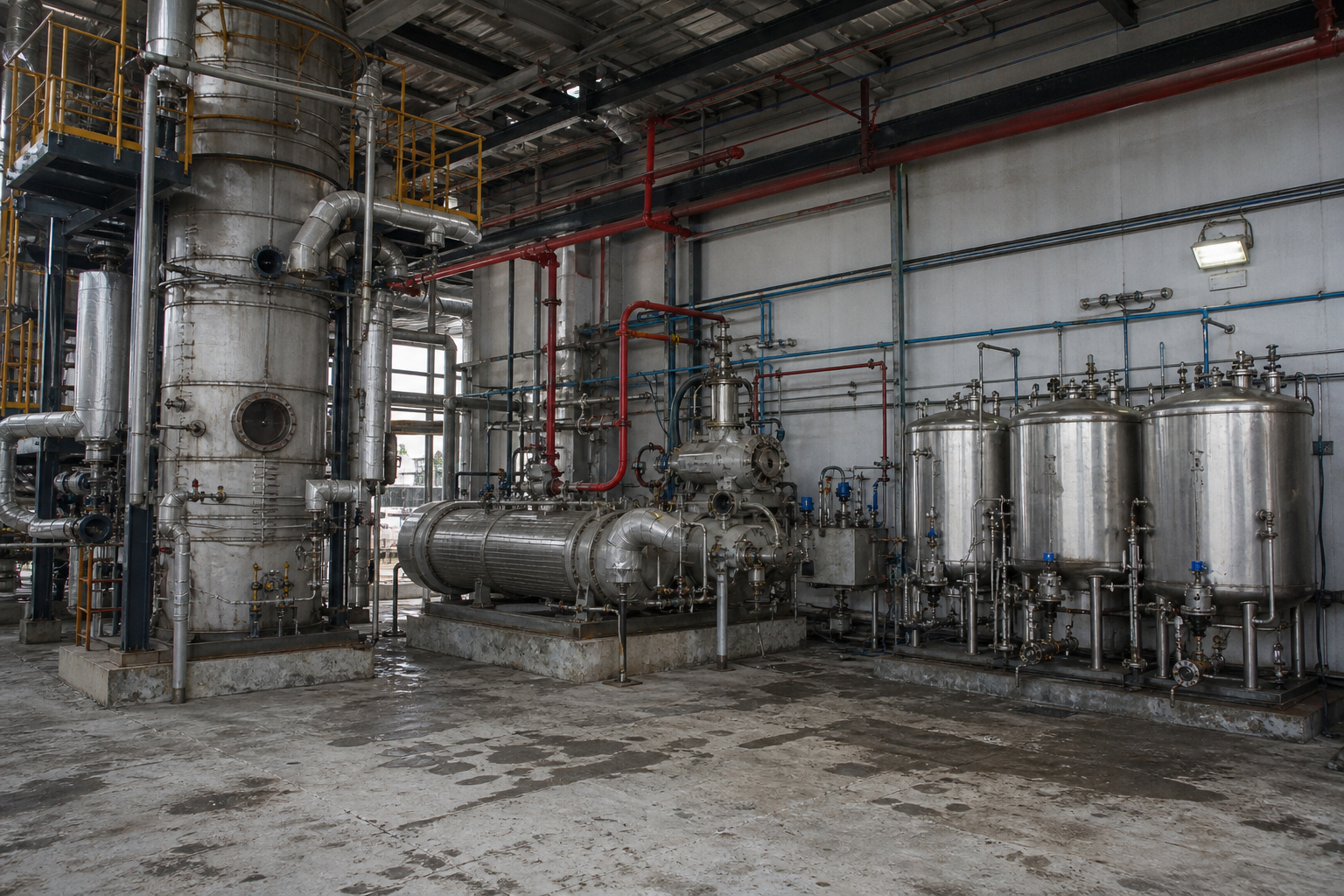
Reference figures from published solvent-recovery equipment and system data.
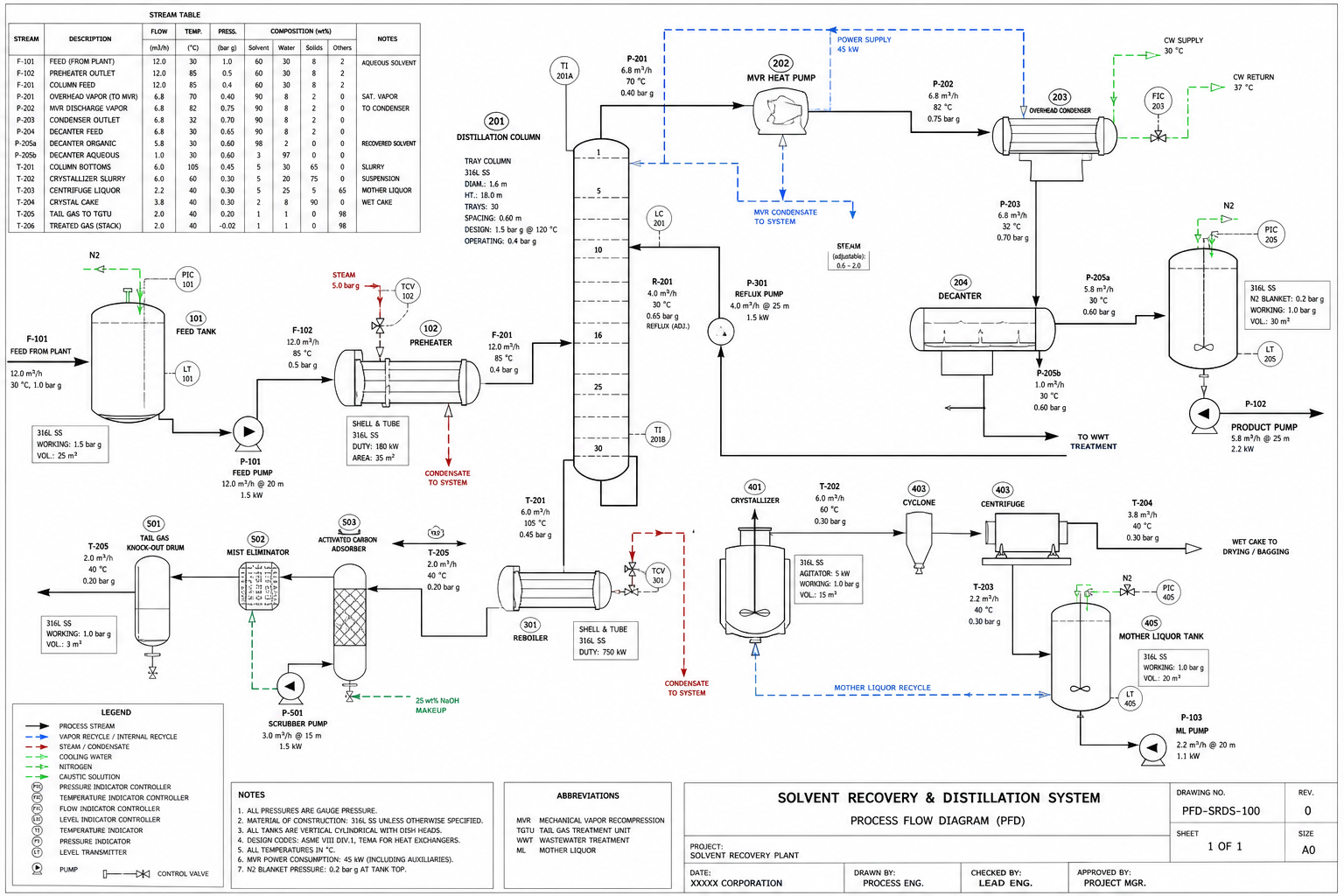
Feed pre-treatment, evaporation / distillation, condensation and residue handling — with the vapor-recompression heat loop and VOC tail-gas treatment closed back into the system.
Feed tank & pre-filtration → MVR distillation column / wiped-film / falling-film evaporator → Condenser & reflux → Recovered-solvent tank (nitrogen-blanketed) → Polishing (activated carbon / ion exchange) → Reuse · Residue → Crystallizer or disposal
Overhead vapor is recompressed and returned as reboiler heat (heat-pump loop); non-condensables pass tail-gas VOC treatment before vent; when salts are present the bottoms crystallize before disposal — nothing leaves the loop but reusable solvent, salt or residue, and clean air.
What every solvent-recovery train carries, and what feed chemistry and purity targets add on top.
Aggregated from published supplier data on MVR distillation systems, wiped-film evaporators, rectification columns and solvent-recovery trains — indicative for preliminary sizing, not a process guarantee.
| System Section | Parameter | Range / Rating | Condition |
|---|---|---|---|
| Whole system | Applicable solvents | MeOH · EtOH · IPA · acetone · EtOAc · n-hexane · DCM · DMF · DMSO · DMAC | flammable / volatile and high-boiling polar solvents in published system coverage |
| Specific energy | 15–40 kWh/t evaporated | single-effect falling-film MVR class, per tonne of water or solvent evaporated | |
| Steam & cooling water | −90% | circulating steam and cooling-water demand vs. conventional distillation once MVR loop is running | |
| MVR distillation | Operating temperature | 40–65°C adjustable · <95°C heat source | low-temperature MVR distillation; fully electric drive after start-up |
| Compressor / reboiler | compression ratio ≤2 · 15°C ΔT | single-stage; heat-transfer approach design basis | |
| High-boiling service | 155°C bottom · 170°C / 0.8 MPa final stage | design temperatures for DMF / DMSO / DMAC class duties | |
| Process schemes | MVR twin-column · 3-effect single · 3-effect 3-column | scheme selection by feed and purity target | |
| Automation | PLC fully automatic | feed / discharge, on-line density, temperature and vacuum regulation | |
| Wiped-film (TFE) | Evaporation intensity | 200 kg/m²·h | agitated scraper thin-film evaporator series |
| Residence time | 5–10 s | material exposure inside the heated film | |
| Feed viscosity | up to 100,000 cP | centrifugal sliding-slot rotor, small-flow film formation | |
| Rotor behavior | self-cleaning | blades resist fouling and wall coking on dirty feeds | |
| Performance | evaporation ratio >95% | low pressure drop, high-vacuum low-temperature duty; stages in series to molecular distillation | |
| Ethanol recovery column | Concentration upgrade | 30–50% → 90–95% | dilute alcohol feeds to reusable-grade solvent |
| Column principle | packed · countercurrent | vapor–liquid counterflow contact, enrichment stage by stage upward | |
| Bottoms & scope | discharge-compliant | low-alcohol residue meets environmental limits; methanol and other low-boilers covered; pharma / chemical / food plants | |
| Falling-film MVR + crystallizer | Specific energy | ~15–40 kWh/t | per tonne of water or solvent evaporated |
| Construction | SS316L standard | duplex / Ti / Hastelloy optional on wetted parts | |
| Solvent safety | ATEX / NFPA concept | nitrogen blanketing, LEL & VOC monitoring across the loop | |
| Condensate polishing | carbon / ion exchange | ethanol condensate refined to reuse grade and returned | |
| Crystallizer options | DTB / Oslo / FC + cooling coils | crystal PSD (D50) set by seeding rate, ΔT and residence time |
Ranges aggregate published specifications from MVR distillation system builders, wiped-film evaporator manufacturers and column / crystallizer suppliers; figures are indicative for screening and must be verified against your solvent identity, feed composition, azeotrope behavior and site utilities.
The evaporation / distillation body is the heart of the loop — pick it by solvent boiling behavior, heat sensitivity and feed cleanliness, not by catalog.
| Route | Residence / Heat | Best For | Watch-outs |
|---|---|---|---|
| MVR distillation column | 40–65°C · heat pump | Waste solvents at scale — methanol, ethanol, acetone, ethyl acetate, n-hexane; steam-free once running, −90% steam & cooling water | compressor sizing is critical; high-boilers need the 155–170°C / 0.8 MPa variant |
| Wiped-film (TFE) | 5–10 s · high vacuum | Heat-sensitive, fouling or high-viscosity feeds to 100,000 cP; evaporation ratio >95%, stages in series toward molecular distillation | smaller single-unit capacity; very high purity needs multi-stage trains |
| Falling-film MVR | low ΔT · single effect | API / fine-chemical streams needing gentle handling; pairs directly with an ethanol crystallizer for salt-bearing solvent recovery | feed must form a stable film; pre-filtration of solids required |
| Packed rectification column | countercurrent stages | Upgrading dilute alcohol 30–50% to 90–95%; methanol and other low-boilers on the same duty | bottoms still need discharge-compliance checks or further treatment |
Route figures follow the published data above; final selection needs your binary / azeotrope data, reflux targets and utility set.
Published system schemes scale the same loop across three service classes — flammable low-boilers, saline liquors and high-boiling polar solvents.
Anonymized configurations reconstructed from published supplier project data.
Engineering guides on MVR distillation, wiped-film machines and solvent-specific recovery schemes.
The evaporation physics, the endgame for saline liquors and the industries that drive these trains.
This page aggregates published supplier specifications and project data (MVR distillation system builders, wiped-film evaporator manufacturers, rectification column and crystallizer suppliers) into an engineering screening view. All names are withheld; configurations are described generically. Figures are indicative ranges for preliminary route screening — final selection requires your solvent analysis, binary / azeotrope data, purity targets and site utilities.
Recurring questions from engineers specifying recovery trains on flammable and high-boiling solvents.
Published systems carry an ATEX / NFPA concept through the whole loop: nitrogen blanketing on tanks, LEL (lower explosion limit) and VOC monitoring at the vents, and Ex-rated execution on equipment. The MVR route also keeps operating temperatures low — 40–65°C with heat sources under 95°C — which narrows the flammable operating window itself.
On dilute alcohol, packed rectification columns publish 30–50% feeds upgraded to 90–95% product; bottoms leave at low alcohol content meeting discharge limits. For higher grades, multi-column MVR schemes (twin-column, three-effect single or three-column) add separation stages, and condensate polishing by activated carbon / ion exchange readies ethanol for direct reuse in API service.
Published figures: once the heat-pump loop closes, external steam is no longer needed and overall energy falls 40%+; circulating steam and cooling-water demand drop about 90% versus conventional distillation. Falling-film MVR trains report specific energy of roughly 15–40 kWh per tonne of water or solvent evaporated, depending on service.
Yes — with the high-boiling variant of MVR heat-pump distillation: design temperatures to 155°C at the column bottom and 170°C / 0.8 MPa at the final stage, single-stage compression ratio ≤2 and 15°C heat-transfer approach as the design basis. These solvents are explicitly listed in published system coverage alongside DCM and ethanol–IPA mixes.
Run a de-solventizing train: falling-film or wiped-film evaporation takes the methanol overhead while the bottoms feed a DTB, Oslo or FC crystallizer with cooling coils that crystallizes the salt out. Crystal size distribution (D50) is controlled by seeding rate, temperature difference and residence time, and the solvent condensate is polished back to reuse grade — the residue leaves as handleable solid, not brine.
Non-condensables from the condensation stage pass a tail-gas VOC treatment before venting, while LEL and VOC monitors watch the loop continuously. Because the process runs as a closed, nitrogen-blanketed system with condensation recovery, the ventilation burden is limited to that small non-condensable stream rather than the full vapor flow.
Send the solvent identity and composition, feed rate and concentration, target recovery purity and site utilities. We will return a route selection — MVR column, wiped-film or falling-film — with an indicative process scheme and energy balance, not a brochure.
Send your feed characterization (TDS, COD, main salts, viscosity), throughput and product targets — we respond with a preliminary process route within two business days.