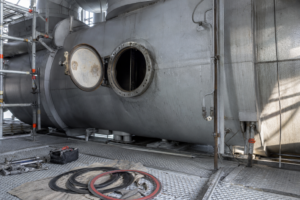
A scraped surface evaporator — also called a wiped film evaporator (WFE) or agitated thin film evaporator (ATFE); the three names describe one machine — handles the feeds every other evaporator type gives up on: viscosities up to 100,000 cP, residence times of seconds, and heavy fouling tendency, all under vacuum deep enough to keep product below 60 °C. A high-speed rotor with blades spreads the liquid into a thin turbulent film on a heated cylindrical wall and continuously wipes the surface clean, so heat transfer stays at 1500–6000 W/(m²·K) even on near-saturated high-salt duty. This guide covers the mechanism, the design parameters that matter (blade-wall gap above all), materials for food and corrosive service, economics, troubleshooting, and where the technology is heading in 2025–26 — the equipment deep-dive. Solvent-recovery applications, applicability by solvent family and documented recovery cases are on our scraped film solvent-recovery solution page.
One Machine, Three Names
Scraped film evaporator, wiped film evaporator, agitated thin film evaporator — these are regional and industry dialects for the same mechanical thin-film technology. Pharmaceuticals tends to say ATFE, chemicals says WFE, and food processing says scraped surface; procurement teams comparing quotes should assume identity unless a drawing proves otherwise. What the machine is not is a molecular still: scraped film operates at roughly 5 mmHg-class vacuum for concentration duty, while molecular distillation goes to ultra-high vacuum for separating components whose boiling points differ by less than 20 °C. A scraped film unit can be the concentration stage feeding a molecular still, but the two are distinct unit operations.
How the Machine Works
Feed enters a vertical (or horizontal) cylindrical body with a heated jacket. Inside, a rotor spinning at 100–500 RPM carries blades that do two jobs simultaneously:
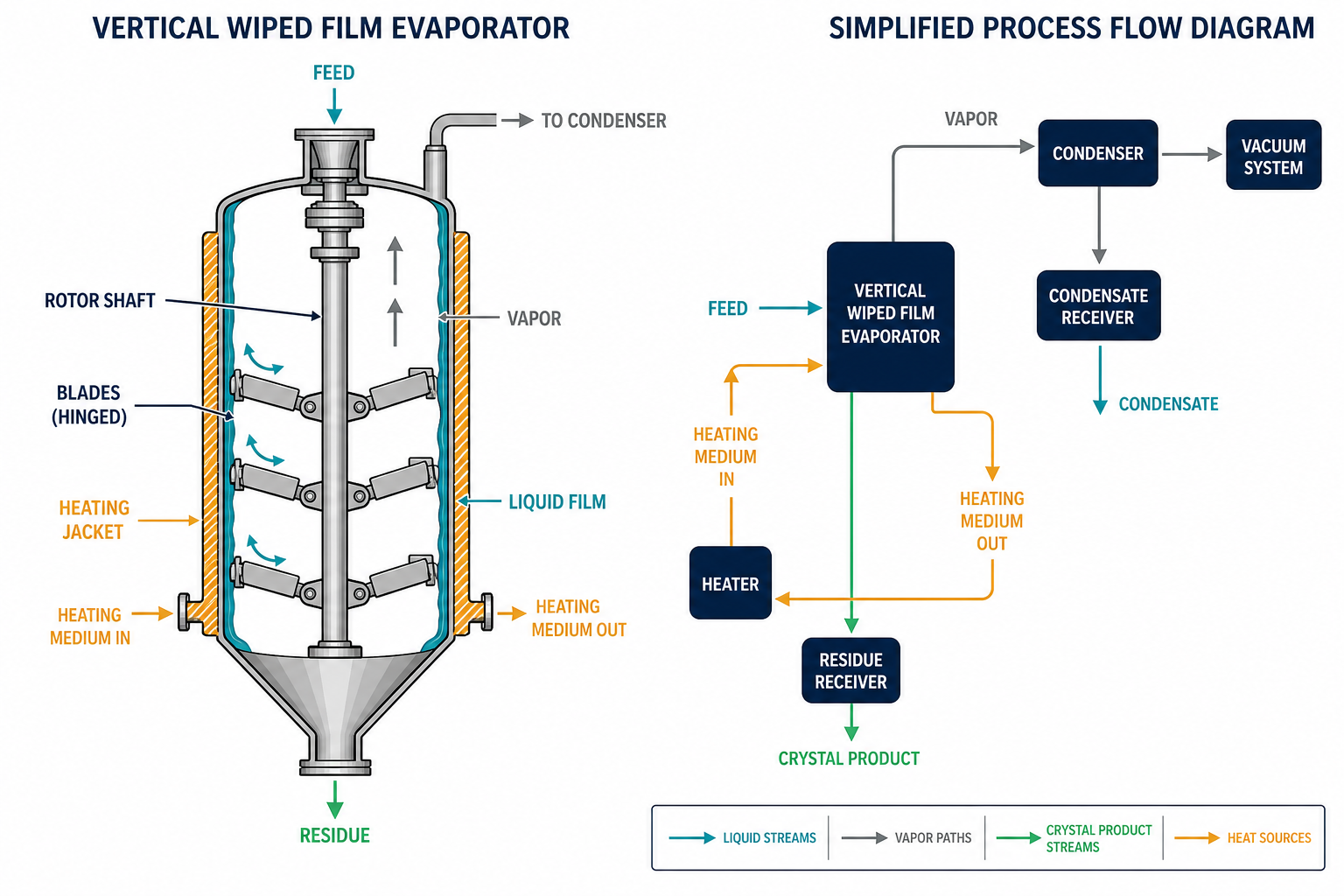
- Film formation. Centrifugal action throws liquid onto the heated wall and spreads it into an ultra-thin, highly turbulent film — far thinner than any gravity-fed film.
- Surface renewal. The blades continuously wipe the wall, so every element of liquid meets the hot surface for only seconds before being mixed back into the turbulent film. Stagnant boundary layers — the enemy of heat transfer and the birthplace of fouling — never get to form.
Vapor released from the film travels a short distance to a condenser (or leaves the body for an external one), and concentrate exits at the bottom. Under 1–10 mmHg vacuum, boiling points drop far enough that thermal degradation essentially stops: vitamins survive, colors hold, APIs stay intact. The mechanism differs fundamentally from circulation-type machines, where liquid passes through a heated loop repeatedly; the comparison is developed in our external and natural circulation evaporator guide.
The Two Numbers That Define the Type: Residence Time and Viscosity
Two capabilities separate scraped-surface machines from every static-film alternative:
| Evaporator type | Max feed viscosity | Typical residence time | Heat-transfer coefficient, W/(m²·K) |
|---|---|---|---|
| Wiped film / scraped surface | 100,000 cP (mPa·s) | 5–30 s | 1500–6000 (high-turbulence wiped-film duty; 1000–3000 in moderate film service, as cited on the solvent-recovery solution page) |
| Falling film | 100–500 cP | 1–3 min | 1000–3000 |
| Rising (climbing) film | Below ~200 cP | 30–60 s | 800–2500 |
| Forced circulation | Up to ~2,000 cP (with large pump power) | 15–30 min | 2000–4000 |
Read the table as a decision map. Below a few hundred cP and with no fouling concern, falling film is cheaper and simpler. The moment viscosity climbs past what a falling film can wet, or residence time must stay under a minute to protect the product, the wiped-film machine is the only conventional answer. Mechanically driven films also transfer heat 30–50% better than the equivalent static film, which translates to roughly 20% less heating area for the same duty (typical published comparisons) — a real saving once you price jacketed surface.
Design Parameters: The Gap Is the Machine
Four parameters govern performance, and one of them outranks the rest:
- Blade-to-wall clearance: 0.5–1.5 mm. This is the life-of-the-machine dimension. Too wide and the film thickens, heat transfer decays, and product burns onto the wall; too narrow and blades score the jacket. Food duty commonly standardizes near 0.8 mm as the working optimum.
- Rotor speed: 100–500 RPM. Each 100 RPM of additional speed is worth roughly 15% more throughput (supplier-published). Moving versus hinged blades outperform fixed blades by 40–69% in evaporation capacity for the same machine — a pharmaceutical plant (external industry reference) swapping fixed for hinged blades lifted throughput from 8 to 13 t/d on the same body.
- Blade tip speed: 2–5 m/s. This is what keeps the wall clean. At that sweep velocity, even near-saturated high-salt wastewater leaves the surface bright — self-cleaning is a native property of the type, not an add-on.
- Vacuum and area. 1–5 mmHg for heat-sensitive work; heating areas run from 0.1 m² laboratory units to 50 m² industrial bodies.
Evaporation intensity lands around 200 kg/(m²·h) with moving or hinged blades — the 40–69% margin over fixed-blade designs in the same duty.
Operating the Three Levers: Speed, Vacuum, Temperature
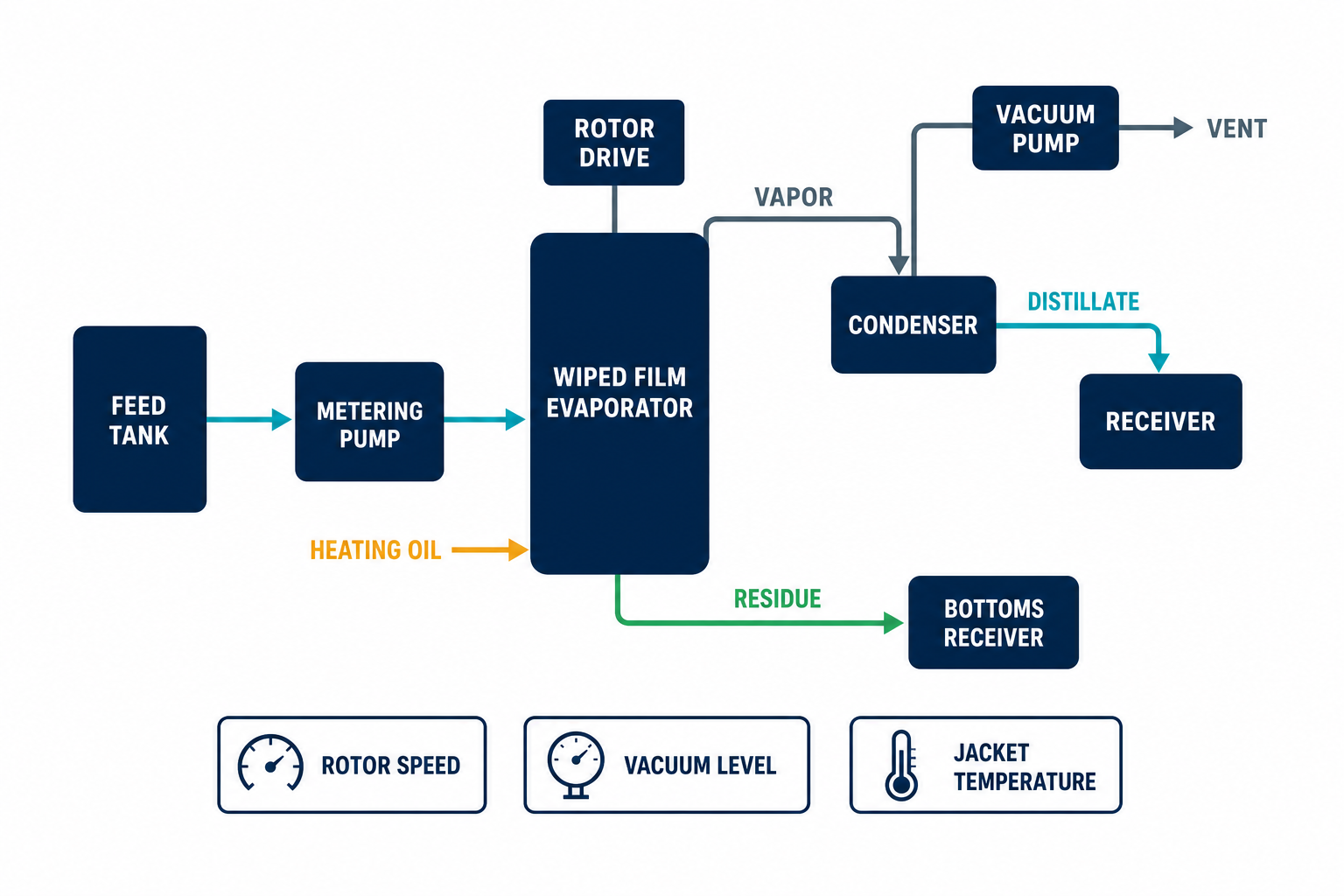
Commissioning and optimization come down to three setpoints. A worked example from honey concentration (illustrative application; external reference data) on a 10 m² machine:
| Parameter | Honey duty setpoint | Effect when pushed |
|---|---|---|
| Rotor speed | 250–350 RPM | Correct tuning lifted yield 18%; inline viscometer triggers a 10% speed reduction above 5,000 cP |
| Vacuum | 5–10 mmHg | Boiling point falls to ≈60 °C; deeper vacuum protects thermals but taxes the seal system |
| Jacket temperature | 80–120 °C (0.4 MPa steam) | Higher jacket temperature raises rate until product color or degradation sets the ceiling |
Throughput on that duty: total residence time stays under 8 seconds, and at the ~200 kg/(m²·h) evaporation intensity quoted above, a 10 m² unit removes roughly 48 t/day of water — concentrating about 60–80 t/day of honey feed from 20 to 78 °Brix. The optimization sequence that works: pull vacuum to 5 mmHg first, raise jacket to 90 °C, then walk rotor speed up from 200 toward 300 RPM while watching motor load. The type’s one structural weakness lives at the shaft: mechanical seals for high vacuum are demanding, and seal health is the first thing to check when vacuum performance drifts.
Materials: Food Grade and Corrosion Grade
For food and pharma duty the materials palette is settled practice:
- Shell and heat-transfer surface in 316L, mirror-polished to Ra ≤ 0.4 μm — the finish that makes CIP effective.
- Blades in PTFE faced on 316L backing — stable to 200 °C and gentle on the wall.
- Food-grade silicone or FFKM double mechanical seals; rotor shaft in duplex 2205; condenser in 316L corrugated tubing (+30% heat transfer versus plain tube, supplier-published).
That materials package, on a honey plant (external industry reference), took vitamin C retention from 72% to 94% versus the previous arrangement. Corrosive duty escalates the ladder: on chloride wastewater above 50,000 ppm, standard 316L shows pitting within roughly three months, and the workable answers are clad or solid Hastelloy C-276, titanium, or in the extreme tantalum. Special rotor coatings have demonstrated 240% longer rotor life in such service (supplier-reported figure), and magnetic drives — eliminating the dynamic seal entirely — hold vacuum below 0.1 mbar indefinitely with zero leakage path.
Where the Technology Earns Its Keep
The application map spans four broad territories (all illustrative applications):
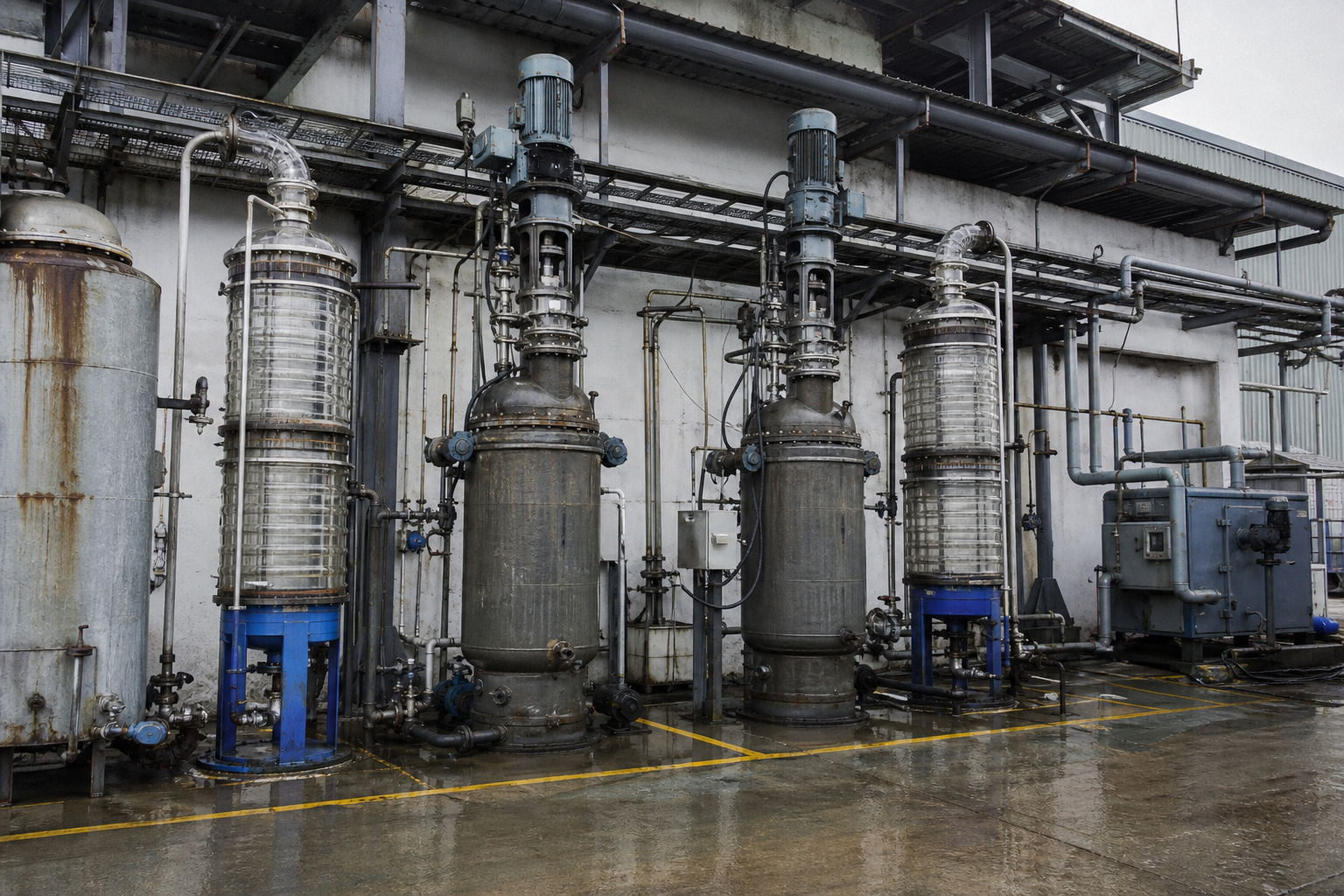
- Food: honey, tomato paste, fruit purees, lecithin — high-solids, high-viscosity, color- and flavor-critical concentrates.
- Pharmaceutical: vitamin C, antibiotics, API solvent stripping — where narrow residence-time distribution prevents localized overheating and impurity spikes.
- Fine chemicals: MDI/TDI devolatilization, low-molecular removal from silicone oils, waste-oil re-refining; DMF recovery runs (external industry reference; a separate published case from the DMF site quoted on our solvent-recovery solution page, which reports 99.2% on 5,000 t/y with a waste-handling saving) lifted from 82% to 99.7% recovery, worth about $700k/year on one line.
- ZLD final concentration: polishing high-salt wastewater to above 50% salt content, slashing the load on downstream drying. Where the salt is meant to be recovered as product rather than dried to hazmat, the crystallizer side of the train is covered in the industrial crystallizer selection guide, and the full zero-discharge train on the ZLD solutions page (illustrative applications).
Economics: Higher CAPEX, Fast Payback
A scraped-surface machine runs about 30% above a falling-film system in capital cost for equivalent nominal duty (typical published comparisons). The difference comes back in 14–22 months on operating cost alone. For a 1 t/h duty, annual figures from an external industry reference comparing a wiped-film unit against forced circulation:
- Electricity: 450,000 → 280,000 kWh (−37%)
- Steam: 1,200 → 850 t when paired with MVR (−29%) — the hybrid configuration is described on our MVR technology page
- Maintenance: $12k → $4.5k (−62%)
- Product degradation: 2–5% → below 0.1%
Net operating cost lands near $70k/year lower. Budget anchors (supplier-published): a 0.5 m² laboratory unit costs $12k–22k; a 10 m² industrial machine runs $250k–500k depending on metallurgy and seal class.
Five Failures You Will Meet, and Their Fixes
- Yield suddenly down ~30%: blade clearance has opened up through wear. Re-blading costs on the order of $1,000 and restores the film.
- Vacuum stuck above 5 mmHg: seal leakage. Replace FFKM seals and repack vacuum grease paths.
- Motor overload: viscosity above design or rotor speed too high for the feed. Drop speed 20% and preheat the feed.
- Wall fouling returning between cleanings: weekly CIP — 120 °C, 2% NaOH, two hours — belongs on the schedule, not on demand.
- Condenser plugging: entrainment. Fit a high-efficiency demister and keep its pressure drop under 50 Pa.
What Is New in 2025–26
Four developments are moving from pilot to product (performance figures as reported by early adopters and suppliers): AI-adaptive rotor control that trims speed ±50 RPM against inline viscosity feedback (+12% yield in trials); nano-ceramic blade coatings at hardness HV 2500 tripling coating life and stretching cleaning intervals from weekly to monthly; MVR-scraped-film hybrids cutting steam demand by 70%, already commercial in Europe; and vibration-plus-thermal sensor packages that predict blade wear 30 days out — early fleets report 85% fewer unplanned stoppages. None of these change the core mechanism; they widen the window in which the machine runs at its best setpoints.
FAQ
Scraped surface, wiped film, agitated thin film — are these different machines?
No. The three terms name the same mechanical thin-film technology from different industries. All use a rotor with blades to form and renew a thin turbulent film on a heated wall; compare drawings, not labels, when evaluating quotes.
What is the maximum viscosity a wiped film evaporator can process?
Up to about 100,000 cP (mPa·s), versus roughly 100–500 cP for falling film and 2,000 cP for forced circulation. Non-Newtonian feeds may need specialized rotor geometries such as Smith or extrusion blades.
How short is residence time, and why does it matter?
Typically 5–30 seconds, versus 1–3 minutes for falling film and 15–30 minutes for forced circulation. Seconds-scale exposure is what preserves heat-sensitive compounds — vitamins, colors, flavors, and APIs that degrade during longer thermal loops.
What is the most critical maintenance item?
Blade-to-wall clearance, specified at 0.5–1.5 mm (about 0.8 mm for food duty). Worn blades open the gap, the film thickens, heat transfer decays, and yield falls — the most common cause of a sudden 30% capacity drop. Mechanical seal health is a close second.
Is a wiped film evaporator the same as molecular distillation?
No. Scraped-film machines concentrate at around 5 mmHg vacuum. Molecular distillation is an ultra-high-vacuum separation technique for systems with boiling-point differences under 20 °C. A wiped film unit can precede a molecular still, but the operations are distinct.