
Complete evaporation and crystallization trains built, wired and tested in the factory — shipped in ISO containers or on flat racks, lifted onto your foundation and hooked up to power, feed and discharge in days. From 25 kg/h containerized pilots to 10 t/h process skids, expanded by bolting modules side by side.
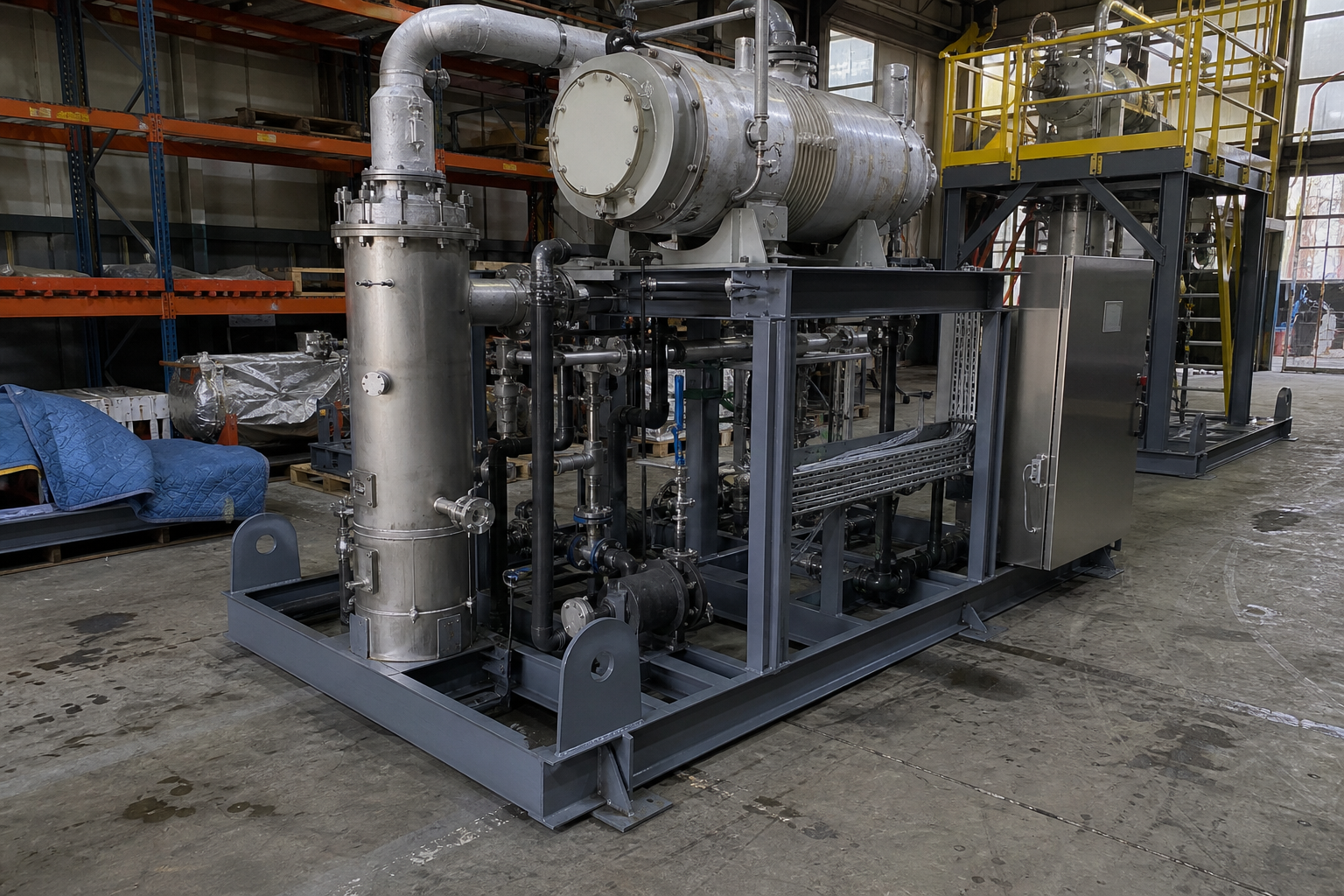
Reference ranges from published skid and containerized system data across heat-pump, MVR and multi-effect builds.
One skid carries the whole train — evaporator body, compressor, separator, pumps, piping and controls — prefabricated, tested and shipped as a single piece.
Feed tank → Preheater → Evaporator module (falling film / forced circulation) → MVR compressor or heat pump → Separator → Concentrate or crystallizer → Product / distillate — all on one skid frame with PLC cabinet & CIP station
Concentration and crystallization variants share one platform: the crystallization skid swaps the discharge end for a crystallizer and centrifuge; the scraper keeps heat surfaces clean on scaling feeds. Condensate returns as clean water; the compressor loop recycles every kilojoule of vapor latent heat.
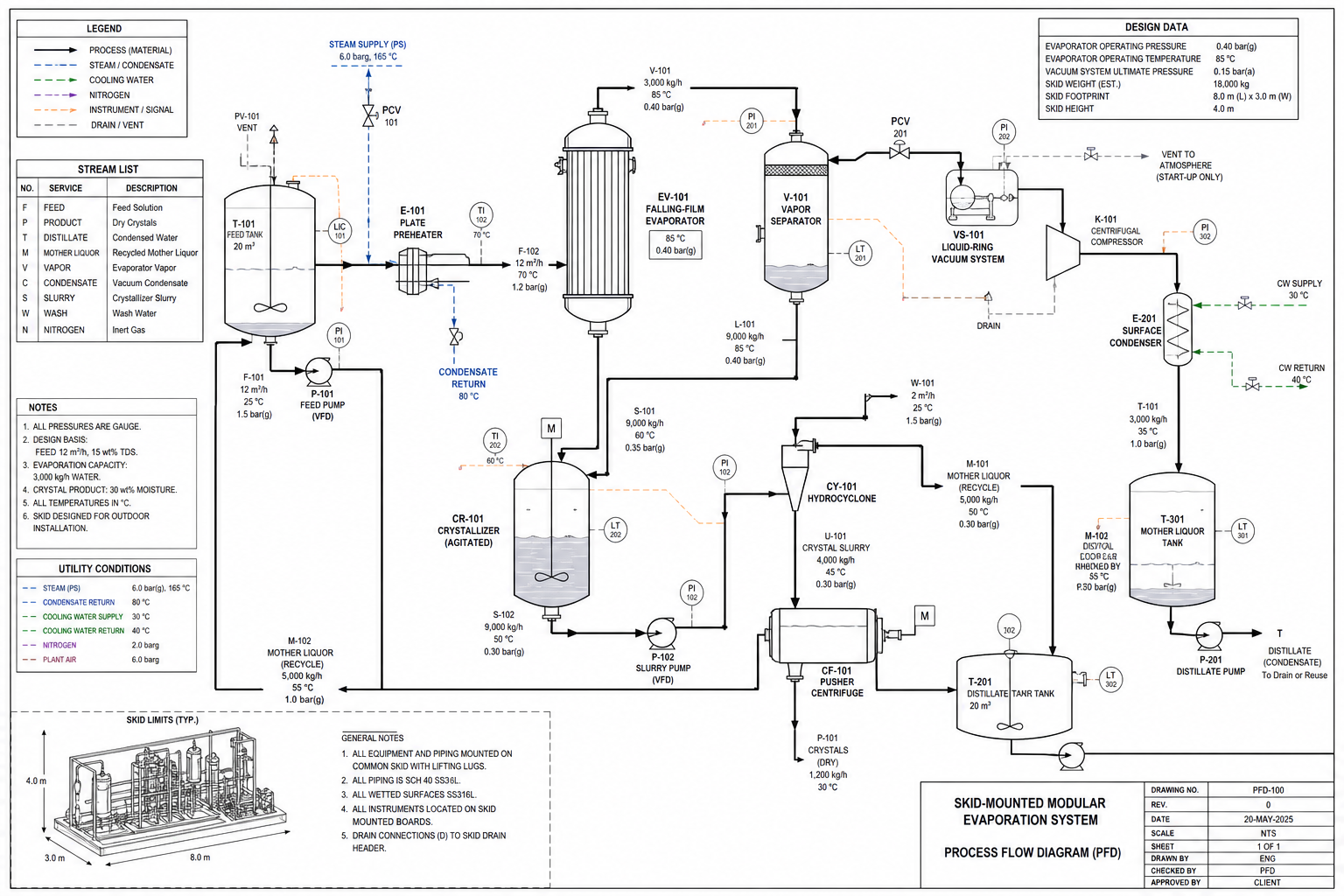
Every skid starts from the same core set; corrosion package, crystallization end and pretreatment are added by duty.
Aggregated from published containerized and skid-mounted system data — indicative ranges for preliminary sizing, not a process guarantee.
| System Class | Parameter | Range / Rating | Condition |
|---|---|---|---|
| Containerized heat-pump units | Concentration series, 6 models | 25–300 kg/h · 5–38 kW / 4–33 kWh · ≈38 °C | high-vacuum low-temperature evaporation; scroll (small) / screw (large) compressors; plug-and-play container, 1/3 footprint |
| Crystallization series, 6 models | 25–300 kg/h · 8.5–90 kW / 5.5–75 kWh · ≈38 °C | vacuum evaporation with salt-out crystallization; motorized scraper keeps heat surfaces clean; same platform as concentration series | |
| Containerized & skid MVR | Containerized MVR, 5 capacity steps | 100–1,000 kg/h · 30–130 kW / 20–110 kWh | Roots vapor compressor; falling-film / forced-circulation × tube / plate exchanger matrix; truckable single-piece delivery |
| Integrated truckable MVR, 6 steps | 100 / 200 / 300 / 400 / 500 / 1,000 kg/h | falling-film or forced-circulation; 3-stage anti-surge protection; installation and commissioning completed before ex-works | |
| Modular MVR units | 3–10 t/h standard modules · 1–4 t/h · 110–410 kW | plate / tube exchangers shipped whole; zero live steam, electricity only; envelope 4.3×2.6×4.5 to 6.0×3.0×7.0 m; >80% energy saving class | |
| Skid evaporation / crystallization systems | 0.5–10 t/h per skid · SEC 20–35 kWh/m³ | multi-skid parallel to 10,000-t/y class; SS316L / Duplex 2205 / 2507 / TA2 / Hastelloy; 40 HC or flat-rack transport | |
| Multi-effect & open evaporation skids | Modular MEE + vacuum crystallization | 0.5–80 t/h · HP-series 3–50 t/h | triple-effect at 99 / 76 / 53 °C and 0 / 448 / 640 mmHg; live steam 0.6–1.0 MPa(abs); removable skid modules avoid long shutdowns |
| Open evaporation containers | 100 t/d reduction per unit | AB-100 class: 4 evaporation modules in an ISO container frame; ≈2,400 MJ per tonne of water; no pressure vessels | |
| Multi-unit expansion | parallel, on demand | units bolt side by side; closed-mode option produces compliant water or vents clean vapor only | |
| Low-temperature heat-pump skids | LPD standard series, 6 steps | 1 / 2 / 3 / 4 / 5 / 10 t/d · 18–144 kW installed | 6–7 kPa, 30–37 °C, 10–108 kW running; envelope 2.5×1.5×2.3 to 5.5×2.2×2.3 m; heat-pump COP 3–6 |
| Heat-pump vacuum skids, 13 models | 10.4–416.7 L/h · 130–160 kWh/t | −0.95 bar, 35 °C; fully electric, closed refrigerant loop, no cooling water; SS316L modular structure | |
| Double-effect heat pump, 6 models | 208.3–833.3 L/h · 80–100 kWh/t | 45% energy cut vs. single-effect; same −0.95 bar / 35 °C envelope | |
| VR series, 4 models | 500 / 1,000 / 2,000 / 3,000 L/d · ≈180 kWh/m³ | R407c / R134a refrigerant; jacket heat exchanger never contacts the feed; foam detector + auto antifoam loop | |
| LT series, 3 models | 0.2 / 0.6 / 1 t/d · ≈100 kWh/m³ | ≈−96 kPa, ≈37 °C; Siemens PLC + touch screen, remote monitoring | |
| Compact continuous skid | 45 L/h · 12 kW · 195–215 W/L | 2.7×1.8×2.8 m envelope; continuous evaporation, no batch dump shutdowns | |
| Delivery & site requirements | Factory completion | 80–90% | piping & electrical integration, static commissioning + FAT before shipment |
| Site installation vs. field-erected | 10–15 d vs. 3–6 months | hook-up 2–5 days; ≈30% less civil works; level pad + three-phase power + feed/discharge connections |
Ranges aggregate published specifications from containerized heat-pump, MVR and multi-effect system suppliers; figures are indicative for screening and must be verified against your feed analysis, site power limit and logistics constraints.
Pick the platform by duty and utilities — the evaporator physics is the same, the packaging and energy source are not.
| System Type | Energy / Temperature | Best For | Watch-outs |
|---|---|---|---|
| Containerized heat-pump | ≈38 °C · electric only | Small waste minimization, oily cutting / degreasing concentrates, lab & pilot ZLD at 25–300 kg/h | concentrate handling needed; small throughput per box |
| Low-temperature heat-pump skid | 30–37 °C · COP 3–6 | Heat-sensitive feeds — juice, honey, landfill leachate, small-scale ZLD at 1–10 t/d | refrigerant loop maintenance; electric-only site required |
| Skid / modular MVR | 20–35 kWh/m³ · no live steam | Process concentration & crystallization at 0.5–10 t/h, 24/7 duty, multi-skid expansion | higher CAPEX; compressor know-how for maintenance |
| Modular MEE skid | live steam 0.6–1.0 MPa | Larger duties where steam exists: salt separation, ZLD preconcentration to 80 t/h | needs boiler house; effect stack adds height |
| Open evaporation container | ≈2,400 MJ/t water | High-volume brine reduction (100 t/d per unit) where power is expensive; VOC-managed | water leaves as humid air; closed-mode option for distillate |
Energy figures follow published data for each platform; final selection needs your electricity / steam price ratio, footprint limit and discharge permit.
Published modular systems scale from laboratory pilots to containerized MVR process skids on the same delivery logic.
Anonymized configurations reconstructed from published supplier project data.
Engineering guides on skid delivery, pilot campaigns and the small-vs-large decision.
The skid is the packaging — these are the technologies and duties it carries.
This page aggregates published supplier specifications and project data (containerized heat-pump and MVR system builders, modular multi-effect suppliers, open-evaporation unit manufacturers) into an engineering screening view. All names are withheld; configurations are described generically. Figures are indicative ranges for preliminary sizing — final selection requires your feed analysis, site power limit, transport constraints and discharge permit.
Recurring questions from engineers weighing the skid route.
Skids win on schedule and certainty: 80–90% factory completion with FAT, 2–5 day hook-up, 10–15 days total installation versus 3–6 months of field assembly, and roughly 30% less civil works. Above roughly 10 t/h per train — or with layouts a container frame cannot hold — field-erected trains take over; below that, skids cut cost, schedule and interface risk.
Published systems span 25–300 kg/h containerized heat-pump units to 0.5–10 t/h MVR process skids. Expansion is by parallel modules: multi-skid plants run 10,000-t/y class duty 24/7, and open-evaporation containers scale the same way at 100 t/d per unit — capacity is added by bolting units side by side, not by rebuilding.
A level pad, three-phase power, and feed / discharge connections. MVR skids need electricity only — no live steam at steady state. Heat-pump units run fully electric with closed refrigerant loops and no cooling water. Modular multi-effect skids are the exception: they need live steam at 0.6–1.0 MPa from your boiler house.
That is what it is for: 20-liter sample campaigns measure boiling-point elevation and viscosity before the full-scale design is fixed, and the pilot runs the same evaporator body type as the production skid — so heat transfer and scaling behavior transfer directly. Crystallizing and scaling feeds additionally run scraped-surface pilot duty before material selection.
SS316L covers general duty; Duplex 2205 and 2507 handle high-chloride brines; TA1 / TA2 titanium and Hastelloy cover the extremes — a ladder that spans pH 1–14 with over 20-year design life. High-chloride systems also use stepped protection, for example titanium tubes with a 2205 shell.
80–90% of piping and electrical integration, static commissioning, and a witnessed FAT. Larger MVR skids add 3-stage anti-surge protection — alarm, control, trip — tuned at the factory, so site work is hook-up and start-up only, with remote diagnostics and cloud monitoring from day one.
Send feed composition and rate, concentration target, site power limit and footprint constraint. We return a skid or module layout with capacity steps, transport plan and hook-up scope — not a brochure.
Send your feed characterization (TDS, COD, main salts, viscosity), throughput and product targets — we respond with a preliminary process route within two business days.