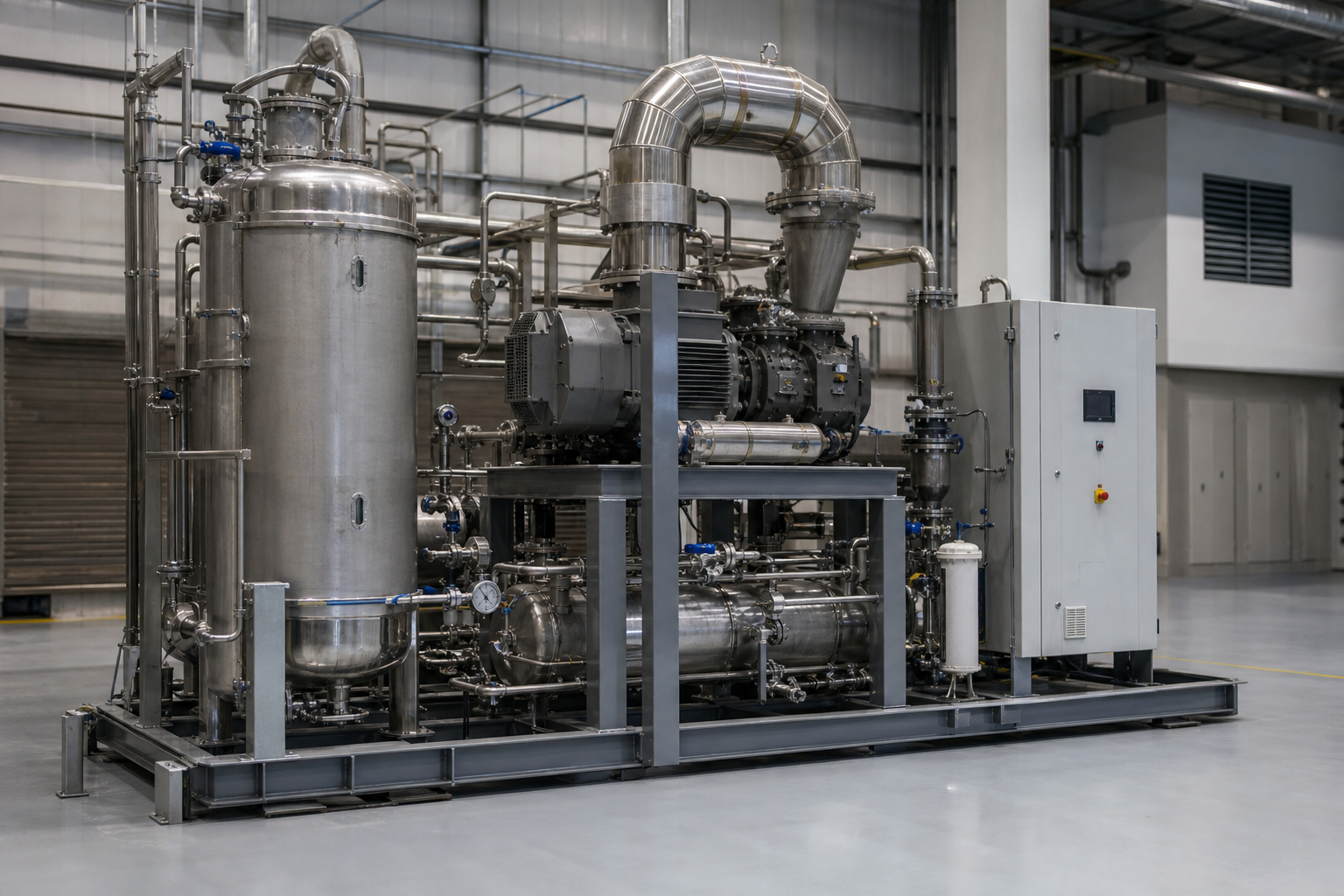
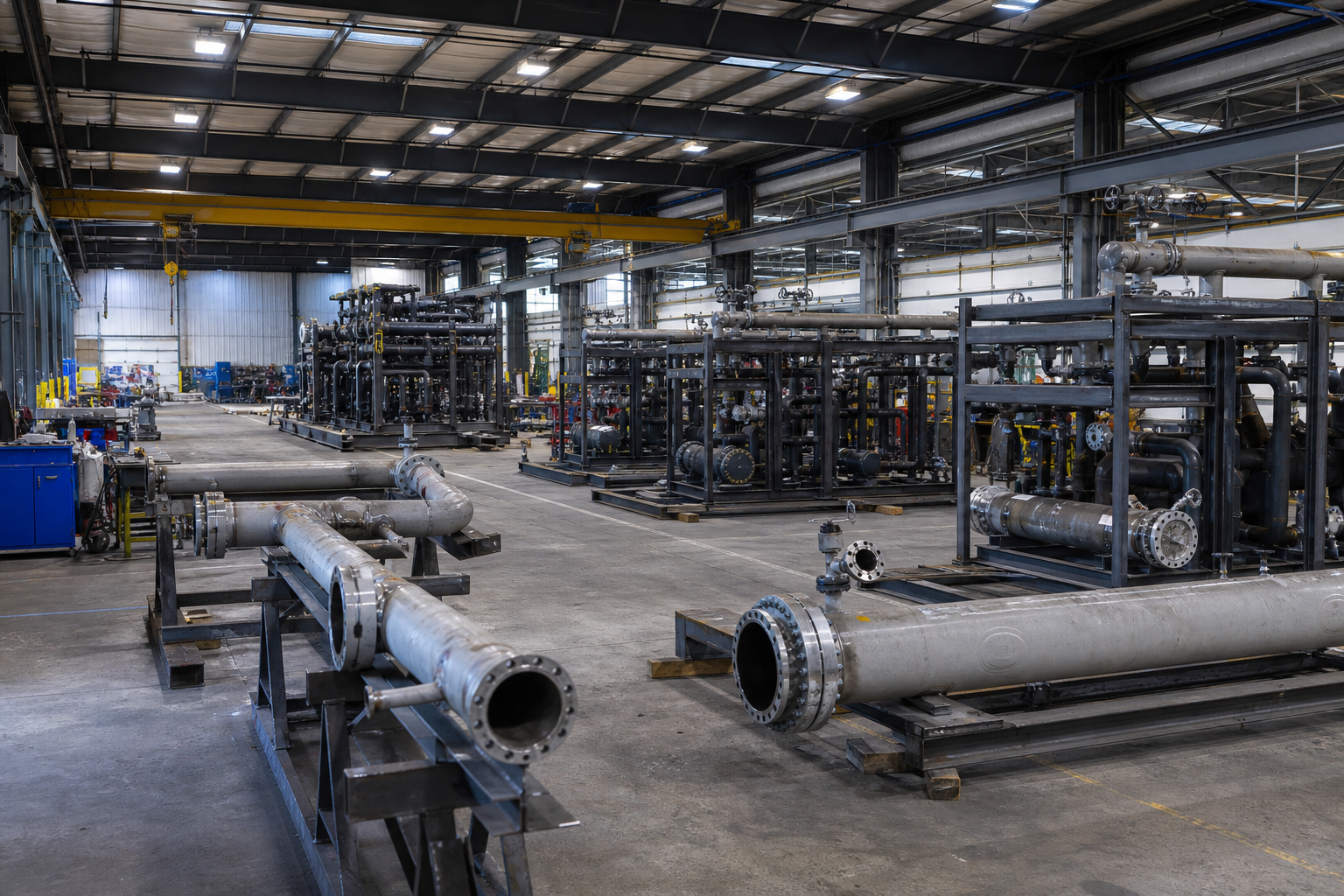
A skid-mounted evaporation system is a complete evaporator or evaporative crystallizer — heat exchanger, separator, vapor compressor, pumps, piping, insulation, instrumentation, and PLC control panel — pre-assembled on a single structural steel base frame in a factory, pressure-tested and function-tested before shipment, and delivered to site as a plug-and-play module. The decisive numbers (industry-reported for modular delivery): 90–95% of piping, electrical, insulation, and commissioning work is completed in the factory; on-site installation time is cut by 50–60% compared with field-built construction; and 3D-optimized layout shrinks footprint by 35–50%. A single skid typically covers 500 kg/h to 10 t/h of evaporation capacity, with projects above roughly 50 t/h handled by multiple skids in parallel — still faster to erect than a field-built equivalent. This article explains what is inside the skid, why modular delivery changes project economics, and how to specify one correctly — the delivery-model view, shared by all applications. Application-side companions: skid-mounted evaporation for wastewater ZLD (the compliance-driven duty) and seawater desalination MED skid systems; the product line itself sits on the skid and modular capability page.
What Skid-Mounted and Modular Really Means
“Skid-mounted” and “modular” describe the same delivery philosophy at two scales. A skid-mounted system arrives as one transportable steel frame carrying all process equipment, interconnecting piping, wiring, and controls; the modular approach extends this by building a plant from several such blocks. Either way, the defining event is the Factory Acceptance Test (FAT): the fully assembled system runs with water or simulated load at the manufacturer’s works before it ever ships, so that welding faults, wiring errors, and control bugs are found with factory resources instead of a site crew standing idle. What arrives at the plant is a module that needs only three field connections — feed line, discharge lines, and electrical power.
The contrast with traditional practice is stark. A field-built evaporator is erected piece by piece on the client’s site: vessels set, tubes welded, pipe runs fabricated in place, cable pulled and terminated, instruments loop-checked — all exposed to weather, site labor availability, and remote-location logistics. External industry references are blunt about where these projects bleed money: the failures are usually not design failures but construction-execution failures — weather delays, inconsistent weld quality in remote areas, and wiring mistakes that surface only at first energization. Budget overruns on field-erected evaporation projects trace back to these execution risks far more often than to process design errors, which is precisely the risk class that factory prefabrication removes.
Two Product Families: Concentration and Crystallization
Skid-mounted evaporators divide into two functional families, and choosing between them is the first specification decision. A concentration skid evaporates water from a liquor up to near-saturation: fruit juice and dairy concentration, traditional Chinese medicine extraction liquor, pharmaceutical intermediates, and low-salt wastewater volume reduction are the classic duties. A crystallization skid carries the duty further — through saturation into nucleation and crystal growth — to separate inorganic salts as solids, which makes it the standard machine for complex high-salt wastewater, battery-material brines, electroplating effluent, and hazardous-waste volume reduction. The two families share the skid discipline but differ in separator geometry, solids handling, and discharge equipment, so the feed’s destiny (concentrate versus crystals) must be fixed before layout begins.
What Moves from Site to Factory: The 90–95% Rule
The core promise of modular delivery is arithmetic: whatever fraction of total work hours can be transferred from a construction site to a factory is a fraction removed from weather risk, site-labor variance, and schedule uncertainty. For a well-engineered evaporation skid, that fraction is 90–95% — pipe spools, supports, insulation, cable trays and terminations, instrument loops, and programming are all factory work, verified by the FAT. Site work shrinks to setting the frame, grouting, and hooking up utilities. Field installation time falls by 50–60%, and because factory welds are made by certified welders under controlled conditions with repeatable inspection, quality variance collapses as well.
| Dimension | Field-built evaporator | Skid-mounted modular system |
|---|---|---|
| Where work happens | On site, exposed to weather and site labor market | 90–95% in factory; site keeps connections only |
| Pre-delivery testing | None possible before erection; commissioning on site | Full FAT with simulated load before shipment |
| Typical field installation time | Baseline (multi-month erection on larger units) | Reduced by roughly 50–60% |
| Footprint | Layout constrained by site fabrication access | 3D-optimized; 35–50% smaller footprint |
| Quality control | Depends on site crew and remote-location welding quality | Factory-certified welds, repeatable inspection |
| Relocation | Practically fixed civil works | Whole skid liftable and movable to a new site |
| Commissioning | Loop-checking and debugging on site | Plug-and-play: connect feed, discharge, power |
The footprint row deserves emphasis for two audiences. Brownfield plants — existing facilities adding a ZLD train or a brine concentrator beside live production — buy space savings directly, because a 35–50% smaller module is often the difference between fitting inside an existing battery limit or not. And in high-land-price industrial parks, footprint is money even on greenfield sites. The relocation row is equally strategic: a complete skid can follow a production transfer between sites, an option a civil-works evaporator simply does not offer.
Capacity Range and Parallel Expansion
Commercial single-skid modules span roughly 500 kg/h to 10 t/h of evaporation. Below about half a tonne per hour, projects often take a compact mini-skid; above 10 t/h, the economics depend on transport limits, and vendors assemble capacity by running multiple skids in parallel — a 50 t/h duty becomes a bank of identical modules sharing a common control architecture. Parallel skids also buy operational flexibility: one module can be taken down for cleaning or maintenance while the rest run de-rated, which matters for continuous-discharge plants that cannot stop. The honest boundary of that logic — field-built still wins in three situations. Single-line duties above roughly 100 t/h reverse the transport economics: the number of parallel modules plus their interconnecting piping and common control overhead outweigh the factory advantage, and a field-erected single train becomes cheaper per ton. Sites without road access or crane capacity for oversized modules (remote mines, island plants, congested brownfield interiors) must build in place regardless of scale. And duty classes that center on vessels no road transport can carry — very tall or thick-wall pressure bodies — keep the field-erection model by physics. This scaling logic is worked through in the comparison of small-scale versus large-scale evaporator systems.
Materials Strategy: Corrosion Is a Skid-Killer
Skid standardization concentrates corrosion engineering at the design stage — correctly, because high-chloride brines destroy commodity stainless fast. In high-salinity brine service, 304 and 316L can develop pitting and stress-corrosion cracking within months, so material selection starts from a full water analysis, not from what is in stock. The working hierarchy: duplex stainless 2205/2507 for high-chloride service where mechanical strength roughly double that of austenitic grades also buys thinner walls and lighter skids; titanium Gr2/Gr7 where extreme chloride levels combine with strong oxidizing acids, exploiting titanium’s self-repairing passive film; and Hastelloy C276/C22 for hydrofluoric acid bearing or complex organic-solvent streams. As a rule of thumb, feeds above roughly 15% dissolved solids deserve a per-sample composition simulation before the metallurgy is frozen.
| Service condition | Candidate material | Why it works |
|---|---|---|
| High chloride, high mechanical load | Duplex 2205 / 2507 | Chloride pitting resistance plus about twice the strength of austenitic steel |
| Extreme chloride + strong oxidizing acids | Titanium Gr2 / Gr7 | Self-repairing passive film survives conditions that crack stainless |
| HF-bearing or complex organic solvents | Hastelloy C276 / C22 | Broad acid and halide resistance for aggressive chemical service |
| Moderate chloride, cost-driven | 316L (with caution) | Adequate only where chloride levels and temperatures stay modest |
The Skid Frame Itself
The base frame is not an afterthought: it carries every dynamic load of pumps and a rotating compressor, and it is the element that makes relocation possible. Established practice uses corrosion-protected structural steel or 316L stainless frames designed for a fatigue life beyond 20 years — the frame must outlive several generations of gaskets, instruments, and possibly even process reconfigurations. Food and pharmaceutical skids add hygiene discipline on top: polished surfaces, drainable dead-zone-free fabrication, and clean-in-place (CIP) circuits designed to 3-A/EHEDG expectations. Forced circulation combined with highly polished heat-exchange tubes raises wall shear and cuts CIP frequency by about 30% in food-grade service (supplier-reported figure), with steam-in-place (SIP) capability for sterile duties.
Sizing and Configuring a Skid Correctly
Capacity sizing is a two-line calculation that too many buyers skip in favor of nameplate folklore. The required evaporation rate equals daily feed volume divided by daily operating hours: a plant evaporating 20 t/d over 24 hours needs 0.83 t/h (illustrative calculation), so the next size up — a 1 t/h skid — is correct, with the margin already built in by rounding up. Evaporators are generally designed for continuous 24-hour operation, so the divisor should reflect realistic uptime, not calendar days. Once capacity is set, three configuration decisions follow.
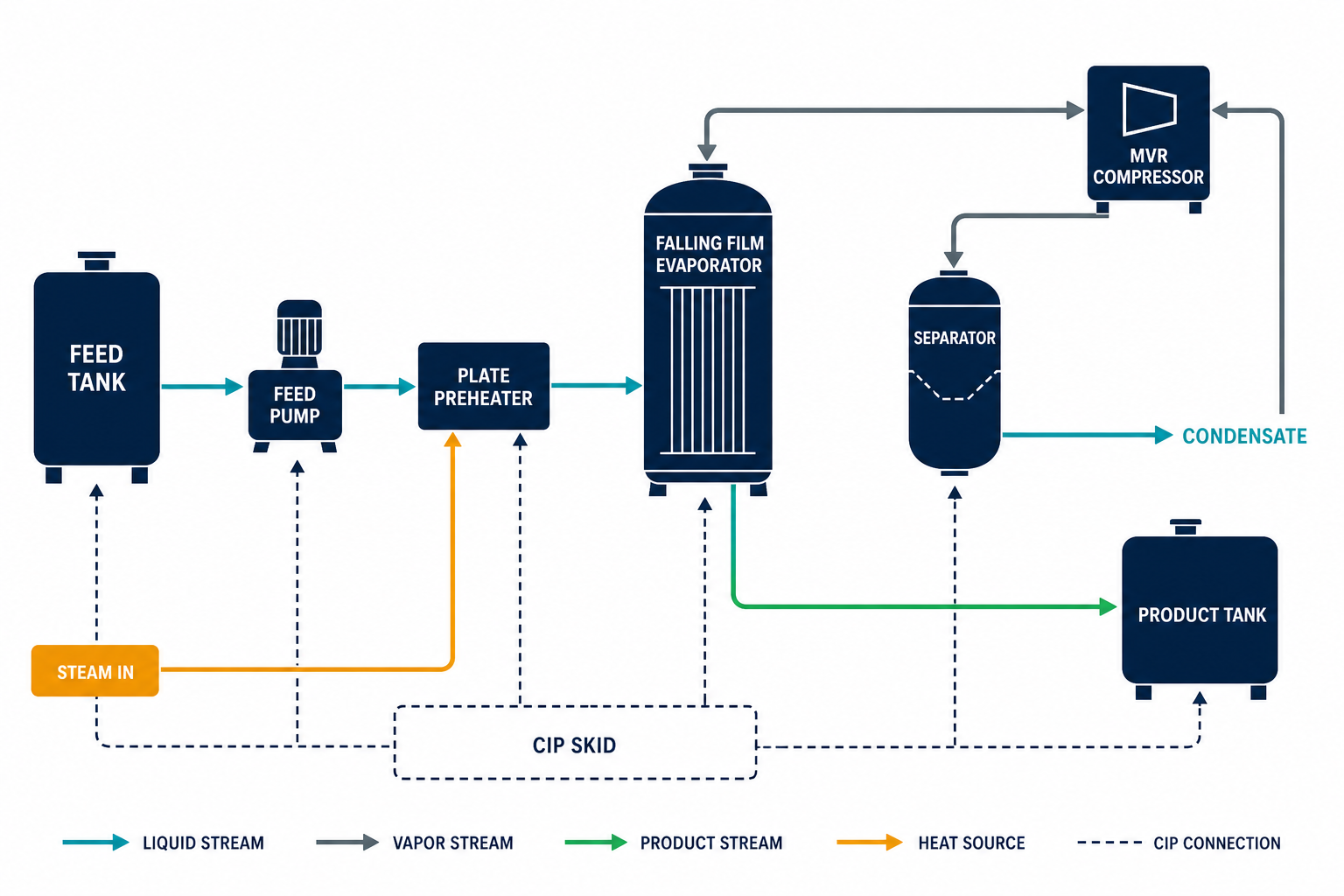
Plate or Tubular, Concentration or Crystallization
Heat-exchanger configuration follows the feed. The conservative rule from vendors who build both: tubular systems handle the widest range of fluids — anything a plate unit can process, a tubular unit can process too, while the reverse is not true. Plate evaporators win where the liquor stays low-viscosity, flows freely, and carries moderate organic load: for such clean duties they deliver higher heat-transfer efficiency in a smaller, lighter package that is easier to open and clean. High-viscosity, fouling, or crystallizing feeds go tubular, usually in forced circulation. The family split from the first section then maps onto duty: concentration skids serve food, pharmaceutical, and beverage concentration; crystallization skids serve inorganic-salt separation — a selection process detailed in the plate evaporator selection guide.
Standard or Premium Trim
Most vendors offer two build levels, and the choice is honest engineering economics. The standard version uses high-value mainstream components and suits duties with benign conditions, intermittent operation, and easy maintenance access. The premium version specifies joint-venture or first-tier brand components for harsh service — continuous runs of 15 days or more, aggressive chemistry, or plants where a single failure day exceeds the component price difference. Specifying premium hardware on a lenient duty wastes capital; specifying standard hardware on a 15-day continuous crystallization duty buys failures. Match the trim level to the operating pattern stated in the contract, not to optimism.
Controls, FAT Discipline, and Scale-Up from Real Water
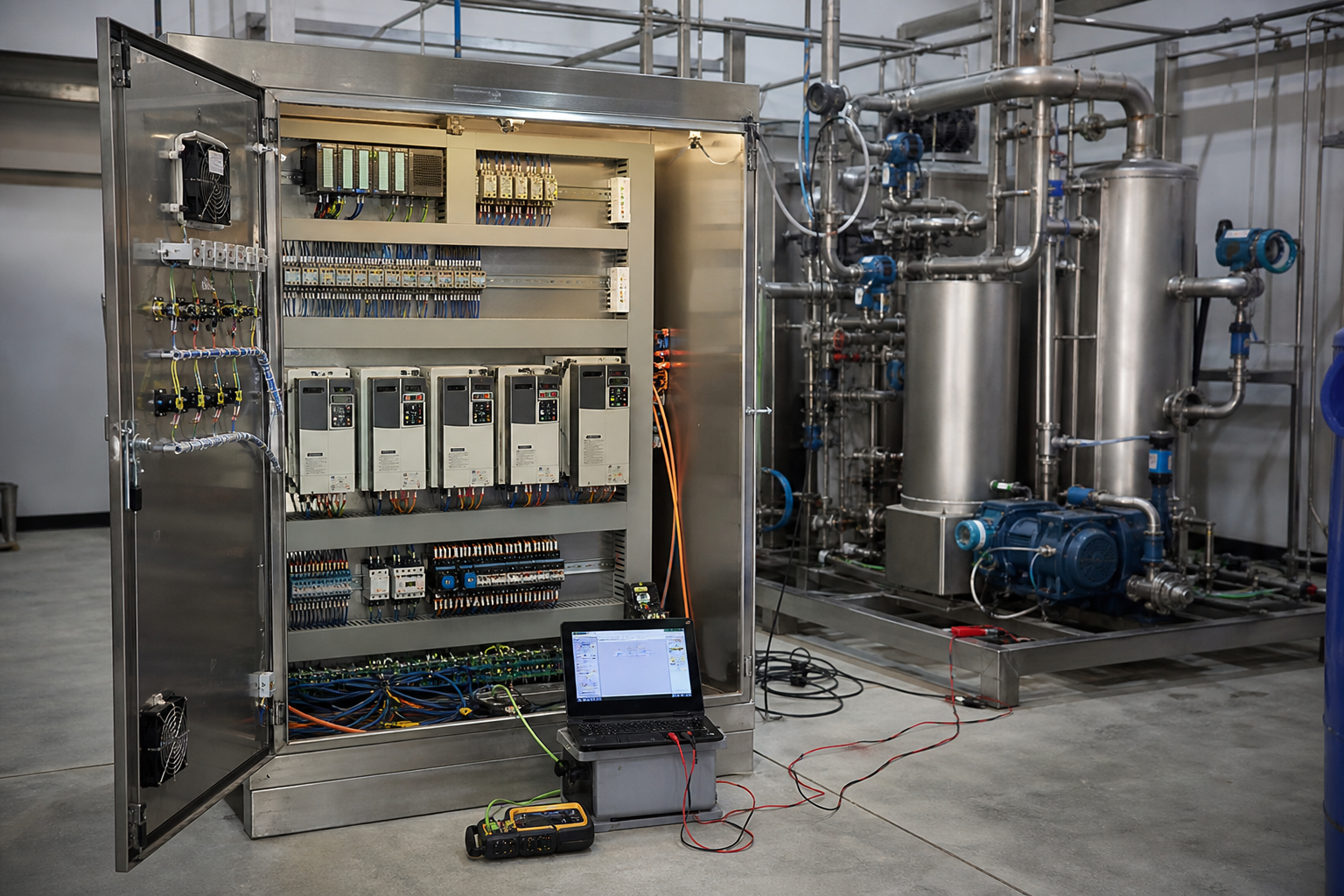
Modern skid control systems close the loop that makes unattended operation credible. A representative architecture uses a Siemens S7-1500 PLC running custom algorithms that track pressure and temperature differentials in real time and modulate the vapor compressor frequency accordingly — including compensation for boiling point elevation (BPE), which shifts liquor properties as concentration rises and is exactly the variable a skid control system must chase. The supplier-reported benchmark: feed concentration swings of 5–15% absorbed without operator intervention while crystal discharge stays stable. Remote-monitoring layers now push hundreds of sensor signals to the vendor for heat-transfer-coefficient trending, AI-based fouling prediction, and automated pump-speed adjustment — cutting unplanned downtime by around 45% in supplier-reported fleet data.
The same discipline applies to scale-up. Serious suppliers size from experimental data on the client’s actual water sample — viscosity, fouling tendency, crystal growth rate — rather than from theoretical solubility curves alone; an externally reported carbonate production line designed this way reached nameplate annual capacity within its first week of operation. The full validation ladder from laboratory to industrial crystallizer, including pilot sizing rules, is covered in crystallization system design and scale-up. The direction of travel is unambiguous: vendor-cited industry reporting for 2025–2026 claims that roughly 82% of mid-size chemical projects now favor modular skid solutions when upgrading — a number to treat as a trend signal rather than a certified census, but consistent with what the delivery economics predict. More background on modular architecture sits on the skid and modular systems capability page, and on MVR evaporation for the vapor-compression core that most skids share.
FAQ
How much site work does a skid-mounted evaporator actually need?
Only three connections: the feed line, discharge lines (concentrate or crystals plus distillate), and electrical power. Piping, wiring, insulation, programming, and testing are 90–95% complete at the factory, verified by a Factory Acceptance Test before shipment. Field installation time typically runs 50–60% shorter than a field-built equivalent.
What evaporation capacity can one skid handle?
Single skids typically span 500 kg/h to 10 t/h. Duties at or above roughly 50 t/h are delivered as multiple skids operating in parallel, which also lets one module be taken offline for cleaning while the rest run. Size from your own numbers: daily volume divided by operating hours, rounded up — 20 t/d over 24 h needs a 1 t/h unit.
Can a skid be moved to a new plant later?
Yes — that is a structural advantage of the format. Because the process plant is one integrated frame designed for lifting (corrosion-protected structural steel or 316L, fatigue life beyond 20 years), it can be relocated when production transfers, unlike civil-works-anchored field construction.
How do I choose between plate and tubular heat exchangers on a skid?
Use tubular for the widest fluid compatibility — anything a plate unit can handle, plus high-viscosity, fouling, and crystallizing feeds. Choose plate when the liquor is low-viscosity and flows well with moderate organics: you gain efficiency, smaller footprint, and easier cleaning. When in doubt, tubular is the safe envelope.
When should I pay for the premium component build?
When the operating pattern is genuinely harsh: continuous runs of 15 days or more, aggressive chemistry, or downtime costs that dwarf component prices. For lenient duties and intermittent operation, the standard build level is the better purchase — match trim to the contracted duty, not to optimism.