
Project Parameters
| Parameter | Value |
|---|---|
| Process route | Multi-effect falling-film evaporation across steep water, glucose and fructose concentration duties |
| Industry | Food processing — corn wet milling & starch sweeteners (Middle East export project) |
| Feed type & key components | Corn steep water, starch milk, glucose syrup and fructose syrup streams |
| Capacity | 600 TPD corn starch + 480 TPD fructose plant scope (comparable regional plants: 600 TPD Indonesia, 550 TPD Saudi Arabia) |
| Construction materials | SS304 / SS316L food-grade wetted parts |
Representative process configuration compiled from published industry project data. Indicative values, not a process guarantee.
Project Description
A corn processing investment in the Middle East — a region that imports its caloric sweeteners — built a 600 tonne-per-day corn starch plant with a 480 tonne-per-day fructose line behind it, substituting import supply with domestic production from imported corn. The reference configuration is the plant’s complete evaporation scope: not one evaporator, but the family of concentration duties that a corn wet mill and sweetener complex runs simultaneously — steep water concentration, starch washing water management, glucose syrup concentration and fructose syrup finishing.
This is the export-project context in its full form: the technology package, the equipment and the commissioning support cross borders together, and comparable published regional plants — a 600 TPD starch-plus-fructose complex in Indonesia, a 550 TPD starch and 120 TPD glucose plant in Saudi Arabia — establish the same execution pattern across the region’s food-security programs.
Process Technology
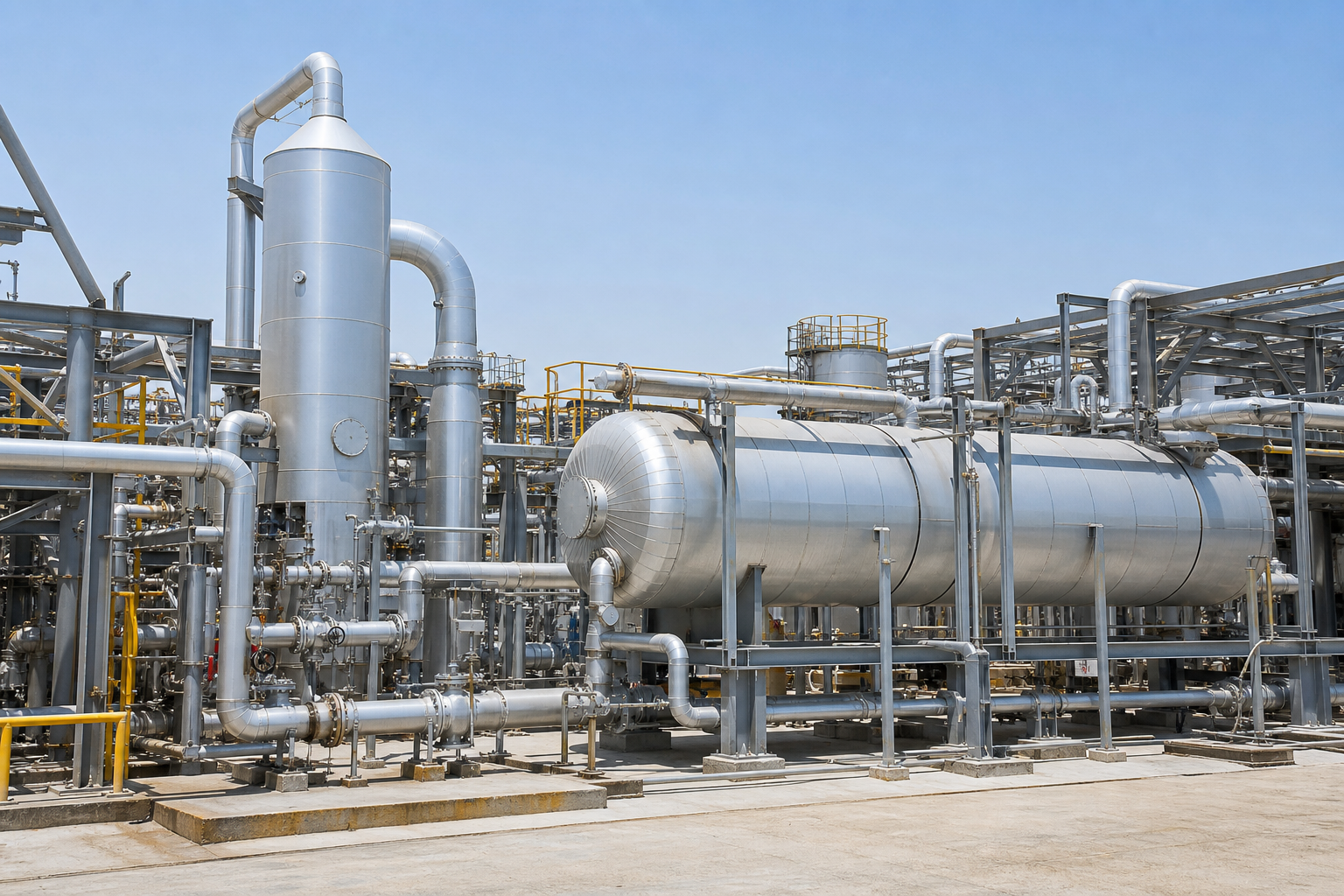
Corn wet milling soaks the grain in steep water, separates germ, fiber, gluten and starch, and every separation stage moves water. The evaporation scope concentrates steep water — the soaking solution loaded with solubles — into a feed-product (corn steep liquor) while recovering condensate for the steeping loop; manages the washing water of the starch refining; and then follows the sweetener chain.
Starch is enzymatically converted to glucose, and the glucose syrup is concentrated in multi-effect falling-film service — short-contact, vacuum, color-protecting geometry for a heat-sensitive sugar stream. The isomerization step converts part of the glucose to fructose, and the fructose syrup finishes in its own concentration train to commercial solids. Multi-effect steam economy carries all the duties: each train reuses vapor effect-to-effect so that one tonne of steam evaporates several tonnes of water, sized against the plant’s boiler house and the region’s fuel economics.
Condensate segregation is engineered per duty: clean later-effect condensate returns to steeping and washing; fouled first-effect condensate from steep water is treated. The syrups leave their trains at target solids into storage and packing — starch, glucose syrup and the fructose product that anchors the plant’s economics.
Equipment Configuration
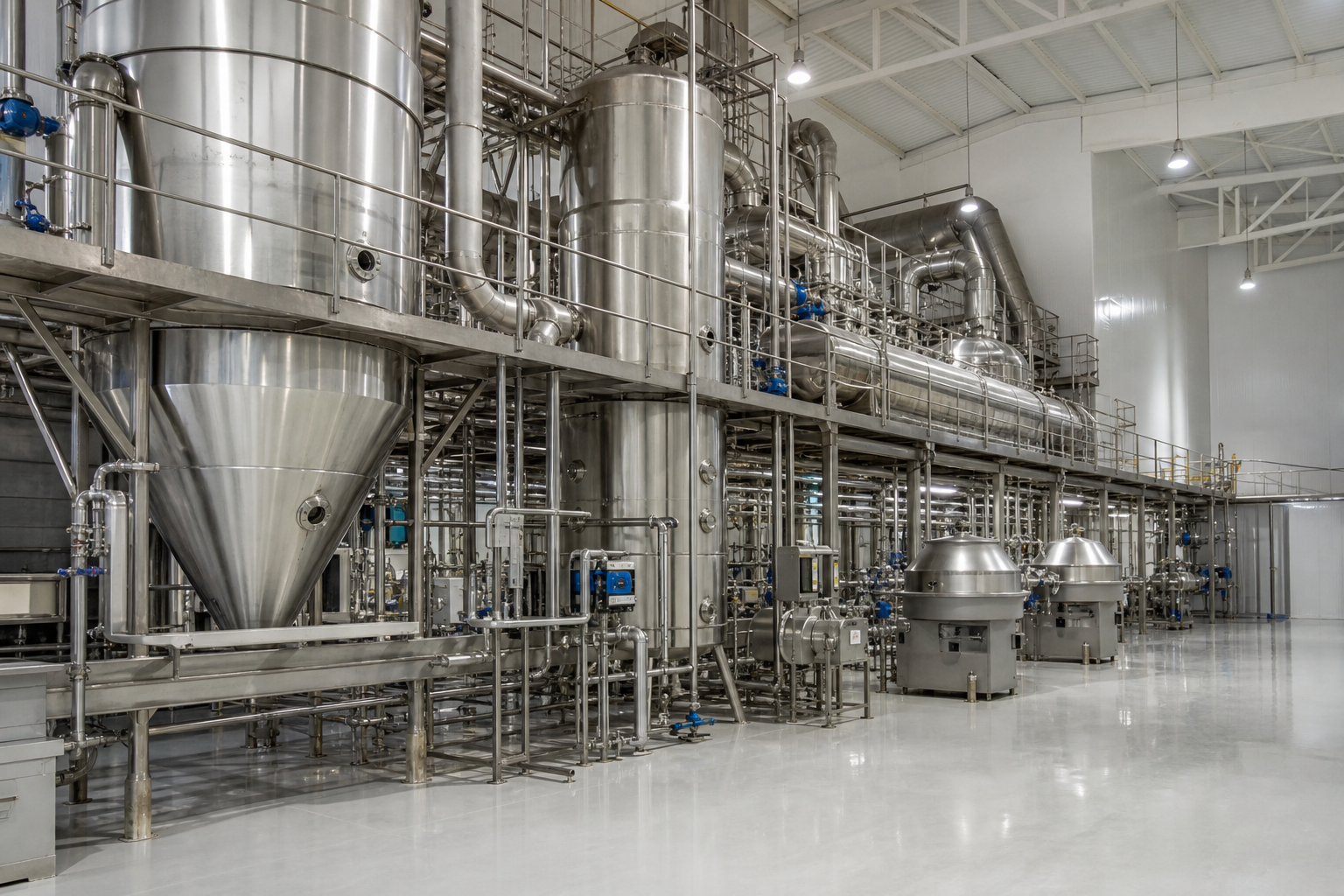
One set of the following equipment is typical for this plant scope:
- Steep-water falling-film concentration train with condensate return to steeping
- Starch washing and refining water management
- Glucose syrup multi-effect falling-film concentration train
- Fructose syrup finishing train with high-solids distribution engineering
- Segregated condensate systems; syrup storage and packing interfaces
- Food-grade SS304/316L; DCS control of the multi-train solids profiles with CIP
Performance & Outcome
Compiled from published industry project data, indicative: plant scopes of this class run steep water, glucose and fructose concentration on multi-effect steam economy with export-project execution from a single technology package. Per-duty capacities and steam economies are quoted per project configuration.
A comparable process routing is covered in Starch Syrup & Sweetener Evaporation.