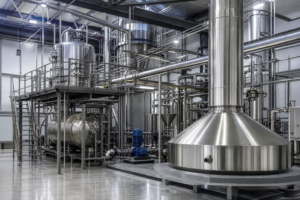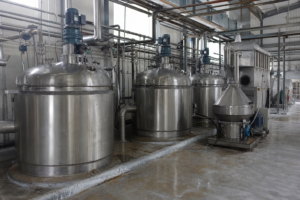
Starch sweetener evaporation spans one of the widest concentration ranges in food processing: syrup leaves saccharification and purification below 20% dry solids and must reach 70–77% for commercial glucose and HFCS products, which means the evaporator removes roughly three quarters of everything the plant pumps through it. The design problem is defined by four liquor properties, heat sensitivity that darkens syrup above modest temperatures, viscosity that climbs steeply with solids, fouling from sugar degradation products, and low but nonzero foaming, and the two configurations that satisfy all four are five-effect falling film trains with thermal vapor recompression and MVR falling film systems that recycle latent heat electrically. On fructose lines there is a further constraint almost unique to this industry: chromatographic separation of F42 syrup wants its feed held near 60% dry solids, so the evaporation train is deliberately staged around a mid-stream concentration target rather than a single final one.
Where Evaporation Sits in the Starch Sweetener Flowsheet
Starch syrup production converts grain and tuber starch into sweeteners through a fixed sequence, and evaporation is the last thermal step before product handling:
- Starch preparation and separation: milling, washing, centrifugal separation of fiber and protein
- Gelatinization and liquefaction: jet cooking with alpha-amylase to dextrins
- Saccharification: glucoamylase to glucose, or controlled conversion for maltose
- Deproteinization and clarification: filter press or decanter, then precoat filtration
- Decolorization: activated carbon adsorption of Maillard and caramelization colorants
- Ion exchange: cation and anion beds removing Ca²⁺, Mg²⁺, Na⁺, Cl⁻, SO₄²⁻, NO₃⁻ and residual protein; mixed beds for taste and odor
- Evaporation: multi-effect or MVR concentration to the product solids specification
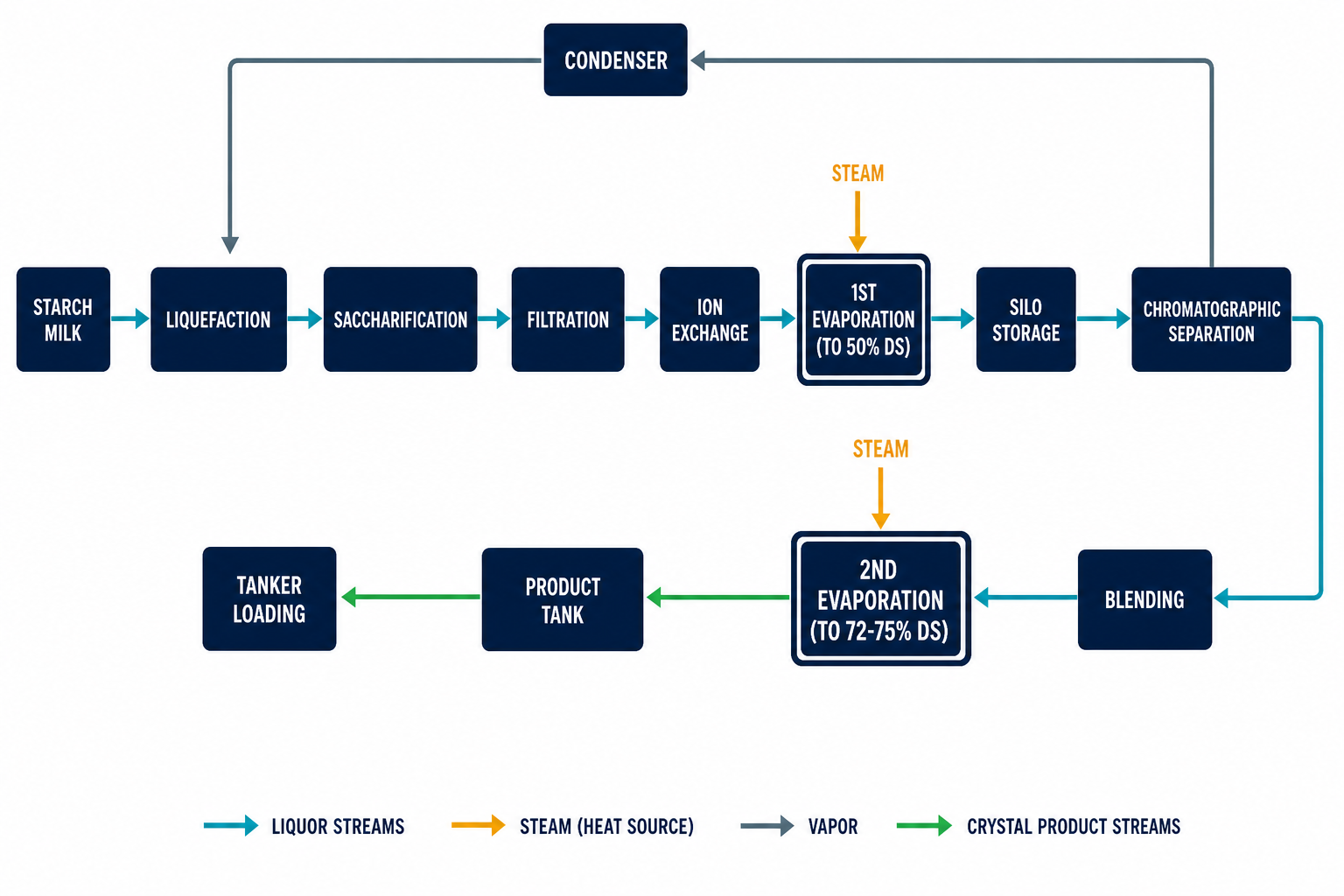
Purification before concentration is not optional sequencing: every ionic and colored impurity that reaches the evaporator concentrates with the sugar and shows up as conductivity, color drift, or crystallization interference downstream. Decolorization in particular protects both the product and the evaporator, since the same colored organics that fail a food specification also polymerize onto heat-transfer surfaces as fouling.
The Concentration Duty: From Thin Liquor to Shipping Solids
Commercial designs concentrate dilute syrup by nearly eight times. In a vendor-published HFCS project in Indonesia — an external industry reference, not an EvapCryst delivery, indicative rather than a project guarantee — a five-effect falling film evaporator with TVR handles 25,000 kg per hour of feed, raising total solids from 10% at inlet to 70–77% in the product. Feed first passes condensate and exhaust-vapor preheaters that recover latent heat from both streams, then distributes uniformly at the top of each calandria through dedicated liquid distributors, falls as a thin film, and boils under vacuum at low temperature with residence time of seconds per pass.
Product families set different final targets, which is why the train is always custom-staged:
| Starch sweetener product | Indicative evaporation endpoint | Notes on the duty |
|---|---|---|
| Liquid glucose (DE 40–60) | ~75–80% DS commercial syrup | Standard thin-to-thick concentration; decolorization quality governs final color |
| Crystalline dextrose | Concentrate to near saturation, then crystallize | Evaporator feeds a cooling or evaporative crystallizer; mother liquor recycles |
| Maltose syrup / maltodextrin | ~75% DS (syrup) or spray-dry from lower DS (powder) | Lower DE syrups are more viscous at equal solids; finishing stage sizing follows |
| HFCS F42 | ~60% DS before chromatography, higher after blending | Concentration deliberately staged around the chromatographic feed specification |
| HFCS F55 | 70–77% DS final | Blended from fructose-rich extract and glucose raffinate streams |
How HFCS Liquor Properties Translate Into Evaporator Design
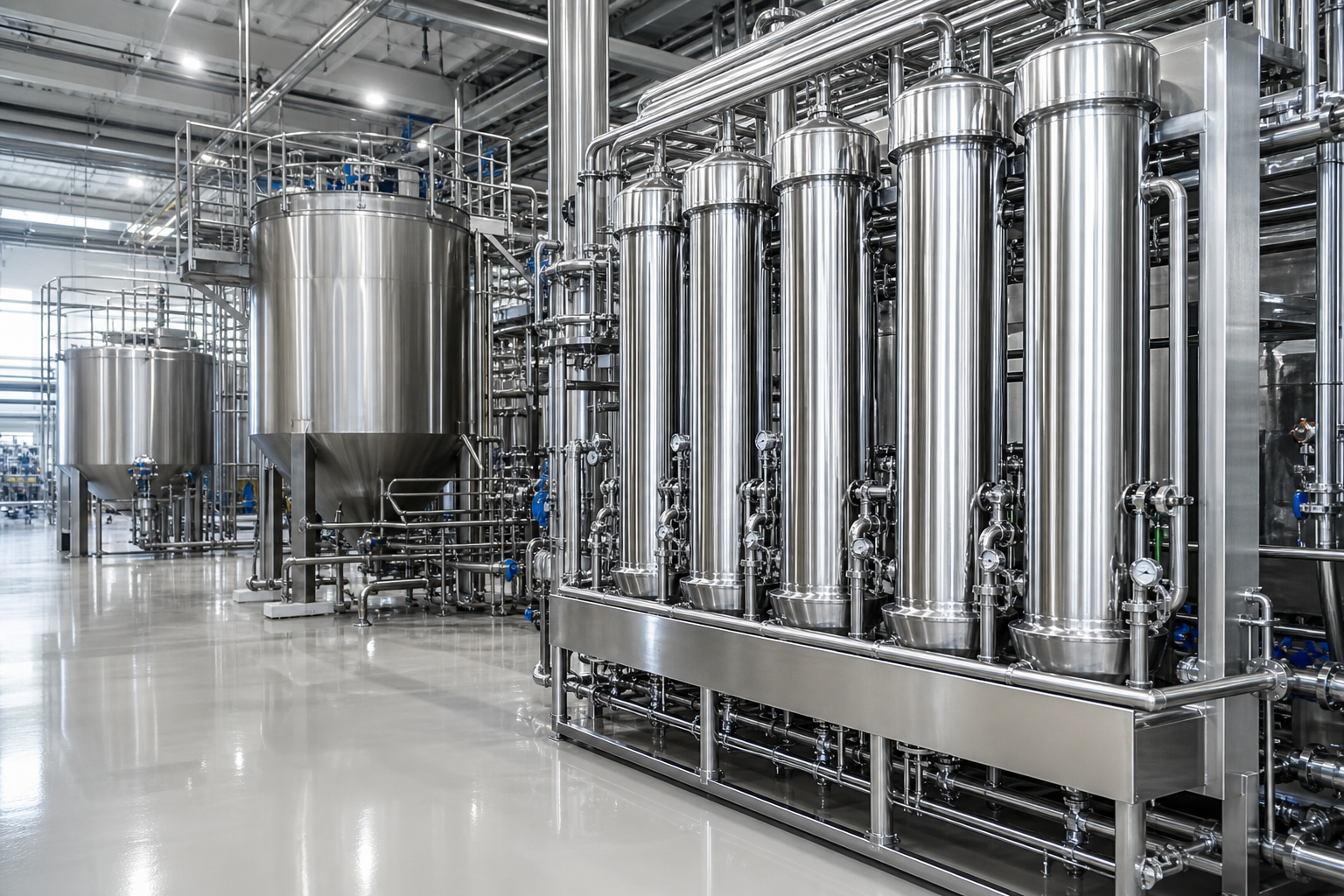
Four properties of high-fructose syrup drive every design decision in the train:
| Liquor property | Consequence if ignored | Design response |
|---|---|---|
| Thermal sensitivity; color formation at elevated temperature | Yellow to brown product, failed food specification | Vacuum operation, small temperature difference per effect, seconds-scale film residence |
| Viscosity rising steeply with concentration | Wetted-wall breakdown, dry spots, fouling at the concentrate end | Distributor and tube sizing for the full concentration range; recirculation or a forced-circulation finisher at high solids |
| Fouling from degradation and trace impurities | Rising ΔT and falling capacity between cleans | Upfront decolorization and ion exchange; automated CIP with alkaline wash, acid wash, and hot water rinse cycles |
| Low foaming versus protein-bearing liquors | Entrainment risk still present at high vapor velocity | Sized demisters and separator geometry; velocity limits on the vapor side |
Ion Exchange: The Quiet Partner of the Evaporator
On F55 fructose lines the ion exchange system runs in three distinct sections, and the evaporator serves each differently: glucose syrup ion exchange ahead of isomerization, F42 ion exchange after the isomerization column, and a mixed-bed polish on the blended F55 product. Cation beds swap calcium, magnesium, and sodium for hydrogen; anion beds swap chloride, sulfate, and nitrate for hydroxide; mixed beds strip the taste and odor bodies that survive single polish. Resin is regenerated with hydrochloric acid and sodium hydroxide on a capacity-based schedule, and regenerated beds re-enter service in the second polishing position before rotating forward, so resin is fully consumed before discharge. The evaporator sees the consequence of this discipline directly: syrup that leaves ion exchange on specification enters the train with low conductivity and deposits little mineral scale, which is the difference between a train cleaned monthly and a train cleaned weekly.
The 60% DS Chromatographic Interface on Fructose Lines
The production of F55 high-fructose syrup proceeds through isomerization and chromatographic separation, and the evaporation train has to serve both. Immobilized glucose isomerase converts glucose to an equilibrium F42 syrup. That syrup is evaporated to roughly 60% dry solids, because the chromatographic separation system is specified around that feed concentration, and enters a simulated moving bed system packed with calcium-form resin: fructose complexes with Ca²⁺ and is retained longer, glucose passes faster, and the feed splits into a fructose-rich extract phase, used to blend F55, and a glucose-rich raffinate, returned to the ion exchange and isomerization front end. Degassing of syrup and desalination of the elution water ahead of the SMB protect the separation resin, which is the most expensive consumable in the flowsheet.
This interface is the reason fructose plants cannot simply maximize final solids in one pass: the train concentrates to 60% for chromatography, and the blended F55 product is re-concentrated or finished to its commercial solids afterward. Evaporation capacity, not crystallizer capacity, is usually the bottleneck on HFCS debottlenecking studies, and the second-stage finisher deserves the same fouling and viscosity engineering as the first.
Energy Configurations: TVR Multi-Effect Versus MVR
Two energy architectures dominate starch sweetener concentration. A five-effect falling film train with thermal vapor recompression uses motive steam to entrain and recompress part of the first-effect vapor, effectively adding an effect at low capital cost; this is the standard choice where the plant already operates a steam system for liquefaction jet cookers and dryers. An MVR system replaces live steam with an electric compressor and suits sites with favorable electricity tariffs or carbon targets. Both reuse the same falling film bodies, distributors, and CIP regimes, so the choice is an economic overlay rather than a mechanical redesign.
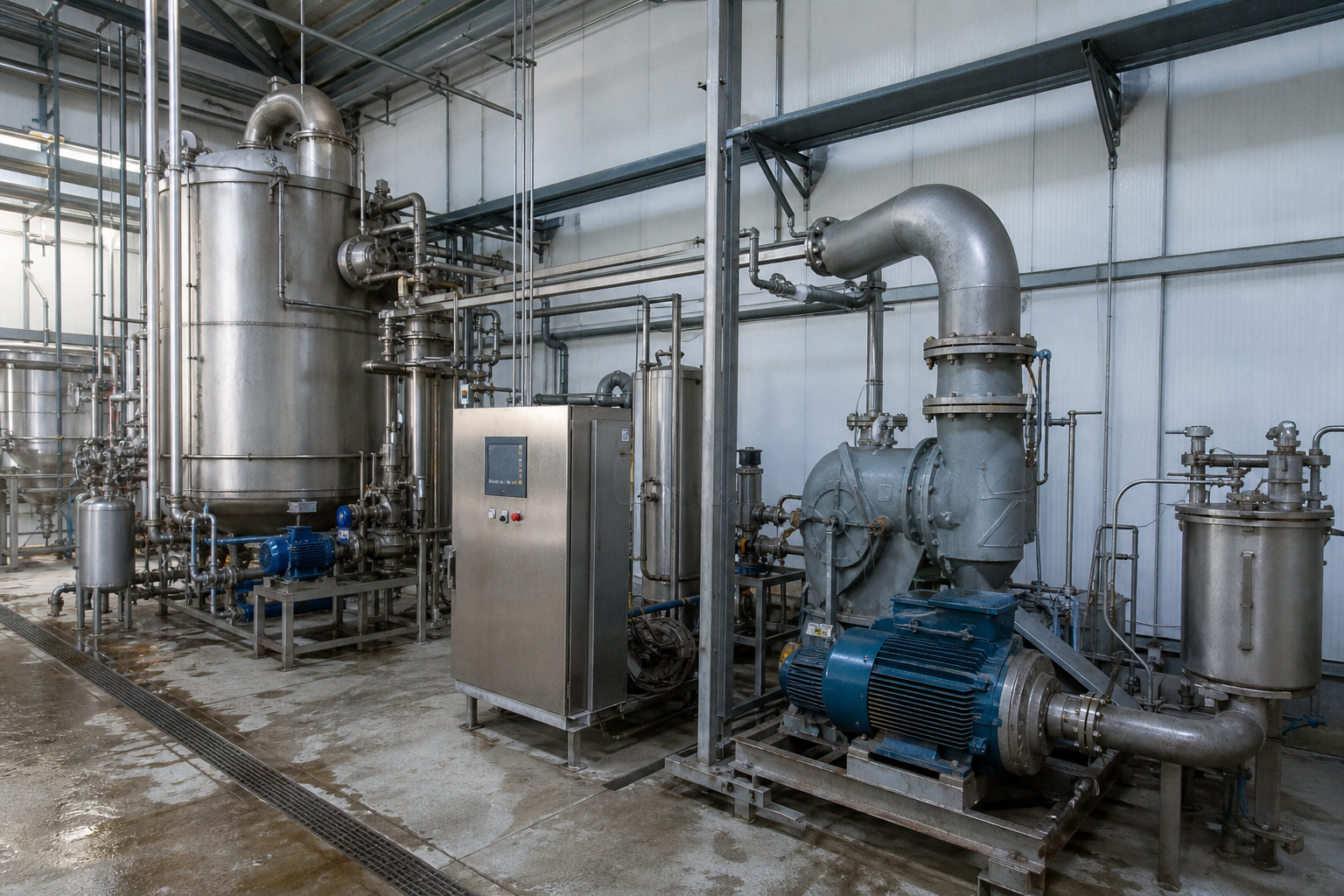
| Process Module | Candidate Equipment Types | Selection Rationale | Indicative Operating Envelope |
|---|---|---|---|
| Feed preheating | Condensate and exhaust-vapor preheaters | Recovers latent heat ahead of the first effect | Per train heat balance |
| Thin-liquor concentration | Falling-film calandria with liquid distributors; TVR or MVR heating | Seconds-scale film residence protects heat-sensitive syrup | Feed ~10–20% DS raised in stages (25,000 kg/h in the published reference) |
| Mid-stream staging (fructose lines) | Dedicated effect section or split train | Chromatographic SMB feed specification sets the target | ~60% DS intermediate |
| High-solids finishing | Recirculation or forced-circulation finisher | Handles steep viscosity at shipping solids | 70–77% DS product (indicative) |
| CIP | Alkaline, acid, and hot-water cycles through distributors | Scheduled cleaning for sugar fouling and changeover | Per fouling and product-switch schedule |
Configuration, materials, and operating ranges depend on actual feed, temperature, pressure, corrosion review, fouling behavior, utilities, and project capacity.
One integration detail separates well-run plants from average ones: the evaporator on a starch site should recover secondary vapor from the liquefaction section as low-pressure heating media, using steam jet pumps to pull flash vapor into the first effect. On a plant that jet-cooks starch continuously, this stream is available every production hour, and designing the evaporator to absorb it displaces live steam that would otherwise be purchased only to be condensed. The governing configurations are detailed on our multi-effect evaporation, falling film, and MVR technology pages, and site-specific economics can be run in the energy cost comparison tool.
CIP, Hygiene, and Product Changeover
Starch sweetener evaporators are cleaned on a scheduled program rather than on demand: alkaline detergent removes organic residue and sugar degradation deposits, acid wash dissolves mineral scale, and hot water rinses clear the system between chemicals and before production. The train is built for this cycle, with smooth product-contact surfaces, self-draining bodies, and CIP supply sized to hold cleaning velocity through the distributor plates, which are the components most prone to hold-up. Plants producing multiple syrups on one train also validate changeover rinsing, because a glucose-to-fructose product switch done carelessly shows up as DE drift in the first hours of the new run.
Related Applications
The same evaporation engineering, thin-film vacuum concentration of heat-sensitive sugar liquors, extends to the adjacent product families covered elsewhere on this site: sugar alcohol production for erythritol, sorbitol, and allulose, and the broader food and beverage evaporation solutions portfolio. Fermentation-complex integration patterns are described on the food and fermentation industry page.
When This Route May Not Fit
Full staged trains are not for every sweetener site. Below roughly mid-scale throughputs, a single- or double-effect unit with simple steam heating concentrates modest flows without the capital and complexity of five effects or MVR. Products shipped at low solids — below about 50% DS — never meet the viscosity wall that justifies a dedicated finisher. Where the site already vents abundant waste-heat steam, electrification via MVR may only raise operating cost and carbon accounting complexity. Highly regulated or pharmaceutical-grade syrups with near-zero cross-contamination tolerance often justify dedicated lines rather than a shared multi-product train. And a plant unwilling to maintain the ion-exchange and decolorization front end will spend its margins cleaning the evaporator instead.
What Must Be Verified
Validation focus: the full product portfolio with its solids targets and viscosity-temperature curves, because the most viscous product at its highest concentration sizes distributors, tubes, and the finisher. Color and heat budget must be demonstrated against specification — vacuum level, per-effect temperature difference, and film residence time on the actual syrup. Feed conductivity and color after ion exchange and carbon should be confirmed as the evaporator’s fouling baseline. Foaming behavior at high vapor velocity checks separator and demister sizing. The TVR-versus-MVR decision needs the site’s real tariff sheet, including waste-heat availability, and changeover rinse protocols need validation before multi-product operation is promised.
Frequently Asked Questions
What solids content does starch syrup evaporation need to reach?
Commercial glucose and fructose syrups ship at 70–77% dry solids, while feed enters evaporation below 20% and sometimes as dilute as 10%, so the evaporator removes three quarters or more of the feed mass. Fructose lines add an intermediate target of about 60% DS ahead of chromatographic separation.
Why is F42 syrup concentrated to only 60% before chromatography?
Simulated moving bed chromatography on calcium resin is specified around a feed near 60% dry solids; viscosity and diffusion set that window. The fructose-rich extract and glucose-rich raffinate leave at lower concentration and are re-concentrated or recycled, which is why fructose plants stage evaporation instead of maximizing solids in one pass.
Should a starch sweetener plant choose TVR or MVR evaporation?
TVR multi-effect suits sites with an existing steam system and cheap fuel, since it adds recompression capacity at low capital cost. MVR suits sites where electricity is competitive with steam or where carbon accounting favors electrification. Both use the same falling film bodies, so the decision should be made from the site utility tariff sheet, not the equipment catalog.
How is fouling controlled in syrup evaporators?
Fouling is controlled upstream and by cleaning design: activated carbon and ion exchange remove the organics and minerals that would concentrate onto tubes, vacuum and thin films keep wall temperatures low, and automated CIP alternates alkaline detergent, acid wash, and hot water rinse on a fixed schedule sized to the distributor geometry.
Can one evaporation train serve glucose, maltose, and fructose products?
Yes, with staged design and disciplined changeover. The train must be sized for the most viscous product at its highest solids, and validated rinse procedures are required between products to prevent DE and fructose-content drift. Dedicated finishing capacity for fructose re-concentration after chromatography is common on multi-product sites.
Planning a starch sweetener evaporation train? Send the product slate, feed and target dry solids, throughput, and the site utility tariffs — in exchange you will receive a first-pass screening of the train arrangement, energy configuration (TVR versus MVR), and staging your products require.