Project Parameters
| Parameter | Value |
|---|---|
| Process route | Evaporation concentration + freeze (cooling) crystallization for Glauber salt recovery |
| Industry | Inorganic salt production / sodium sulfate refining |
| Feed type & key components | Sodium sulfate-rich brine and sulfate mother liquor from salt-field and chemical operations |
| Evaporation capacity | 10 t/h |
| Construction materials | SS316L wetted parts (indicative for neutral sulfate service) |
Representative process configuration compiled from published industry project data. Indicative values, not a process guarantee.
Project Description
A sodium sulfate production and refining site in East China, in the Shandong region, works with sulfate brines whose composition sits deep inside the Glauber salt crystallization field. The site’s commercial target is a clean, marketable sodium sulfate product rather than mere volume reduction: mixed or uncontrolled crystallization yields off-spec salt, and every ton of sulfate that leaves the plant as low-grade material erodes margin. Recovering sulfate as high-purity Glauber salt (Na2SO4·10H2O), then converting toward anhydrous product, is what turns the brine into revenue.
The reference configuration for this duty is a 10 t/h train that pairs evaporation with freeze crystallization. The logic is dictated by the chemistry: sodium sulfate solubility falls steeply as temperature drops below the Glauber transition point, so chilling a concentrated liquor precipitates crystal hydrate efficiently without boiling away the water. Evaporation alone would demand far more energy per ton of salt; freezing alone cannot lift a dilute brine into the crystallization window. The combination of the two unit operations is the economical route.
Process Technology
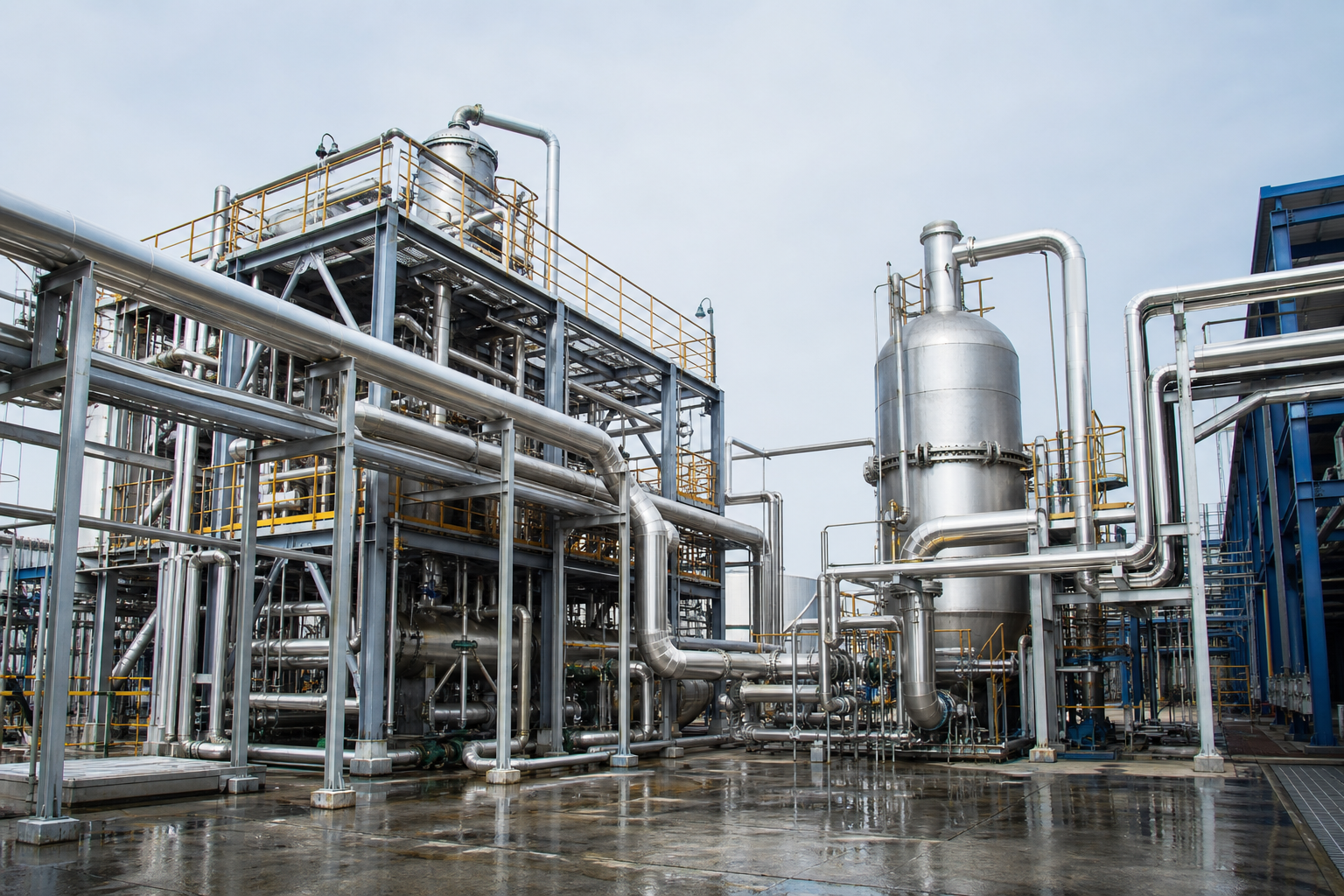
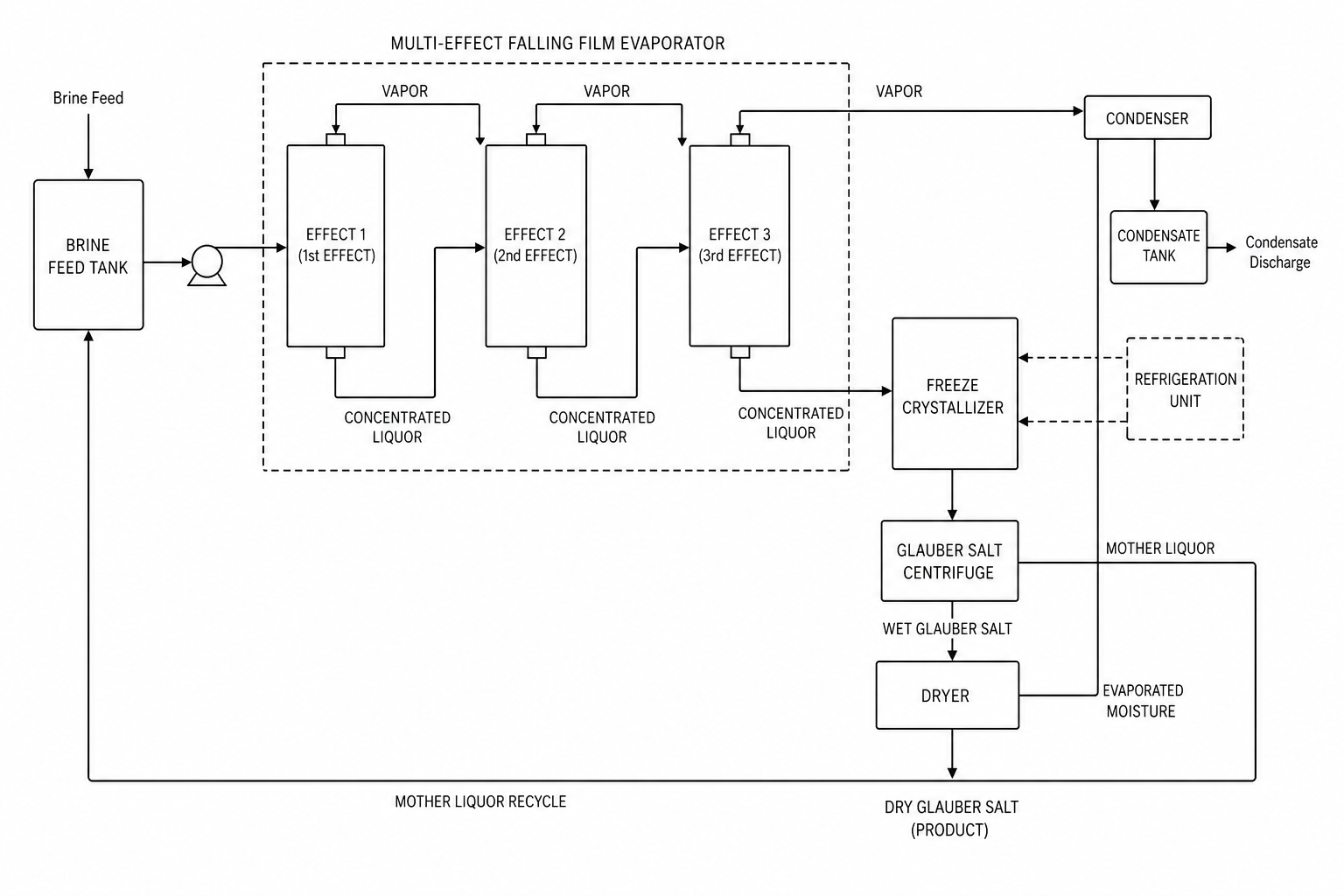
Brine is received in an agitated feed tank where suspended solids are settled and traces of hardness are controlled, protecting both the heat transfer surface downstream and the crystal quality at the cold end. The conditioned liquor then enters the evaporation section, which concentrates the feed to a sulfate level at which the subsequent cooling step becomes productive.
The evaporator operates as a multi-effect system: vapor boiled off in the first effect heats the second, so the fresh-steam demand is a fraction of single-effect evaporation. Concentration is stopped short of sulfate saturation at hot conditions — pushing further would invite wall crystallization and fouling — and the hot concentrate is transferred to the crystallization section.
Freeze crystallization is the salt-recovery heart of the train. The concentrated liquor is chilled in a controlled fashion, either under vacuum or through surface-cooled crystallizers with scraped or agitated heat exchange, driving the solution into the Glauber stability field. Sodium sulfate decahydrate nucleates and grows as discrete crystals while impurities remain preferentially in the mother liquor. Crystal growth is managed for size and washability: a well-grown Glauber crystal dewaters and washes cleanly on a centrifuge, while a fined-up slurry carries mother liquor into the product.
Dewatered Glauber salt proceeds to drying and, where the offtake requires anhydrous material, to a melting-and-recrystallization or direct drying conversion step. The mother liquor, still carrying soluble impurities and unrecovered sulfate, recycles to the evaporator feed; a small controlled purge prevents impurity build-up over cycles. Condensate from the evaporation effects is collected as clean warm water for plant use.
Around the crystallizer, the control philosophy concentrates on two variables. The chilling curve sets the supersaturation the crystals actually see: cool too fast and nucleation runs away into fines that blind the centrifuge; cool too gently and the train loses capacity. The suspension density in the crystallizer body sets the growth surface available, which is how the operator holds crystal size across feed swings. Both loops run automatically against density and temperature measurements, with the refrigeration plant following the heat balance rather than leading it.
Equipment Configuration
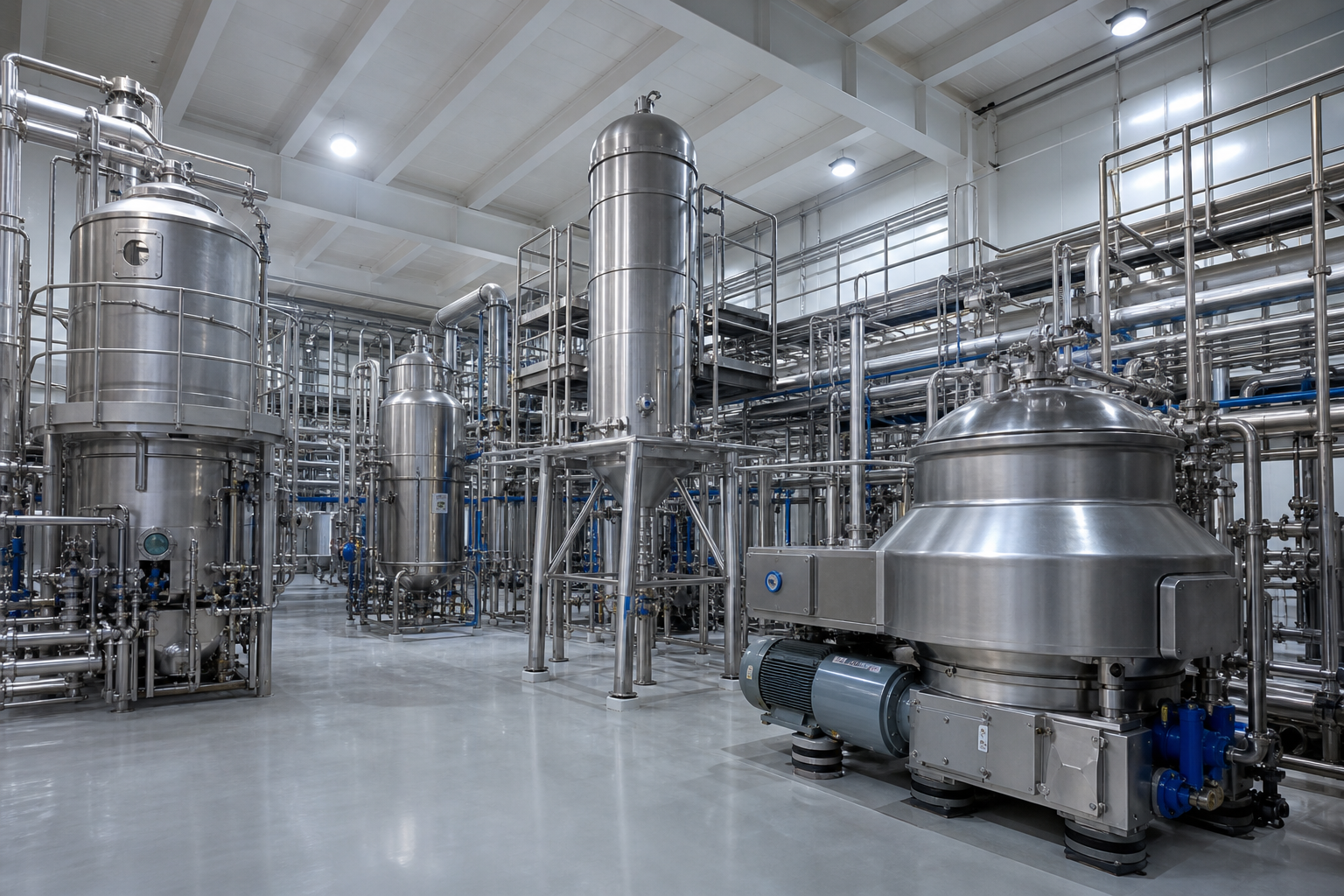
One set of the following equipment is typical for this duty:
- Brine feed tank with conditioning and hardness control ahead of evaporation
- Multi-effect evaporator (falling-film concentration bodies) with thermo-compressor or live-steam first effect
- Freeze crystallization section: chilled or vacuum-cooled crystallizers with refrigeration or vacuum plant and agitated heat exchange
- Glauber salt centrifuge with washing, plus mother-liquor return to the feed tank
- Dryer and optional anhydrous conversion (melt / recrystallization) for product finishing
- Condensate collection and warm-water recovery; PLC control of concentration density, chilling curve and purge ratio
SS316L is the reference wetted material for neutral sodium sulfate service; low-temperature sections in chilled brine can be configured with matching austenitic grades, and higher-alloy wetted parts are specified where chloride excursions are expected.
Performance & Outcome
Compiled from published industry project data, indicative: evaporation-plus-freeze trains of this class recover sodium sulfate as a washable Glauber salt that converts toward anhydrous product grades, recycle the majority of the water as clean condensate, and hold impurities in a small controlled purge. Energy figures depend on the chilling depth required and the feed sulfate concentration and are quoted per project.
For context on where this equipment class fits, see Salt Separation & Resource Recovery Systems.