Project Parameters
| Parameter | Value |
|---|---|
| Process route | Aeration & DAF pretreatment + chemical sedimentation + plate-type MVR forced-circulation evaporation crystallization + tail-water safeguard |
| Industry | Shale gas field services, high-salinity wastewater ZLD (Southwest China) |
| Feed type & key components | Fracturing flowback water: high hardness, high TDS, high COD with residual gel breakers and surfactants |
| Evaporation capacity | 1,000 m³/d design throughput (plant total) |
| Construction materials | Plate heat exchanger evaporation train; alloy selection per chloride service (indicative) |
Representative process configuration compiled from published industry project data. Indicative values, not a process guarantee.
Project Description
Shale gas acreage in the karst terrain of Southwest China produces a flowback stream that concentrates three problems at once: the hardness of the formation water, the salinity carried up with it, and the COD contributed by gel breakers, friction reducers and surfactants pumped downhole. Landlocked disposal wells are scarce in the region, and trucking to a distant injection site puts a permanent cost on every cubic meter produced. The representative configuration answers that constraint with a plant designed for 1,000 m³/d at a gas field in the Zunyi area of Guizhou province, run by the operator as a self-invested production facility rather than a disposal contract.
The design philosophy is a deliberately short route. Instead of stacking membrane stages, advanced oxidation and evaporation end to end, the train compresses the flowsheet into pretreatment, a single plate-type MVR evaporation crystallization step, and a tail-water safeguard — fewer unit operations to staff, fewer chemicals to dose, and a smaller footprint on difficult mountain sites.
Process Technology
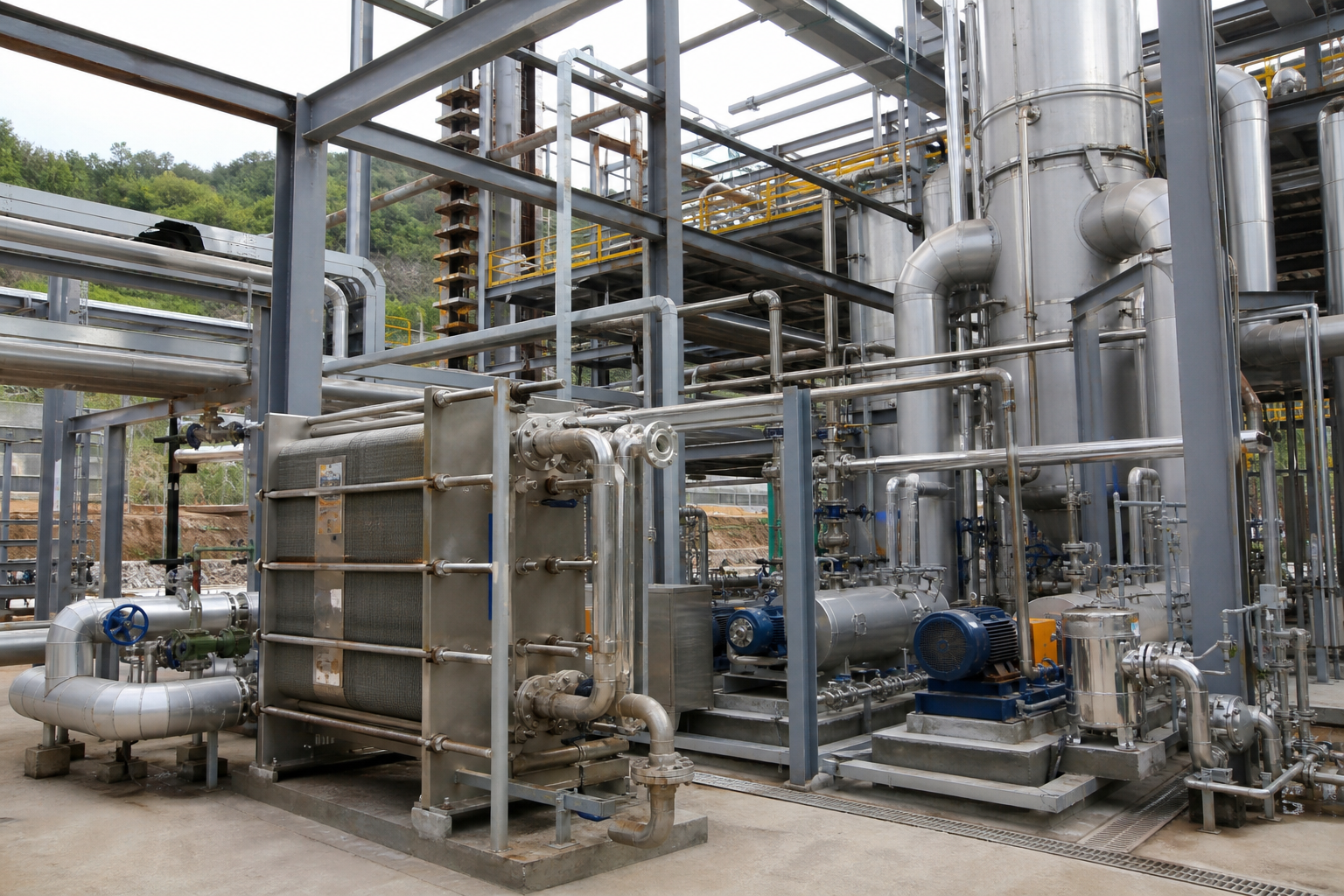
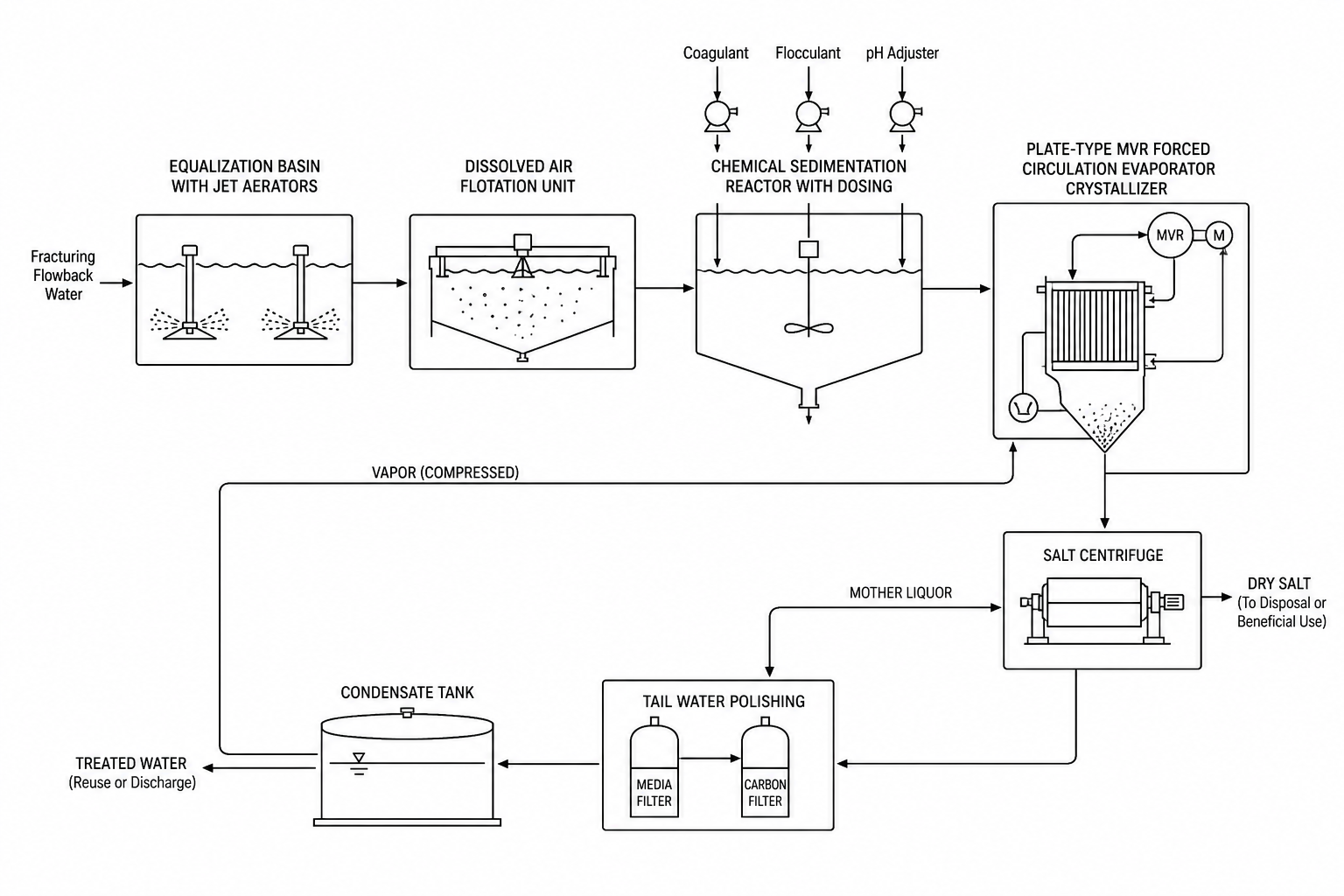
Raw flowback water is collected and equalized, then aerated through jet aerators to strip volatile components and keep the basin mixed. Dissolved air flotation follows, pulling suspended oil and flocculated solids out ahead of the evaporator — the organics and oils that would otherwise foul heat transfer surfaces or carry into the condensate.
Reaction sedimentation removes hardness: alkali and flocculant dosing precipitate calcium and magnesium as sludge before the liquor ever sees the boiling zone. The clarified brine then enters the plate-type MVR forced-circulation train. Plate heat exchanger bodies give the evaporator a high heat transfer coefficient in a compact frame; forced circulation sweeps the evaporating liquor across the plates at velocity, suppressing scaling in a feed that is, by nature, a scale-former.
Water leaves as condensate and salt leaves as crystal slurry. A tail-water safeguard stage polishes the condensate so that the plant’s water product meets GB 8978-1996 level-1 discharge criteria under the reference configuration, with online monitoring on hardness, COD and conductivity. The crystallized salt is dewatered for disposal or off-take depending on local acceptance.
The plant runs under intelligent central control: online water-quality monitoring, self-diagnosis and alarm functions across the train, so that a mountain-site facility can be supervised with a small crew. Comparable published flowback configurations in North and Northwest China run the same evaporation-crystallization chemistry at 90 t/d and 600 t/d scales, confirming the route across the gas field sector.
Equipment Configuration
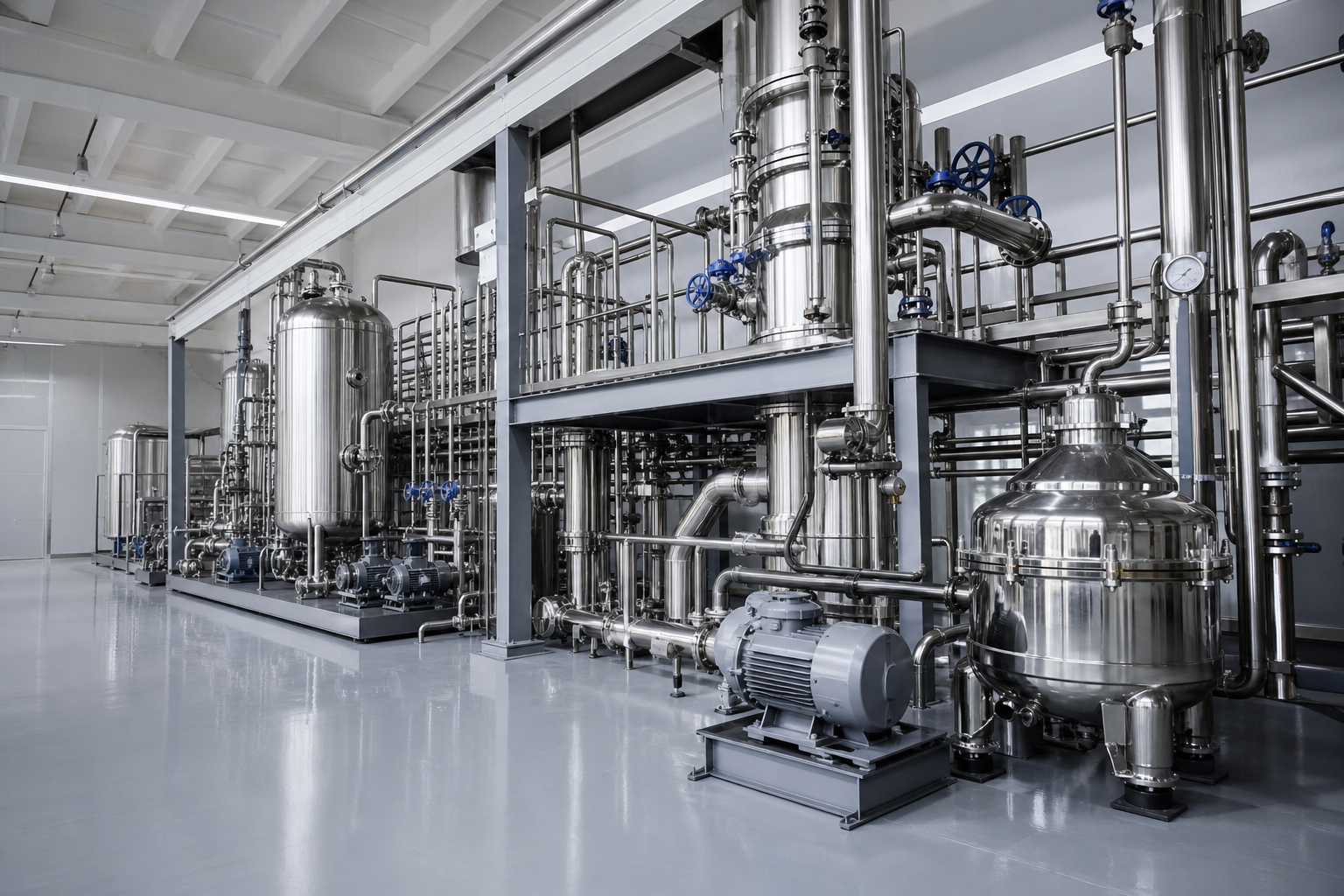
One set of the following equipment is typical for this duty:
- Flowback collection and equalization basin with jet aeration
- Dissolved air flotation for oil and suspended solids
- Reaction sedimentation with alkali and flocculant dosing for hardness removal
- Plate-type MVR forced-circulation evaporation crystallization train
- Tail-water safeguard polishing with online quality monitoring
- Central intelligent control system with self-diagnosis and alarms
Performance & Outcome
Compiled from published industry project data, indicative: short-route plate MVR trains of this class convert 1,000 m³/d of high-hardness, high-salinity flowback into GB 8978-1996 level-1 water product with salt dewatered at source, on electrically driven evaporation energy and an unattended-leaning control philosophy. Specific energy and salt quality are quoted per project brine.