Project Parameters
| Parameter | Value |
|---|---|
| Process route | Integrated evaporation & crystallization across starch, fermentation and refining sections |
| Industry | Food & fermentation / amino acids — corn deep processing |
| Feed type & key components | 1,500,000 tpy corn input; threonine and tryptophan fermentation broths, starch milk, steep water, glucose streams |
| Scale | 1.5 million tpy corn processing — among the largest single corn-to-amino-acids projects in China |
| Project timeline | Designed 2017; trial-run production 2019 |
| Construction materials | SS304/SS316L wetted parts (food-grade) |
Representative process configuration compiled from published industry project data. Indicative values, not a process guarantee.
Project Description
Designed in 2017 and in trial-run production by 2019, the 1.5 million tpy corn deep-processing project behind this configuration stands among the largest single corn-to-amino-acids investments in China, located in the Northeast corn belt where the raw material sits. The plant converts corn into starch and glucose streams, ferments the glucose to threonine and tryptophan, and refines the amino acids to feed-grade and food-grade products — with evaporation and crystallization plants woven through every section.
The published record for this project class highlights what large scale buys: unit water consumption and unit power consumption 15% or more below the industry average, near-zero discharge across the site, and comprehensive by-product utilization — corn germ, gluten, fiber and fermentation residues all leaving as products rather than waste. Evaporation is where those numbers are earned: a corn-to-amino-acids plant evaporates tonnes of water for every tonne of product, and the integration between evaporator effects, condensate returns and crystallizer heat duty is the difference between an average and a benchmark site.
Process Technology
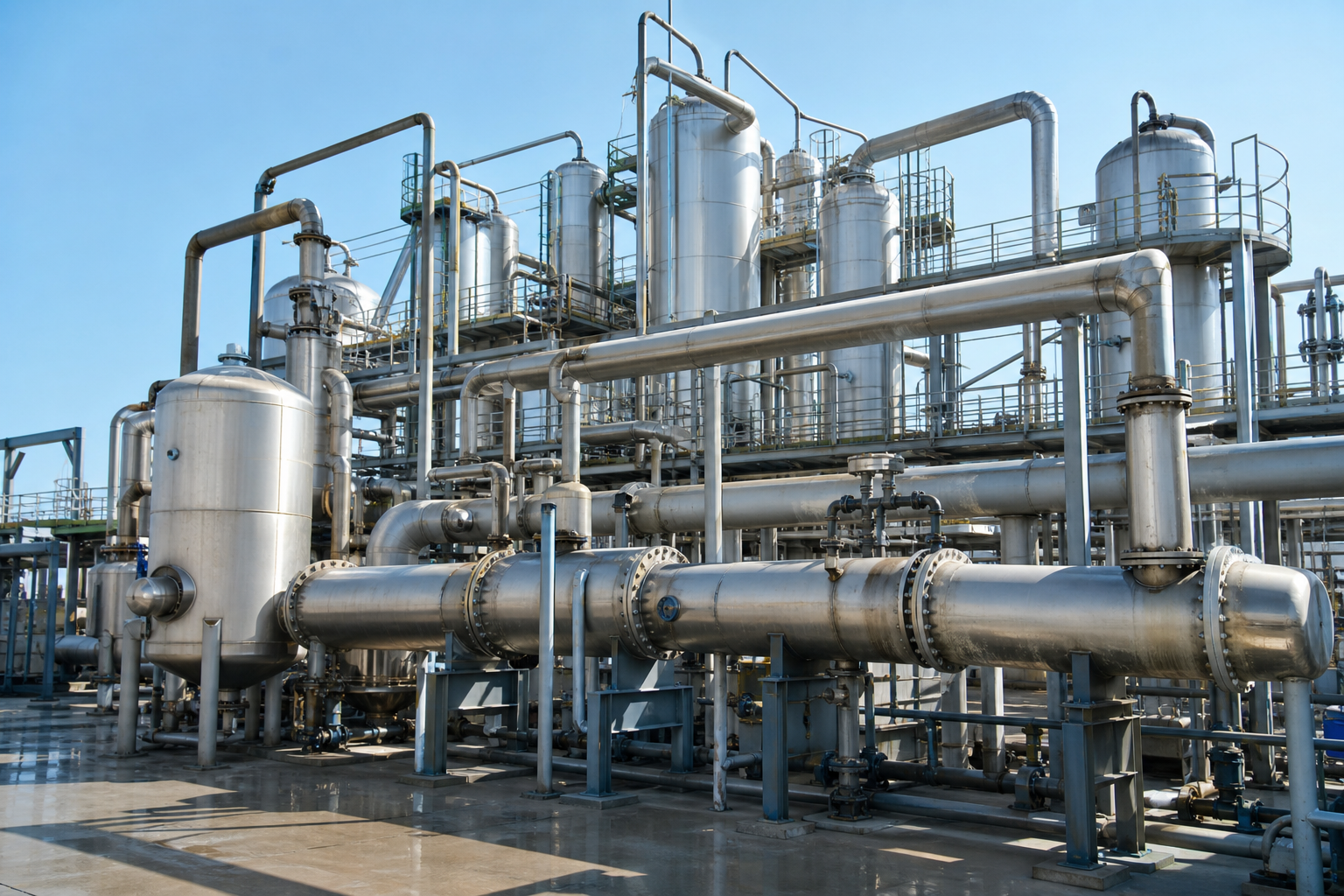
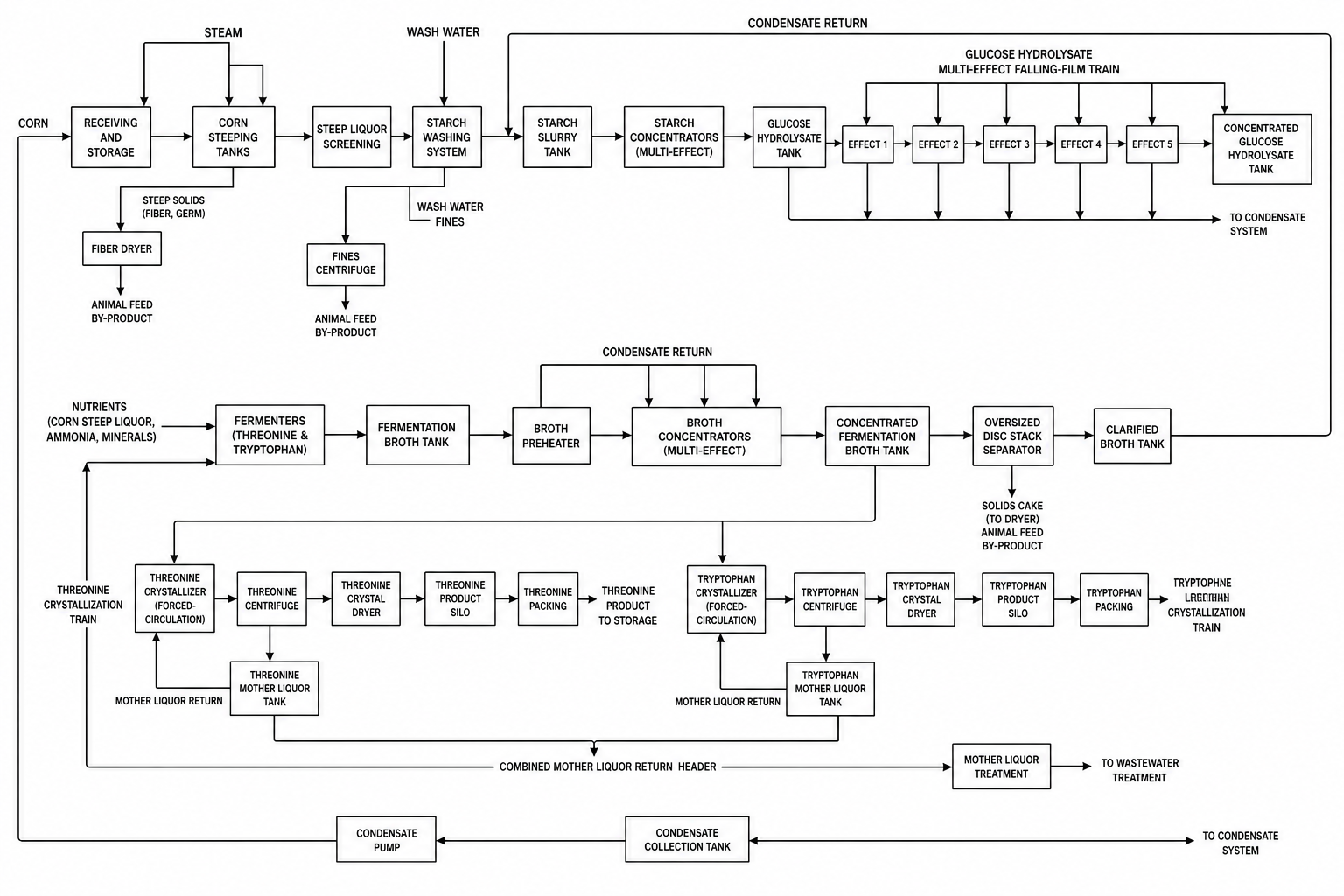
The evaporation scope spans four duty families. In the wet-milling front end, steep water and starch milk washing demand low-temperature, hygienic concentration with condensate returned directly to process. In the glucose section, enzymatic hydrolysate concentrates in falling-film service — short contact time protecting sugar color — feeding fermentation preparation at controlled solids. In the fermentation section, broth concentration ahead of refining handles high-organic, foaming feeds with oversized separators and gentle thermal profiles. And in the amino-acid refining sections, threonine and tryptophan mother liquors concentrate and crystallize in forced-circulation service, where the amino acids are grown, centrifuged, dried and packed.
Energy integration is the plant’s signature. Multi-effect evaporator trains reuse vapor body-to-body; condensate flashing recovers sensible heat to preheat feeds; and thermal vapor recompression injects motive steam into effect vapor where the site steam balance favors it. Crystallizer mother liquors return to the front of their trains, so the only water leaving the site is clean condensate and vapor — the near-zero discharge claim in the published record.
Product crystallization is staged per amino acid: threonine crystallizes readily from refined liquor with classified withdrawal and wash control governing purity; tryptophan, produced at smaller volume and higher value, runs tighter supersaturation control and gentler handling through centrifuge and low-temperature drying to protect crystal quality. Both close with dryers and packing for feed-grade output.
Comparable single-product plants from the same technology family — an 80,000 tpy threonine project with a 10 tph evaporative crystallization system, published by the same engineering source — fix the scale relationship between amino-acid capacity and crystallization duty, confirming the sizing logic inside this integrated plant.
Equipment Configuration
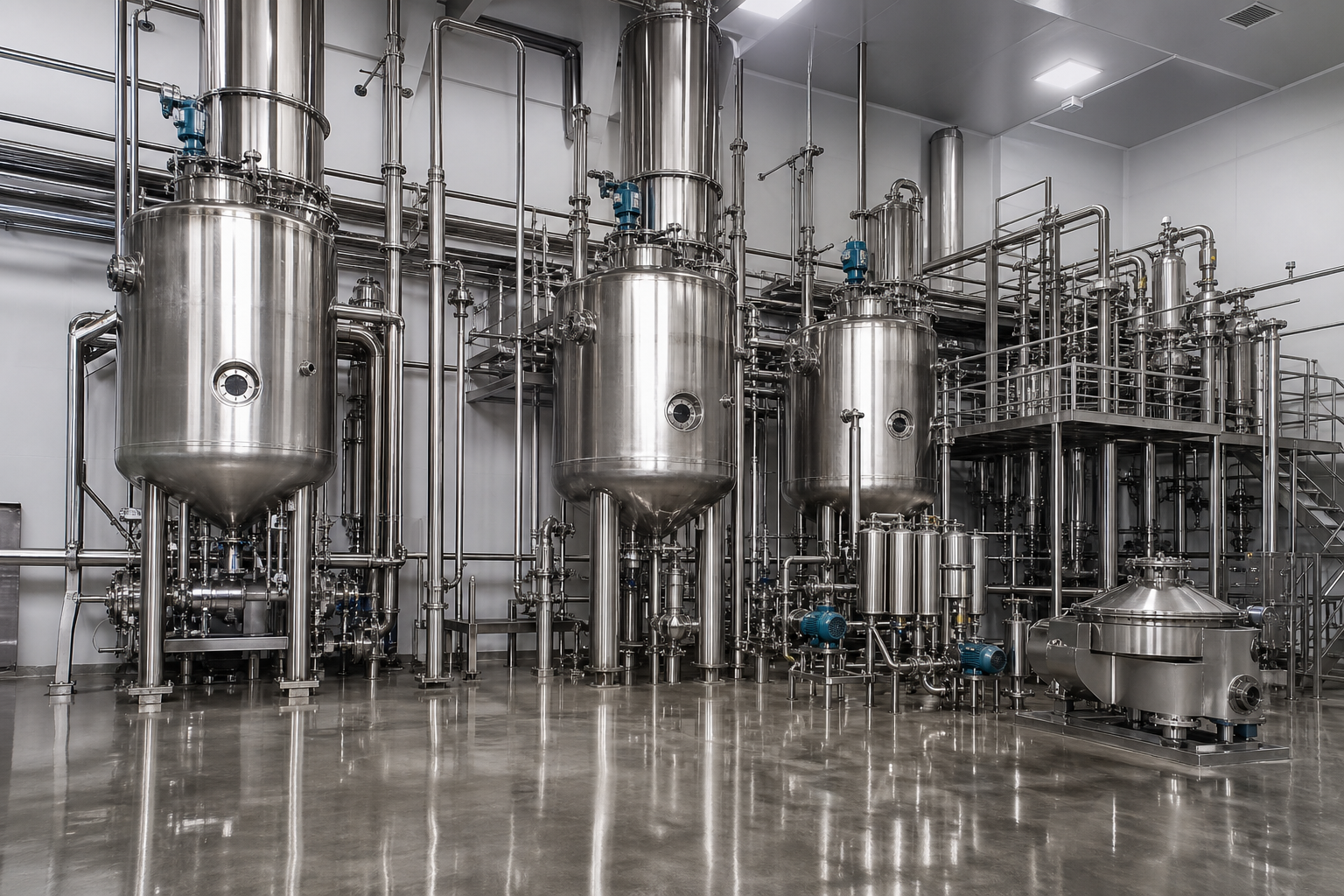
One set of the following equipment is typical for this duty:
- Steep-water and starch-section hygienic falling-film concentrators with process-water condensate return
- Glucose hydrolysate multi-effect falling-film train feeding fermentation preparation
- Fermentation broth concentration with foam-tolerant oversized separators
- Threonine and tryptophan forced-circulation crystallizers with classified withdrawal
- Centrifuges, dryers and packing for feed-grade amino acids
- Mother-liquor returns, TVR/multi-effect energy integration, DCS control site-wide
Performance & Outcome
Compiled from published industry project data, indicative: unit water and power consumption at 15%+ below industry average as reported in the published source, near-zero discharge, and full by-product utilization for this class of 1.5 million tpy integrated plant. Amino-acid grades and per-section energy figures are quoted per project.
Project economics of this scale are discussed further in Threonine Fermentation Broth Evaporation & Crystallization.