Project Parameters
| Parameter | Value |
|---|---|
| Process route | MVR plate falling-film + tubular falling-film concentration; MVR double-effect trains on salt-bearing streams |
| Industry | Pharmaceutical intermediates — fermentation API environmental station |
| Feed type & key components | Antibiotic intermediate wastewater; sodium sulfate-bearing stream; ammonium chloride-bearing stream |
| Evaporation capacity | 396 t/h ×5 trains + 124 t/h ×1 + 32 t/h ×1 (approx. 2,136 t/h total installed) |
| Construction materials | SS316L / higher alloys per stream (indicative) |
Representative process configuration compiled from published industry project data. Indicative values, not a process guarantee.
Project Description
A large fermentation-platform pharmaceutical site in Xinjiang, Northwest China, producing antibiotic intermediates at the ten-thousand-ton scale, operates a dedicated environmental station that receives three distinct high-salinity streams from production: a general antibiotic intermediate wastewater, a sulfate-rich stream and an ammonium chloride-bearing stream. Under the site’s zero-discharge commitment, none of the three may leave the battery limit as brine, and the volumes involved — of an order rarely seen in pharmaceutical environmental engineering — rule out treatment by anything less than a fully engineered evaporation program.
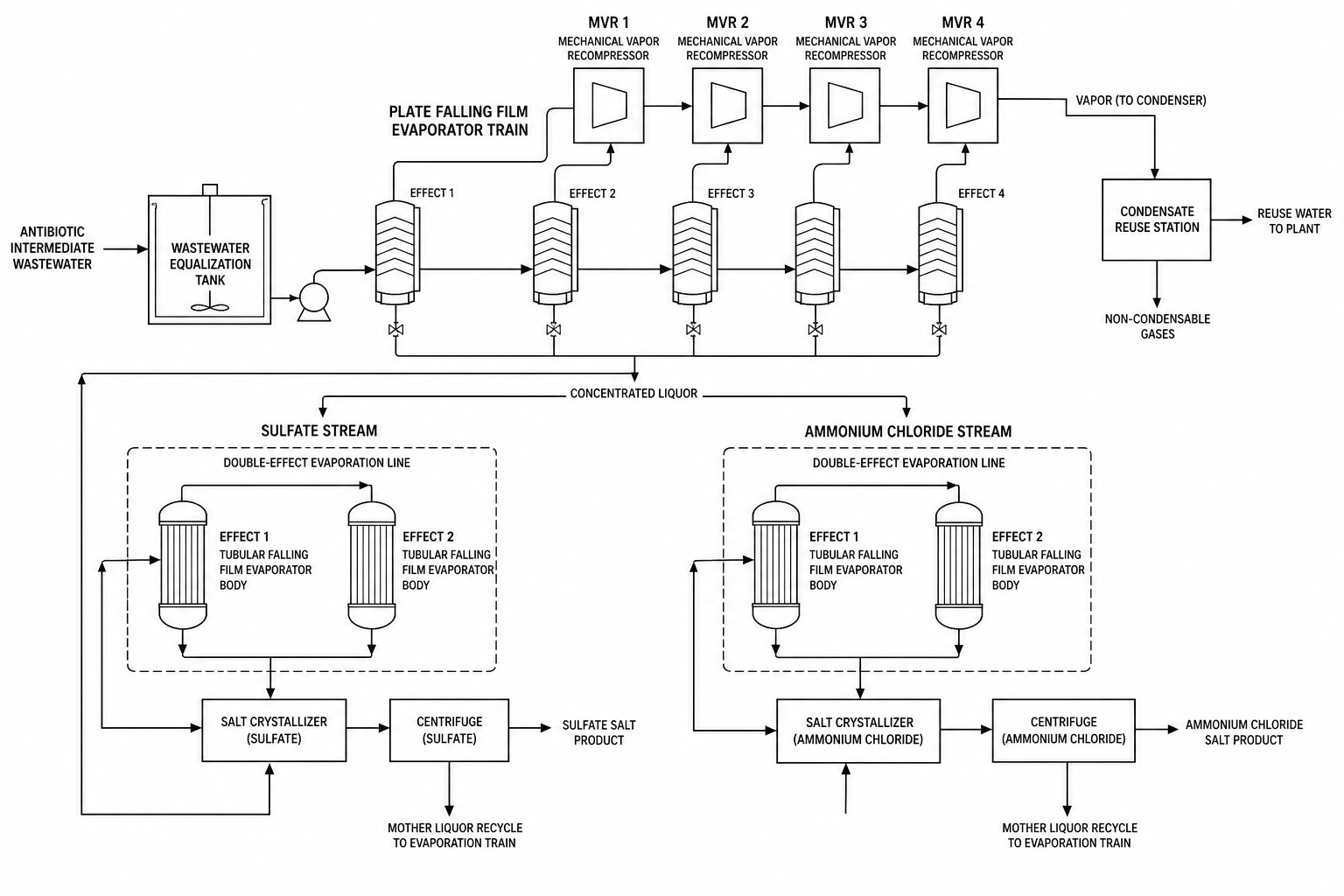
The reference configuration is a seven-train program: five 396 t/h lines built around MVR plate falling-film and tubular falling-film bodies, plus one 124 t/h and one 32 t/h MVR double-effect line covering the salt-bearing and smaller streams. The split reflects the stream map rather than a single duty: high-volume main wastewater is concentrated in the large lines, while sulfate- and ammonium-bearing liquors are processed on trains whose metallurgy and crystallization ends are matched to their salt chemistry.
Process Technology
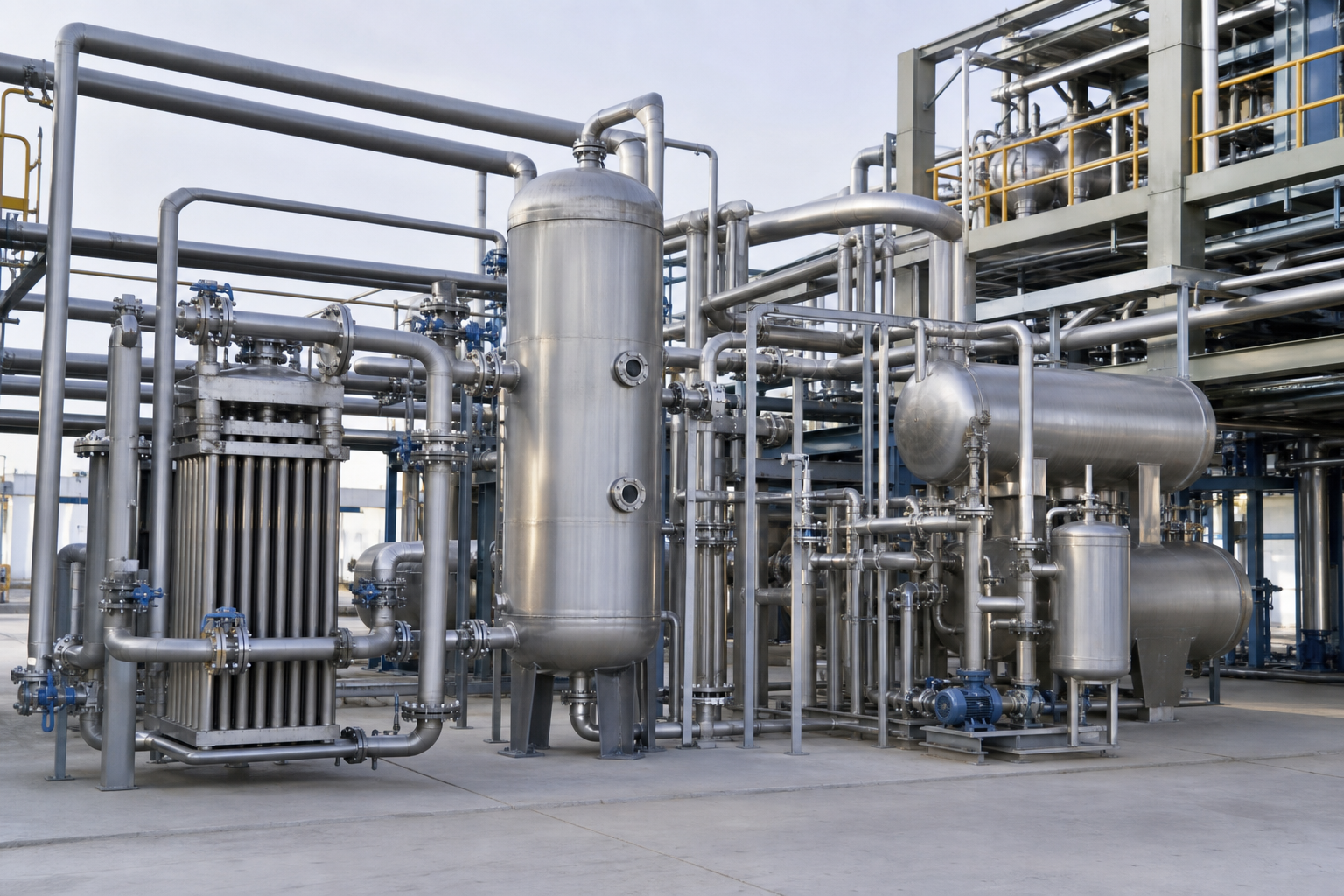
Each main train follows the same logic at its own scale. Wastewater is equalized, screened for residual antibiotic activity and suspended solids, then preheated against outgoing streams. In the concentration section, plate falling-film bodies handle the early, lower-viscosity evaporation duty: their corrugated channels sustain high transfer coefficients in a compact frame, which matters when five identical lines must share a finite plot. Tubular falling-film bodies carry the duty as concentration and viscosity rise, with wider passages tolerating the heavier liquor toward the back end of the train.
All large lines run under mechanical vapor recompression. Secondary vapor is cleaned in demisters, compressed electrically, and returned as heating vapor, so steady-state steam consumption is close to zero across a program of this size — the economic foundation on which a 2,000 t/h class evaporation program becomes defensible at all.
The salt-bearing streams are processed on the MVR double-effect trains. The sulfate-bearing liquor is concentrated to the sodium sulfate crystallization window and the salt is recovered as a solid stream; the ammonium chloride liquor follows its own crystallization route. Mother liquors recycle internally with a controlled purge for organics management, and condensate from the whole program is collected for reuse in the environmental station and production utilities.
Equipment Configuration
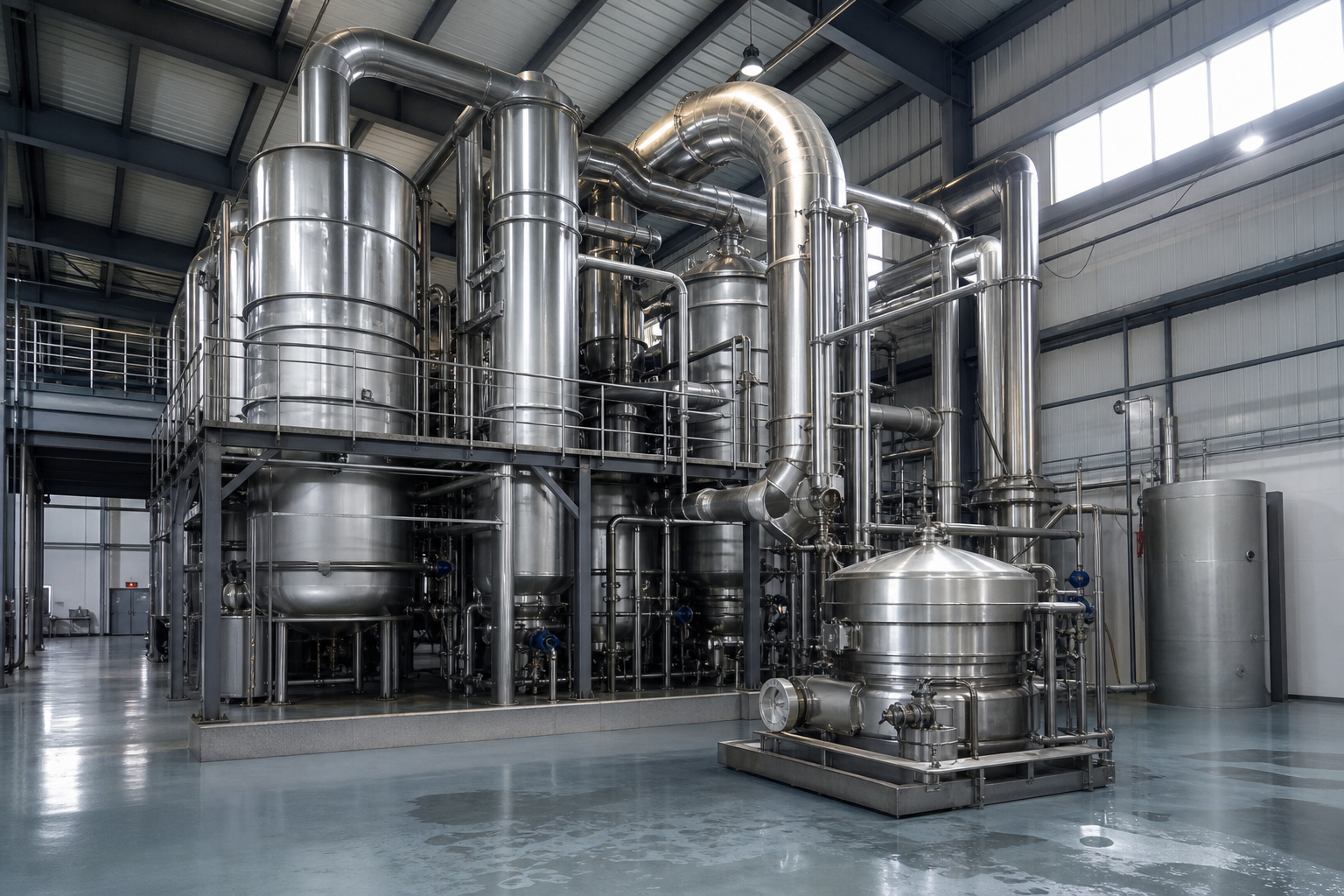
One program of this class includes, per train and in common:
- Stream-specific equalization and filtration, with monitoring of residual antibacterial activity ahead of evaporation
- MVR plate falling-film bodies (front duty) and tubular falling-film bodies (back duty) on the 396 t/h lines
- MVR double-effect evaporation and crystallization packages for the sulfate- and ammonium-bearing streams
- Mechanical vapor recompressors with anti-surge and variable-frequency control on every line
- Crystallizers, dewatering and salt handling matched to each salt chemistry; condensate collection and reuse station common to the program
- Program-level DCS balancing the seven trains against the production campaign
SS316L is the indicative baseline for neutral service, with higher alloys on the chloride- and ammonium-bearing circuits where hot-end chloride concentration demands them.
Performance & Outcome
Compiled from published industry project data, indicative: programs of this class concentrate antibiotic intermediate and salt-bearing wastewater at total installed capacities above 2,000 t/h, recover sodium sulfate and ammonium chloride as separated solid streams, and return condensate to plant reuse under zero-discharge commitments. Energy, salt purity and recovery figures depend on stream composition and campaign loading and are validated per project.