Engineered ZLD and resource recovery for textile and dyeing operations — high-COD, high-color, high-salt effluent with caustic recovery, dye recovery and mixed-salt separation opportunities.
Feed typically presents COD 1,000–15,000 mg/L, color >1,000 Pt-Co and NaCl / Na₂SO₄ at 1–8%, with 60–75% heat recovery available from 60–90°C effluent — targeting reusable-grade salt (Ca²⁺ / Mg²⁺ <10 mg/L, Fe³⁺ <5 mg/L).
Textile wastewater combines four of the most punishing characteristics for evaporation and crystallization systems. Solving them together — not in isolation — is what defines a workable route.
Dye molecules, auxiliaries, surfactants and sizing agents (PVA, starch) produce COD 1,000–15,000 mg/L — much of it biologically refractory (anthraquinone, azo chromophores). Direct crystallization yields colored, organic-contaminated salt; AOP + biological pre-treatment decides downstream salt quality.
Residual reactive and disperse dyes (color >500–2,000 Pt-Co) carry through conventional treatment and stain the salt product. Color removal before evaporation (target <50 Pt-Co) is a product-quality decision, not just an aesthetic one — dyeing customers reject colored salt at >100 Pt-Co.
Reactive dyeing uses 40–80 g/L NaCl or 20–40 g/L Na₂SO₄ as electrolyte; the salt is the dominant mass flow in the wastewater (5,000–80,000 mg/L TDS). Separating it into a reusable dyeing-grade product (Ca²⁺, Mg²⁺, Fe³⁺ each <5–10 mg/L) is the economic case for ZLD vs. paying $80–200/t for hazardous mixed-salt disposal.
Dyeing effluent leaves the process at 60–90°C. Capturing this heat reduces evaporator steam duty materially; ignoring it makes MVR economics fail. Heat integration is not optional — it is the difference between viable and uneconomic operation.
From compliance-driven dyeing effluent ZLD to caustic, salt and dye recovery — each application pairs a driver with its dominant technology route.
Compliance-driven minimization of dyeing effluent to zero liquid discharge — with condensate recovered for the next dyeing batch.
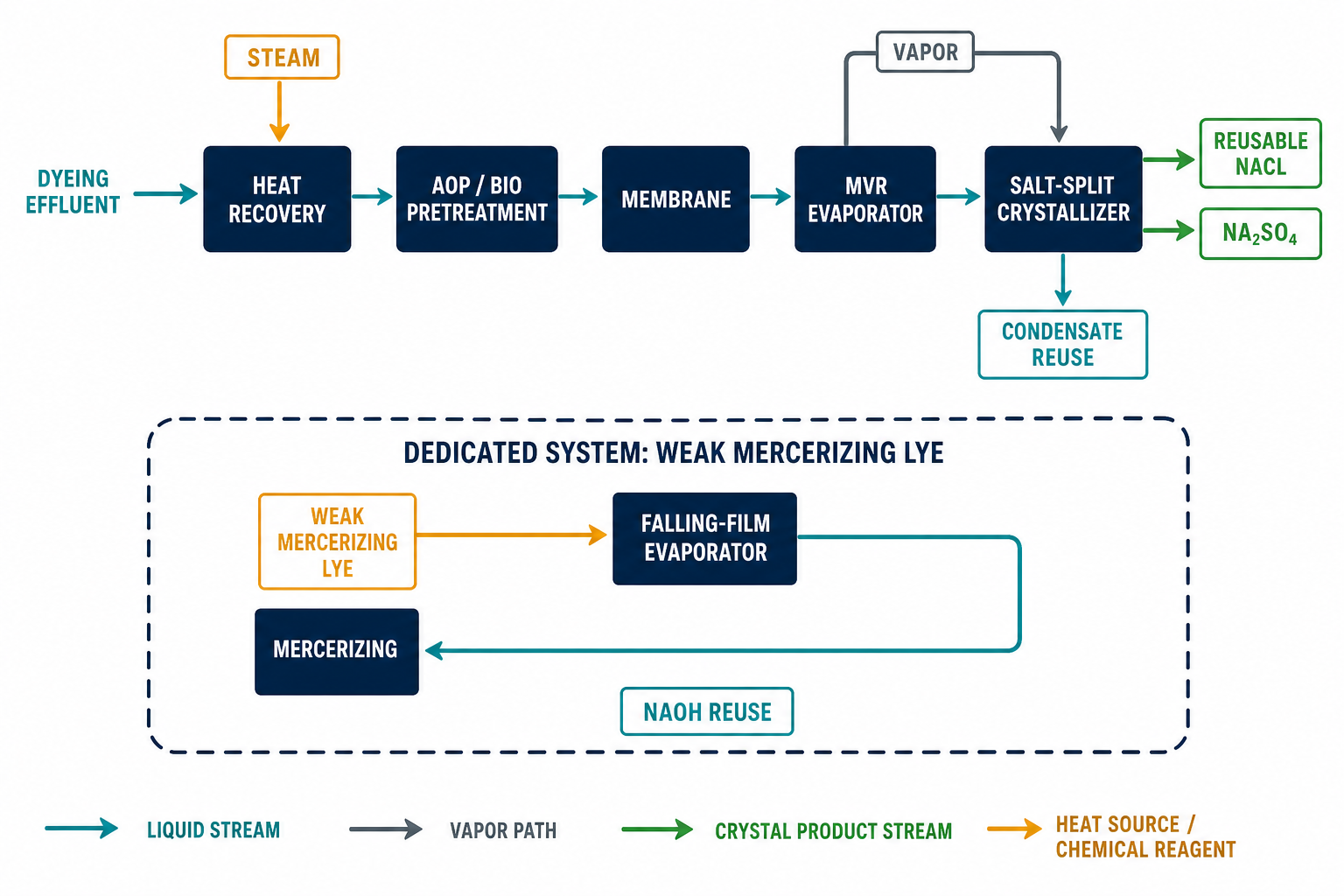
Weak mercerizing lye concentrated by falling-film evaporation and reused in the mercerizing loop — a dedicated system, never combined with the dyeing wastewater evaporator.
Selective crystallization driven by the dyeing salt composition, producing reuse-grade salt for the dyeing process.
Recovery of selected reactive / disperse dye systems, where concentration ahead of recovery and disciplined mother-liquor management make the loop work.
Selection depends on dye chemistry and the COD / TDS ratio. The sequence below is a screening frame — validated per stream, never assumed.
Anaerobic / aerobic stages for dye removal and breakdown of sizing agents, auxiliaries and surfactants — the biodegradable COD fraction.
Ozone / Fenton / UV attacks the refractory chromophores (anthraquinone, azo) that biology leaves behind.
Activated carbon / resin polishing for residual color and organics ahead of the evaporator.
UF / NF / RO lifts the feed from ~1% to 5–8% TDS before thermal duty — shrinking the evaporator size.
Targets before evaporation: COD <500 mg/L and color <50 Pt-Co — product-quality limits for the recovered salt, not just aesthetic ones. Preliminary screening only; pre-treatment selection depends on dye chemistry and COD / TDS ratio.
Indicative process flow for reactive dyeing wastewater with high NaCl load, color and COD.
The canonical sequence: source heat recovery (60–90°C effluent → plate heat exchanger, 60–75% recovery) → biological / AOP pre-treatment (COD <500 mg/L, color <50 Pt-Co) → membrane pre-concentration (NF / RO, 1% → 5–8% TDS) → MVR (15–25 kWh per tonne water) or multi-effect (0.25–0.40 t steam per tonne water) evaporator → split-salt crystallization (NaCl vs Na₂SO₄, exploiting eutectic) → reusable-grade salt + condensate reuse.
Simplified PFD for indicative routing only. Salt-splitting feasibility depends on the NaCl/Na₂SO₄ ratio, organic load and dye type. Reusable-grade salt claims require dyeing-loop validation with the customer’s dyeing process.
Preliminary screening only — the winning route is fixed by feed characterization, utility prices and the reuse target, never by default.
Low-energy ZLD: NF / RO pre-concentration (1% → 5–8% TDS) ahead of MVR evaporation at 15–25 kWh per tonne water — or multi-effect at 0.25–0.40 t steam per tonne water when steam is favored.
Scaling- and fouling-dominant service — the default crystallizer choice where dyeing brines carry organics and hardness; applied after AOP + MVR concentration.
Caustic recovery and cleaner streams — dedicated mercerizing lye concentrator across the 280→450 g/L range with nickel-alloy heating surfaces.
Split-salt operation outside the eutectic band (~17.5% Na₂SO₄ at 100°C), exploiting metastable-zone differences to yield two salts with separate reuse paths. Feasibility is composition-dependent.
Salt purity and reuse-grade classification depend on residual organics and trace color. Mixed-salt separation feasibility requires laboratory phase-equilibrium test work. Routes shown are for preliminary screening only — reusable-grade salt for re-dyeing requires pilot validation on the customer’s dyeing process, and caustic recovery from mercerizing requires dedicated falling-film design with special alloy heating surfaces.
Common feed streams in textile dyeing and finishing mills, with the technology route typically considered for first-pass screening.
| Chemical / Stream | Source / Context | Key Behavior | Typical Route | Material Focus |
|---|---|---|---|---|
| STREAM 01Reactive dyeing wastewater | Cotton reactive dyeing, high electrolyte | NaCl 40–80 g/L; color 500–3,000 Pt-Co; COD 2,000–15,000 mg/L | Membrane + MVR + Split | Titanium / Duplex |
| STREAM 02Disperse dyeing effluent | Polyester disperse dyeing, carrier-based | COD 1,500–8,000 mg/L; dispersants; lower salt | AOP + MVR + FC | Duplex 2205 |
| STREAM 03Mercerizing lye | Cotton mercerizing caustic bath | NaOH 200–300 g/L; viscosity 30–80 cP; recoverable | Falling Film Recovery | Ni-200 / Special alloy |
| STREAM 04Printing rinse water | Rotary / digital printing wash-off | COD 3,000–15,000 mg/L; pigment, binder, thickener | Coagulation + MVR | Duplex 2205 |
| STREAM 05Sizing / desizing wastewater | Warp sizing, PVA / starch removal | BOD 2,000–10,000 mg/L; TDS <1,000 mg/L | Bio + Membrane | 316L |
| STREAM 06Salt recovered from dyeing | Crystallized NaCl / Na₂SO₄ from ZLD | Target: NaCl >97%, Ca²⁺ / Mg²⁺ / Fe³⁺ each <10 mg/L | FC / DTB | Titanium (TA2) |
Routes shown are for preliminary screening only. Reusable-grade salt for re-dyeing requires pilot validation on the customer’s dyeing process. Caustic recovery from mercerizing requires dedicated falling-film evaporator design with special alloy heating surfaces.
Alkalinity, chloride and sulfate profiles — not habit — decide the metallurgy.
| Stream Condition | Recommended Material | Engineering Rationale |
|---|---|---|
| M1High-NaOH mercerizing streams | Nickel 200 / special alloys | Caustic stress-corrosion cracking attacks 316L at these concentrations; viscosity 30–80 cP and BPE 15–30°C drive dedicated falling-film design |
| M2Chloride-rich reactive dye brines | Titanium (TA2) | Chloride profile drives selection — titanium on salt crystallization service (NaCl 40–80 g/L electrolyte streams) |
| M3Sulfate-rich streams | Duplex 2205 | Disperse dyeing effluent and printing rinse service with Na₂SO₄-dominant salt load |
| M4Mild combined effluent | 316L | Sizing / desizing streams at TDS <1,000 mg/L — low-corrosion service |
Material selection follows the characterized feed — final choice is confirmed by corrosion coupon testing during bench & pilot validation.
Dyeing effluent arrives hot — ignoring that heat makes MVR economics fail. Integration is not optional.
We publish only what we can document — own deliveries and verified, anonymized references. Nothing else.
Project notes from our own textile & dyeing deliveries are being compiled for this page. Until documentation is complete, this slot stays intentionally empty — we do not list projects we cannot stand behind.
Public-domain and anonymized references for textile & dyeing ZLD and caustic recovery will be added after verification. We do not fabricate case data.
EvapCryst organizes its delivery capability around four solution categories. The textile & dyeing industry most often combines S1 with S3.
Dyeing effluent ZLD with condensate reuse for the next dyeing batch.
Reusable-grade NaCl / Na₂SO₄ crystallization for re-dyeing salt recovery.
Mercerizing caustic recovery and dyeing auxiliary purge optimization.
Heat recovery from hot dyeing effluent + MVR retrofits for steam-driven concentrators.
Sometimes — it depends on the residual organic and trace-metal profile. Cotton reactive dyeing is sensitive to Ca²⁺, Mg²⁺, Fe³⁺ (each should be <5–10 mg/L) and residual organics (TOC <50 mg/L) that affect dye sorption and shade reproducibility. Reusable-grade salt is achievable in favorable cases after effective color / COD pre-treatment, but the salt must be validated by a dyeing trial on the customer’s fabric and recipe. We do not promise re-dyeing-grade salt without that validation.
Reactive dyeing effluent typically contains both Cl⁻ (from NaCl electrolyte) and SO₄²⁻ (from Na₂SO₄ electrolyte or reactive dye fixation). Their eutectic behavior and crystallization temperatures differ — at the NaCl-Na₂SO₄-H₂O eutectic (~17.5% Na₂SO₄ at 100°C) co-crystallization is unavoidable and produces contaminated salt of no reuse value. Selective crystallization outside the eutectic band, exploiting differences in metastable zones, can produce two separate salts each with a reuse path. Feasibility is composition-dependent.
Dyeing effluent exits the dyeing vessel at 60–90°C; incoming fresh water is at 15–25°C. A plate heat exchanger (typically 316L or Ti plates) transfers heat from outgoing effluent to incoming make-up water, recovering 60–75% of the thermal energy and reducing both evaporator steam duty and fresh-water heating load. The heat exchanger must be designed for fouling resistance (dyeing effluent fouls aggressively) — typically wide-gap plates with CIP capability.
Mercerizing lye carries 200–300 g/L NaOH with viscosity 30–80 cP and BPE 15–30°C — concentrations that aggressively attack 316L by caustic SCC and require Nickel 200 or special alloys. The falling-film evaporator design also differs: caustic has a steep viscosity increase with concentration and high BPE. A dedicated caustic recovery evaporator (typically concentrator + vacuum cooler for the 280→450 g/L range) is never combined with the dyeing wastewater evaporator.
Send us your wastewater analysis (COD, TDS, Cl⁻/SO₄²⁻, color, temperature) and reuse target. Within 2 business days you will receive a feasibility assessment, simplified PFD and indicative scope.
Send your feed characterization (TDS, COD, main salts, viscosity), throughput and product targets — we respond with a preliminary process route within two business days.