Membrane bioreactors have become the standard biological front end for large textile effluent plants precisely because they produce an effluent the downstream stages – reuse RO, or a ZLD evaporation train – can actually live with. The published scale anchors: installations above 180 MLD (180,000 m³/d) using ZeeWeed MBR technology across textile applications, more than 30 textile effluent treatment plants delivered in India and Bangladesh – including the first textile MBR ETP in Bangladesh to reach ZDHC aspirational level as a retrofit in constrained footprint, and one of the country’s largest denim washing plants running ZeeWeed MBR to ZDHC compliance (Veolia Water Technologies published material – an external industry reference, not an EvapCryst delivery). The design premise for this article: in textile ZLD trains, the MBR is not the water-recovery stage – it is the stage that makes every stage after it feasible.
Why the Biological Front End Decides the Whole Train
Peer-reviewed characterization of textile effluent shows biological treatment removing 80-85% of BOD and COD in well-operated systems – the single largest pollutant reduction in any textile flowsheet, and the cheapest per kilogram. What biology leaves is the hard fraction: residual color, refractory organics, surfactant residues and the full inorganic salt load. Every downstream technology pays for what biology failed to remove: RO membranes foul on the organics; evaporators foam and discolor their product salt; crystallizer crops inherit the contamination. A conventional activated-sludge plant plus clarifier delivers water at 20-50 mg/L suspended solids and variable quality; an MBR delivers it at effectively zero suspended solids, tighter and more stable, because the membrane barrier replaces the gravity settler whose failure mode – sludge bulking, a documented weakness of textile activated sludge – propagates directly into everything downstream.
The Bangladesh retrofit case published by the technology supplier makes the argument concretely: a textile plant with limited available footprint achieved ZDHC aspirational-level effluent by replacing conventional clarification with an MBR within the existing envelope, adding water reuse on top. The denim-washing case adds the sludge dimension – MBR operation reduced the sludge handling burden that was constraining the plant. These are selection arguments, not performance guarantees: they show what the configuration class does when the problem is footprint, stability and downstream protection.
Illustrative Feed Envelope for Screening
The envelope below consolidates published textile MBR application data with peer-reviewed effluent characterization. It is an illustrative envelope built from published industry material – not a customer dataset, and not a performance guarantee.
| Parameter | Illustrative range | Basis / note |
|---|---|---|
| Plant scale class | Up to and above 180,000 m³/d in textile service | Published ZeeWeed MBR application scale |
| Reference footprint | 30+ textile ETPs across India and Bangladesh | Published delivery count |
| Influent COD (mixed textile) | ~700-5,000 mg/L depending on stream mix | Peer-reviewed textile ranges by stage |
| Biological removal | 80-85% BOD/COD in well-operated systems | Peer-reviewed review data |
| MBR effluent TSS | Effectively zero (membrane barrier) | Definitional vs clarifier route |
| Downstream objective | ZDHC compliance levels; reuse RO feed; ZLD evaporator feed | Sets MBR design stringency |
Process Solution: MBR as the Hinge of the ZLD Train
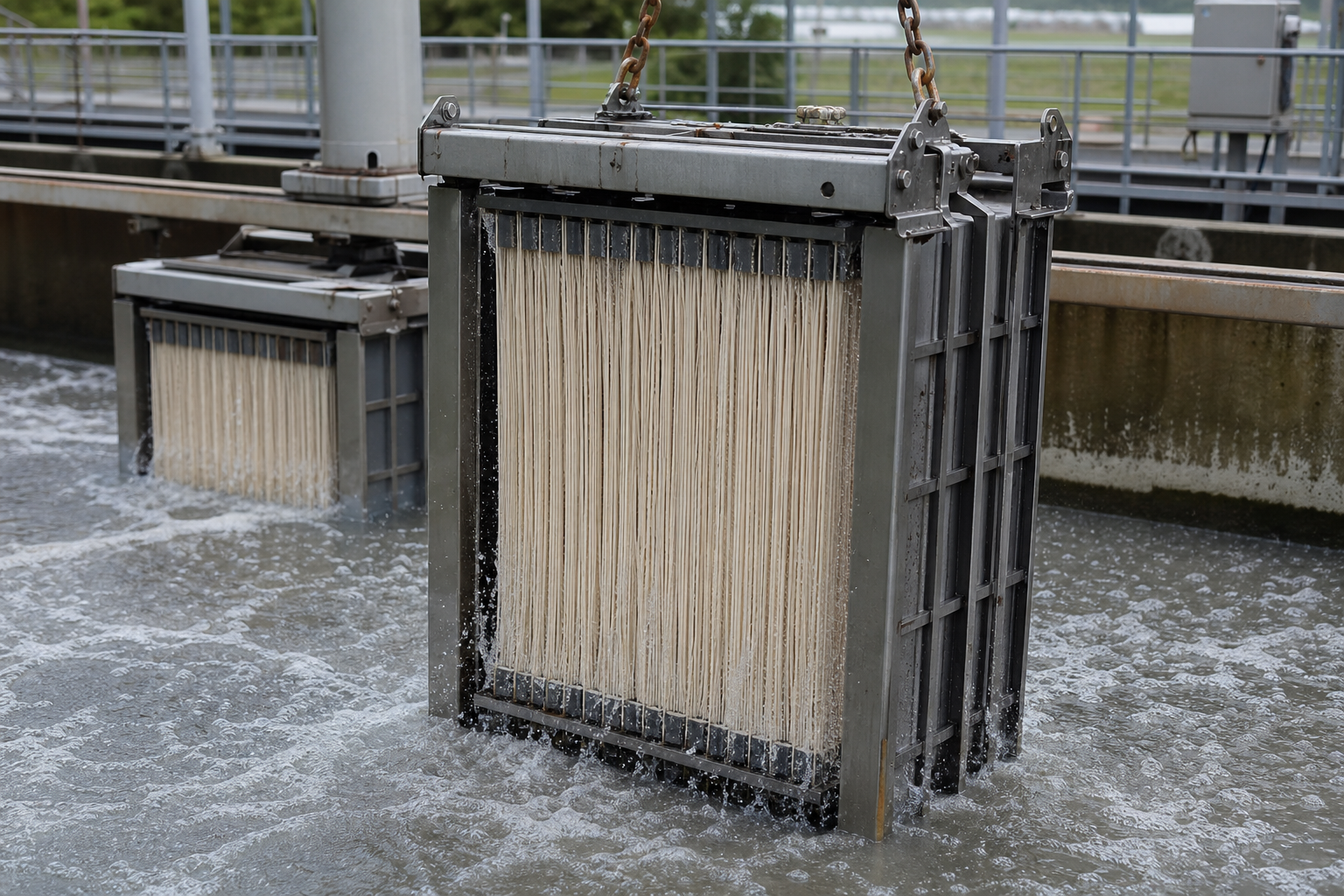
In the full ZLD architecture, the MBR sits as stage two of four. Stage one is conventional pretreatment – screening, equalization, and where the stream carries dye-bath loads, chemical coagulation or adsorption to shave peak color and toxicity before biology. Stage two is the MBR itself: aeration basin plus immersed (or external tubular) ultrafiltration membranes, operating at high mixed-liquor concentrations (typically 8-12 g/L MLSS versus 3-4 in conventional plants), which is what lets it deliver more biology in less tankage and hold the permeate quality steady through hydraulic and load swings. Stage three is the reuse or concentration block – RO on the MBR permeate where the objective is reuse-grade water, with the same sodium chloride and sulfate management the textile membrane routes require. Stage four is the thermal back end on the RO reject – falling-film concentration and forced-circulation crystallization closing the ZLD boundary.
The critical interfaces are chemical. MBR permeate is clarifier-free and solids-free but still carries the dissolved refractory COD and color that survive biology – the published Bangladeshi retrofit reached ZDHC aspirational level through the MBR’s stability rather than through sterile permeate; for RO feed downstream, ozone or nanofiltration polishing between MBR and RO is the standard companion where color and organics run high. On the reject side, what the MBR did or did not degrade decides the evaporator’s foaming behavior and the product salt’s color – the same coupling the denim-loop route documents from the other direction.
Technical Features That Decide Whether the Coupling Holds
Three features carry the engineering weight. The first is membrane integrity as the quality guarantee. The MBR’s value proposition to the ZLD train is that its permeate variance is near zero – no clarifier upset, no solids spike, ever reaching the RO. That guarantee is only as good as the integrity monitoring (pressure-decay testing, turbidity trending on permeate) and the membrane’s survival against textile-specific stresses: fiber lint (pre-screening discipline), dye-complex foulants (cleaning chemistry), and temperature excursions.
The second is sludge strategy. Textile MBRs run high MLSS, which concentrates the sludge disposal question the Bangladeshi denim case explicitly flags as a plant constraint. The sludge line – wasting rate, dewatering, disposal or co-processing – is part of the water train’s economics, not an appendix to it.
Third is the ZDHC/compliance overlay. Brand-driven programs (ZDHC and BSR initiatives) set effluent quality levels that conventional plants reach intermittently and MBR plants reach continuously. Where a mill’s order book depends on brand compliance, the biological front end’s stability is a commercial parameter, not just an engineering one – the published cases frame it exactly this way.
Process Modules
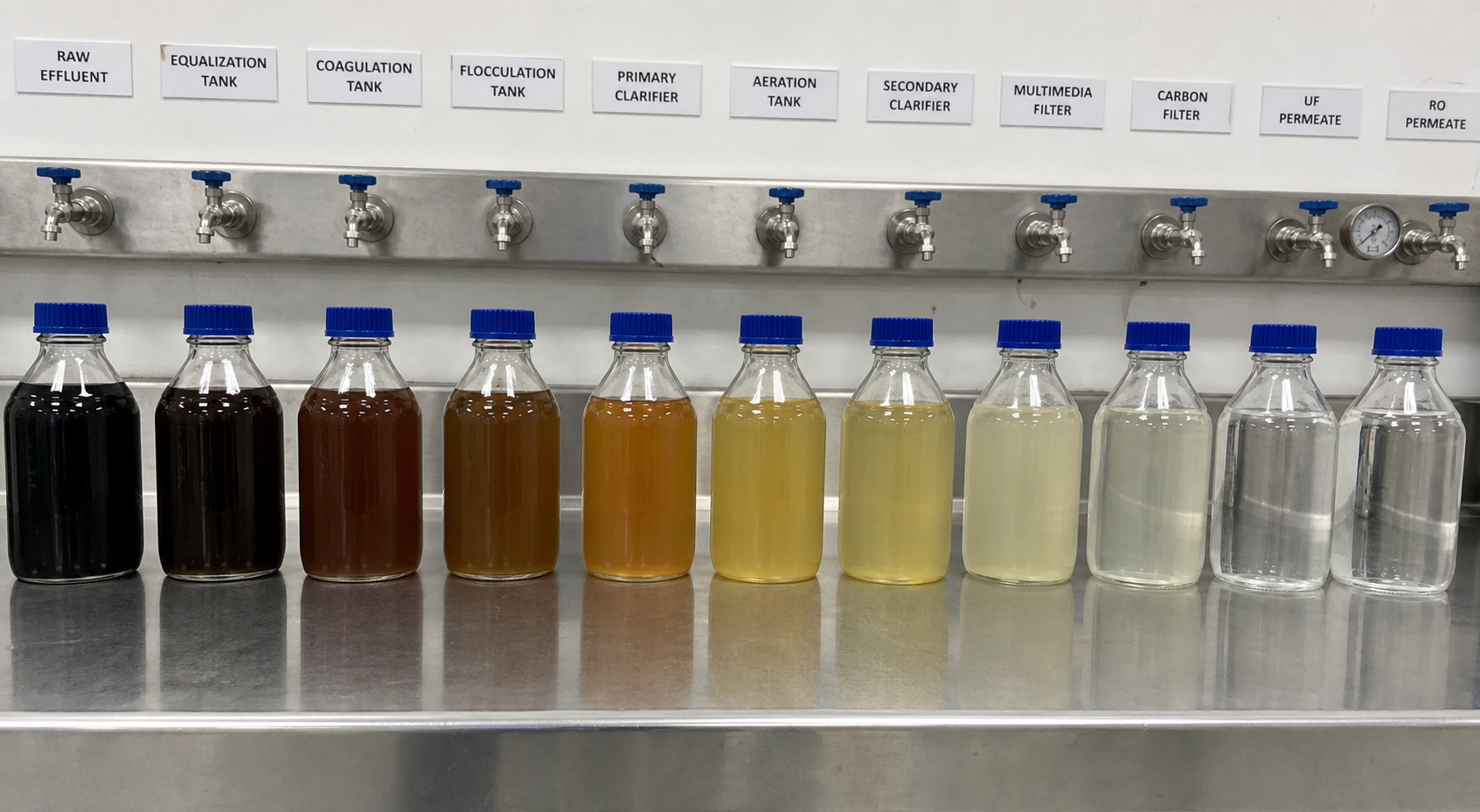
| Process module | Candidate equipment types | Selection rationale | Module duty |
|---|---|---|---|
| Pretreatment | Screens, equalization, coagulation/adsorption | Shave peak color and toxicity before biology | Protect the bioreactor |
| Biological + solids barrier | MBR (immersed UF membranes, high MLSS) | Stable solids-free permeate in tight footprint | 80-85% COD/BOD removal, zero TSS |
| Polishing (conditional) | Ozonation or NF on MBR permeate | Residual color/organics ahead of RO | Stabilize RO feed |
| Water recovery | Reuse RO arrays | Lowest-cost desalination of MBR permeate | Reuse-grade permeate |
| Thermal closure | Falling-film concentrator + forced-circulation crystallizer | ZLD boundary on RO reject | Salt solids out; distillate returned |
| Sludge line | Wasting, dewatering, disposal/co-processing | High-MLSS operation concentrates this duty | Keep solids out of the water train |
Configuration, materials and operating envelopes above are potential considerations only; actual selections depend on feed composition, temperature, fouling behavior, utilities and project capacity.
Expected Performance and Limits
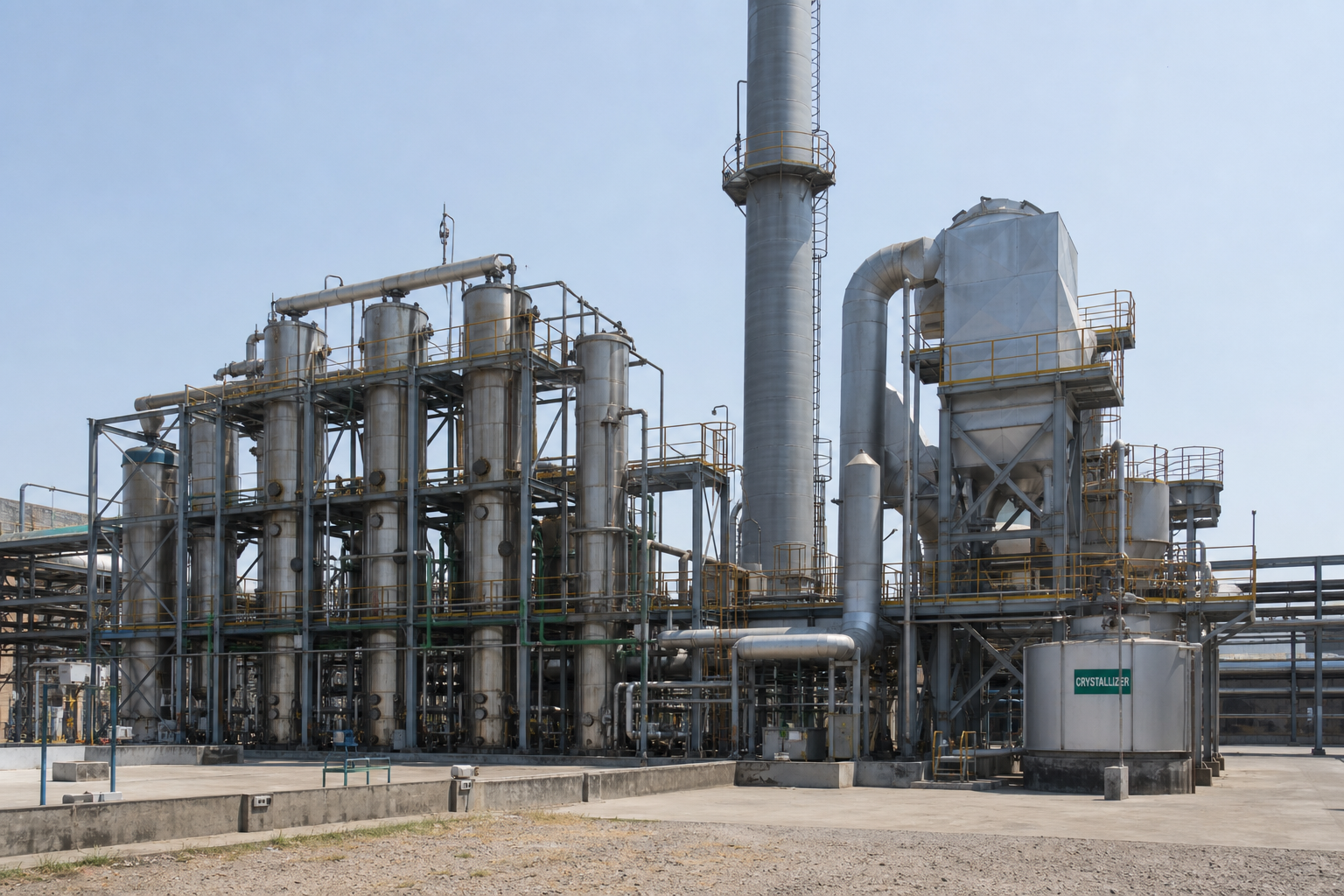
The published reference performance: ZeeWeed MBR installations above 180 MLD in textile service; 30+ textile ETPs in India and Bangladesh; the first textile MBR ETP in Bangladesh at ZDHC aspirational level (a footprint-constrained retrofit adding reuse); a large denim washing plant at ZDHC compliance with reduced sludge burden (Veolia Water Technologies published material – external industry references; indicative, not project guarantees, and not EvapCryst deliveries). Against the peer-reviewed baseline, biological stages remove 80-85% of BOD/COD; the MBR converts that removal into a continuously protected permeate rather than an intermittently protected one. The practical limits: MBR permeate is not RO-permeate – dissolved refractory COD, color and all salts pass through the membrane barrier and must be handled downstream; membrane replacement is a real operating cost line whose interval is set by cleaning discipline and influent control; and the high-MLSS operation concentrates sludge production into a disposal question that must be answered before commissioning, not after.
Industry References and Validation
Two public anchors. The Veolia textile MBR application set: >180 MLD scale, 30+ Indian and Bangladeshi textile ETPs, ZDHC aspirational retrofit and denim-washing references (Veolia Water Technologies published material; an external industry reference, not an EvapCryst delivery). And the peer-reviewed characterization basis: 80-85% biological COD/BOD removal for textile effluent, stage-by-stage TDS and COD ranges, and the activated-sludge bulking weakness in textile service that the membrane barrier eliminates (MDPI Sustainability 2022 review; external academic reference). For your own project, validation effort should concentrate on: biological treatability testing on your real stream mix (dye classes, sizes, finishes); MBR pilot flux and cleaning-interval determination under your loading; an integrity-monitoring and pre-screening specification; and a downstream compatibility package – permeate COD/color versus your RO or ZLD back-end requirements.
Frequently Asked Questions
Does an MBR replace the RO stage?
No. The MBR replaces the clarifier and stabilizes the biology – its permeate is solids-free but still carries dissolved salts, refractory COD and color. RO on MBR permeate is the water-recovery stage; the two are sequential, not alternatives.
Why choose MBR over conventional activated sludge plus clarifier?
Three published reasons: footprint (retrofit cases fit MBR where tanks cannot grow), stability (no bulking upsets reaching downstream stages), and permeate quality (zero TSS feeds reuse RO reliably). Where land is cheap and limits loose, conventional plants still compete.
What fouls textile MBR membranes?
Fiber lint (a pre-screening failure), dye-surfactant complexes and their degradation intermediates (a cleaning-chemistry question), and temperature or pH excursions. The published denim case adds sludge rheology at high MLSS as an operability factor. Fouling control is an influent-control problem first.
How does MBR fit a ZLD mandate specifically?
It is the enabling biological stage. ZLD trains concentrate everything biology misses into the thermal back end, where organics become foam, discoloration and contaminated salt. A stable MBR minimizes that carryover – which is why large textile ZLD programs standardize on membrane biology.
What is ZDHC aspirational level?
The stricter of the ZDHC wastewater guideline tiers – a brand-driven effluent quality standard. The published Bangladeshi retrofit reached it within an existing footprint by MBR substitution, which is the configuration’s signature move: more treatment quality in the same box.
When This Route May Not Fit
If the effluent is small and steady – a single-line finishing house at a few hundred cubic meters per day – conventional biology plus polishing delivers adequate feed quality at lower capital, and MBR’s stability premium buys little. If the stream is dominated by toxic or biologically inert chemistry (carrier solvents, high sulfide), biology of any configuration struggles and physicochemical routes lead. And if there is genuinely no downstream reuse or ZLD stage, the MBR’s permeate-quality advantage is spent on a discharge pipe that does not need it.
What Must Be Verified Before Committing
Five items: biological treatability testing on the full stream mix including seasonal chemistry variation; MBR pilot flux, trans-membrane-pressure trend and cleaning-interval data at your loading; pre-screening and lint-control specification matched to membrane vendor requirements; permeate quality profiling (COD, color, surfactants) against your intended downstream stage; and the sludge balance – wasting, dewatering and confirmed disposal or co-processing outlet. These map directly onto the modules above and are the standard screening package we would run before any quote.