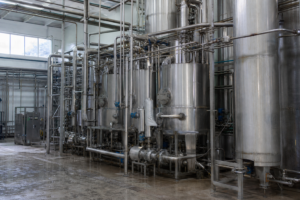
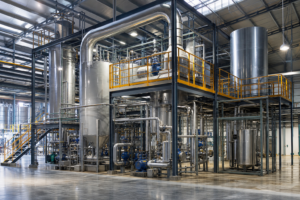
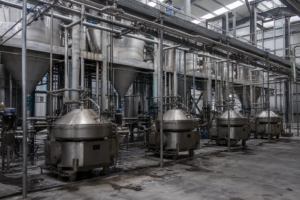
Allulose (D-psicose) plants win or lose on two unit operations downstream of the enzymatic converter: the chromatographic separation that purifies the rare sugar from fructose and glucose, and the evaporation-crystallization train that turns the diluted eluate into a free-flowing crystal. A well-configured MVR or TVR evaporation system concentrates the 10–25% dry-substance chromatography fractions to crystallization strength, achieving industry-reported steam savings of 60–90% versus fresh-steam evaporation, while keeping product temperature low enough to protect the heat-sensitive ketose sugar from color formation. On commercial lines of typically 50–100 tonnes per day, evaporation and crystallization together account for the largest share of plant energy consumption, which makes their design the main lever on production cost after chromatography performance.
Why Allulose Is a Demanding Sugar to Concentrate and Crystallize
Allulose delivers roughly 70% of sucrose sweetness at near-zero calories, which has made it one of the fastest-growing rare sugars in beverages, dairy, bakery, and confectionery reformulation. Three properties complicate its downstream processing:
- Extreme dilution after separation. Simulated moving-bed or batch chromatography elutes the allulose fraction with water at 10–25% dry substance. Every kilogram of product must first have several kilograms of water removed—evaporation duty is therefore several times larger than in a typical starch-syrup plant.
- Heat sensitivity. Reducing ketose sugars form color bodies through Maillard and caramelization pathways when held hot. Product temperature above roughly 60–70 °C for extended periods darkens the syrup and degrades crystallization performance, so evaporators must combine low ΔT operation with short residence time.
- High viscosity and boiling-point elevation at concentration. Like other low-molecular-weight sugars, concentrated allulose liquors climb steeply in viscosity and BPE, which reduces available temperature difference and can push wall temperatures into the color-formation range if heat flux is not controlled.
The Complete Process Chain and Where Evaporation Fits
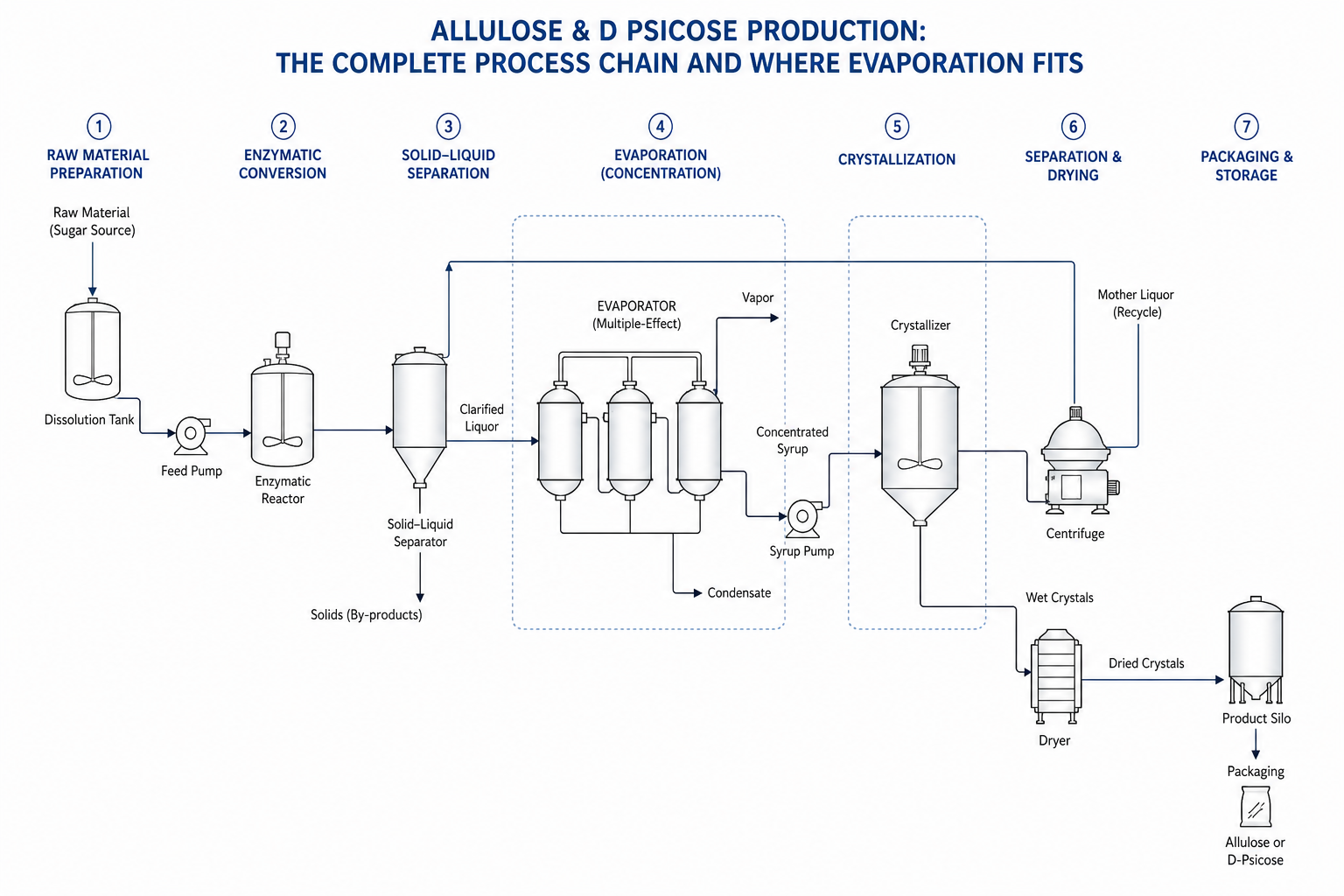
A commercial allulose line comprises six stages; the middle four are where an integrated evaporation-crystallization supplier adds value:
- Enzymatic conversion: D-psicose-3-epimerase converts fructose syrup to an equilibrium mixture (conversion ceiling typically around 25–30% without recycling).
- Chromatographic separation: SMB or batch resin columns separate allulose from unconverted fructose and glucose. This step sets the ceiling on product purity and overall sugar recovery—and is widely regarded as the key technology for commercial viability.
- Ion exchange and polishing: deashing and color removal before concentration.
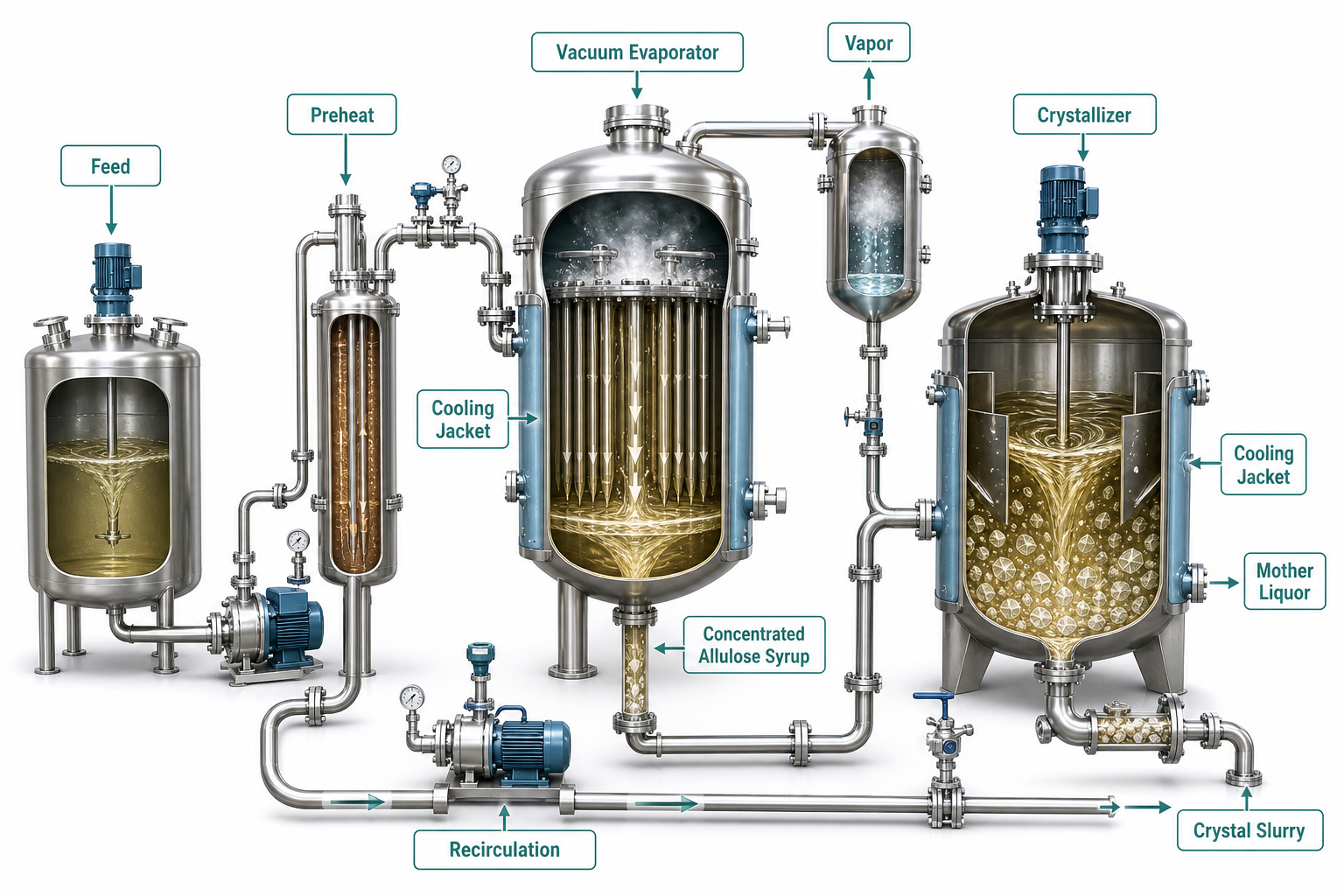
- Evaporation concentration: MVR or TVR falling-film evaporation raises the purified fraction from 10–25% to 50–70% dry substance ahead of the crystallizer, with condensed vapor recovered as chromatography wash water.
- Crystallization: seeded cooling or evaporation crystallization produces the crystal phase; mother liquor rich in fructose recycles to chromatography.
- Centrifugation and drying: continuous centrifuges separate crystals from mother liquor; fluid-bed drying delivers the finished crystal product.
At procurement level the middle of the line resolves into four core modules:
| Module | Candidate Equipment Types | Selection Rationale | Indicative Operating Envelope |
|---|---|---|---|
| Polishing and ion exchange | Continuous or batch ion-exchange beds | Deashing and color removal protect downstream duty | Feed to evaporation at purification spec |
| Evaporation concentration | MVR falling-film body plus finisher section | Low ΔT and short residence time protect the ketose | 10–25% to 50–70% dry substance at 55–65 °C |
| Crystallization | Seeded cooling or vacuum-cooling crystallizer | Metastable-zone control grows uniform crystals | Fructose-rich mother liquor recycled |
| Centrifugation and drying | Continuous centrifuge; fluid-bed dryer | Crystal-mother separation with food-grade finishing | Finished crystal to packing |
Configuration, materials, and ranges depend on actual feed, corrosion review, fouling behavior, utilities, and project capacity.
Evaporator Configuration for a Heat-Sensitive Rare Sugar
The standard configuration is a two-stage falling-film system:
- Stage 1 — MVR falling film. The bulk water removal happens here at 55–65 °C under moderate vacuum, with a mechanical vapor recompressor recycling the vapor as heating medium. Tubes and liquid distributors are designed for low ΔT (typically 5–10 °C across the bundle) so wall temperature never wanders into the color-formation range.
- Stage 2 — finisher. A small forced-circulation or concentrating falling-film section takes the liquor to crystallization feed strength, sized for the high-viscosity end of the range.
- Vapor condensate reuse. Clean condensate from the first stage is collected separately and returned as chromatography elution and resin-regeneration water—closing the plant water balance and reducing both effluent and fresh-water cost.
Where electricity is expensive relative to steam, TVR (thermal vapor recompression) with an ejector, or a three-effect evaporator with thermocompression, achieves intermediate steam economies. Table 1 compares the three options as applied to rare-sugar service.
| Configuration | Specific energy vs single effect | Best fit | Watch-outs |
|---|---|---|---|
| MVR falling film | Effectively 10–20% (electric) | Continuous 50–100 TPD lines; expensive steam; energy-cost-driven projects | Compressor selection for low ΔT; power reliability |
| TVR multi-effect | 30–50% | Stable steam supply at moderate pressure | Higher product temperature than MVR; color margin must be verified |
| Plain multi-effect (2–3 effects) | 40–55% | Smaller plants; simplest maintenance | Deepest vacuum on last effect increases condenser duty |
Crystallization Strategy: Crystal Quality and Mother-Liquor Loop
Allulose crystallization is usually operated as seeded cooling crystallization (or vacuum-cooling crystallization for tighter temperature control) because solubility falls steeply with temperature. Design and operating practice that reliably deliver uniform crystals:
- Supersaturation control in the metastable zone—feeding seed at controlled supersaturation and holding the cooling profile so the crystal population grows rather than nucleating fines;
- Adequate liquor circulation (draft-tube or forced circulation depending on vessel type) to keep the growing crystals suspended and temperature uniform;
- Mother-liquor recycling—fructose-rich mother liquor returns to the chromatography step rather than being sold as low-value syrup, which materially improves overall sugar recovery and plant economics;
- Hygienic execution—316L wetted parts, polished surfaces, CIP circuits, and clean vapor contacts, since the product is food-grade.
Typical performance envelope
| Parameter | Illustrative range (published commercial references) |
|---|---|
| Plant capacity | 50–100 tonnes/day finished crystal |
| Chromatography eluate dry substance | 10–25% |
| Evaporator feed temperature (MVR stage) | 55–65 °C |
| Liquor strength to crystallizer | 50–70% dry substance |
| Steam saving vs fresh-steam single effect | 60–90% (MVR at the high end) |
| Overall sugar recovery (with mother-liquor recycle) | Set mainly by chromatography, typically the decisive cost factor |
The ranges above are an illustrative envelope assembled from published external references, not EvapCryst deliveries, indicative rather than a project guarantee, and not a project datasheet; site-specific data governs design.
Cost Structure: Where the Money Goes
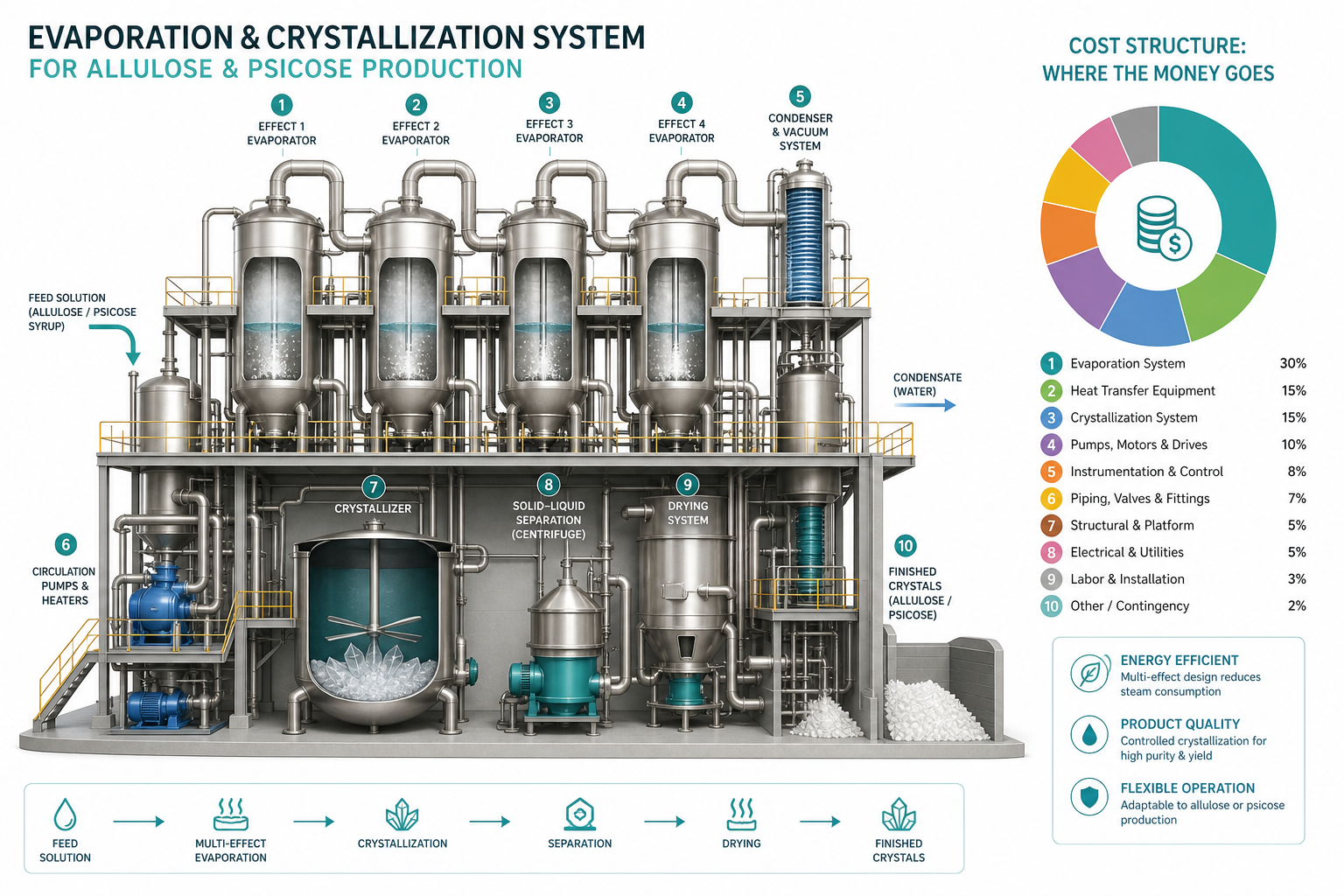
Published analyses of rare-sugar economics point to the same hierarchy: raw sugar cost, chromatography performance, then evaporation energy. The practical cost-reduction levers, in the order most plants should attack them:
- Chromatography optimization—purity and recovery of the separation dominate everything downstream; a one-point recovery improvement outweighs most energy savings;
- Energy-efficient evaporation—MVR with condensate reuse to chromatography;
- Continuous ion exchange in place of batch beds, cutting regenerant and water;
- Heat integration—condensate and flash heat recovery across the plant rather than optimized single machines;
- Automation—stable supersaturation and temperature control protects crystal yield and avoids off-spec campaigns.
Integration matters more than individual equipment efficiency: a plant with a mediocre evaporator but a well-closed water and heat loop routinely outperforms one with excellent standalone machines and no integration.
Why Pilot Verification Precedes Full-Scale Commitment
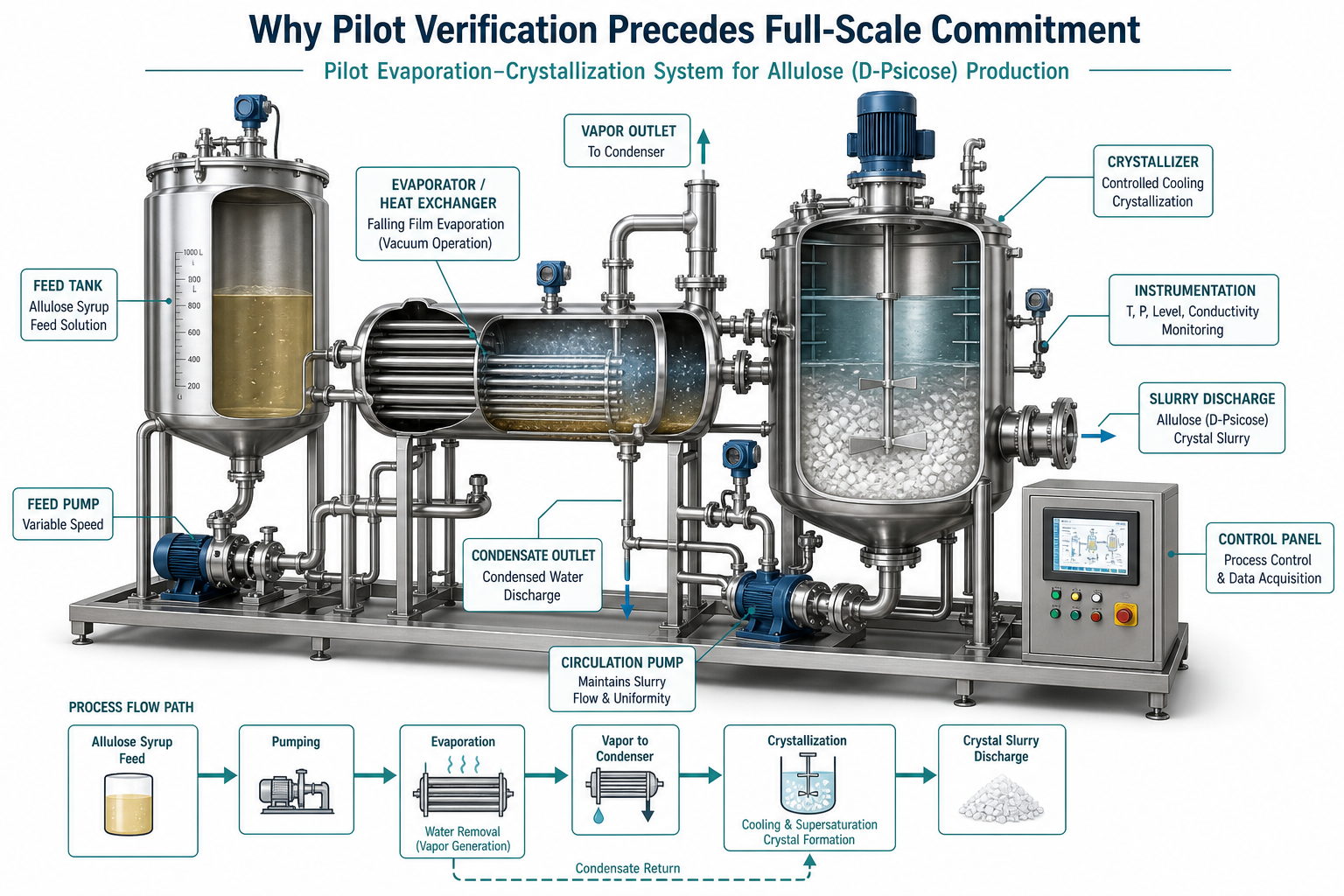
Allulose behavior in evaporation and crystallization—color development kinetics, viscosity curve, crystallization window—varies enough with feed origin and upstream purification that serious suppliers insist on pilot verification before scale-up. A pilot campaign of a few weeks validates: process feasibility at target concentrations, product color stability, separation efficiency of the specific feed, crystallization kinetics and achievable crystal-size distribution, and the economic model against real utility prices. Skipping this step and discovering a color or crystallization problem at 50 TPD costs far more than the pilot program.
Hygienic Design and Food-Grade Execution
Because allulose is a food ingredient sold into beverage, dairy, and bakery supply chains, the evaporation and crystallization train must be executed to food-processing standards, not general chemical standards. The baseline package: 316L stainless wetted parts with polished product-contact surfaces; crevice-free welds and drainable, cleanable geometry with no dead legs in vapor and condensate lines; a full CIP system with spray coverage verified in every vessel, including separators, condensers, and crystallizer tops; and segregation of food-contact condensate from utility water circuits. Material and product certificates, surface-finish verification, and CIP validation protocols should be written into the acceptance criteria at contract stage rather than negotiated during commissioning. Plants exporting to regulated markets typically also demand a documented hygienic design review of the vapor path, since condensate reused for chromatography elution comes into indirect product contact.
Utilities and Layout Considerations
Three utility decisions shape the final layout. First, cooling-water temperature sets the achievable vacuum in the evaporator and the crystallizer if vacuum-cooling is chosen—warm climates may require a chilled-water circuit to hold the 55–65 °C evaporation band. Second, electrical supply quality governs MVR compressor selection: a variable-frequency drive with soft start protects both the compressor and the plant grid, and brief power dips must be rideable without losing vacuum. Third, water balance across the plant should be drawn before equipment is sized: with chromatography wash, resin regeneration, and CIP all drawing water, reusing evaporator condensate commonly cuts fresh-water demand for the separation block by more than half, and the savings compound over the life of the plant. A modular or semi-modular equipment split—evaporation train and crystallizer delivered as pre-assembled blocks—shortens site erection on greenfield projects and preserves the option to relocate capacity as the rare-sugar market develops.
When This Route May Not Fit
Allulose crystallization only pays where the chromatography front end is already sound: if separation purity or recovery is weak, the evaporator and crystallizer amplify losses rather than value, and capital spent there is misdirected. The route also misfits product plans built on syrup rather than crystal — a liquid allulose line needs concentration and hygienic handling, not seeded cooling crystallizers and centrifuges. Sites with very cheap steam and modest scale may find plain multi-effect simpler than MVR, and TVR color margins must be verified rather than assumed on a heat-sensitive ketose. Campaign or toll producers running many small sugar programs should hesitate before a dedicated train, which amortizes only on sustained throughput. And projects that skip pilot verification of color kinetics and crystallization windows are accepting scale-up risk no vendor should underwrite.
What Must Be Verified
Before an allulose evaporation-crystallization project is committed, the following must be verified against site data rather than the illustrative envelope above. The actual eluate composition and dry-substance range from the chromatography step, since every duty downstream is sized from it. Color-formation kinetics of the specific liquor under held-hot conditions, from laboratory holds at candidate temperatures. The viscosity and boiling-point-elevation curve to crystallizer feed strength, checked against falling-film and finisher design margins. Crystallization window tests with the real feed — metastable zone, seeding response, achievable crystal size distribution. Condensate quality against chromatography elution requirements, where reuse is planned. And a utility review of electricity, steam, and cooling-water temperature that fixes the MVR-versus-TVR-versus-multi-effect choice on site numbers. Each item maps to a pilot campaign of a few weeks.
Frequently Asked Questions
Why is chromatographic separation called the key technology for allulose commercialization?
Enzymatic conversion stops at an equilibrium mixture, so purity and recovery of the allulose fraction are set by the separation step. It determines product purity, how much unconverted sugar is recycled versus lost, eluate concentration (and therefore evaporation duty), and a large share of operating cost.
What evaporation technology suits the heat sensitivity of allulose best?
MVR falling-film evaporation at 55–65 °C with low temperature difference. The low operating temperature suppresses Maillard and caramelization color formation, and short residence time in falling-film service limits hot exposure to minutes.
Can the mother liquor be sold instead of recycled?
It can be sold as a fructose-rich syrup at low value, but recycling it to chromatography usually recovers substantially more allulose value. The optimum depends on syrup market prices versus separation capacity.
Is the evaporator condensate clean enough for reuse?
First-effect and MVR-stage condensate from a polished, ion-exchanged feed is typically clean enough for chromatography elution and resin washing after cooling, which is why condensate routing should be designed in from the start.
What capacity range justifies a dedicated allulose line?
Published turnkey references cluster around 50–100 TPD. Smaller entries often start with shared fermentation/starch infrastructure and a dedicated separation-crystallization block.