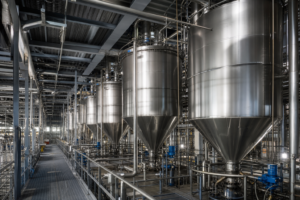
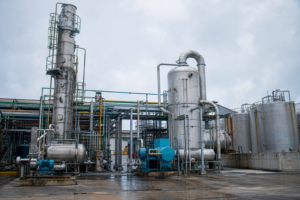
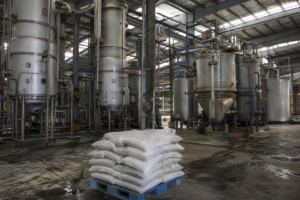
Distilling cardanol from cashew nutshell liquid (CNSL) is a battle against heat and friction: the product is a heat-sensitive, high-boiling phenolic that darkens and polymerizes when held hot, yet the separation demands temperatures around 320 °C. The industrial answer is a wiped film evaporator (WFE) — a high-speed rotor that mechanically spreads the viscous bio-oil into a ~0.5 mm film on a heated wall under deep vacuum, so cardanol evaporates and recondenses within seconds of heat exposure. Operating below 100 Pa, the vacuum lets the 320 °C duty run at wall conditions that would require 400 °C+ at atmospheric pressure. Published plant results from Asian cardanol producers using this approach (vendor-published external industry references, not EvapCryst deliveries) report purity climbing from roughly 92% to 98%+, color improving from dark brown toward light yellow, throughput up about 25%, and combined energy consumption down roughly 15% versus the batch stills replaced (indicative, not project guarantees).
The Material: Why CNSL Breaks Ordinary Distillation Equipment
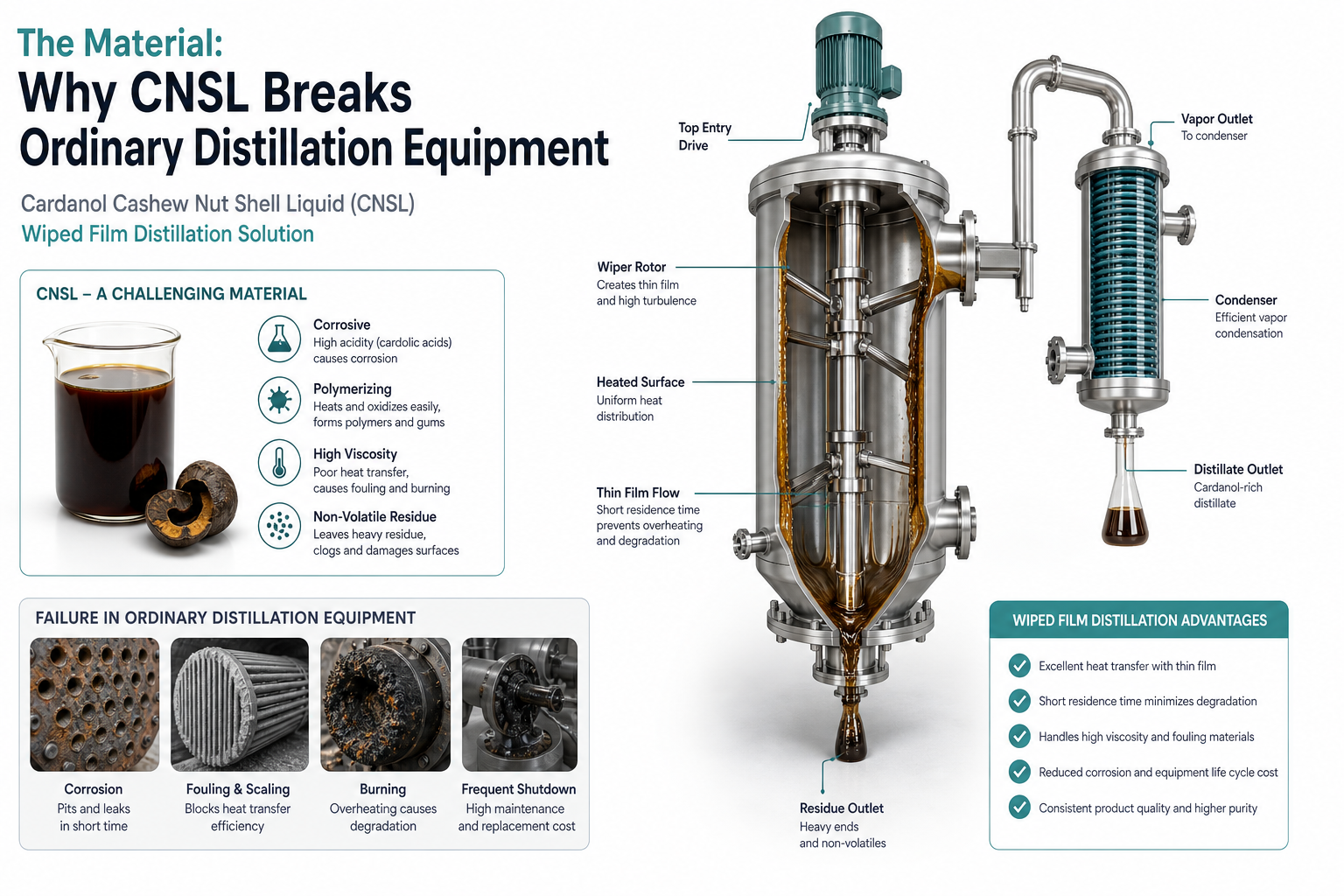
CNSL is a bio-based phenolic stream extracted from cashew shells, containing anacardic acid, cardol, 2-methylcardol, and cardanol — the target monomer, a phenol with a C15 unsaturated side chain that commands strong demand in epoxy curing agents, surface coatings, friction materials, and surfactants. Natural CNSL must first be decarboxylated (thermally or chemically) to convert anacardic acid to cardanol; the distillation then purifies cardanol from cardol, polymers, and heavy residue.
Three physical properties team up against conventional stills:
- Heat sensitivity with polymerization. Held hot, phenolics polymerize and form color bodies; the residue side progressively becomes a dense, glue-like polymer that insulates heating surfaces and eventually chars — the notorious “coking” that destroys batch-still heating surfaces.
- Extreme and rising viscosity. As light fractions distill off, the remaining material thickens dramatically; gravity-driven films stall, heat transfer collapses, and local hot spots accelerate both darkening and fouling.
- High boiling point plus trace lights. Cardanol’s high boiling range demands either very high temperature or very deep vacuum; meanwhile traces of water and low boilers in the feed destroy the deep vacuum a molecular still needs if they are not removed first.
How the Wiped Film Evaporator Answers Each Property
Managing extreme viscosity without surface fouling
Unlike falling-film units that rely on gravity, the WFE rotor mechanically forces the liquor into a uniform ~0.5 mm film. The wiping action continuously renews the heat-transfer surface, while the shear force at the blade edge breaks the surface tension of the resin — releasing volatile cardanol molecules from the thick liquid matrix instantly. This is the only practical way to maintain continuous (24/7) feed on a material whose viscosity would otherwise stall flow, and it keeps operation dead-zone-free where polymers could otherwise accumulate.
Surviving the 320 °C threshold
- Metallurgy: at 320 °C standard steels lose integrity — duplex 2205 or high-grade 316L bodies maintain mechanical precision and thermal-stress resistance without warping;
- Heating system: high-velocity thermal-oil jacket circuits eliminate hot spots, the primary cause of cardanol darkening and polymerization; uniform wall temperature is what protects Gardner-color specifications;
- Sealing: high-temperature double mechanical seals (rated 350 °C+) preserve deep vacuum and prevent oil oxidation and air ingress;
- Vacuum: operation below 100 Pa lowers the boiling point so that what needs 400 °C+ at atmospheric pressure distills at 320 °C.
Maximizing purity: short residence time and short-path capture
In cardanol production, time at temperature is the enemy — the longer the oil stays hot, the darker and lower-value it becomes. In a WFE the material enters, is wiped across the wall, and the cardanol evaporates and condenses within seconds. In short-path (molecular) configuration, the condenser sits inside the evaporator body, minimizing vapor travel distance and pressure drop so high-boiling cardanol molecules are captured immediately after release, protecting both yield and color.
| Module | Candidate Equipment Types | Selection Rationale | Indicative Operating Envelope |
|---|---|---|---|
| Drying and degassing WFE | Wiped-film evaporator, rotor-fed | Strips water and light boilers; protects deep vacuum | Around 100–1,000 Pa |
| Short-path still | Molecular distillation unit, internal condenser | Color-critical final cardanol cut | Around 0.1–100 Pa |
| Heating system | High-velocity thermal-oil jacket circuit | Uniform wall temperature is color control | Wall duty near 320°C under vacuum |
| Vacuum group | Deep-vacuum pumps, cold traps | Sets boiling-point suppression | Below 100 Pa at the still |
| Product and residue handling | Condensers, hot residue pumps, sealed receivers | Seconds-level exposure continues to collection | Hot, sealed, inert handling |
Configuration, materials, and operating ranges depend on the actual feed, origin chemistry, corrosion and coking review, site utilities, and project capacity.
Why Most Plants Run WFE + Short Path in Series
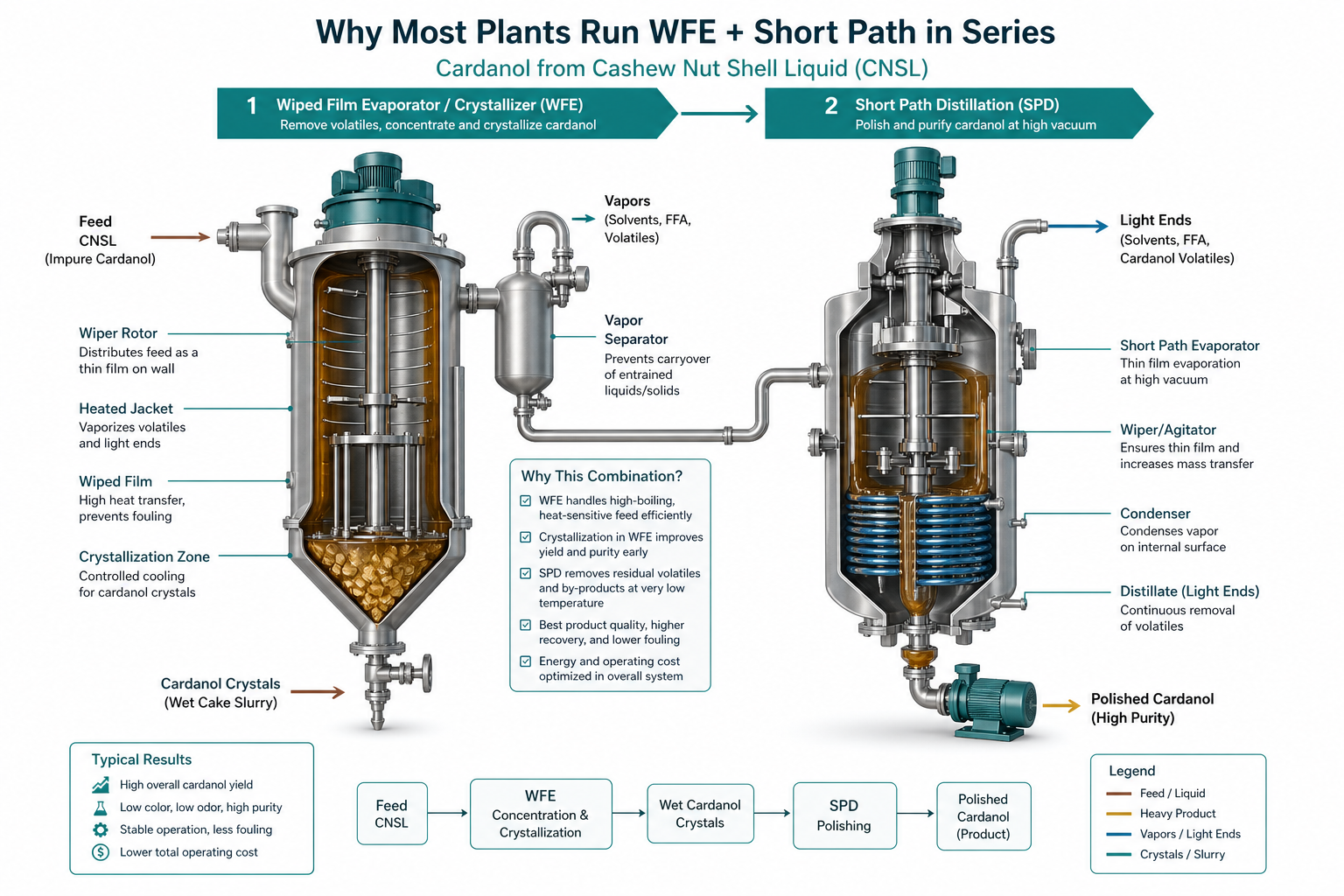
A single distillation stage cannot simultaneously strip light boilers and collect high-purity cardanol at the deepest vacuum. Industrial lines therefore split the duty:
| Stage | Typical operating vacuum | Duty |
|---|---|---|
| Wiped film evaporator (drying/degassing stage) | ~100–1,000 Pa | Remove water and low-boiling components; pre-concentrate; protect downstream vacuum |
| Short path (molecular) distillation | ~0.1–100 Pa | Final cardanol purification from cardol and heavies; color-critical cut |
The WFE stage is what makes the molecular stage viable: trace water and lights that would destroy sub-100 Pa vacuum are stripped first, and the feed reaches the short-path unit pre-concentrated and homogeneous. Plants that skip the pretreating stage fight chronic vacuum instability and frequent molecular-still cleanouts.
Batch Still vs Continuous WFE Line
| Aspect | Traditional batch pot still | Continuous wiped film line |
|---|---|---|
| Heat exposure | Hours per batch | Seconds per pass |
| Product color | Dark; heat history accumulates | Light; minimal heat exposure |
| Heating surface life | Coking and charring force periodic replacement | Continuously wiped surface stays clean |
| Throughput | Limited by batch cycle | 24/7 continuous feed; published external cases +25% annual output on retrofits |
| Energy | Reheat every batch | Steady-state; published external cases ~15% combined-energy reduction |
| Vacuum stability | Degrades with lights and water | Protected by dedicated WFE stripping stage |
Published Plant Experience
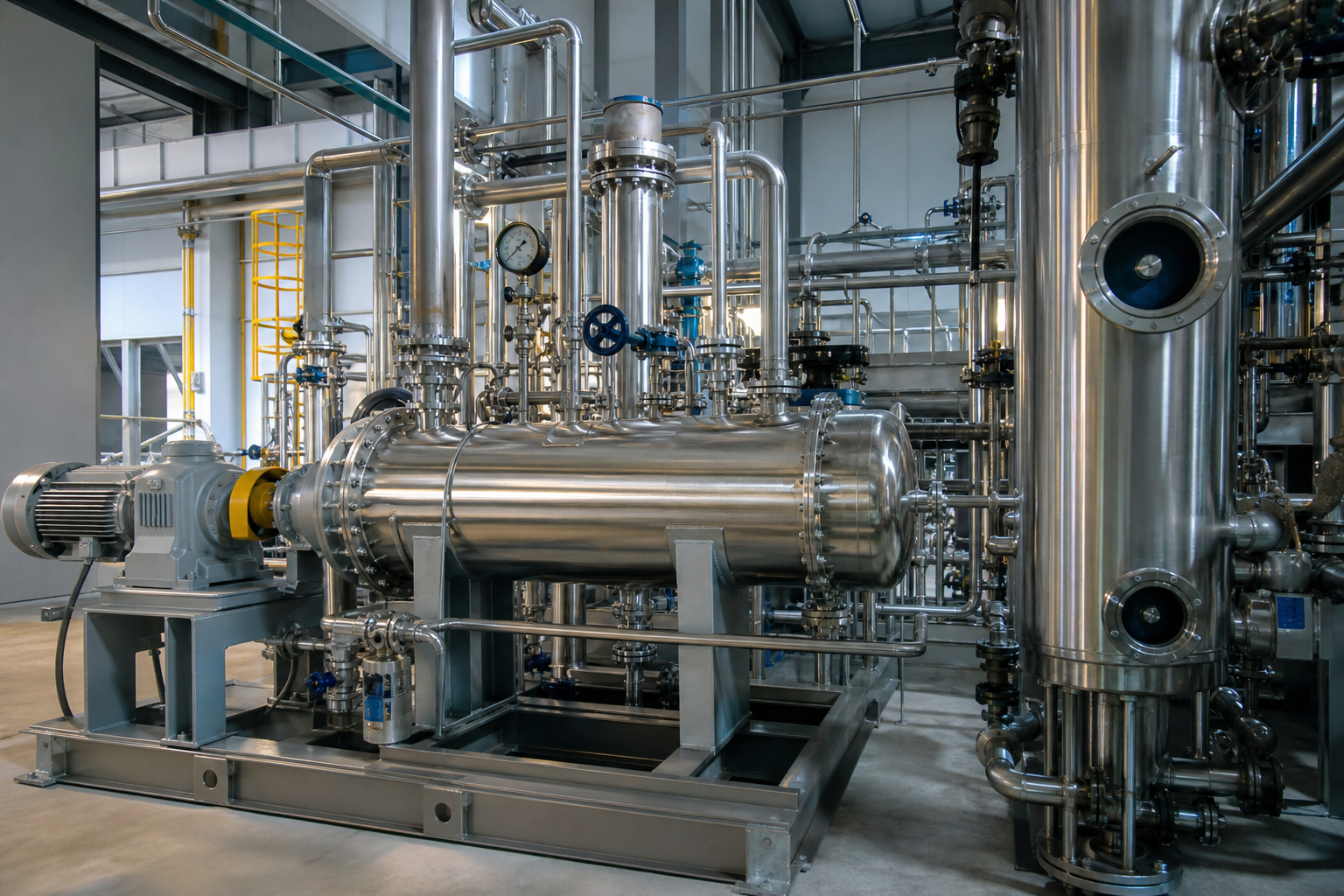
Field results reported by cardanol producers in Vietnam (a principal processing hub, alongside Indian and East-African capacity) running WFE-based lines, compiled as external industry references and not EvapCryst deliveries:
- Cardanol purity lifted from approximately 92% to above 98%;
- Equipment availability (uptime) improved by roughly 30% as coking-related stoppages disappeared;
- Annual output up about 25% on the continuous duty cycle;
- Combined energy consumption down roughly 15% versus the replaced batch process;
- Product color moved from dark brown to light yellow — the property that gates premium pricing in resin applications.
Taken together, these vendor-reported numbers are what moved the industry from batch pots to continuous wiped-film lines; treat them as indicative external references, not project guarantees, and measure any quotation against them.
Scale-Up: From Lab Proof to 10,000-Ton Lines
Commercial cardanol plants scale to around 10,000 tons per year of product on continuous WFE/short-path trains. The disciplined path there has three gates:
- Feed characterization — origin-specific CNSL composition varies with shell source and decarboxylation route;
- Lab/pilot verification — a laboratory wiped-film unit confirms color and purity targets at proposed wall temperature, vacuum, and residence time before full-scale capital commits;
- Modular scale-up — replicating the validated train (often skid-mounted, duplex-2205 construction) rather than enlarging a single vessel, preserving the film mechanics that make the process work.
Buyer’s Checklist for a Cardanol Distillation Project
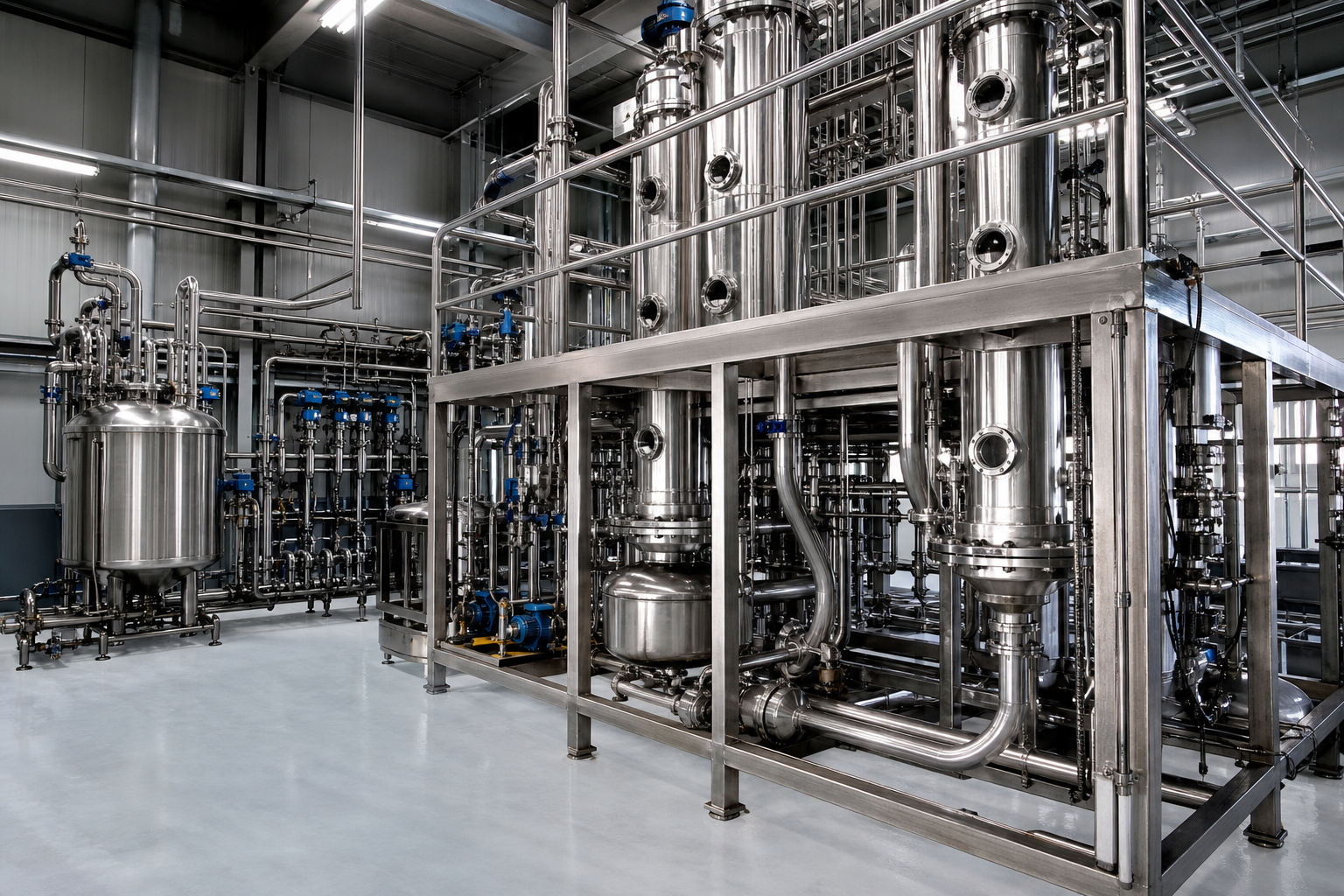
- Scraper design: adjustable blades matched to the viscosity range of your crude CNSL, with shear performance documented on similar feedstocks;
- Seal ratings: mechanical seals rated for 350 °C+ service; ask for the vacuum-decay test criteria;
- Metallurgy: duplex 2205 or verified 316L on all wetted hot parts; standard 304 anywhere hot is a red flag;
- Heating package: high-velocity thermal-oil circuit with demonstrated wall-temperature uniformity (hot-spot control is color control);
- Two-stage architecture: dedicated WFE stripping stage ahead of the short-path still, with interstage condensate handling;
- Pilot data before commitment: color and purity confirmation on your feed at your throughput, in writing.
Applications That Justify the Investment
Cardanol’s commercial pull comes from its side-chain chemistry: the C15 unsaturated chain gives cardanol-derived materials hydrophobicity, flexibility, and fast cure characteristics that petro-phenolics cannot match. The volume applications are epoxy curing agents (cardanol-based mannich and phenalkamine hardeners for marine and protective coatings), friction materials (brake-pad phenolic resins with improved fade behavior), surface coatings and inks, surfactants and intermediates for agrochemicals, and growing specialty niches such as resins for electronics. Because these markets pay for purity and color consistency, the distillation train is not a utility at a cardanol plant — it is the value-capturing step, and under-investing in it shows up directly in the realized price per ton of product. Producers moving up-market from technical-grade to refined cardanol typically find that the wiped-film line pays for itself in the price spread long before the energy and uptime gains are counted.
Commissioning Focus on a Cardanol Line
Three checks during commissioning decide whether the plant will hit its quality targets for the campaign. First, vacuum integrity end-to-end: a decay test on the cold system, then again at operating temperature, because seal and gasket behavior at 320 °C differs from cold-shop conditions. Second, wall-temperature uniformity mapping across the jacket under full thermal-oil flow — any hot band above the recipe temperature is where color bodies will form. Third, residence-time confirmation with the actual crude, verifying that the rotor speed and feed rate deliver seconds-level exposure rather than the minutes-level hold that quietly destroys color. Plants that document these three results at start-up have a baseline for every troubleshooting cycle that follows; plants that skip them spend their first off-spec campaign re-deriving the same numbers.
When This Route May Not Fit
This route exists for one reason: protecting a heat-sensitive, high-value monomer. A wiped-film line is over-engineering for low-volume or intermittent cardanol demand; a rented or toll-distillation route avoids the capital until volumes justify it. Technical-grade CNSL sellers who compete on price, not color, gain little from 98%+ purity hardware. Sites without reliable deep-vacuum maintenance capability will strand the asset: short-path stills live and die by seal and gasket discipline. Feed with unusual origin chemistry, such as uncharacterized decarboxylation routes, undermines recipes copied from published plants. If the product market pays no premium for light color, the entire business case of seconds-level residence collapses back to an ordinary distillation decision. Each exception has a cheaper alternative route.
What Must Be Verified
Cardanol projects justify a strict verification sequence. Feed characterization comes first: CNSL composition and decarboxylation route vary by origin, and both set the recipe. Lab or pilot wiped-film runs on the actual crude must confirm color and purity targets at the proposed wall temperature, vacuum, and residence time, in writing, before capital. Vacuum capability needs decay-test evidence at temperature, not just cold. Metallurgy verification: duplex 2205 or qualified 316L on hot wetted parts, with no standard 304 anywhere hot. Heating uniformity should be demonstrated by wall-temperature mapping. And the commercial layer: offtake prices by grade and color, so the purity investment is priced against realizable spread. Each gate exists because a cardanol mistake is expensive to unwind after startup.
Frequently Asked Questions
Why can’t cardanol be purified in a conventional vacuum distillation column?
Column residence time at the required temperature is long enough for polymerization and coking; the residue viscosity also stalls liquid distribution. The wiped-film machine limits hot exposure to seconds and mechanically renews the surface, which is what the chemistry demands.
What purity can a WFE/short-path line actually reach?
Published external plant experience (not an EvapCryst delivery) shows approximately 92% feed-grade material lifted to 98%+ cardanol, with color improving from dark brown to light yellow — the level epoxy and coating formulators specify.
Is natural or technical CNSL the right feed?
Both routes reach cardanol, but the decarboxylation method (thermal versus chemical) sets the impurity slate the distillation must remove. The WFE line handles either; the operating recipe differs, and feed characterization is the first engineering step.
How much vacuum does the system need?
The short-path stage runs at roughly 0.1–100 Pa, which is why the upstream WFE drying/degassing stage (100–1,000 Pa) exists — it strips water and light boilers that would otherwise collapse the deep vacuum.
What throughput do these lines reach?
Continuous WFE-based trains support plants of roughly 10,000 tons per year of cardanol. Published external retrofits of batch plants report about 25% more annual output on the same feed supply.