Project Parameters
| Parameter | Value |
|---|---|
| Process route | MVR falling-film concentration + forced-circulation evaporation crystallization |
| Industry | New materials / lithium recovery from saline wastewater |
| Feed type & key components | Sodium chloride wastewater with lithium chloride, aluminum chloride, calcium chloride; 15–18% total salt, pH 6–8, COD 5,000–10,000 mg/L |
| Evaporation capacity | 5 t/h |
| Lithium uplift | Li concentration raised from approx. 3 g/L to ≥12 g/L (indicative) |
| Construction materials | SS316L wetted parts (indicative for chloride service; higher alloys per chloride-temperature envelope) |
Representative process configuration compiled from published industry project data. Indicative values, not a process guarantee.
Project Description
A new-materials producer generates a saline wastewater whose dominant salt is sodium chloride but whose value sits in a minor component: lithium, present at roughly 3 g/L as lithium chloride alongside small amounts of aluminum and calcium chlorides. Disposing of that water throws the lithium away; treating it as a lithium-bearing brine turns a waste line into a resource line. The task is twofold — concentrate the water hard enough that downstream lithium recovery becomes practical, and crystallize the bulk sodium chloride so it leaves the process as a manageable solid rather than a growing dissolved load.
The reference configuration is a 5 t/h MVR train pairing falling-film concentration with forced-circulation crystallization. The published operating window for this class of feed is demanding on both ends of the train: 15–18% incoming salinity with 5,000–10,000 mg/L COD means the concentration stage must tolerate organics without fouling blind, and the crystallization stage must handle a sodium chloride liquor working toward saturation. The four-fold lithium uplift — 3 g/L to 12 g/L and above — is the yardstick the train is built around.
Process Technology
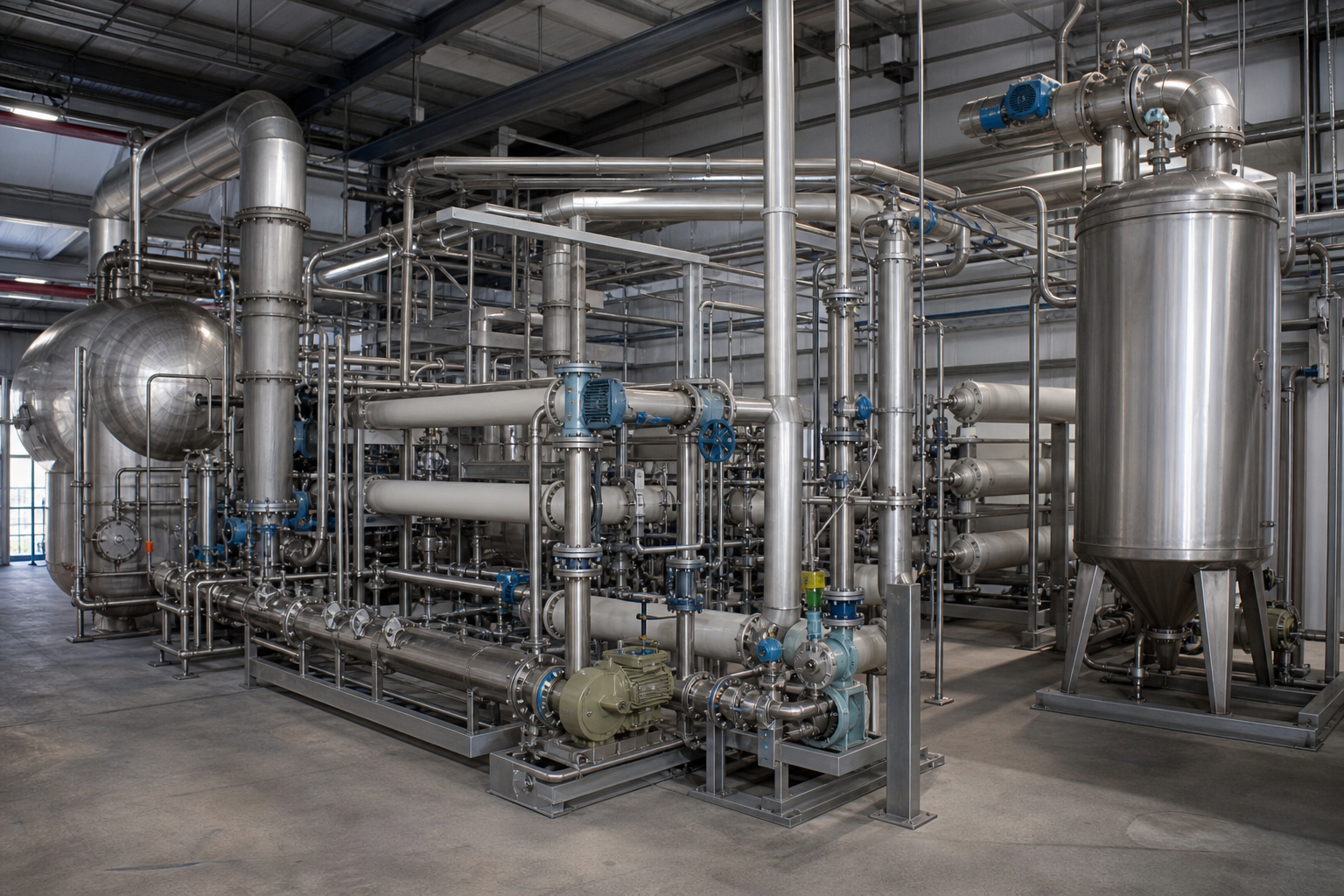
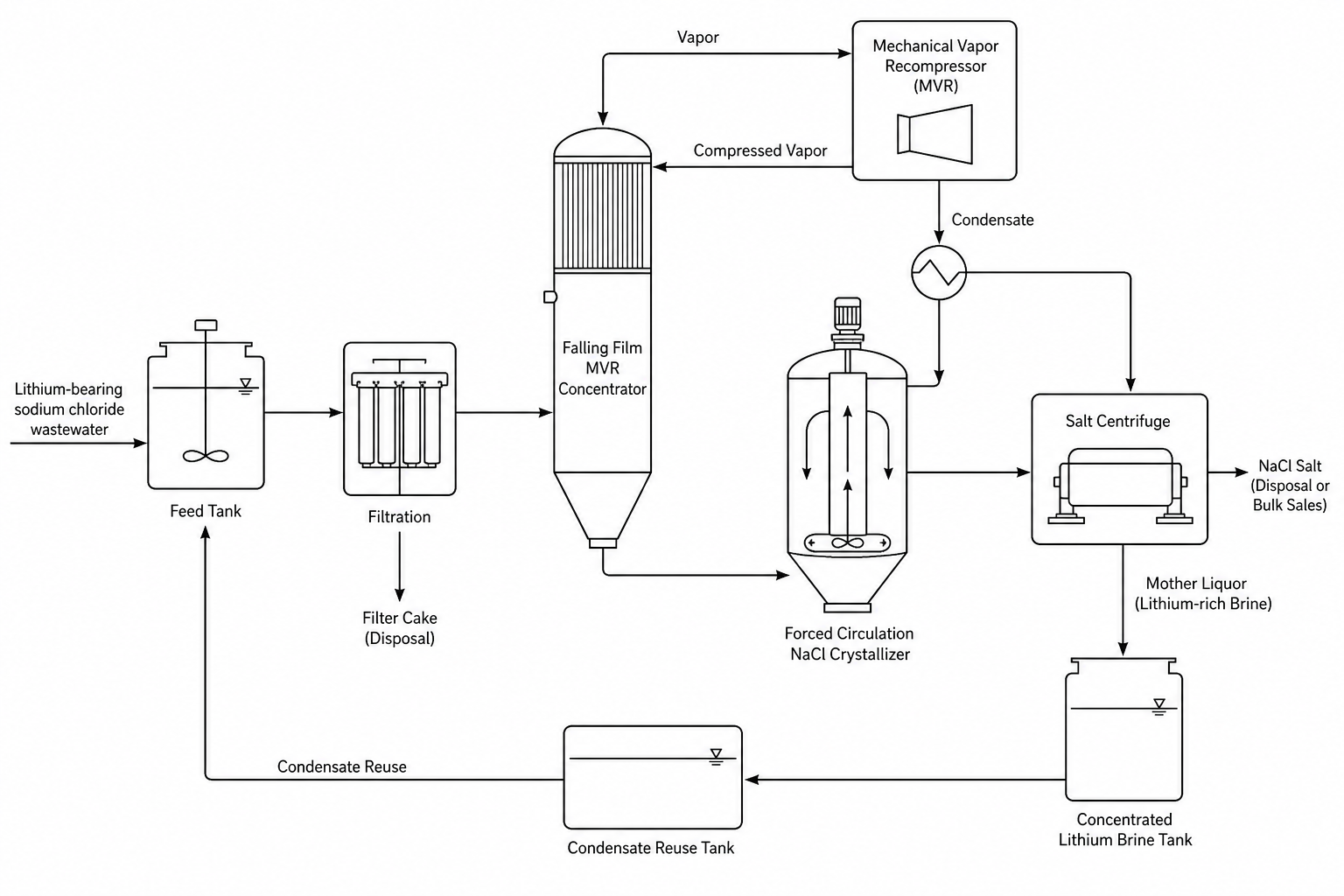
The wastewater is equalized and filtered to protect the heat transfer surfaces from suspended solids, then fed to the falling-film concentrator. Falling film is the right evaporator body for the front end of this duty: the liquor is a clear, pumpable brine through most of its concentration window, and thin-film evaporation at low temperature difference removes water fast without cooking the organic load onto the tube walls. The COD in this feed is the fouling risk that shapes the design — film distribution, washing sequences and conservative wall temperatures keep the organics moving through rather than baking on.
Secondary vapor from the separator is compressed by the mechanical vapor recompressor and returned as heating medium, so the concentration duty runs on electrical power at a fraction of the steam demand of a conventional evaporator. At 5 t/h scale this is exactly the size class where MVR economics are sharpest: the compressor is modest, the power draw is small in absolute terms, and the avoided steam infrastructure is a large share of the project cost.
As the liquor approaches sodium chloride saturation it advances to the forced-circulation crystallizer. Saturated NaCl liquor is a scaling fluid that deposits on any superheated wall, so the crystallizer evaporates with pumped high velocity and suppressed wall superheat — supersaturation is generated in the bulk liquid and relieved on growing salt crystals. Salt is withdrawn as crystal slurry, dewatered on a centrifuge, and recovered as solid sodium chloride; the mother liquor, now several times richer in lithium relative to water, is the concentrated brine the project exists to produce. A purge controls aluminum, calcium and organic inventory in the recycle.
Condensate from the train is hot, low-salt water suitable for plant reuse. Lithium reporting to the concentrated brine at ≥12 g/L is compatible with downstream purification and lithium salt recovery.
Equipment Configuration
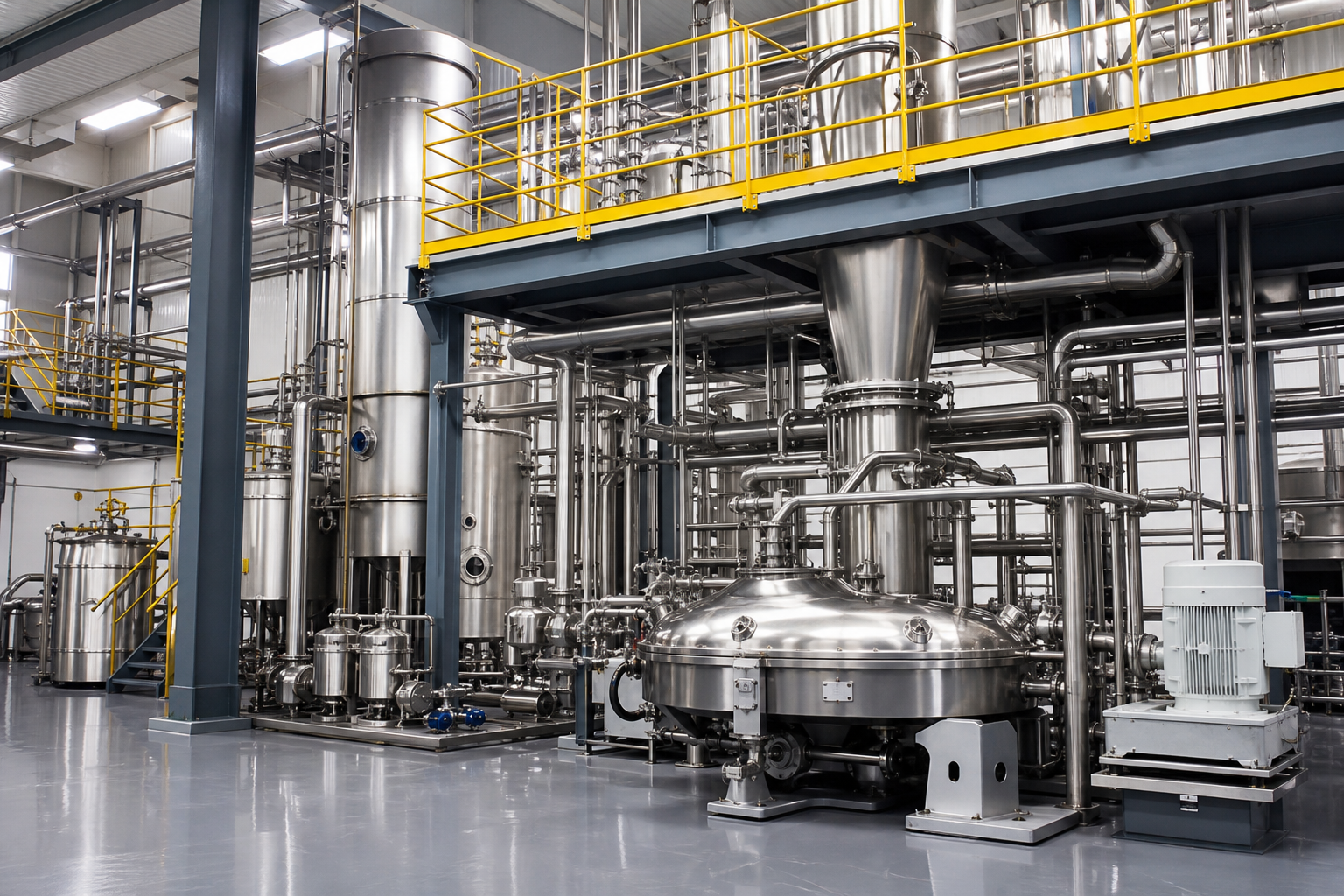
One set of the following equipment is typical for this duty:
- Feed equalization and filtration for the 15–18% salinity wastewater
- Falling-film MVR concentrator with mechanical vapor recompressor and CIP washing
- Forced-circulation crystallizer for sodium chloride with classified withdrawal
- Centrifuge for salt dewatering; mother-liquor (concentrated Li brine) tankage
- Condensate collection and reuse pumping; controlled purge for Ca/Al/organics
- PLC control of brine density, crystallizer slurry and compressor load
SS316L is the indicative reference; high-chloride zones toward saturation are assessed per project for duplex or higher-alloy upgrades.
Performance & Outcome
Compiled from published industry project data, indicative: trains of this class concentrate lithium-bearing chloride wastewater from approx. 3 g/L to ≥12 g/L lithium while crystallizing the bulk sodium chloride as a solid product, on electrically driven MVR energy. Salt recovery rates and brine purity figures are validated per project.
Readers comparing technologies may also find High-Salinity Wastewater ZLD & Salt Crystallization useful.