Project Parameters
| Parameter | Value |
|---|---|
| Process route | MVR falling film concentration + forced circulation evaporation crystallization, ZLD |
| Industry | Integrated chemical park wastewater, mixed effluent (China) |
| Feed type & key components | Mixed high-salt chemical wastewater, blended organics, mixed salt system |
| Feed capacity | 30 t/h |
| Construction materials | SS316L wetted parts, higher alloys per chloride content (indicative) |
Representative process configuration compiled from published industry project data. Indicative values, not a process guarantee.
Project Description
A chemical park is wastewater’s hardest blending problem: dozens of producers, each with its own chemistry, discharging into shared sewers that end at one outfall the regulator no longer permits. Mixed organics, variable salt loads, periodic shock loads — the park’s central treatment plant sees a composition that changes with every upstream production campaign. The reference configuration is a 30 t/h MVR evaporation and crystallization train at a Chinese chemical park, taking the salt-bearing fraction of that mixed effluent to zero liquid discharge.
Biological treatment handles the dilute organic fraction and rejects the saline one — salt above a few percent suppresses the biomass — so the saline concentrate becomes a dedicated thermal duty. The train’s contract is simple to state: no liquid leaves the site; salt leaves as solid; water returns as condensate. Everything in the process section exists to honor that contract on a feed whose composition the plant does not control.
Process Technology
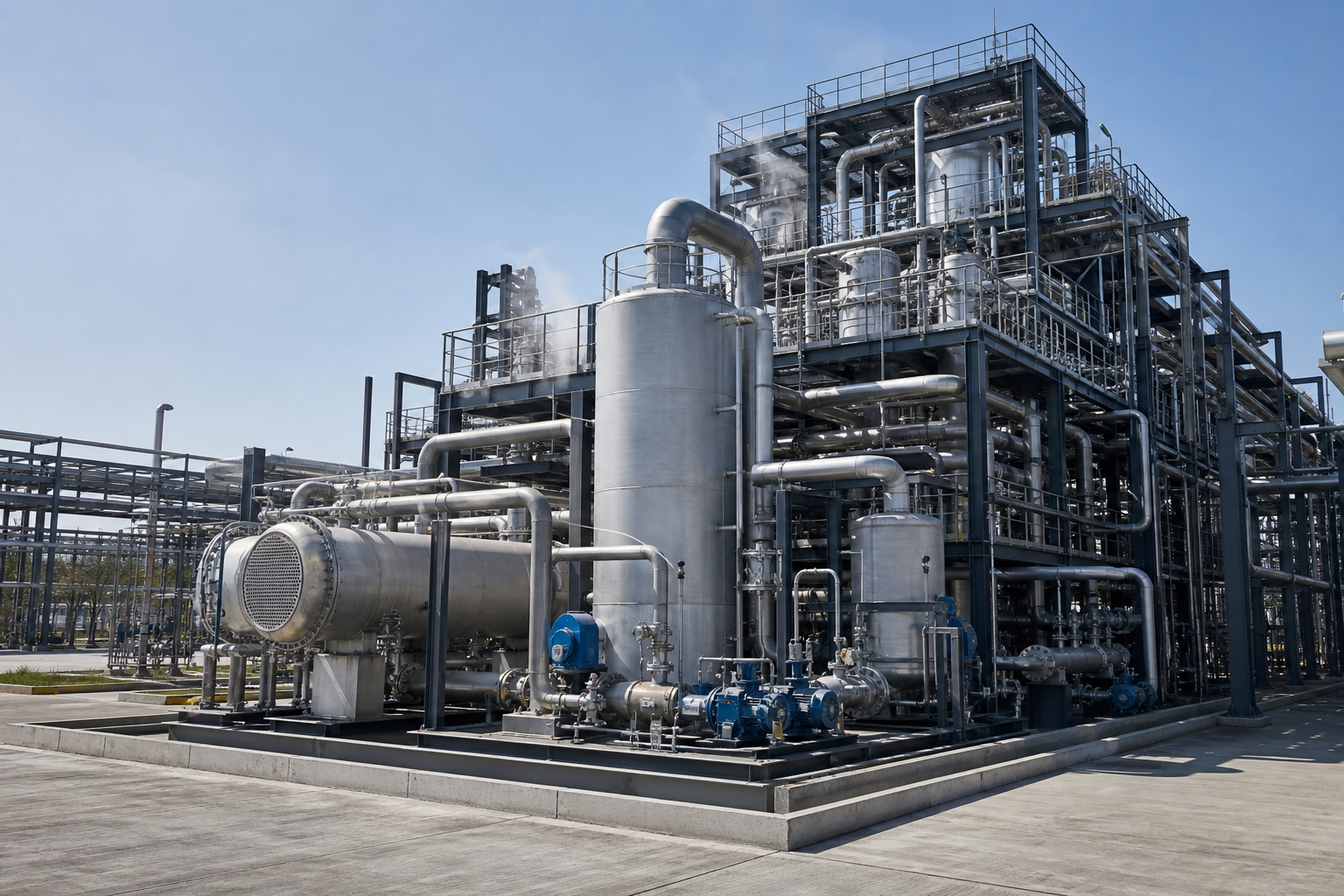
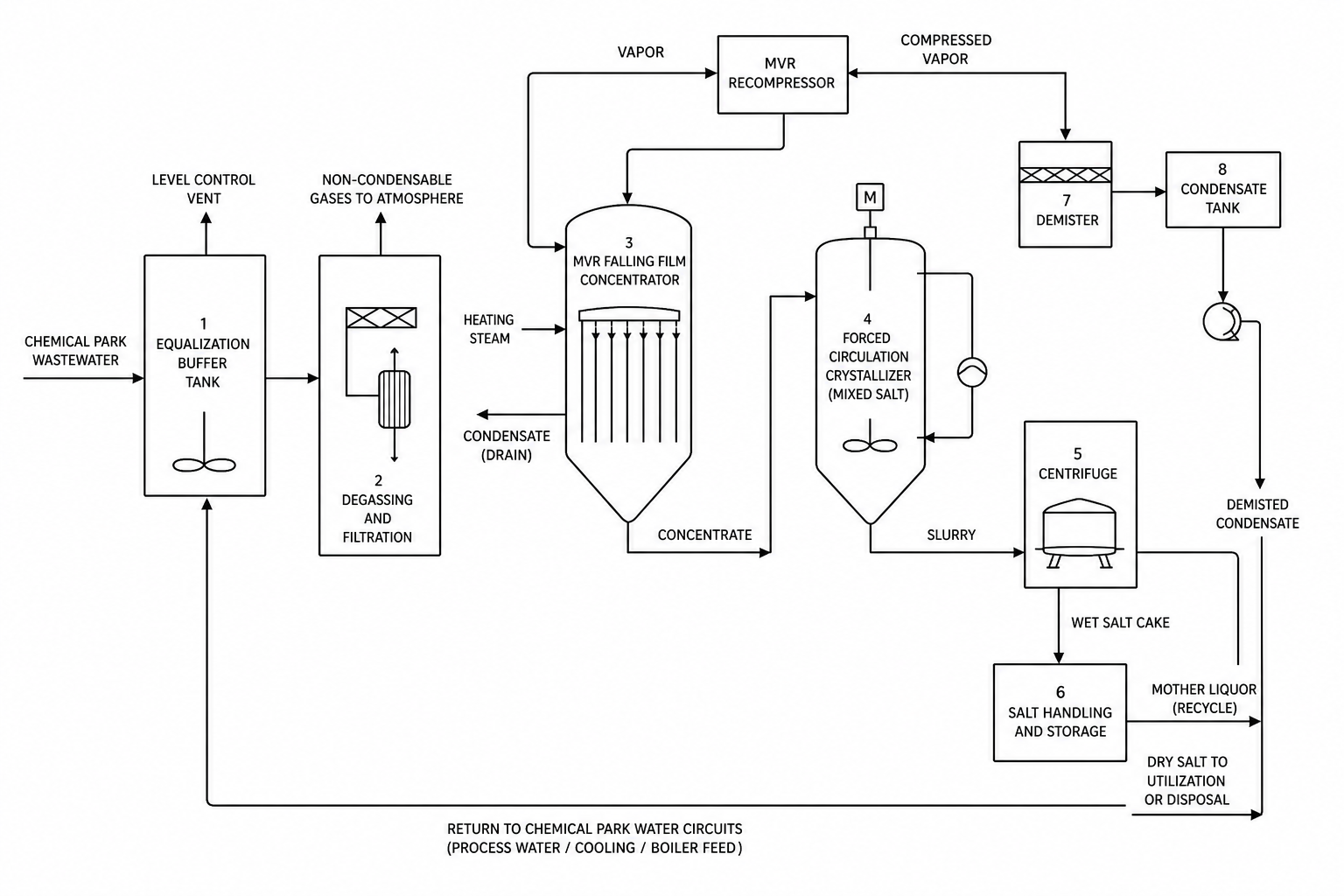
Park effluent equalizes in buffering that absorbs upstream swings, then passes degassing and filtration. The MVR falling film concentrator takes the first lift: liquor distributes as a film inside the tubes, boiling gently under vacuum with short residence time — a geometry that concentrates clean-to-moderately-fouling feeds efficiently and hands a dense brine to the crystallization stage while the recompressor recycles the vapor as heating duty.
Crystallization is forced circulation: the dense brine boils inside tubes under high circulation velocity, with suspended crystals tolerated as a slurry rather than excluded from the heat transfer surface. On a mixed salt system the train crystallizes a mixed salt product — the honest outcome for blended park effluent, where separating sodium from calcium or sulfate from chloride is rarely justified on a stream whose composition changes weekly. Crystal slurry centrifuges to a dewatered solid for compliant disposal; where park salt loads justify it, softening and segregation stages upstream can steer the crystallizer toward a purer salt fraction.
The vapor path runs demisting to keep organics out of the condensate; the condensate — the majority of every incoming tonne — returns to the park’s circulating water and washing systems. A small purge of concentrated mother liquor manages accumulating refractory organics. Comparable published chemical park ZLD configurations across Chinese industrial parks run the same membrane-front, MVR-middle, crystallizer-end logic at 20–100 t/h scales.
Equipment Configuration
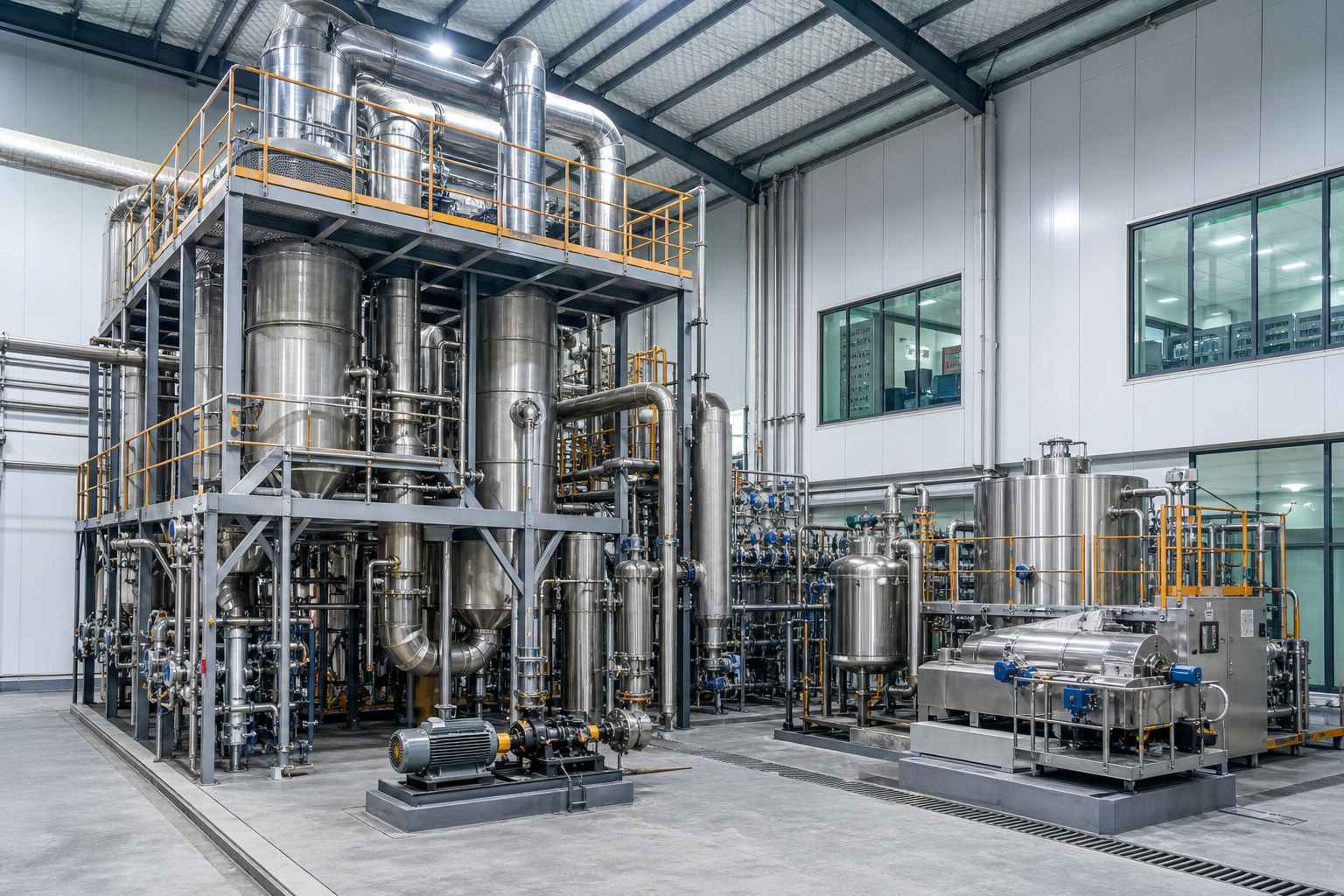
One set of the following equipment is typical for this duty:
- Equalization and buffering against upstream composition swings
- Degassing and filtration pretreatment
- MVR falling film concentrator with centrifugal recompressor
- Forced circulation crystallizer for mixed salt production
- Centrifuge, drying interface and solid salt handling
- Demisted condensate system returning to park water circuits
- PLC / DCS control of concentration, crystal inventory and ZLD balance
Performance & Outcome
Compiled from published industry project data, indicative: trains of this class deliver zero liquid discharge on mixed chemical park wastewater at 30 t/h on MVR energy, with condensate reuse and dewatered mixed salt as the only outputs. Condensate quality and salt disposal classification are quoted per project effluent analysis.
Simplified PFD
The simplified process flow diagram above shows equalization, MVR falling film concentration, forced circulation mixed-salt crystallization and condensate return to the park’s water circuits.