Project Parameters
| Parameter | Value |
|---|---|
| Process route | MVR falling-film concentration + tubular forced-circulation crystallization, fractional salt separation |
| Industry | Refining — FDFCC flue gas treatment blowdown |
| Feed type & key components | Flue gas treatment effluent bearing sodium sulfate and sodium chloride |
| Evaporation capacity | 15 t/h in two sections (9 t/h + 6 t/h) |
| Construction materials | SS316L / duplex on chloride-rich sections (indicative) |
Representative process configuration compiled from published industry project data. Indicative values, not a process guarantee.
Project Description
A refinery in Heze, Shandong Province, operating a 1.2 million ton-per-year FDFCC (flexible dual-riser fluid catalytic cracking) unit, scrubs its flue gas through a treatment train whose blowdown carries the captured contaminants as a mixed sodium salt liquor — sulfate from SOx capture alongside chloride. The effluent from the flue gas treatment system cannot be discharged under the site’s permit, and the refinery’s answer is a dedicated liquid discharge crystallization system: evaporate the water, separate the two sodium salts, and return condensate to the scrubber circuit.
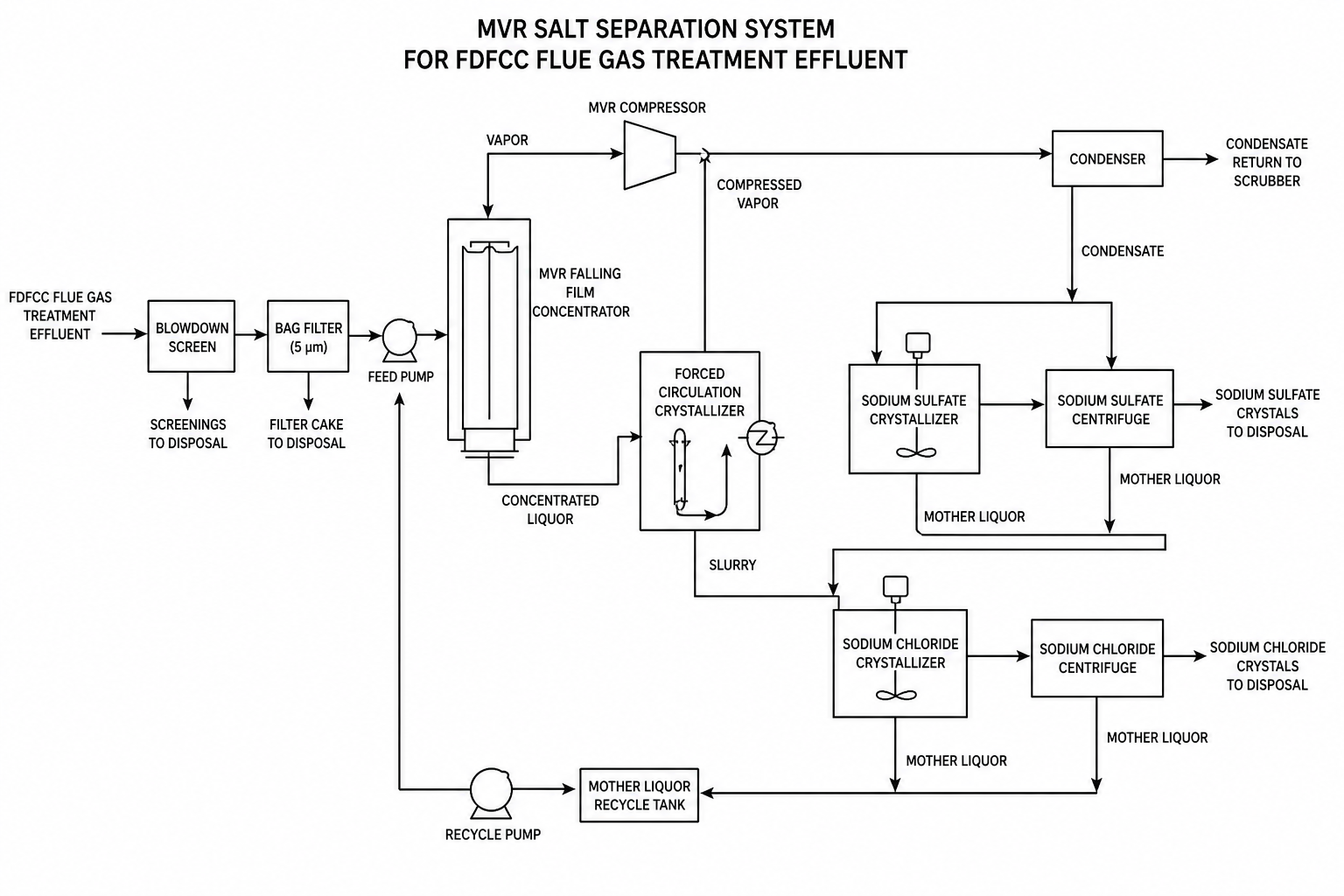
The reference configuration splits the 15 t/h duty into two sections — 9 t/h and 6 t/h — mirroring the stream and salt-separation logic: an MVR falling-film concentration section that takes the effluent to the crystallization window, and forced-circulation crystallization stages that recover sodium sulfate and sodium chloride as separate solids.
Process Technology
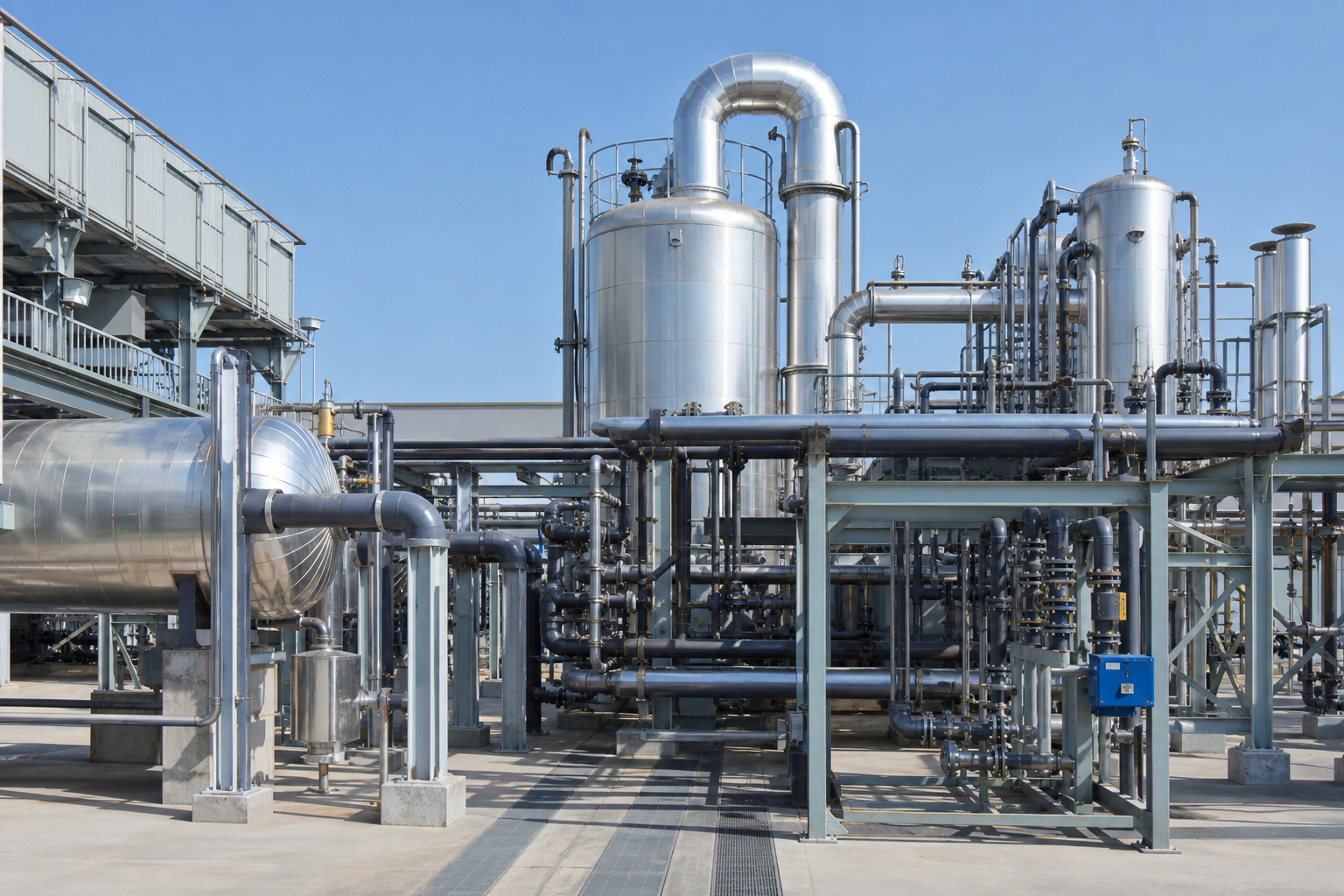
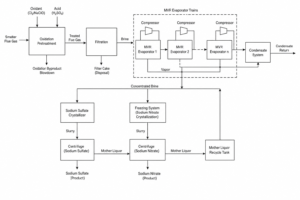
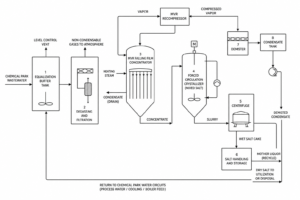
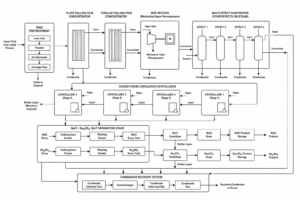
Scrubber blowdown is collected, screened for gypsum and soot fines, and clarified; the liquor is then polished through filtration to protect the plate-and-tube surfaces from the suspended solids typical of flue gas service. The 9 t/h concentration section runs as an MVR falling-film train: liquor films down the tubes under vacuum, secondary vapor is recompressed electrically and returned as heating steam, and the effluent is concentrated to the salt saturation window at low temperature and short residence — keeping energy inside the battery limit rather than drawing live steam from the refinery header.
Concentrate reports to the crystallization sections. Because the two salts interact through their common sodium ion, separation proceeds by staged crystallization: evaporation is controlled so that one salt crystallizes while the other remains in solution, the slurry is centrifuged, and the mother liquor advances to the next stage where the complementary salt is recovered. The 6 t/h forced-circulation section carries the crystallizing duty — pumped high-velocity circulation through tubular exchangers with boiling suppressed to the separator, the standard architecture for liquors that crystallize on the heat transfer surface, as sulfate liquors reliably do.
Solids from the two stages leave as separate sodium sulfate and sodium chloride streams for managed offtake; mother liquor recycles to the concentration section with a small purge to keep trace metals and fine soot residues from accumulating. Condensate from the MVR train and crystallizer heaters is collected and returned to the flue gas scrubber as make-up — the loop that makes the system a zero-liquid-discharge unit for the FCC environmental train.
Equipment Configuration
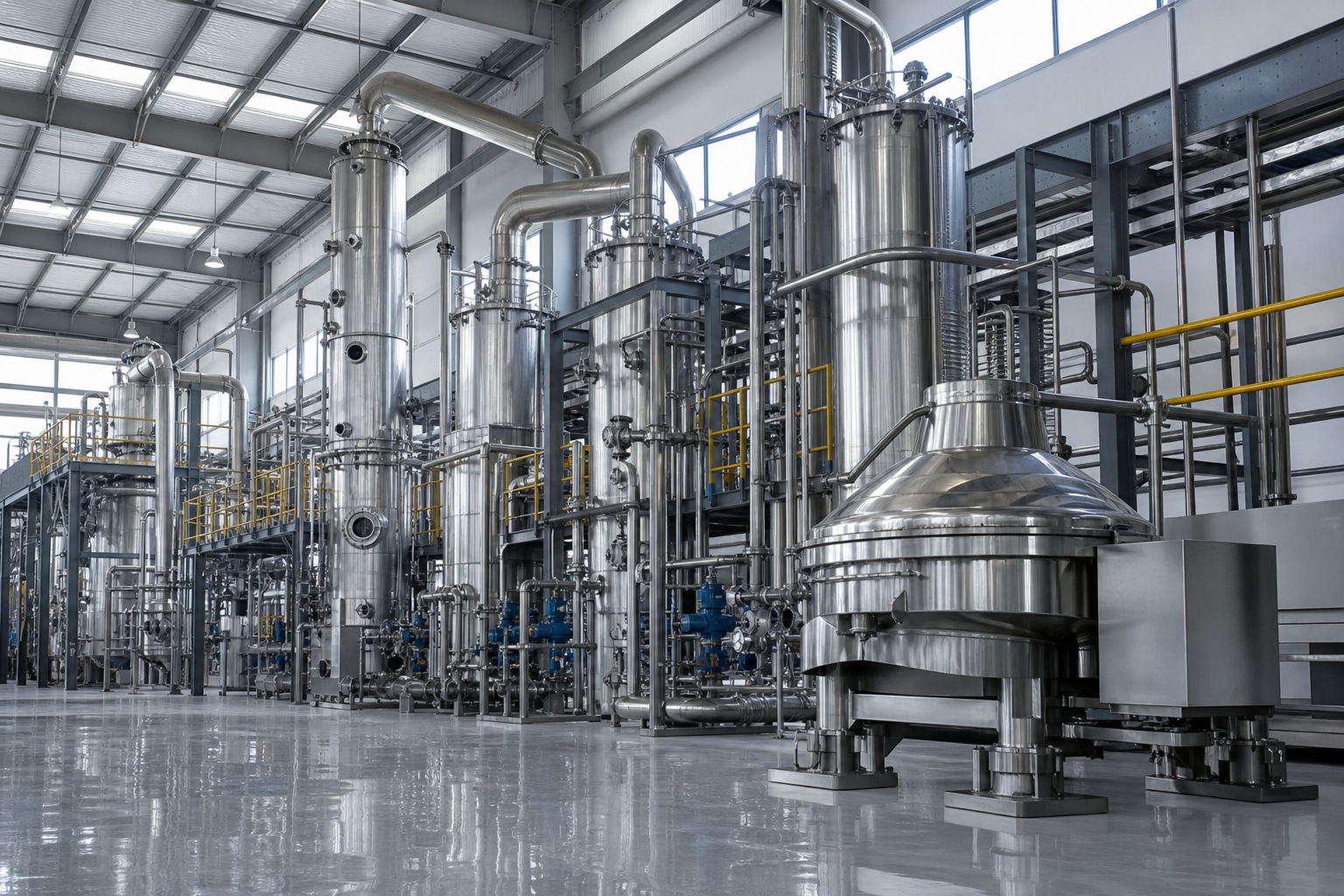
One system of this class comprises:
- Blowdown collection, screening and filtration for soot and gypsum control
- 9 t/h MVR falling-film concentration body with mechanical vapor recompressor
- 6 t/h forced-circulation crystallization section with tubular heater and separator
- Staged salt crystallization and centrifuges for separate Na2SO4 and NaCl recovery
- Mother-liquor recycle with controlled purge; condensate return to the scrubber circuit
- Density- and temperature-based control of the separation windows
SS316L is indicative for the sulfate-side service, with duplex on the chloride-rich sections where hot-end chloride concentration demands it.
Performance & Outcome
Compiled from published industry project data, indicative: systems of this class take FDFCC flue gas treatment effluent to zero liquid discharge at duties around 15 t/h, separating sodium sulfate and sodium chloride into individual solid streams and returning condensate to the scrubber. Salt purities, split sharpness and energy figures depend on the sulfate-to-chloride ratio of the blowdown and are validated per project.