
Project Parameters
| Parameter | Value |
|---|---|
| Process route | MVR multi-stage distillation (concentration + rectification) |
| Industry | Man-made cellulose fiber spinning (solvent recovery loop) |
| Feed type & key components | Dilute DT solvent solution from fiber washing, 20% DT by weight |
| Feed capacity | 9 m3/h (operating load range 75–100%) |
| Specific energy | 64.8 kW·h per tonne of feed material (indicative) |
| Construction materials | SS316L wetted parts (indicative); Ex-rated equipment to IIB T4 |
Representative process configuration compiled from published industry project data. Indicative values, not a process guarantee.
Project Description
A cellulose fiber spinning line using the DT solvent route generates a steady stream of wash water carrying roughly 20% solvent. The solvent is too valuable to discharge and the wash water volume too large to discard: the economics of the whole fiber process depend on closing the loop — reconcentrating the dilute solution, purifying the solvent back to spinning quality, and returning clean water to the washing stage. Solvent systems of this family also carry a process-safety dimension: the vapor is flammable, so every piece of thermal equipment on the loop is engineered for hazardous-area service.
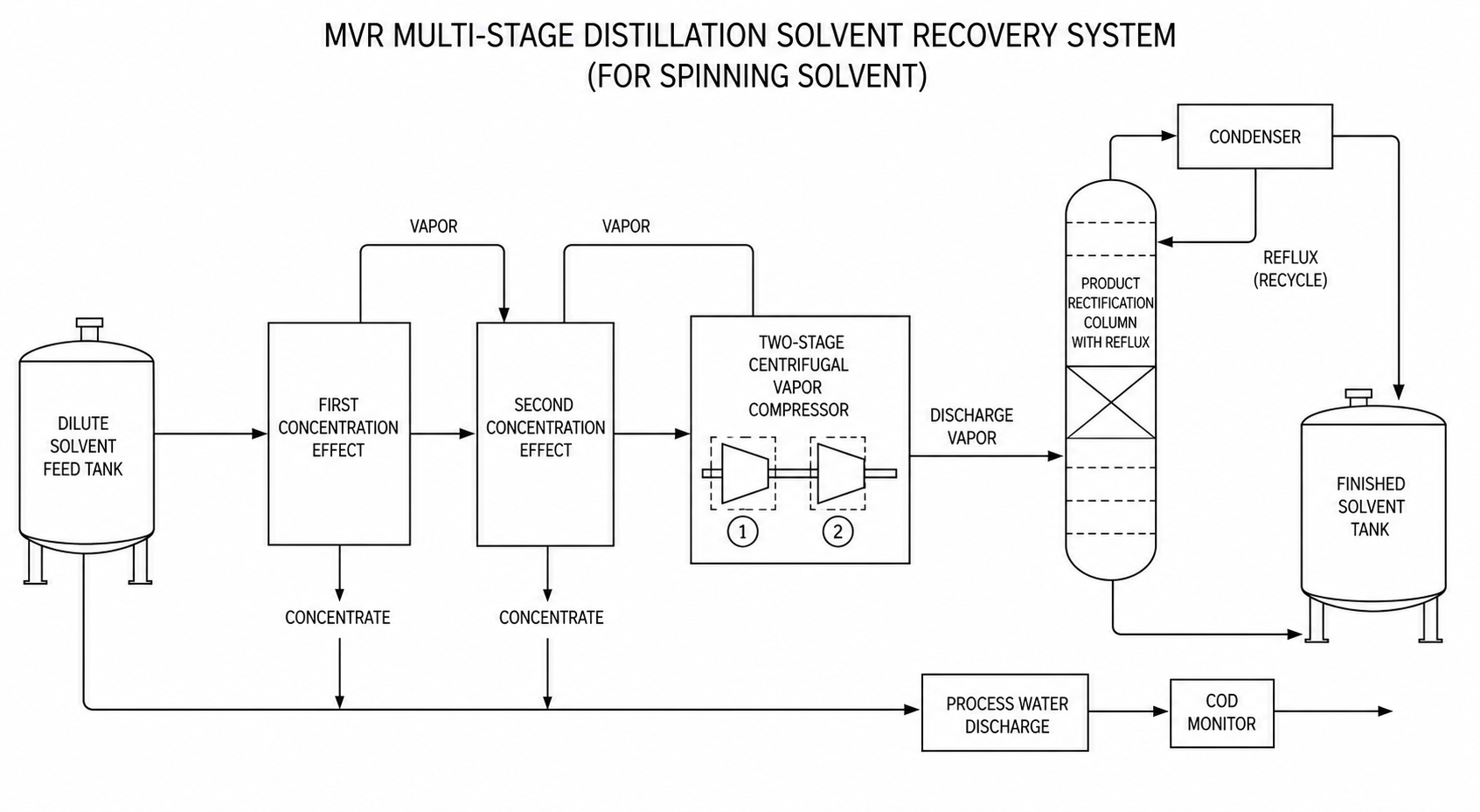
The reference configuration is a 9 m3/h MVR multi-stage distillation train. Rather than a single brute-force column, the duty is split into staged concentration steps — first effect lifting the DT from 20% to 55%, second effect from 55% to 80% — followed by a rectification column that takes the enriched liquor to finished solvent above 99.5%. The staged approach keeps each heat-transfer duty in its most efficient concentration window and holds the full material path below 90°C, protecting both the solvent chemistry and the equipment.
Process Technology
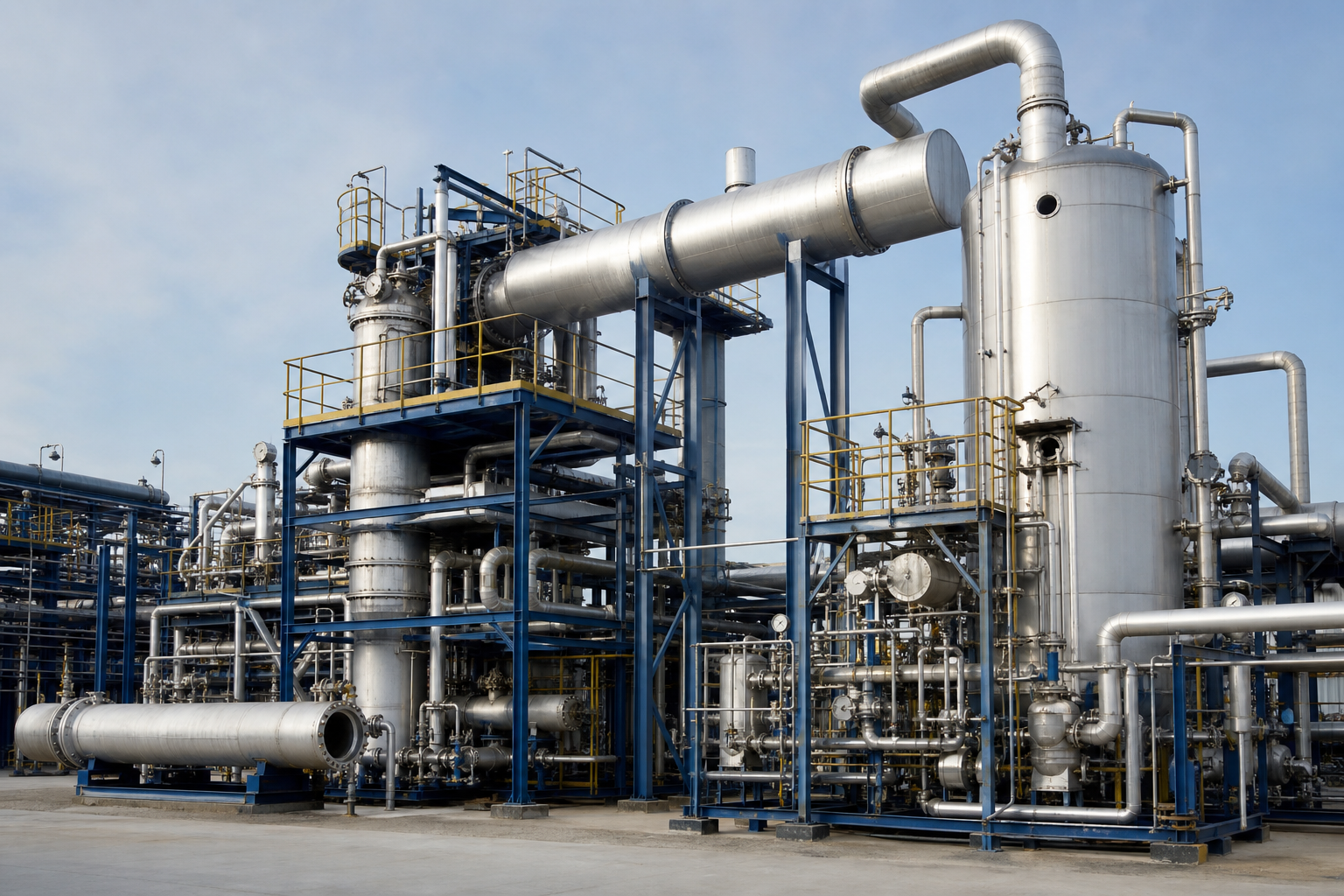
Dilute DT solution from the fiber washing plant is collected, filtered and pumped to the first concentration stage. Both concentration effects are served by a two-stage centrifugal mechanical vapor recompressor arrangement: the first compressor stage lifts the secondary vapor by about 20°C, the second by a further 18–20°C, together restoring enough driving temperature difference to reboil the columns on electrical power alone. The two-stage configuration matters here — a single centrifugal stage cannot economically span the temperature lift this solvent system requires, and the split arrangement keeps each compressor in its efficient operating region.
Temperature discipline runs through the whole flowsheet: all material temperatures are held below 90°C. Solvent recovery duties live close to the thermal degradation and fouling thresholds of their organics, and low-temperature MVR operation is what allows high solvent recovery without darkening the product or polymerizing fouling films onto the heat transfer surfaces.
The rectification column completes the loop. Enriched 80% liquor is fed to the column, which separates finished DT solvent at the top of its concentration profile — above 99.5% DT with water content below 0.5% — while the water drawn off the process exits with a COD below 100 ppm, clean enough for wash-water reuse or direct discharge per local permit. That water quality figure is the quiet headline of the plant: it means the solvent and the water are both recovered, not merely separated.
Control is built on a PLC platform of the Allen-Bradley 1756 class, managing column temperatures, compressor load and feed pacing. The electrical and instrumentation scope is rated for explosion class IIB, temperature class T4 — the standard hazardous-area envelope for flammable solvent vapor service.
Equipment Configuration
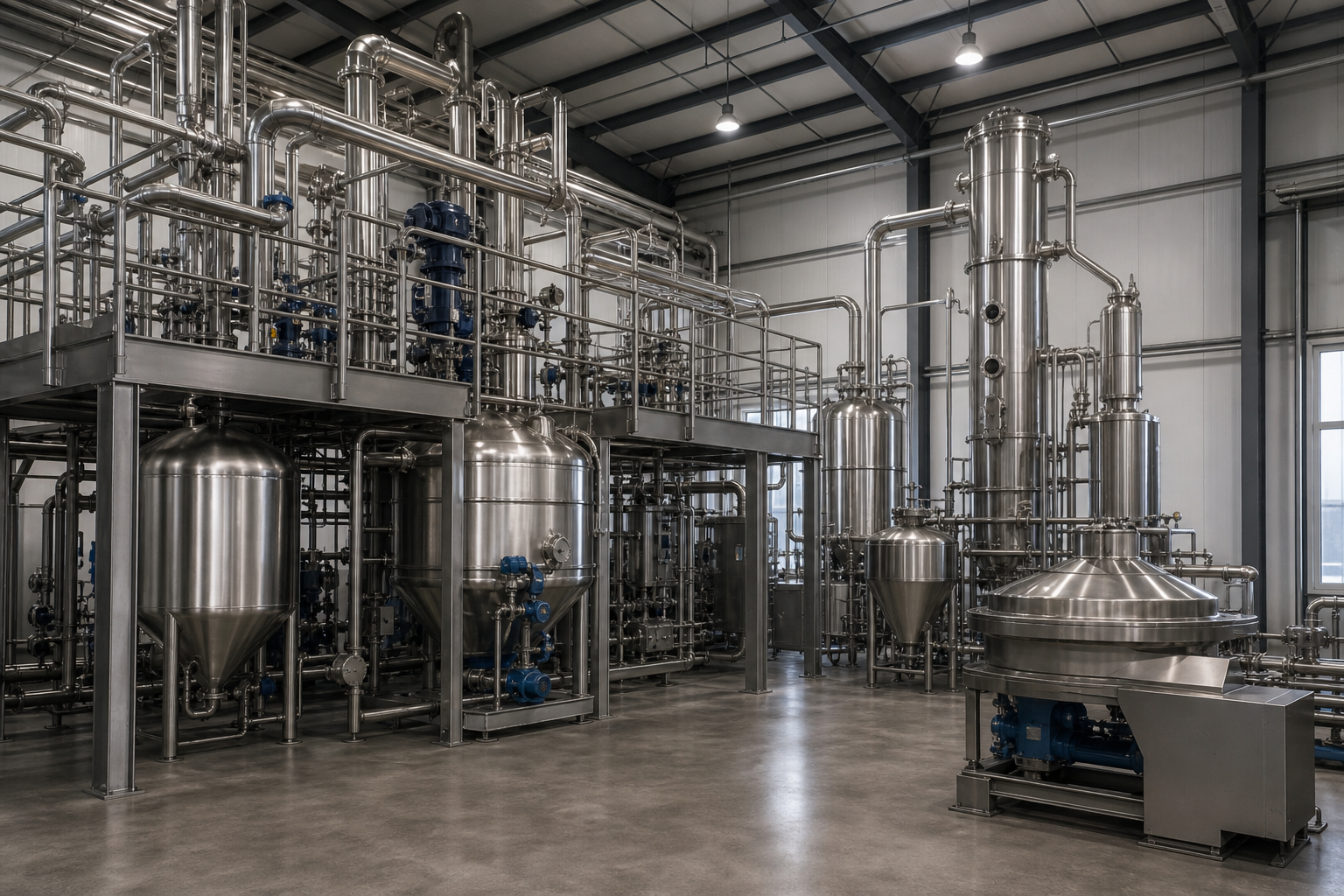
One set of the following equipment is typical for this duty:
- Feed tank, filtration and metering for the 20% dilute DT solution
- First concentration effect (20% → 55%) and second concentration effect (55% → 80%)
- Two-stage centrifugal mechanical vapor recompressor (approx. 20°C + 18–20°C lifts) with anti-surge control
- Product rectification column with reflux system finishing solvent to >99.5% / <0.5% water
- Process water polishing with COD monitoring (<100 ppm indicative performance)
- PLC control (AB 1756 class) with Ex-rated IIB T4 electrical scope throughout
SS316L is the indicative reference for wetted parts in this service; solvent compatibility and chloride exposure are assessed per project.
Performance & Outcome
Compiled from published industry project data, indicative: trains of this class recover spinning solvent above 99.5% purity with water content below 0.5%, discharge process water below 100 ppm COD, and run the entire material path below 90°C on 64.8 kW·h per tonne of feed. Turn-down to 75% load is part of the published operating envelope.


