
Project Parameters
| Parameter | Value |
|---|---|
| Process route | MVR evaporation, rising film, low-temperature vacuum service |
| Industry | Ejiao / gelatin production, traditional medicine (China) |
| Feed type & key components | Ejiao (donkey-hide gelatin) extract liquor, high-viscosity collagen hydrolysate |
| Evaporation capacity | 4 t/h |
| Construction materials | SS316L food / pharma grade wetted parts (indicative) |
Representative process configuration compiled from published industry project data. Indicative values, not a process guarantee.
Project Description
Ejiao — donkey-hide gelatin — is one of the oldest documented gelatin productions in the world and one of the most demanding evaporation duties in traditional medicine manufacturing. Hide is hydrolyzed over days; the resulting liquor is a collagen hydrolysate solution that thickens dramatically as it concentrates, toward the consistency that casting and flaking into the finished block require. The reference configuration is a 4 t/h MVR evaporator at a Chinese ejiao producer, running rising film service under vacuum to take the liquor from thin extract to casting concentration.
Two properties of the liquor dictate everything. Viscosity: gelatin solutions film poorly as they thicken, and a concentrator that cannot move the film cannot transfer heat. Heat sensitivity: prolonged high temperature degrades collagen and darkens the product — in a product whose color and clarity are quality attributes, thermal abuse is visible in the finished block. The configuration answers both with vacuum, low temperature and MVR energy economy.
Process Technology

Clarified extract liquor feeds the evaporator, which runs under vacuum so the liquor boils in the 60–70 °C class rather than at atmospheric boiling. In the rising film tubes, vapor generated at the wall forms the driving core that lifts the liquor upward — the two-phase flow that keeps the heat transfer surface wetted even as viscosity climbs, a geometry well suited to gelatin service where a falling film would struggle to distribute a heavy liquor evenly.
The MVR compressor takes the secondary vapor, raises its pressure and temperature electrically, and returns it to the calandria as heating steam. The plant therefore buys electricity, not boiler steam, for its evaporation energy — and because the vapor recirculates rather than exhausting, the thermal stress on the collagen stays bounded: low temperature, short residence time, one pass. A finishing stage polishes the concentrate to the casting density; the thick liquor advances to casting, chilling and flaking into the final ejiao block.
Condensate — clean water evaporated from the liquor — returns to hide washing and process make-up. Comparable published gelatin and collagen concentration configurations run the same low-temperature MVR logic across gelatin, bone gelatin and collagen peptide plants; scraped film equipment takes over at the highest viscosity tail of the duty, and neighboring configurations of this class are outlined in the process description above.
Equipment Configuration

One set of the following equipment is typical for this duty:
- Extract clarification and liquor feed system
- MVR rising film evaporator with centrifugal recompressor, vacuum service
- Finish concentration stage to casting density
- Casting / chilling interface for the concentrated gelatin liquor
- Condensate recovery to hide washing and process water
- CIP system for hygienic turnaround between batches
- PLC control of vacuum, temperature and density endpoints
Performance & Outcome
Compiled from published industry project data, indicative: MVR systems of this class concentrate gelatin and ejiao liquors at low temperature with electrically driven energy economy, preserving color and clarity in the finished product. Specific energy and concentration endpoints are quoted per project liquor viscosity profile.
Simplified PFD
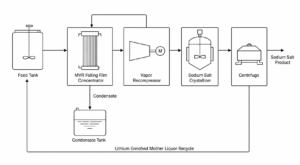
The simplified process flow diagram above shows clarified extract, low-temperature MVR rising film evaporation, finish concentration to casting density and condensate recovery.