
Project Parameters
| Parameter | Value |
|---|---|
| Process route | MVR evaporation + forced circulation crystallization + hydrazine recovery interface |
| Industry | Hydrazine hydrate production, fine chemicals (China) |
| Feed type & key components | Hydrazine hydrate process wastewater, high COD with high salinity |
| Feed capacity | 50 t/h |
| Construction materials | SS316L wetted parts (indicative for hydrazine service) |
Representative process configuration compiled from published industry project data. Indicative values, not a process guarantee.
Project Description
Hydrazine hydrate is a reducing agent that downstream industry never sees but always depends on: it deoxygenates boiler water in power plants, reduces cells in pharma synthesis, and propellant and polymer chemistry both draw on it. Its manufacture, however, is a saline affair — the Raschig and ketazine routes both leave mother liquors carrying salt, organics and residual hydrazine at a scale that a fine chemicals site cannot discharge. The reference configuration is a 50 t/h MVR evaporation train at a Chinese hydrazine hydrate producer, desalinating high-COD hydrazine wastewater while keeping the hydrazine values in the loop.
The water chemistry defines the duty: high COD means organics that foam, foul and slip into condensate if the evaporator lets them; high salinity means the train must crystallize salt rather than merely concentrate; and residual hydrazine is both a product to recover and a nitrogen species that permit limits track in any effluent. Direct biological treatment is off the table — hydrazine is toxic to the biomass — so thermal separation carries the whole load.
Process Technology
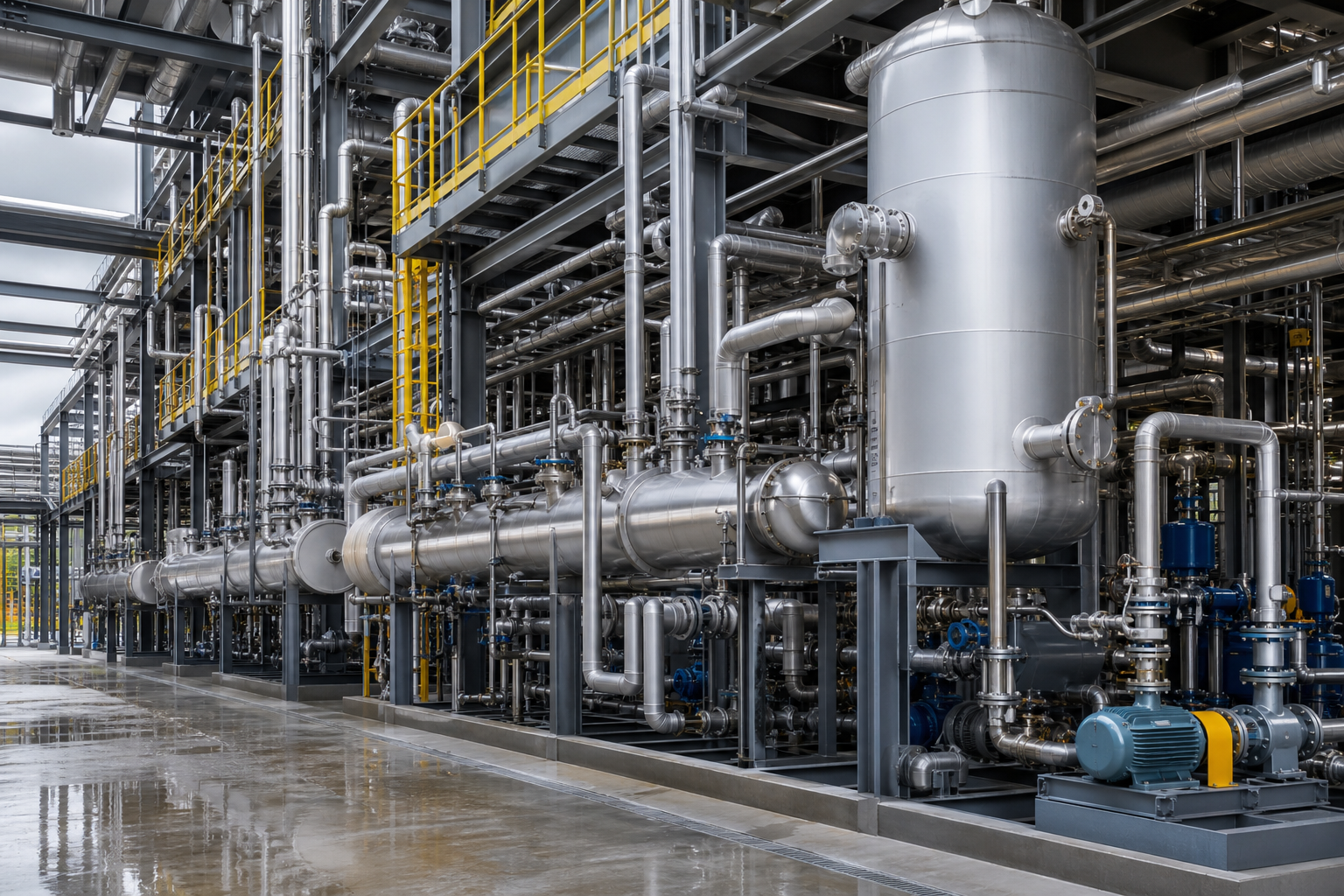
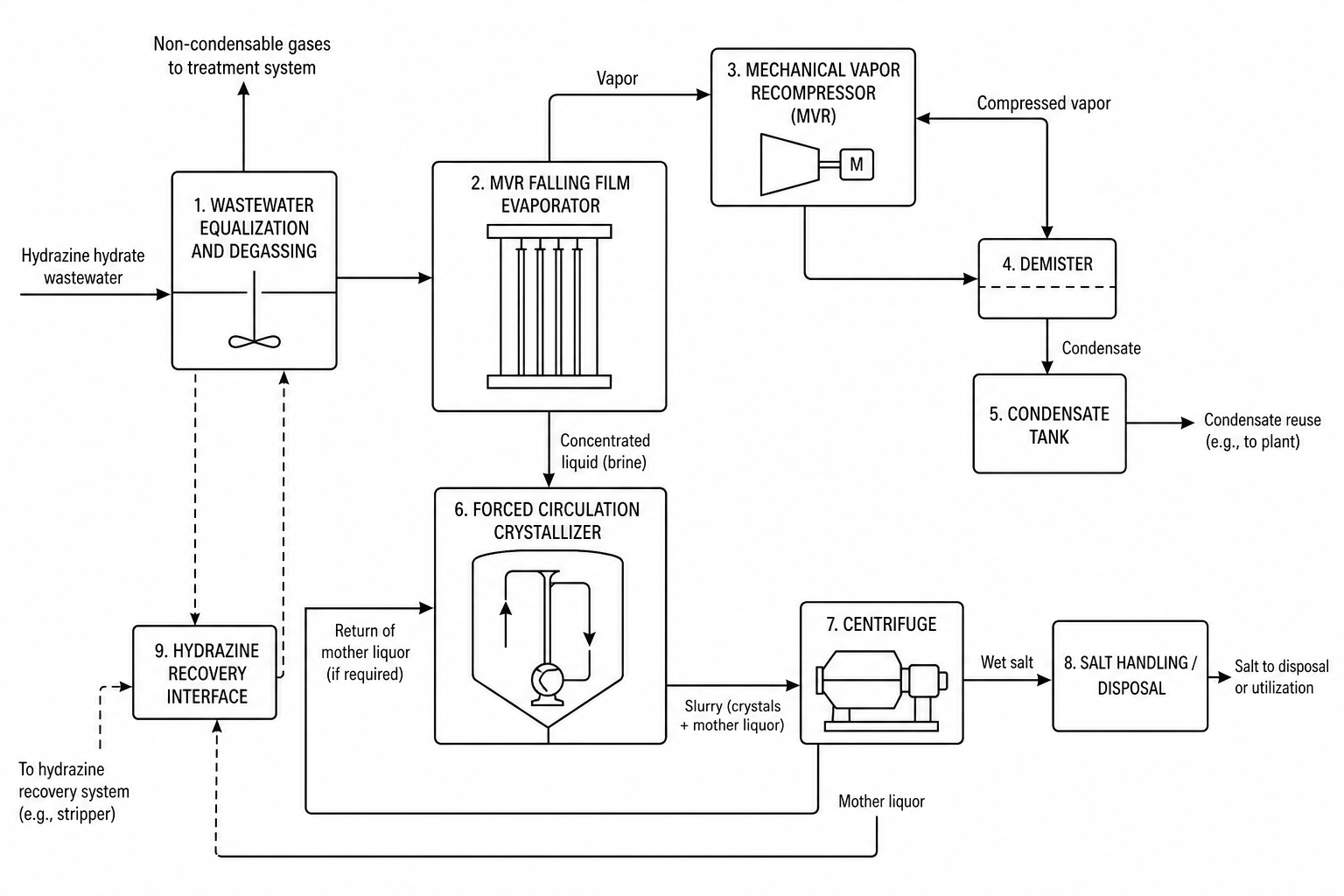
Wastewater equalizes and passes degassing and filtration for suspended solids. The MVR evaporator concentrates it under vacuum: a centrifugal compressor lifts secondary vapor to heating duty, so the train runs on electrical energy rather than live steam — the defining economy of MVR on a stream this large, where a steam-driven multi-effect train would put a permanent fuel line item under the environmental budget.
Because the feed carries dissolved salt at concentrations beyond what a falling film alone can polish, the concentration stage hands off to forced circulation crystallization: boiling within the tube under high circulation velocity, indifferent to suspended crystals, tolerant of the fouling organics that would crust a film surface. Salt crystallizes continuously, is centrifuged from the liquor, and leaves as a solid stream for disposal or assessment; mother liquor, still carrying hydrazine and organics, recycles to the front of the train or diverts to the recovery interface.
The vapor path is where COD control happens: demisting and washing stages keep organics out of the condensate so the recovered water is clean enough for plant reuse — washing, make-up, cooling. A hydrazine recovery interface takes the hydrazine-bearing fractions back toward the product side of the plant, so the wastewater train doubles as a yield-protection unit. Comparable published configurations for hydrazine and other high-COD saline chemical wastewaters run the same MVR-plus-crystallizer logic at 20–50 t/h scales across the Chinese fine chemicals sector.
Equipment Configuration
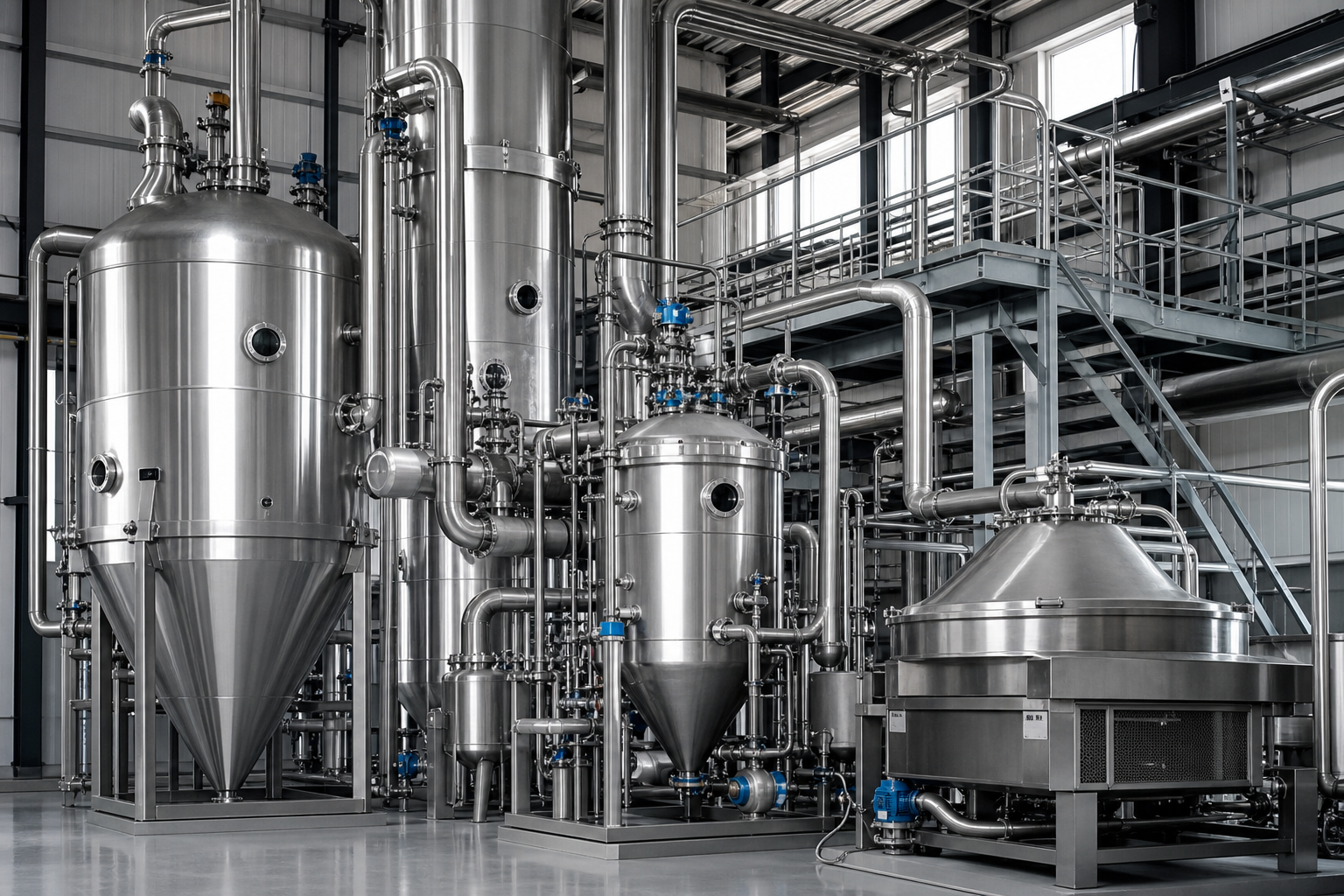
One set of the following equipment is typical for this duty:
- Wastewater equalization, degassing and filtration
- MVR evaporator with centrifugal vapor recompressor
- Forced circulation crystallizer for salt separation
- Centrifuge and salt handling for the crystallized solids
- Hydrazine recovery interface on the enriched fractions
- Demisted condensate system with organics wash-out staging
- PLC control of concentration, crystal inventory and condensate quality
Performance & Outcome
Compiled from published industry project data, indicative: trains of this class desalinate high-COD hydrazine wastewater at 50 t/h on MVR energy, producing reusable condensate and a dewatered salt stream while holding hydrazine values inside the plant loop. Condensate COD and specific energy are quoted per project wastewater analysis.
Simplified PFD
The simplified process flow diagram above shows wastewater equalization, MVR evaporation, forced circulation salt crystallization, hydrazine recovery and condensate reuse.


