Project Parameters
| Parameter | Value |
|---|---|
| Process route | MVR falling-film evaporation + four-effect duty, with MVR evaporating crystallization of ammonium sulfate in continuous operation |
| Industry | Fermentation — amino acid (lysine) production |
| Feed type & key components | Lysine-production waste liquor; ammonium sulfate, residual organics, amino-acid traces |
| Evaporation capacity | 80 t/h |
| Recovered product | Ammonium sulfate crystal by continuous MVR evaporation crystallization |
| Region | East China (Shandong) |
Representative process configuration compiled from published industry project data. Indicative values, not a process guarantee.
Project Description
Lysine plants generate a characteristically difficult liquor. Downstream of fermentation and extraction, the mother streams carry ammonium sulfate from the pH-control and ion-exchange steps together with residual sugars and amino-acid organics — a feed that is both scaling and foaming, and far too valuable in sulfate to simply discharge. The published project behind this configuration treats 80 t/h of this liquor at an amino-acid producer in East China, pairing MVR falling-film concentration with continuous MVR crystallization that recovers ammonium sulfate as a saleable fertilizer-grade crystal.
The scale matters. At 80 t/h, steam-driven evaporation would tie up tens of tonnes of live steam per hour; the published configuration runs the duty on electrically driven vapor recompression, recompressing the process’s own secondary vapor instead of buying fresh steam. The four-effect section published for the same project covers flexibility duty — the plant keeps a multi-effect path for turndown and compressor-maintenance windows, an arrangement mature amino-acid complexes use to keep the wastewater line as available as the production line it serves.
Process Technology
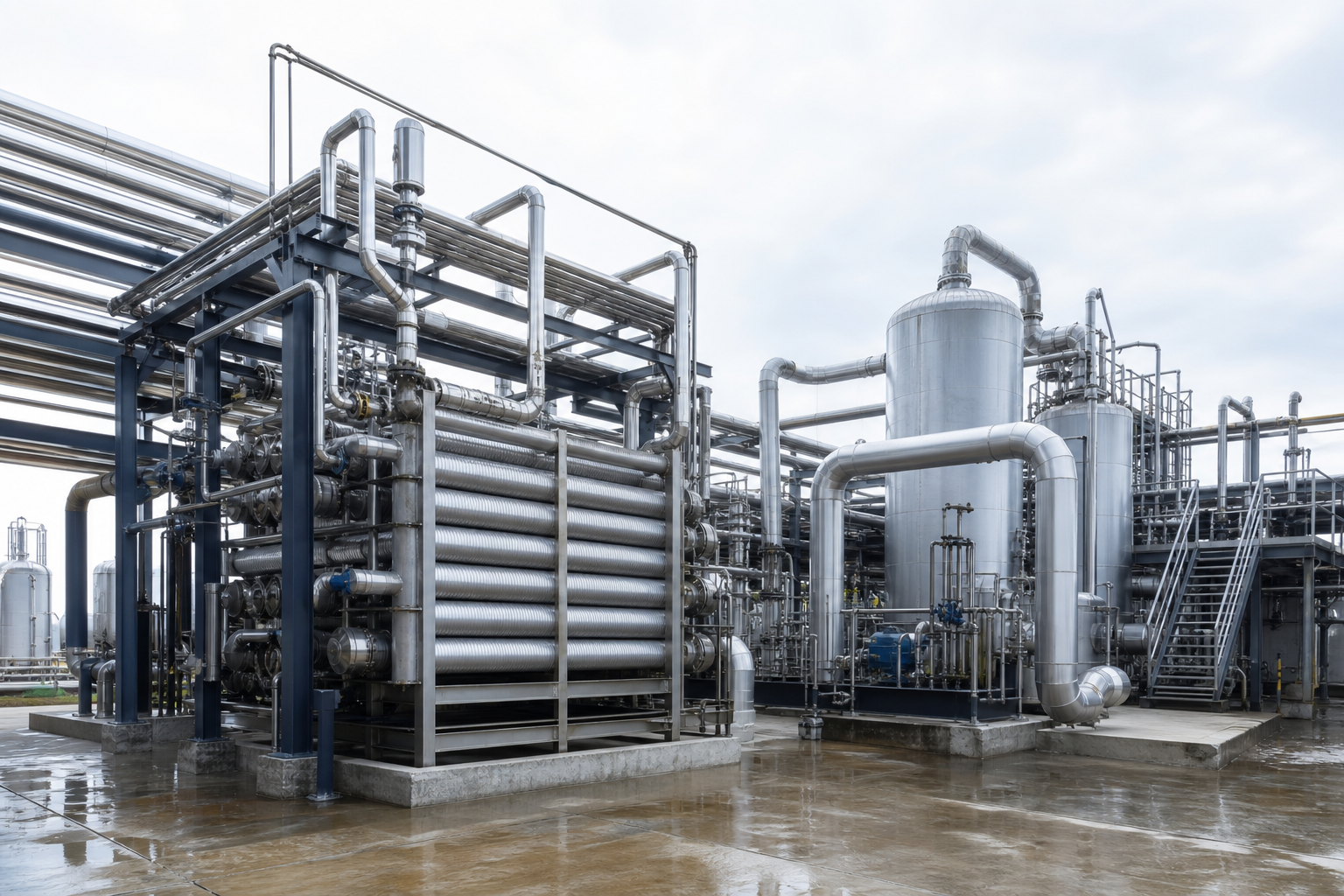
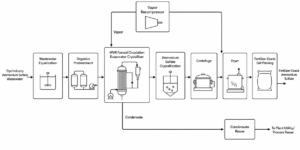
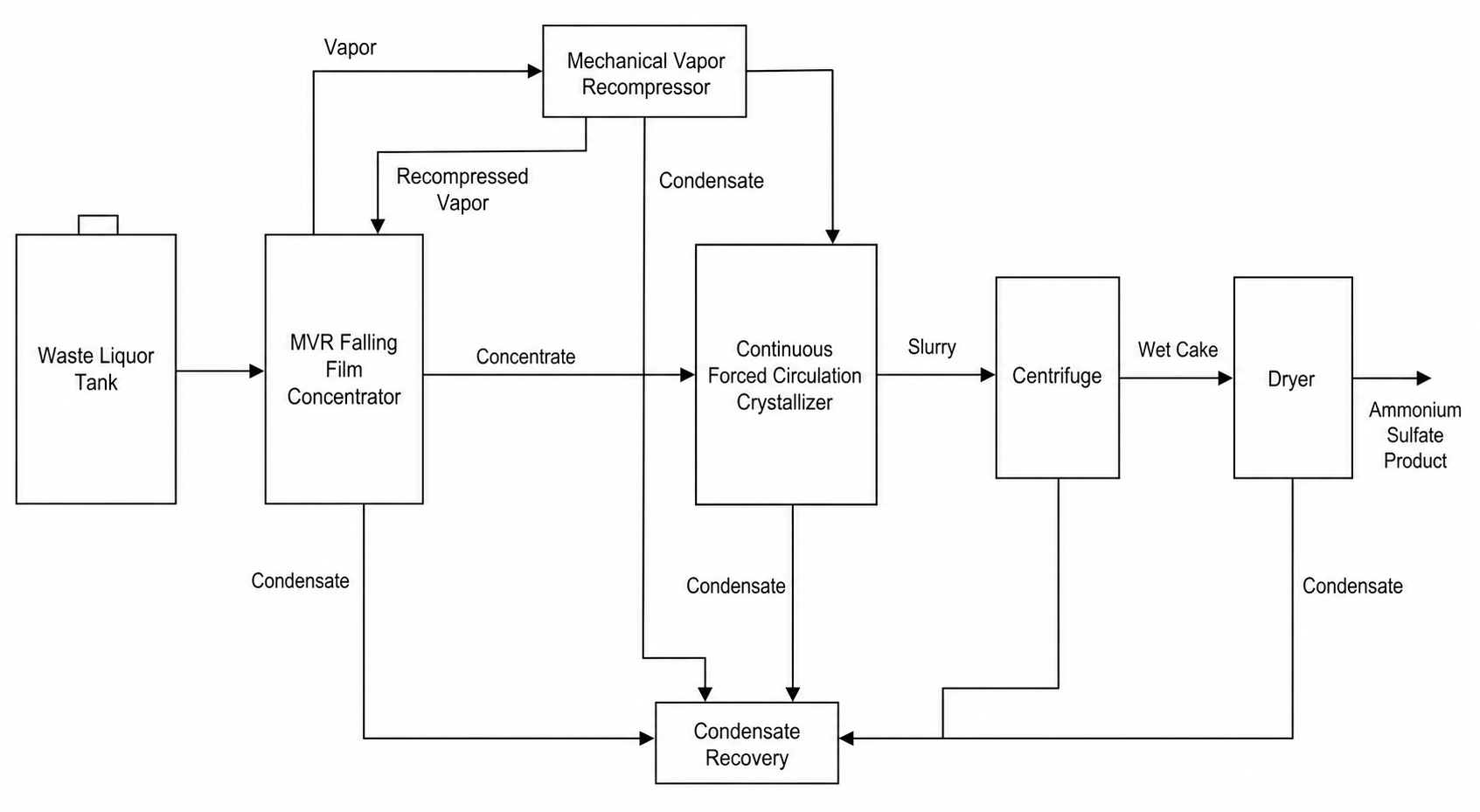
Liquor is degassed and filtered, then pumped to the MVR falling-film concentrator. Falling film is the deliberate choice for the concentration leg: the liquor’s organics foam and its viscosity rises with solids, and a distributed film with short residence time concentrates gently without the long hot hold-up that would caramelize residual sugars onto a heating surface. Wide-body separators with demisters protect the compressor from the entrainment that foaming feeds tend to throw.
The mechanical vapor recompressor lifts the separator vapor by a small temperature difference and returns it as heating steam to the same calandria — the evaporator becomes its own heat source, and the plant trades a steam boiler load for a modest electric load. For an 80 t/h duty this is the published crossover point where MVR energy economics beat live steam decisively.
As saturation approaches, liquor advances to the crystallization stage: an MVR-heated forced-circulation crystallizer operating continuously. Pumped circulation suspends the crystal bed and controls supersaturation so ammonium sulfate grows as clean, separable crystals rather than scaling the heat-transfer surface; classified withdrawal keeps crystal size in the range the centrifuge and dryer want. Mother liquor returns to the crystallizer with a controlled purge to stop impurity build-up.
The crystal slurry dewaters on a continuous centrifuge, dries to fertilizer-market moisture, and ships as by-product ammonium sulfate. Condensate from the concentration effect is hot and low in organics, returning to the plant’s water loop; crystallizer condensate segregates to the reuse header. The net water balance — 80 t/h in, condensate out, crystal out — is the zero-discharge arithmetic that Chinese amino-acid complexes now design against.
Equipment Configuration

One set of the following equipment is typical for this duty:
- Waste-liquor buffer tank with degassing and guard filtration
- MVR falling-film concentrator with wide-body separator and demisters
- Four-effect evaporation section for flexibility and maintenance-duty coverage
- Mechanical vapor recompressor train for both concentration and crystallization service
- Continuous forced-circulation ammonium sulfate crystallizer with classified withdrawal
- Centrifuge, dryer and packing for fertilizer-grade ammonium sulfate
- Segregated condensate recovery to the plant water loop
Performance & Outcome
Compiled from published industry project data, indicative: configurations of this class concentrate 80 t/h of lysine liquor on MVR energy, recovering ammonium sulfate continuously at fertilizer crystal quality with condensate returned to plant reuse. Specific energy per tonne of water evaporated and crystal purity figures are quoted per project liquor chemistry.