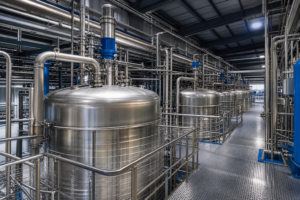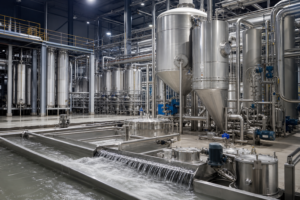
Hydroquinone (1,4-benzenediol) is purified commercially by crystallization, and continuous cooling crystallization fits its chemistry: solubility in water falls steeply as temperature drops, so a controlled cooling profile converts hot saturated solution into uniform crystals while leaving the impurity slate in the mother liquor. The simple description hides difficult engineering — hydroquinone is oxidation-prone, browning with quinone by-products under air and light, and crystal quality sets the grade boundary between industrial, photographic and pharmaceutical material. This page covers the feed-creating production routes, the crystallizer design and its four critical control points, and the oxidation and purity management that decide sellable yield.
What Hydroquinone Is Used For, and Why Grade Matters
Hydroquinone serves three main markets with sharply different purity expectations. In traditional black-and-white photography it is a classic developing agent, where trace metals and color bodies degrade film performance. In the rubber and polymer industries it functions as a polymerization inhibitor that prevents premature vulcanization and uncontrolled crosslinking during storage and processing. In pharmaceuticals it is a synthesis input for antibiotics such as chlortetracycline and oxytetracycline, where impurity limits tighten again. Downstream of these uses it appears as an intermediate for antioxidants, agrochemicals, and specialty dyes.
The commercial point is that the same molecule sells into materially different price bands depending on purity and color stability—and both of those properties are determined in the purification stage, not the reaction stage. A crystallization system designed for industrial grade cannot be pushed to photographic grade by operating harder; the difference is designed into the process.
Production Routes Set the Crystallizer’s Feed Impurities
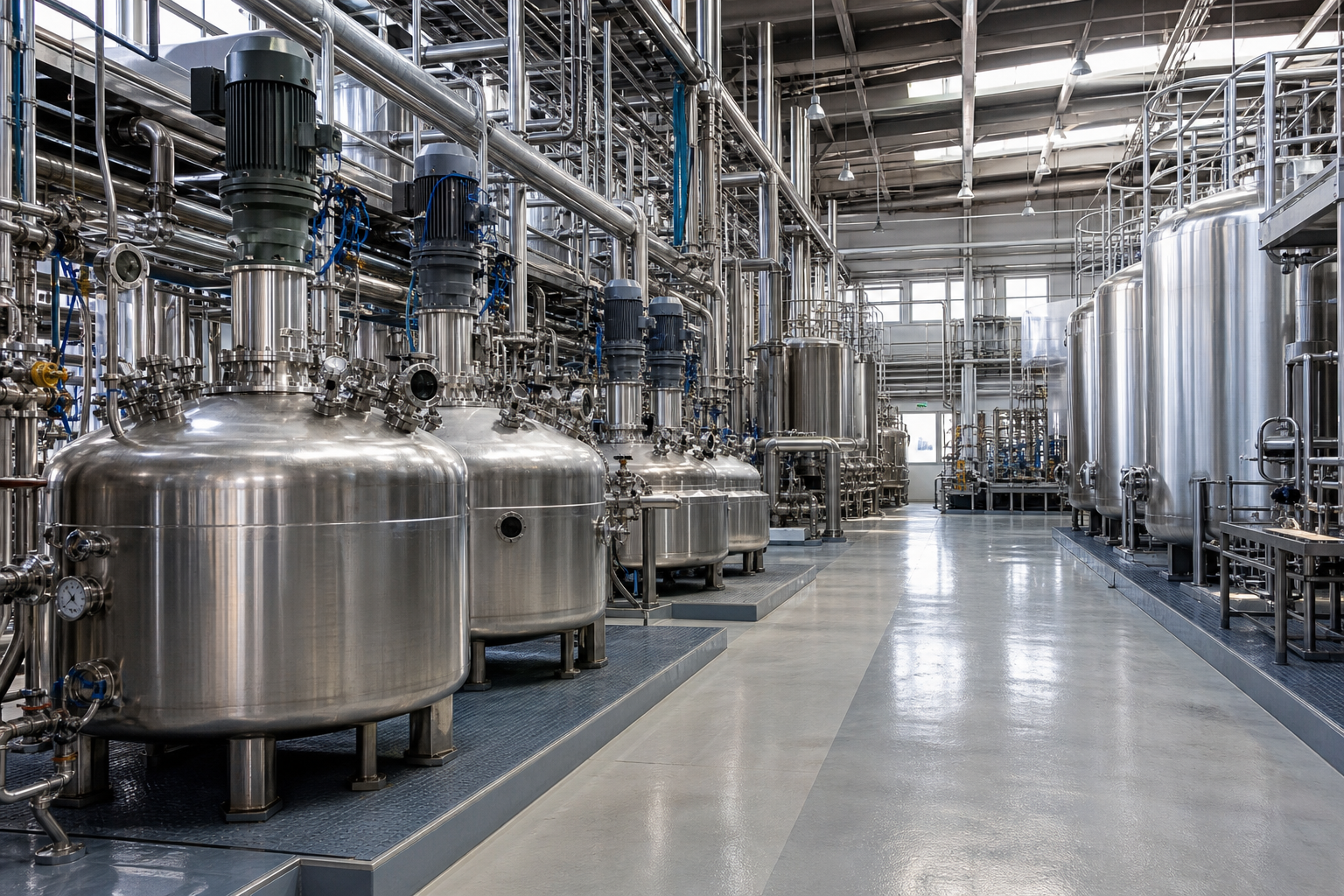
Two synthesis routes dominate globally, and each hands the crystallizer a different problem.
| Route | Chemistry | Co-products / By-products | Crystallization Consequence |
|---|---|---|---|
| Phenol hydroxylation | Phenol + hydrogen peroxide over solid catalysts | Catechol (ortho-isomer) co-produced at an industry-reported hydroquinone-to-catechol weight ratio on the order of 1:0.4-0.6 | Isomer separation duty: catechol behaves differently in solution and must not co-crystallize into product |
| Aniline oxidation (classical) | Aniline oxidized to quinone, then reduced | Heavy metal bearing waste streams (manganese/chromium reagents historically) | Residual quinone and metal traces; heavier environmental and purification burden |
| Other / electrochemical | Various lab-to-plant scale routes | Route-specific | Evaluated case by case |
The phenol route, now the mainstream, creates the crystallizer’s central separation task: hydroquinone and catechol are positional isomers with different solubility-temperature behavior, and cooling crystallization is precisely what exploits that difference. Mother liquor management then becomes the economic lever—catechol accumulates in the recycled mother liquor and must be drawn off for recovery or sale rather than recycled to extinction, because rising catechol concentration both depresses hydroquinone yield and contaminates the crystal surface.
Downstream of the Crystallizer: Separation, Drying, and Handling
Crystallization makes separation possible; the product spec is sealed in the solid-liquid separation and drying that follow. Crystals leave as slurry and are dewatered on centrifuges or, for coarser fractions, screen-bowl or peeler machines — drier cake means shorter thermal exposure, and shorter exposure means better color. Drying is a race between moisture removal and oxidation: warm air, indirect heating under inert cover and short residence times are standard, with product cooled before bagging so sealed packages do not condense moisture. Because hydroquinone is a reducing agent and skin sensitizer, handling is engineered for dust containment, grounding against fine-dust ignition and exposure limits — and since it sublimes appreciably, hot sections and dryer exhausts need temperature discipline so product value is not carried up the stack.
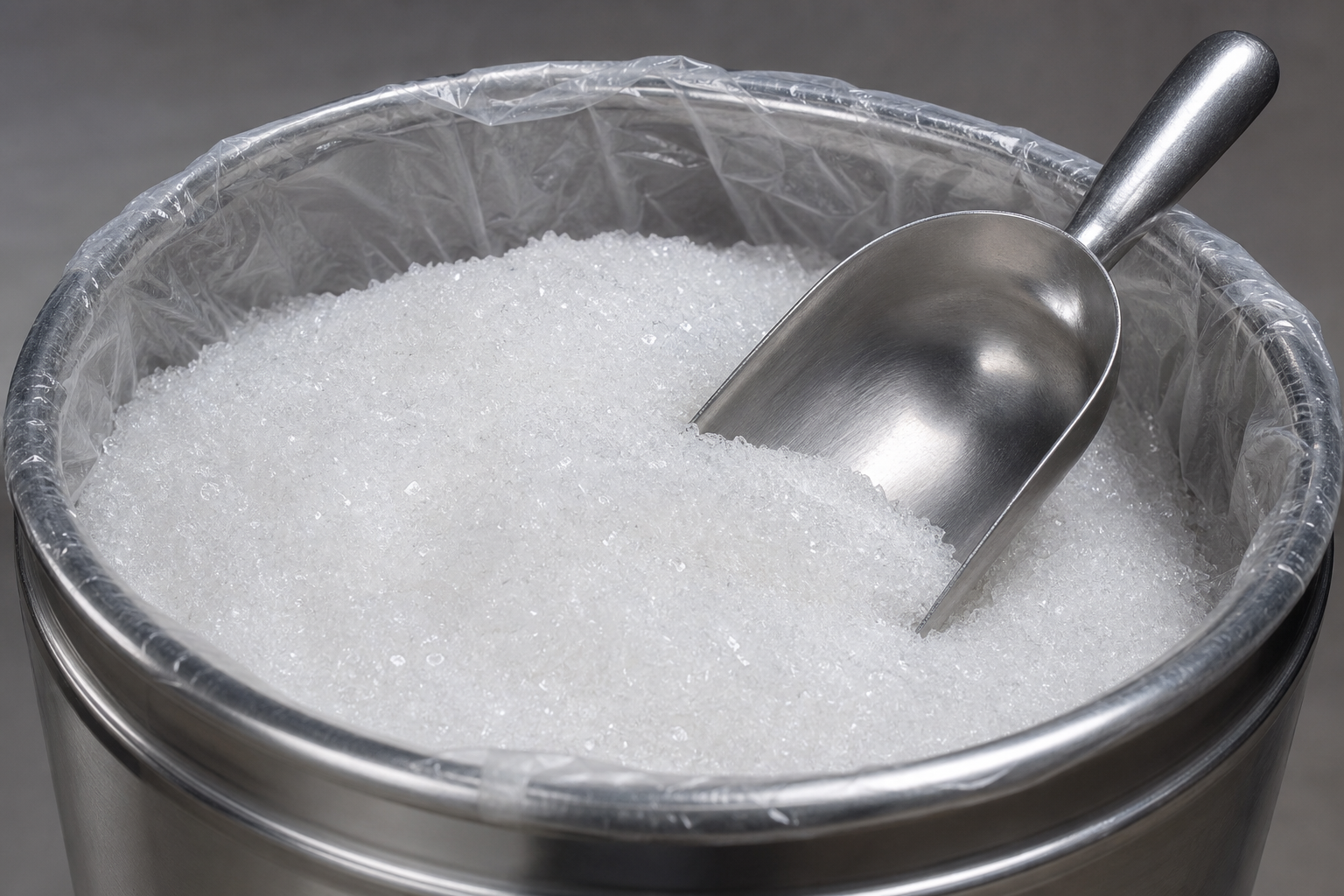
Storage and packaging close the quality loop: multi-layer bags with moisture barriers, storage below ambient temperature excursions and first-in-first-out rotation protect against caking and slow oxidative discoloration on the shelf — extending plant discipline into the warehouse, where photographic-grade reputation is made or lost.
Why Continuous Cooling Crystallization Fits Hydroquinone
The choice of cooling crystallization follows directly from the solubility curve. Hydroquinone’s solubility in water is modest at ambient temperature — handbook-typical values around 6-8 g per 100 mL at room temperature — and rises several-fold as temperature increases; a hot saturated solution therefore deposits a large crystal fraction on controlled cooling from near-dissolution temperature down toward ambient, with high yield per pass and no evaporation energy spent. Against evaporative crystallization, this avoids concentrating oxidation-prone liquor at boiling temperature for extended periods—a genuine quality advantage for a material that darkens with heat and air.
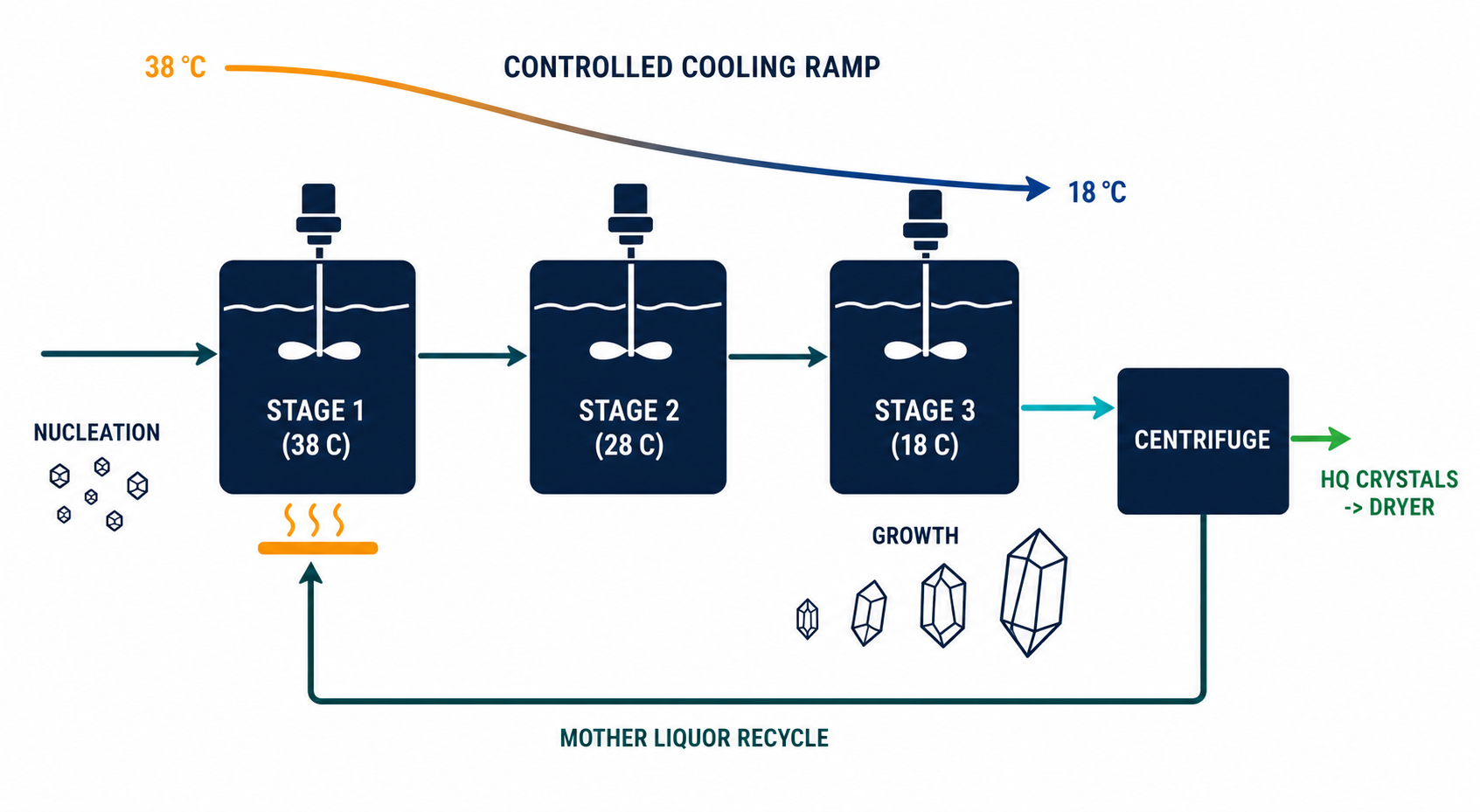
Continuous operation brings three documented advantages over batch in this service. Throughput: no downtime between charges, raising effective capacity from the same equipment. Consistency: real-time control of temperature, stirring and cooling rate holds every crystal to the same growth history that only one batch in a batch plant experiences well. Energy: heat exchanger design plus an energy-recovery module returns waste heat from the cooled slurry to the incoming hot liquor, cutting net cooling and heating duty together.
The Four Control Points That Decide Crystal Quality
Published process literature — an external industry reference, not EvapCryst project data — identifies four parameters that determine crystal size, distribution and purity in hydroquinone continuous cooling crystallization. Each is a control loop, and each fails in a characteristic way when run open-loop.
| Control Point | What It Governs | Failure Mode |
|---|---|---|
| Temperature profile | Uniform crystal growth; supersaturation generation rate | Too-fast cooling nucleates fines; temperature instability patches crystal quality |
| Stirring speed | Homogeneity of nucleation and growth; suspension of crystals | Too low—local supersaturation and encrustation; too high—secondary nucleation and crystal attrition |
| Supersaturation | Balance of nucleation rate against growth rate | Above the metastable limit, nucleation showers produce fine, dusty crystals with poor centrifuge yield |
| Impurity level | Product purity and crystal habit | Accumulated catechol and quinone species discolor crystal and shift habit; mother liquor purge rate too low lets them build |
In operation these four interact: a stirred vessel holding stable supersaturation inside the metastable zone, cooled along a profile matched to the solubility curve, with a disciplined purge, holds crystal size distribution and color for weeks. Disturb any one — feed temperature swings, agitator trip, purge closed to chase yield — and damage appears first as fines on the centrifuge, later as off-color product.
| Process module | Equipment candidates | Selection basis | Indicative envelope |
|---|---|---|---|
| Feed dissolution | Inert-blanketed dissolvers | Oxidation exclusion | Hot saturated solution |
| Cooling crystallization | FC with external cooling; classified-suspension designs | Solubility-curve yield, crystal quality | Uniform crystals, high yield per pass |
| Dewatering and drying | Centrifuge; inert-cover dryer | Short thermal exposure | Low-color crystal cake |
| Polishing (optional) | Vacuum sublimation | Tightest color, trace specs | Photographic-grade fraction |
Configuration, materials and envelopes depend on the actual liquor analysis, target grade, impurity profile and capacity.
Oxidation and Color Control: The Photographic Grade Barrier
Hydroquinone oxidizes in air to benzoquinone, accelerated by temperature, light and trace metals; neglect shows as white crystals trending cream then brown, and photographic buyers reject on color alone. Countermeasures are process-wide: hot solution handled under nitrogen or inert blanket, light excluded from liquor vessels, a compatible reducing protective agent where specification allows, ferrous surfaces kept out of liquor contact so dissolved iron does not catalyze darkening.
For the highest purity demands, crystallization is complemented by sublimation: hydroquinone sublimes under vacuum, and vacuum sublimation-based purification can lift material beyond what recrystallization alone achieves—historically the route to photographic-grade and fine-chemical product. The practical architecture in demanding plants is crystallization for bulk purification and yield, sublimation as a polishing stage on the fraction that must meet the tightest color and trace specifications.
Crystallizer Equipment Selection for This Duty
Hydroquinone service rewards crystallizers that separate the cooling surface from crystal-laden liquor or control wall temperature tightly: forced circulation with external surface cooling, and classified-suspension designs growing crystals in a fluidized bed clear of the cooling zone, both fit; scraped-surface coolers serve where wall encrustation dominates. Encrusted hydroquinone fouling is the chief availability risk — the encrustation is pure product lost to the wrong place — hence the emphasis on wall ΔT control and the energy-recovery loop, which trims utility consumption while reducing the exchanger’s temperature driving force.
Vendor evaluation for hydroquinone duty should therefore ask three questions directly: what wall temperature difference the design holds at the cooling surface, how the energy recovery loop is configured, and what the reference plant’s encrustation cleaning interval actually was.
For a broader treatment of crystallizer types and selection logic—forced circulation, DTB, OSLO, and cooling versus evaporative routes—see our crystallization systems technology page. Sister fine-chemical cases are covered under sodium phosphate crystallization, the concentration-side equipment under MVR evaporation systems, and the wastewater context of isomer-bearing mother liquors under pesticide mother liquor treatment.
When This Route May Not Fit
This route assumes a phenol-route-type feed where cooling crystallization exploits the hydroquinone-catechol solubility difference. It may not fit heavily contaminated liquors — aniline-route feeds bearing manganese or chromium residues need pretreatment before any crystallizer sees them. It may not fit multipurpose fine-chemical plants running short campaigns with frequent product switches, where batch crystallization is the honest configuration. It may not fit where the mother liquor has no catechol outlet: without a draw-off for the accumulating isomer, the loop drifts toward contamination and the economics decay. And it may not fit a site that cannot inert and protect hot liquor from air and light — for this molecule, oxidation discipline is not optional polish but the entry ticket to any grade above industrial.
What Must Be Verified
Before the route is fixed, the validation focus is: a full feed liquor analysis — hydroquinone tenor, catechol ratio, quinone species, trace metals, color bodies — because the isomer ratio sets the mother-liquor strategy. Then the solubility curve and metastable zone width measured on the real liquor, not on pure-water data, since impurities shift both. Then the purge rate at which catechol accumulation stops being tolerable, and the outlet for that purge stream. Then the oxidation audit: which vessels see hot liquor, what blanketing and light exclusion they need, what ferrous surfaces remain in contact. Then the drying and packaging specification against the target grade. Bench crystallization on real feed is the evidence base.
Required inputs: the feed liquor analysis, product grade target and capacity — in exchange, an initial direction on crystallizer configuration, control philosophy and polishing needs.
FAQ
Why is cooling crystallization preferred for hydroquinone?
Because its solubility in water falls steeply with temperature, controlled cooling deposits a large crystal fraction at high yield per pass without evaporation energy—and without holding oxidation-prone liquor at boiling temperature, which protects product color.
What are the main impurities removed in hydroquinone crystallization?
Catechol, the co-produced positional isomer from the phenol hydroxylation route; residual benzoquinone from oxidation; and reaction by-products and trace metals from the synthesis stage. Cooling crystallization separates them on solubility difference, provided the mother liquor purge keeps the accumulating species below the level where they contaminate the crystal surface.
How is product discoloration prevented?
By excluding the oxidation triggers: inert-gas blanketing of hot liquor, light exclusion, limiting ferrous metal contact to avoid iron-catalyzed darkening, protective reducing agents where the specification permits, and temperature discipline throughout dissolution and crystallization.
Continuous or batch crystallization for hydroquinone?
Continuous. Documented advantages include elimination of inter-batch downtime, real-time control of temperature, stirring, and cooling rate holding every crystal to the same growth history, and lower net energy via heat recovery between the hot feed and cooled slurry streams. Batch remains acceptable for small campaigns or frequent product switching.
Can hydroquinone reach photographic grade by recrystallization alone?
Bulk recrystallization carries purity most of the way; the tightest color and trace-metal specifications are typically met by adding a vacuum sublimation polishing stage, since hydroquinone sublimes readily under vacuum and the sublimate is exceptionally clean.