
Project Parameters
| Parameter | Value |
|---|---|
| Process route | Rectification (fractional distillation) column system for solvent and process liquor recovery |
| Industry | Fine chemicals / solvent recovery |
| Feed type & key components | Process liquor and industrial wastewater streams carrying recoverable organic components |
| Throughput | 2 t/h feed to the column system |
| Construction materials | SS316L wetted parts (indicative) |
Representative process configuration compiled from published industry project data. Indicative values, not a process guarantee.
Project Description
A fine-chemical plant in Central China, in the Hubei region, operates process steps that leave behind liquors in which usable solvent is diluted with water and light impurities. Purchasing fresh solvent to replace what is lost, and paying to dispose of what remains, is a double cost that compounds with every campaign. The engineering objective is separation by volatility: recover the solvent as a distillate fraction clean enough to return to the process, and discharge the stripped residue as a far smaller effluent problem.
The reference configuration for this duty is a 2 t/h rectification system. At this scale the design emphasis shifts from brute capacity toward separation sharpness and energy discipline: a modest feed rate, a column that must deliver a tight split, and a reboiler duty that has to be economical because the value recovered per ton is finite.
Process Technology
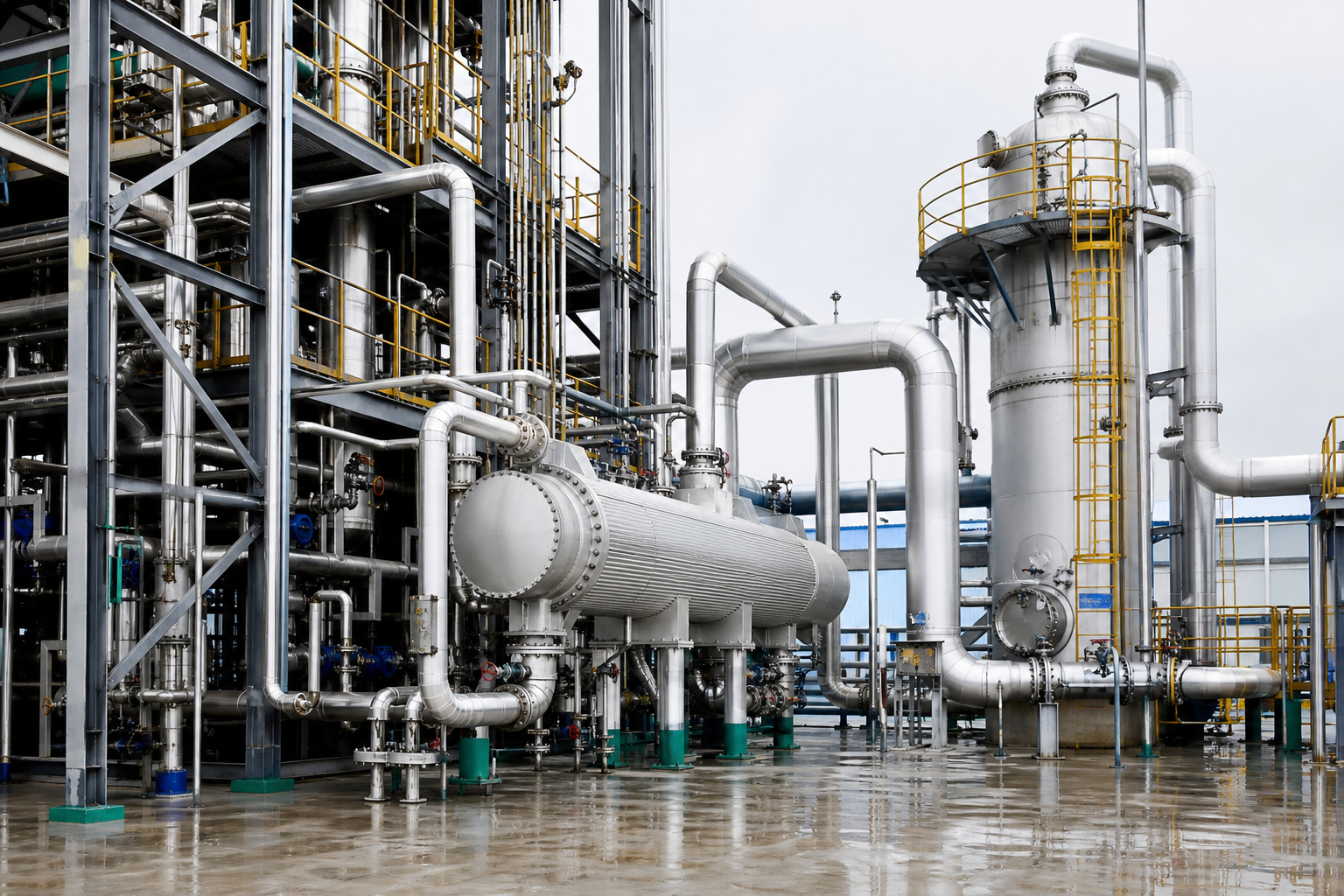
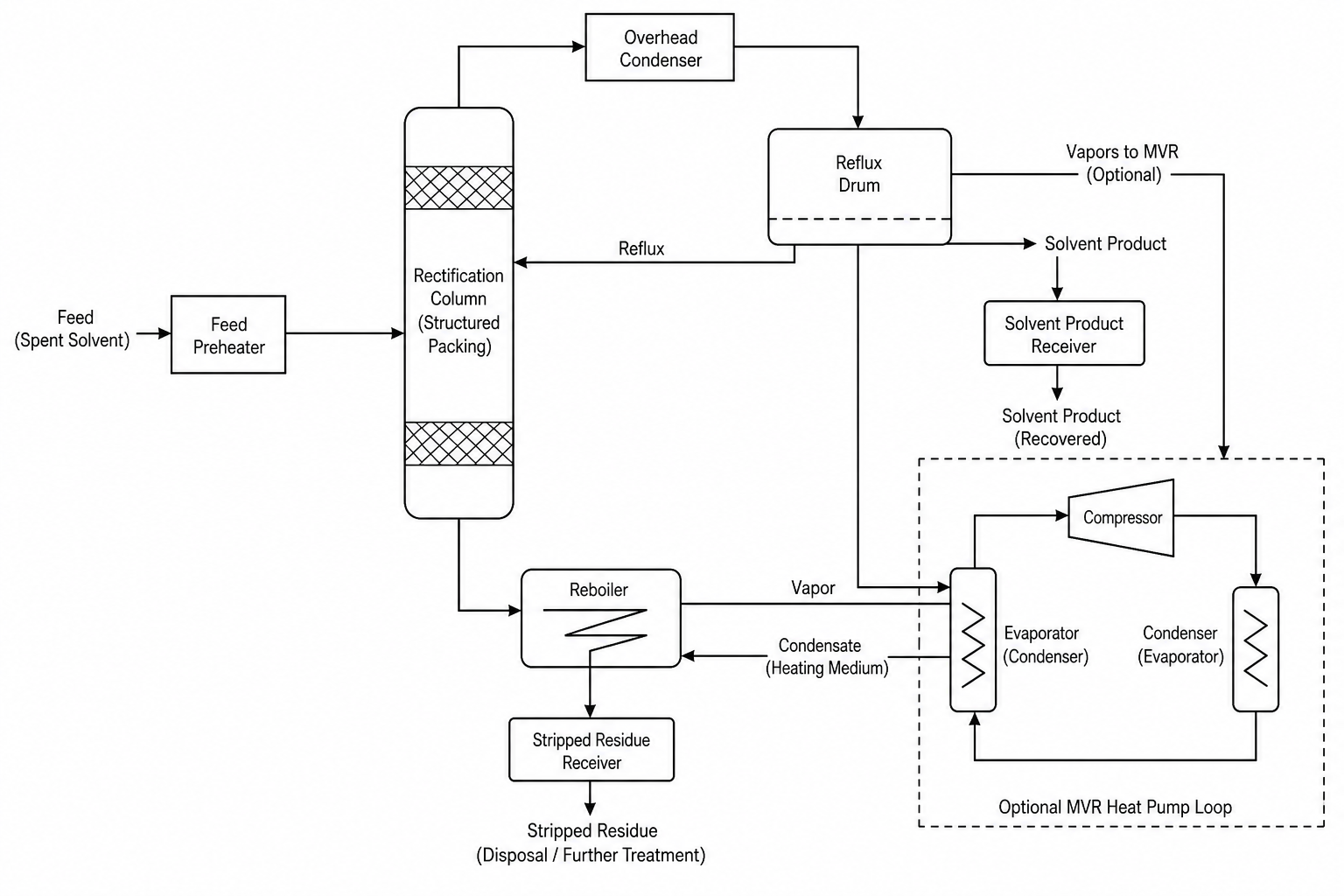
Feed liquor is preheated against hot product streams to recover sensible heat, then enters the rectification column at the appropriate tray or packing position. Inside the column, repeated vapor–liquid contact on trays or structured packing separates the more volatile solvent from water and heavier components: vapor rising up the column enriches in solvent, liquid descending strips solvent out of the residue.
The column runs with a reboiler at the base and a condenser at the top, with a controlled reflux ratio setting the balance between throughput and product purity. The distillate — the recovered solvent fraction — is condensed, part returned to the column as reflux and part drawn as product to storage. The bottoms stream leaves as stripped residue with the solvent removed, dramatically smaller in both volume and disposal cost.
For energy, the conventional design burns live steam in the reboiler; the heat-pump alternative couples the condenser and reboiler through mechanical vapor recompression, upgrading the overhead vapor so it can drive the reboiler. On solvents with a favorable boiling range, MVR heat-pump rectification can displace most of the live-steam demand with electricity, which changes the operating economics of a small recovery column fundamentally. Where the feed carries salts or high-boiling foulants, an evaporation stage ahead of the column keeps the rectification section clean and the split sharp.
Column internals are selected against the actual split. Structured packing offers low pressure drop per stage and high capacity, which suits vacuum service and thermally cautious feeds; trays tolerate fouling and liquid-level surprises better and remain the conservative choice where the feed composition wanders. Reflux drum sizing and decanter arrangements matter as much as the column itself when the solvent and water form two liquid phases on condensation — a well-designed phase separation at the top of the column can deliver product purity that no amount of additional packing height will achieve.
Equipment Configuration
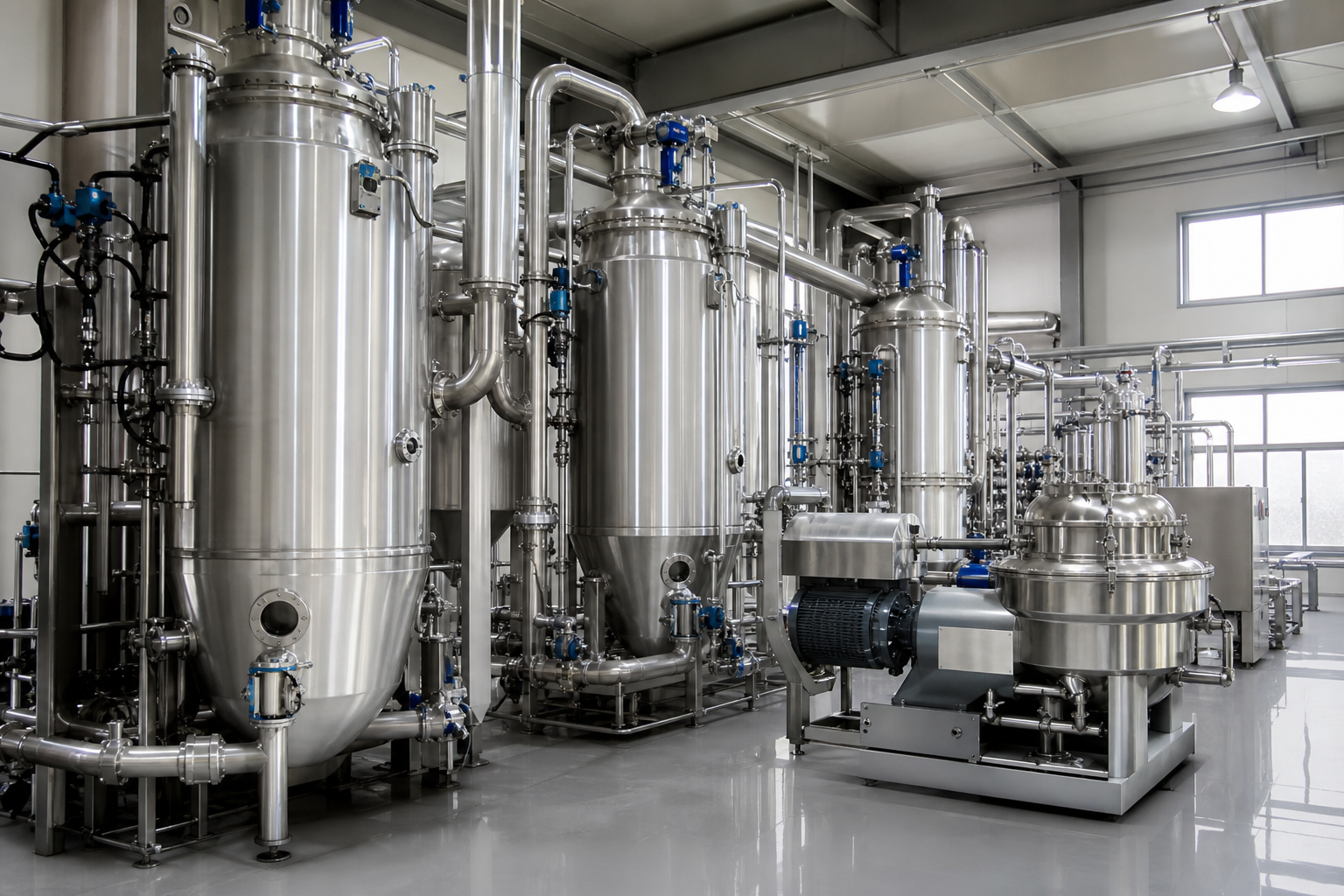
One set of the following equipment is typical for this duty:
- Feed preheater recovering heat against product and residue streams
- Rectification column with trays or structured packing sized for the specified split
- Reboiler (steam or MVR heat-pump configuration) and overhead condenser with reflux arrangement
- Product and residue receivers with pumps to storage and effluent
- Optional upstream evaporation stage for salt-bearing or fouling feeds
- Instrumentation and PLC control of reflux ratio, column pressure and cut points
SS316L is the reference wetted material for common organic-water service; solvent chemistry outside the austenitic envelope specifies matching alloys.
Performance & Outcome
Compiled from published industry project data, indicative: rectification systems of this class recover the majority of the solvent value from dilute process liquor as a reusable distillate cut and reduce the effluent load to a stripped residue. Purity and recovery depend on the volatility gap of the actual components and are validated per project.
A parallel deployment on a related wastewater stream is documented in MVR Distillation and Rectification Solutions.


