
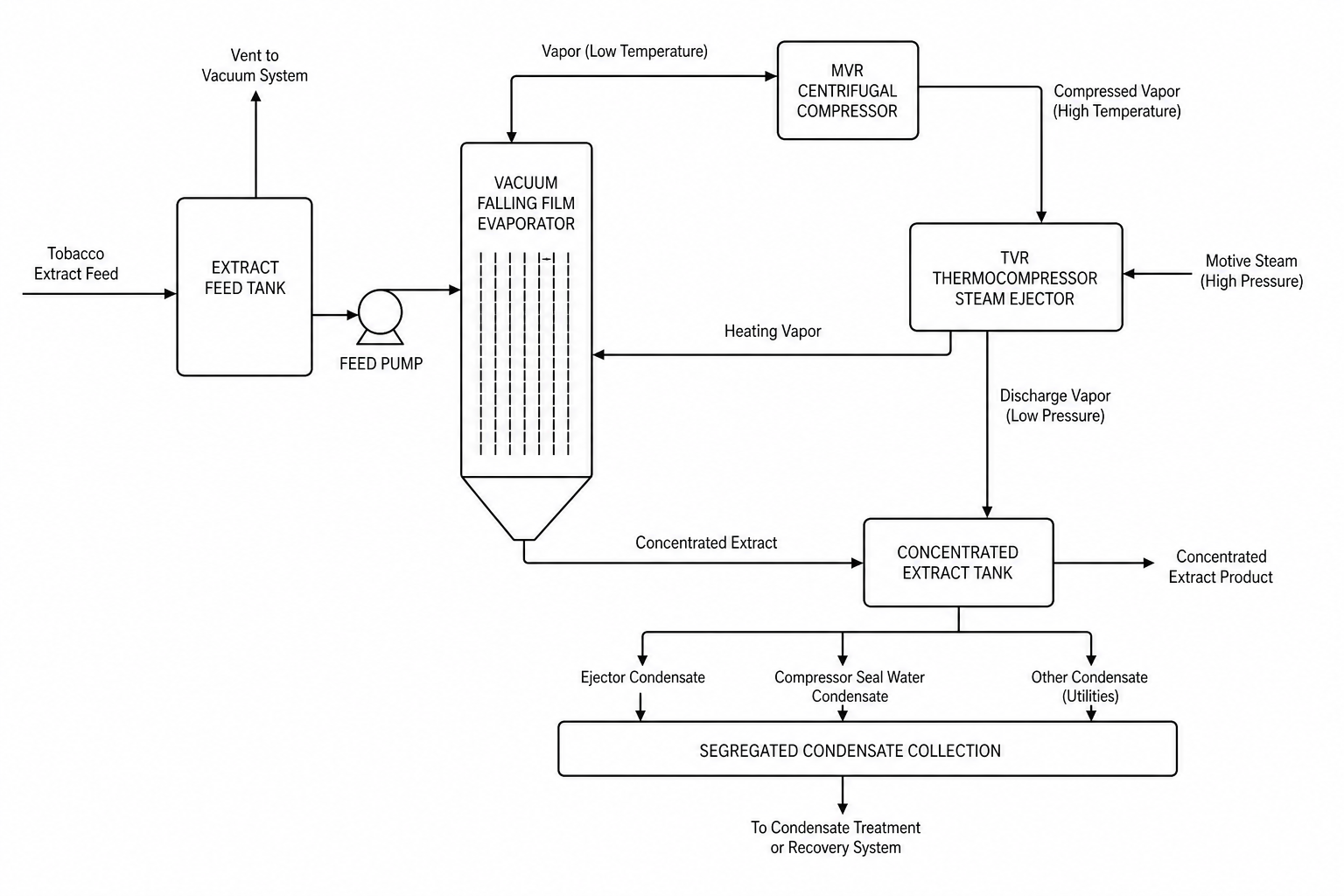
Project Parameters
| Parameter | Value |
|---|---|
| Process route | Hybrid MVR + TVR evaporation (extract concentration) |
| Industry | Tobacco processing — leaf extract concentration (China) |
| Feed type & key components | Aqueous tobacco leaf extract; soluble solids, nicotine fractions, aroma compounds |
| Evaporation capacity | 5 t/h |
| Construction materials | SS316L wetted parts (indicative for food-grade extract service) |
Representative process configuration compiled from published industry project data. Indicative values, not a process guarantee.
Project Description
Tobacco processing extracts more than anyone outside the industry expects: solubles are washed from leaf and stem material for recombination into reconstituted sheet, and the extract — carrying soluble solids, nicotine fractions and the aroma chemistry that is the product’s identity — must be concentrated before it re-enters the sheet former. The reference configuration is a 5 t/h hybrid MVR + TVR concentration system at a Chinese tobacco plant, an evaporation duty where energy strategy and product gentleness are the two design axes.
The hybrid drive is the configuration’s signature. MVR supplies the base energy — electrically driven recompression carrying the steady-state duty — while TVR (thermal vapor recompression, a steam-jet ejector) adds boost from whatever live steam the site already has, trimming the compressor load and giving the plant a two-source energy posture: run on electricity when power is advantageous, lean on steam when it is not. For aroma-carrying feeds there is a third reason: TVR’s steam is also the startup and control medium that lets the train heat and cool gently.
Process Technology
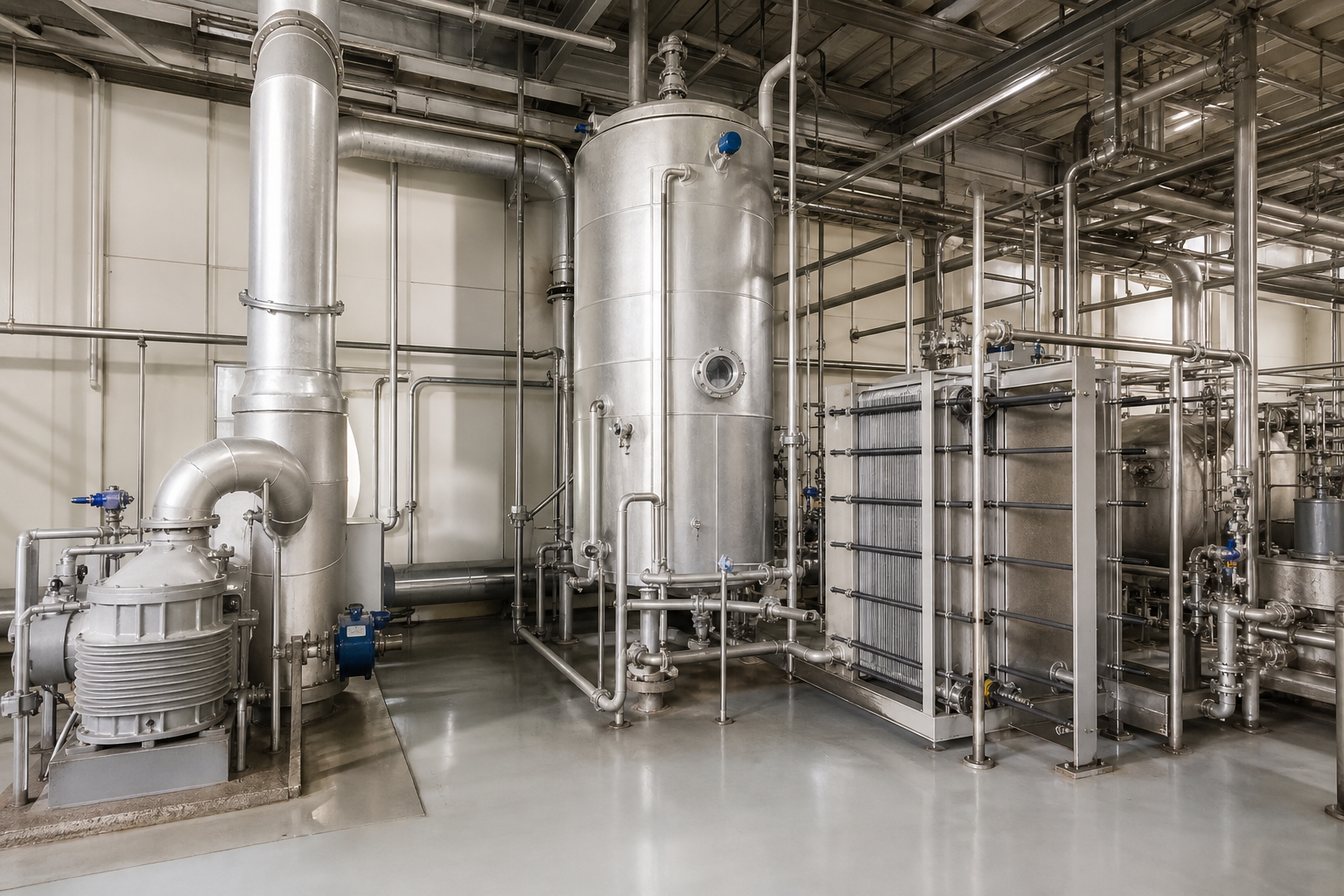
The extract is collected from the extraction batteries and filtered for leaf fines. Concentration runs under vacuum in falling-film service — the configuration for thermolabile, aroma-carrying feeds: a thin film descends the tubes, evaporates at low temperature within seconds of residence, and the volatile top notes that define the product survive the process instead of leaving with the vent or darkening on a hot wall.
The MVR compressor recycles the bulk of the secondary vapor as heating steam on a closed electrical loop. The TVR ejector entrains a portion of vapor with live steam and returns the mixed flow at higher pressure — the hybrid arrangement that sizes the compressor for average duty rather than peak, and gives the train its steam-side control handle.
Concentrated extract advances to the sheet-forming circuit, where its soluble solids re-enter the reconstituted leaf; condensate — clean water with aroma traces — is collected by segregation for the plant’s water systems. The train runs at the intersection the tobacco industry actually operates in: product quality from low-temperature vacuum falling film, energy economics from dual-source recompression.
Equipment Configuration
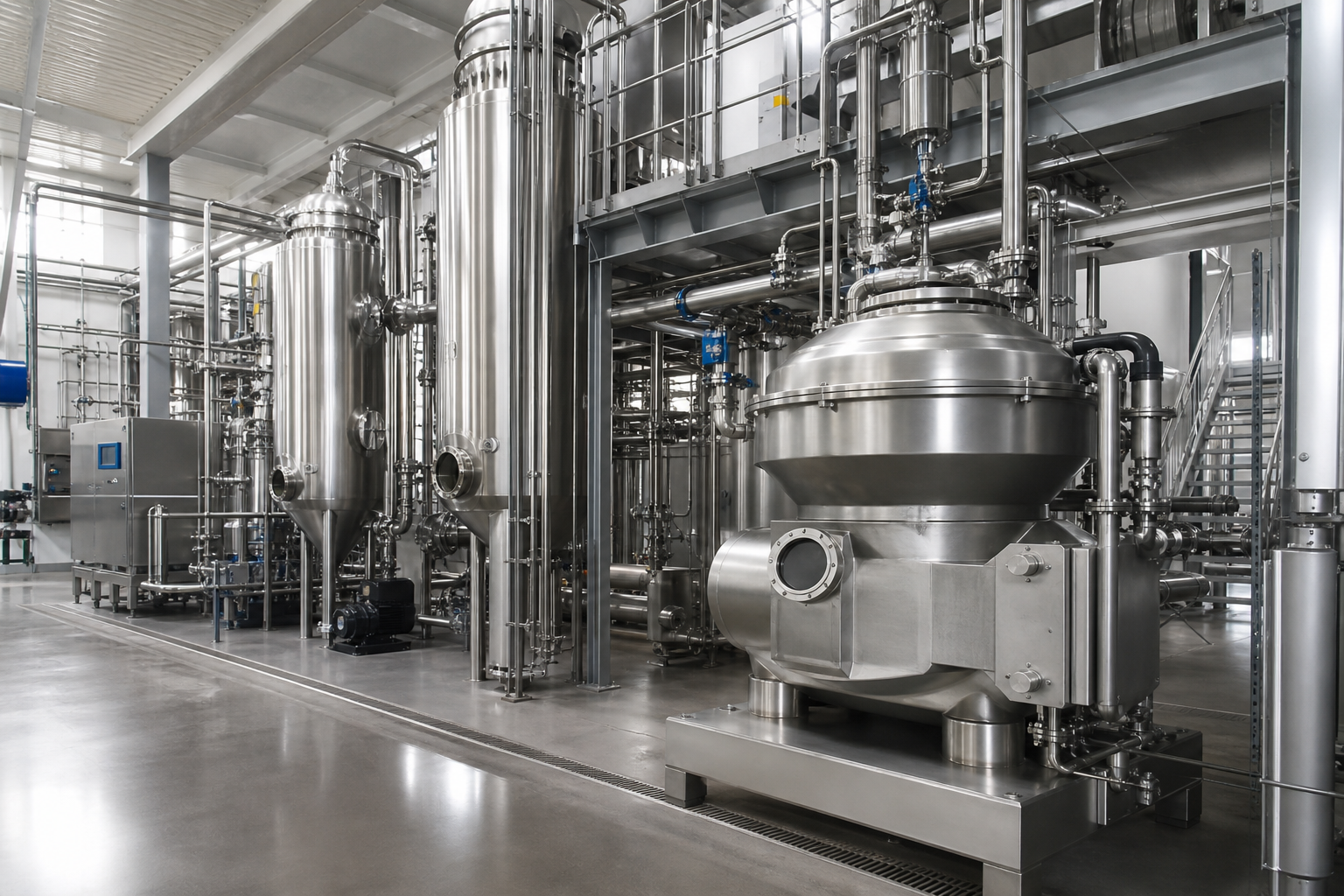
One set of the following equipment is typical for this duty:
- Extract collection and fines filtration
- Vacuum falling-film evaporation train for aroma retention
- Centrifugal MVR compressor for base duty
- TVR thermocompressor for steam-side boost and trim
- Segregated condensate collection and routing for plant water reuse
- PLC control balancing the dual energy sources against process load
Performance & Outcome
Compiled from published industry project data, indicative: hybrid trains of this class concentrate tobacco extract at low temperature with dual-source energy, retaining aroma volatiles and recovering condensate. Solids endpoint, aroma retention and specific energy are quoted per project extract program and utility prices.


