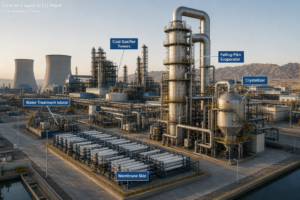
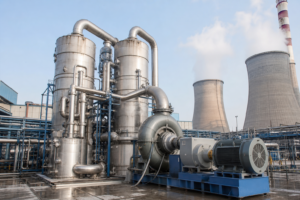
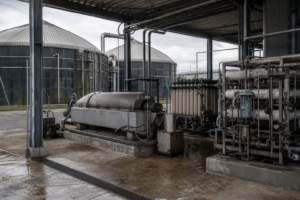
Lithium precipitation mother liquor — the filtrate left after lithium carbonate is precipitated from a purified lithium sulfate solution — is the largest and most valuable loss stream in a lithium salt plant. Evaporation and concentration recovers that value: it recycles clean condensate to the front of the process, crystallizes the accumulated sodium sulfate (or ammonium sulfate) as a saleable by-product, and concentrates residual lithium so it can be returned to precipitation instead of being discharged. With mechanical vapor recompression (MVR) as the thermal backbone, the specific energy demand is typically, in industry-reported operation, in the range of 20–40 kW·h per ton of water evaporated, which is what makes closing this loop economical rather than merely compliant.
Where Lithium Precipitation Mother Liquor Comes From
In the dominant sulfate route to battery-grade lithium carbonate, a purified lithium sulfate solution reacts with soda ash (sodium carbonate):
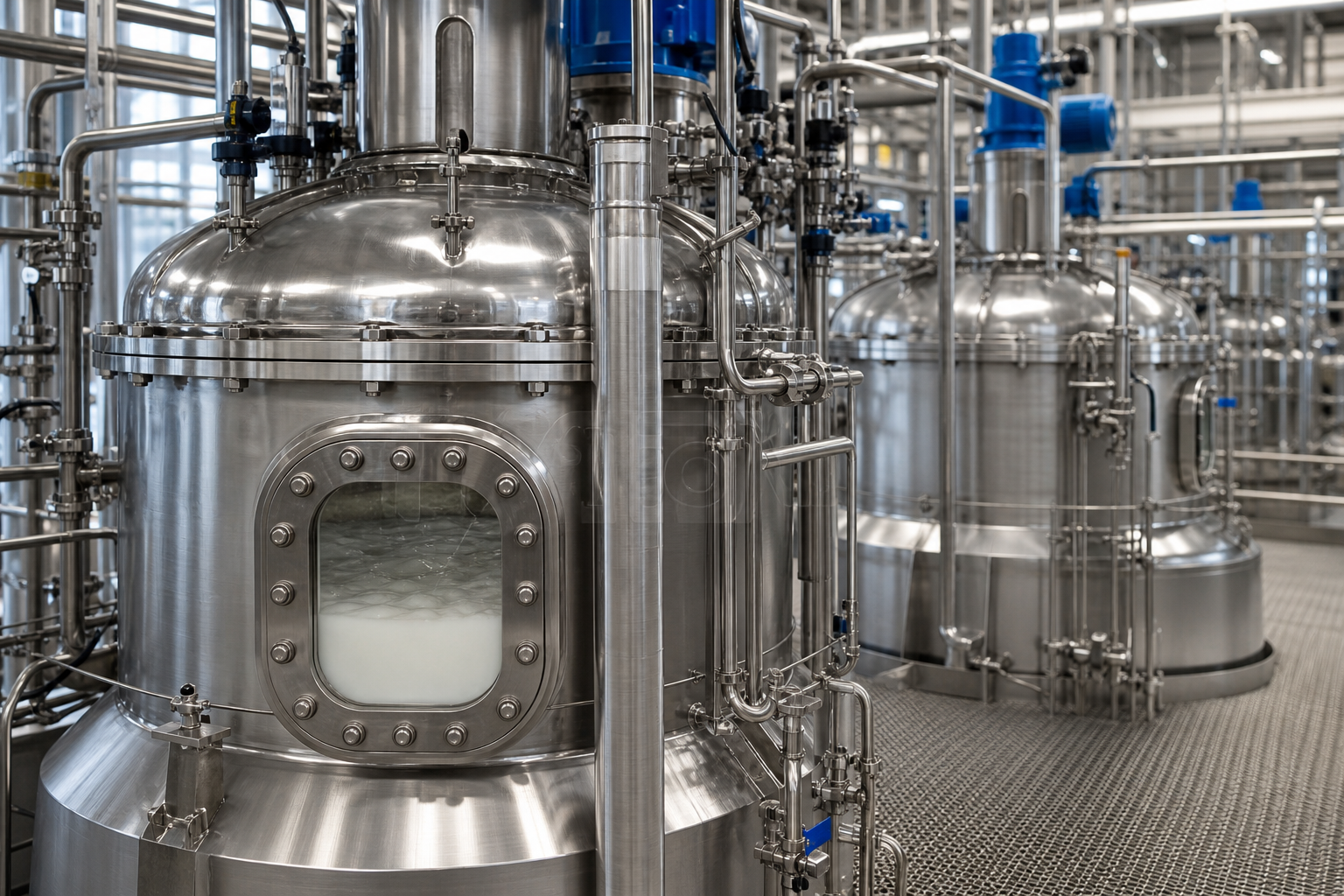
Li₂SO₄ + Na₂CO₃ → Li₂CO₃↓ + Na₂SO₄
Lithium carbonate is poorly soluble — roughly 1.3 g per 100 g of water at room temperature — so it precipitates and is filtered off. Everything else stays in the mother liquor. The same chemistry applies across feedstocks: spodumene conversion plants, lepidolite processing, salt-lake brine purification, and the growing stream of hydrometallurgical recycling of black mass, where lithium is re-precipitated after nickel, cobalt, and manganese have been recovered as their sulfates.
Because precipitation is an equilibrium, the filtrate always carries the liabilities of that equilibrium. The envelope below is illustrative – derived from published sulfate-route plant data, not a record of any single plant:
| Constituent | Illustrative level | Why it matters |
|---|---|---|
| Sodium sulfate (Na₂SO₄) | Commonly 10–20 wt% | The mass carrier; must be crystallized out or it accumulates and inhibits further precipitation |
| Residual lithium (as Li) | Commonly ~1–5 g/L | Direct economic loss if discharged; worth 100% recovery at current feedstock economics |
| Carbonate / bicarbonate | Excess from soda ash dosage | Consumes acid in downstream adjustments; co-precipitates with scaling cations |
| Calcium, magnesium, iron, aluminum | Trace (mg/L) | Scaling ions — concentrate sharply during evaporation and foul heat transfer surfaces |
Why the Mother Liquor Must Be Treated as a Recovery Stream
Three pressures converge on every lithium salt producer:
- Lithium accounting. At residual concentrations of a few grams per liter and mother liquor volumes that scale with production, untreated mother liquor sends a measurable percentage of purchased or extracted lithium to the effluent plant. Corporate lithium yield — a headline metric for battery-supply-chain customers — cannot be closed without mother-liquor recovery.
- Sodium balance. Every mole of lithium precipitated leaves a mole of sodium sulfate in solution. If the liquor is recycled to dissolving without salt removal, sodium accumulates until precipitation efficiency collapses. Salt crystallization is therefore a process necessity, not just environmental housekeeping.
- Discharge compliance. High-sulfate, high-sodium brines are increasingly restricted from direct discharge; zero liquid discharge framing is becoming the default expectation for new lithium chemical capacity.
The Overall Recovery Route
A modern mother-liquor recovery island follows a sequence that mirrors generic mother liquor recovery practice but is tuned to sulfate chemistry:
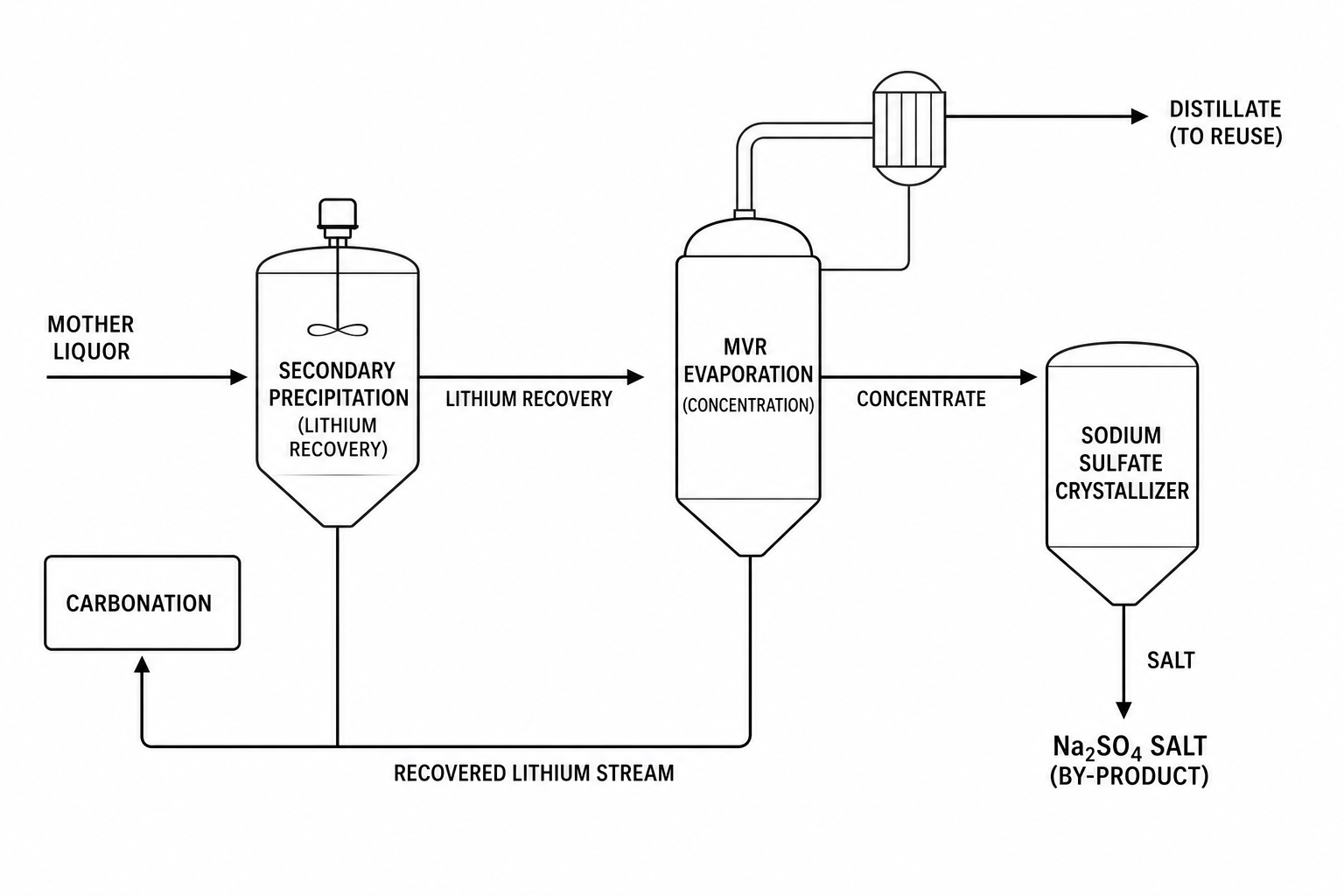
- Liquor collection and polishing. Recover wash filtrates and mother liquor, adjust pH, and remove scaling cations (softening by chemical precipitation or ion exchange) so the evaporator sees a stable, low-fouling feed.
- Evaporation and concentration. MVR evaporation concentrates the liquor under vacuum at moderate temperature. Condensate — the large majority of the mass — leaves as clean water.
- Sodium sulfate crystallization. At the concentrated end of the train, Na₂SO₄ is crystallized and separated as Glauber’s salt or anhydrous sodium sulfate.
- Lithium re-enrichment. The sulfate-depleted, lithium-enriched final mother liquor is returned to the precipitation stage (or to a dedicated re-precipitation step), converting residual lithium from a loss into product.
- Condensate reuse. Distillate returns to cake washing, dissolving, or scrubbing duties, closing the plant water balance.
Read as process modules, the recovery island looks like this – candidate equipment types, the selection rationale, and the indicative operating envelope each module must cover (envelopes derived from published industry data, not project specifications):
| Process Module | Candidate Equipment Types | Selection Rationale | Indicative Operating Envelope |
|---|---|---|---|
| Liquor collection and polishing | pH adjustment; softening by precipitation or ion exchange | Stable, low-fouling feed for the evaporator | Scaling cations removed before concentration |
| Evaporation and concentration | MVR forced-circulation evaporator | Sulfate brine service with rising viscosity | Vacuum at moderate temperature; 20-40 kWh/t reported |
| Sodium sulfate crystallization | Evaporative (hot end) or cooling/freeze (cold end) crystallizer | Solubility-curve strategy selects the product form | Anhydrous above the ~32.4 °C transition; Glauber’s below |
| Salt dewatering | Centrifuge, dryer, packing | Dry, saleable or disposable by-product | Mother liquor returned to the evaporator |
| Lithium re-enrichment | Return to precipitation or dedicated re-precipitation circuit | Converts residual lithium from loss to product | Sodium-depleted, lithium-enriched final liquor |
| Condensate reuse | Distillate to washing, dissolving, or scrubbing | Closes the plant water balance | Majority of evaporated mass as clean water |
Configuration, materials, and operating ranges depend on the actual feed, temperatures, pressures, corrosion review, fouling behavior, utilities, and project capacity.
Sodium Sulfate Crystallization: The Design Heart of the System
Sodium sulfate has one of the most unusual solubility curves among industrial salts: about 4.8 g per 100 g of water at 0 °C, rising steeply to a maximum of roughly 49.7 g per 100 g of water near 32.4 °C — the transition between decahydrate (Glauber’s salt) and anhydrous phases — before falling again at higher temperature. This curve defines two industrial crystallization strategies:
| Strategy | Operating principle | Product | Where it fits |
|---|---|---|---|
| Evaporative crystallization (hot end) | Evaporate above the transition temperature; salt crystallizes as water is removed | Anhydrous Na₂SO₄ | Mother-liquor recovery where energy cost is managed by MVR and a dry by-product is preferred |
| Cooling / freeze crystallization (cold end) | Chill the liquor below the transition; solubility drops sharply and decahydrate drops out | Na₂SO₄·10H₂O (Glauber’s salt), later re-melted or dehydrated | Cold-climate sites or hybrid evaporation-plus-refrigeration trains |
In lithium plants, evaporative crystallization of anhydrous sodium sulfate at the hot end is the common choice because it integrates directly with the MVR train and yields a dry, free-flowing by-product that can be upgraded or sold. The crystals are dewatered in a centrifuge, dried, and packed; mother liquor from the crystallizer returns to the evaporator, so sodium leaves the loop only as solid product.
Evaporator Configuration and Materials
Forced circulation is the default. Mother liquors concentrate into near-saturated, scaling-prone sulfate brines with rising viscosity — exactly the service where falling-film evaporators lose heat transfer and plug. Forced-circulation evaporation keeps high liquid velocity through the tubes, suppresses local supersaturation on heat-transfer walls, and tolerates the crystallizing edge of the concentration window.
Compressor choice follows duty. Centrifugal compressors suit the large, steady duties of a continuous lithium plant; Roots-type or screw compressors handle smaller or more fluctuating trains. Falling-film pre-concentration stages can precede the forced-circulation finisher when the feed is still dilute and clean, improving overall economy.
Materials. Neutral sodium sulfate service is comparatively benign — 316L stainless steel is the common baseline — but chlorides carried in from brine feedstocks or recycled streams push heat-exchange surfaces toward duplex alloys or titanium on a case-by-case basis. A complete water analysis (sulfate, chloride, calcium, magnesium, trace metals, and organics from any solvent-extraction carryover) is the precondition for material selection.
Impurity management. Boron, chlorides, and organic extractant residues that report to the mother liquor can contaminate the salt product or the recovered lithium. Where the salt is destined for sale, a salt re-dissolution and re-crystallization polishing step, or an activated-carbon treatment on the liquor, protects by-product grade.
Lithium Recovery: Closing the Metal Balance
Evaporation does two things for lithium recovery at once. It removes the sodium burden that limits precipitation efficiency, and it raises lithium concentration in the final liquor, which improves the yield of the subsequent re-precipitation. Typical integration options, in increasing order of complexity:
- Direct recycle: sulfate-depleted mother liquor returns to the precipitation tank, where fresh soda ash recovers residual lithium as product carbonate.
- Re-precipitation stage: a dedicated small precipitation circuit treats the concentrated liquor under optimized temperature, carbonate dosage, and seeding, maximizing lithium conversion before any purge.
- Polishing recovery: where a purge is still needed to bleed accumulated impurities, polishing by adsorption or further carbonate precipitation keeps the purged lithium below economically painful levels.
Published industry references describe deployments following exactly this pattern – external references from trade and vendor literature, presented as illustrative of the configuration rather than as EvapCryst deliveries: evaporation-and-concentration islands for sodium sulfate recovery from lithium precipitation mother liquor in primary lithium chemical plants, combined iron phosphate production with lithium extraction from Na₂SO₄ mother liquor, and evaporation-crystallization trains treating lithium precipitation mother liquors in battery-recycling complexes where cobalt, manganese, and nickel sulfate production and lithium recovery share one salt-recovery utility.
Outputs and Their Value
A well-run recovery island turns one waste stream into three products:
- Clean condensate — the majority of the evaporated mass, returned to washing and dissolving duties and displacing fresh water.
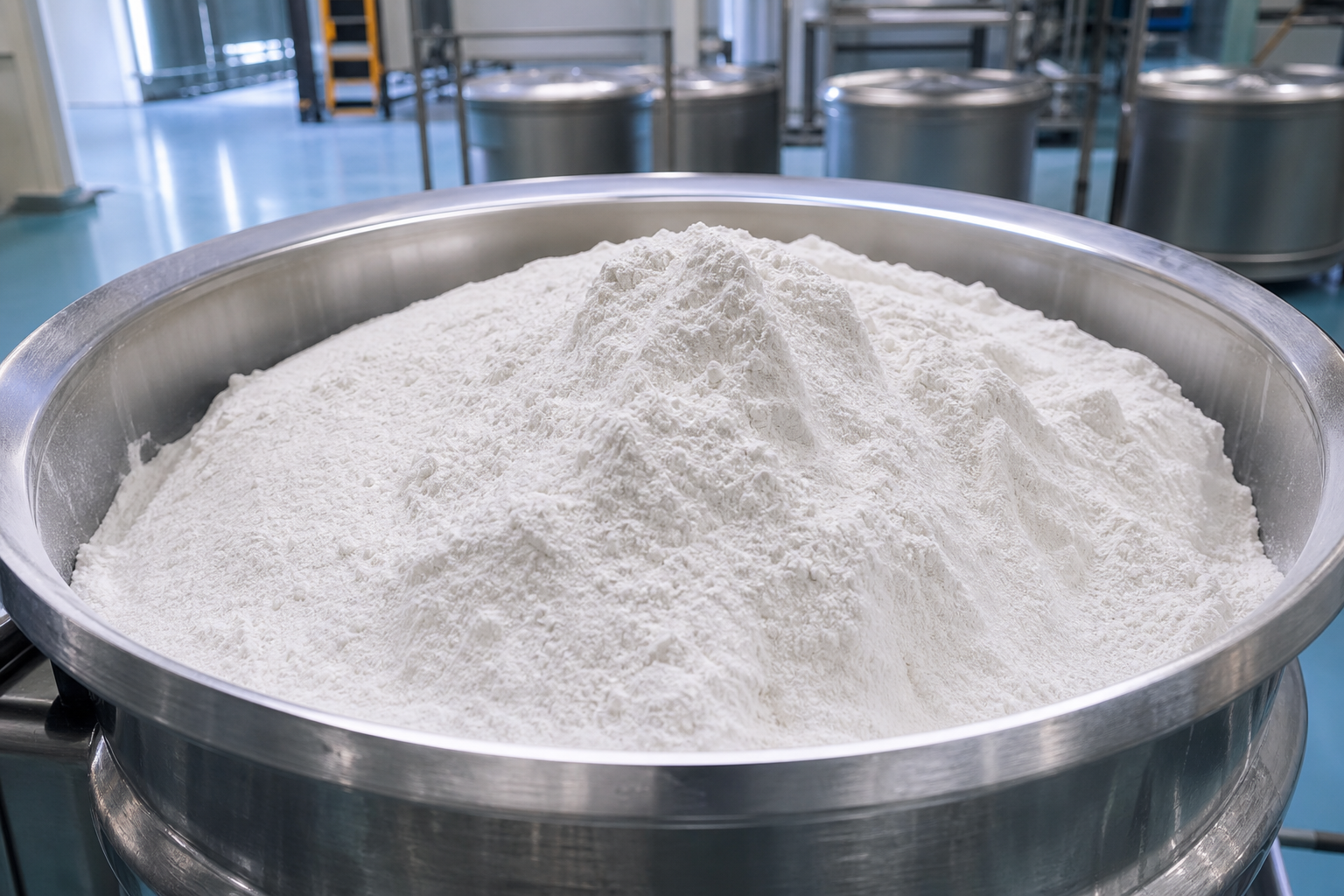
- Anhydrous sodium sulfate — a saleable commodity (detergent, glass, textile, and paper industries) when purity allows, or a stable, low-volume solid for controlled disposal when it does not.
- Additional lithium carbonate — recovered from a stream that was previously a loss line on the lithium balance.
For feedstocks processed with ammonium-based chemistry — some brine routes and hydrometallurgical variants — the same evaporation-crystallization island instead recovers ammonium sulfate, which is saleable into the fertilizer chain. The unit operations are identical; only the salt and its market change.
Selection and Procurement Checklist
- Confirm mother-liquor chemistry across the full operating envelope (not a single grab sample): sulfate, lithium, carbonate, chloride, calcium, magnesium, and organics.
- Size the train on water to be evaporated per hour, not on liquor volume, and carry 10–20% margin for fouling between cleaning cycles.
- Choose forced-circulation finishing for the crystallizing stage regardless of what pre-concentration technology precedes it.
- Define the salt product specification and its acceptance route (sale vs. disposal) before fixing the crystallizer design and washing regime.
- Require a bench or pilot evaporation test on actual mother liquor to verify scaling rate, crystal morphology, condensate quality, and corrosion behavior.
- Integrate the lithium-recycle control logic — sodium concentration and lithium enrichment targets — into the plant DCS from day one.
For the underlying capability lines, see our mother liquor recovery solution, MVR evaporation technology, salt separation and crystallization systems, and forced-circulation crystallizers. Smaller or modular recovery duties can also be delivered as skid-mounted evaporation systems; industry context is available on our battery materials industry page.
When This Route May Not Fit
This recovery island earns its place on lithium value and sodium necessity. Where the mother liquor is very small relative to plant throughput, or lithium prices collapse, the re-precipitation loop’s payoff thins while the evaporator still must be paid for. Chloride-heavy brine feedstocks may push materials selection to duplex or titanium and change the cost basis. If the by-product salt has no acceptance route – no buyer and no disposal site for contaminated sulfate – salt handling becomes the project’s weak leg. And plants already equipped with a different sodium-management strategy should compare against their existing balance before duplicating salt-recovery capacity.
What Must Be Verified
Mother-liquor chemistry must be confirmed across the full operating envelope, not from a single grab sample: sulfate, lithium, carbonate, chloride, calcium, magnesium, and organics. A bench or pilot evaporation test on the actual liquor verifies scaling rate, crystal morphology, condensate quality, and corrosion behavior before the train is fixed. The salt product specification and its acceptance route – sale versus disposal – should be settled before crystallizer design and washing regime are frozen. The lithium-recycle control logic (sodium concentration and lithium enrichment targets) belongs in the plant DCS specification from day one. And sizing should be on water evaporated per hour with 10-20% fouling margin, not on liquor volume.
Frequently Asked Questions
What is lithium precipitation mother liquor?
It is the filtrate remaining after lithium carbonate has been precipitated from purified lithium sulfate solution with soda ash. It is rich in sodium sulfate (commonly 10–20 wt%) and still carries residual lithium, typically in the low grams-per-liter range, set by the solubility equilibrium of lithium carbonate.
Why can’t the mother liquor simply be recycled without treatment?
Because every kilogram of lithium carbonate produced leaves roughly an equivalent molar amount of sodium sulfate in solution. Uncontrolled recycle accumulates sodium until precipitation efficiency degrades; salt must be crystallized out on a controlled purge for the loop to stay stable.
Which evaporator type suits sulfate mother liquor?
Forced-circulation evaporators for the crystallizing stage. The liquor becomes near-saturated and scaling-prone as it concentrates, and high circulation velocity is the reliable defense against tube fouling. Falling-film stages are acceptable only for clean, dilute pre-concentration duty.
Is the recovered sodium sulfate sellable?
Often yes. Anhydrous sodium sulfate of adequate purity sells into detergent, glass, paper, and textile applications, and in ammonium-based chemistries the recovered salt is ammonium sulfate with fertilizer value. Product qualification depends on impurity control — chlorides, boron, and organics — in the crystallization and washing design.
How is residual lithium actually recovered?
By removing the sodium burden and concentrating the liquor, then returning it to precipitation with fresh carbonate — either the main precipitation stage or a dedicated re-precipitation circuit. The evaporator does not recover lithium directly; it creates the chemical conditions under which precipitation becomes efficient again.
To start a first-pass screening, send the mother-liquor analysis across the operating envelope (sulfate, lithium, chloride, hardness, organics) and the target outputs – salt product route and lithium recovery intent.