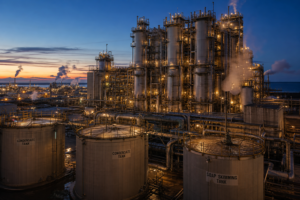
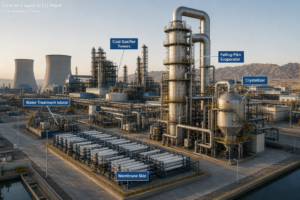
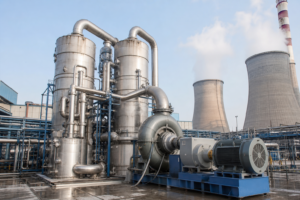
Evaporation followed by crystallization is the most direct route to zero liquid discharge (ZLD) for wastewater from SCR denitration catalyst plants. Manufacturing and regenerating honeycomb V2O5–WO3/TiO2 catalyst generates a stream that combines high and variable salinity with regulated heavy metals — vanadium and tungsten — plus fine suspended titania and organic binders: a mixture that suppresses biological treatment and overwhelms precipitation chemistry. A purpose-designed evaporation–crystallization train separates more than 95% of dissolved metals and salts in a single phase-change step (an industry-reported level for this duty class, not a project guarantee), returns clean condensate to mixer, scrubber and washing duty, and concentrates the vanadium and tungsten into a small solid residue that can be routed to metals recovery instead of hazardous-waste landfill.
Where SCR Catalyst Wastewater Comes From — and Why It Is Hard to Treat
Commercial SCR catalyst is produced by kneading anatase titania powder with vanadium and tungsten salts, glass fiber and organic binders, extruding the paste into honeycomb monoliths, drying and calcining them at several hundred degrees Celsius, then cutting and finishing the fired modules. Almost every step produces water that carries the same precious and regulated elements as the product itself:
- Mixer, extruder and tooling washdown — clean-in-place rinses loaded with titania fines, soluble vanadate and tungstate, and binder organics.
- Calcination off-gas scrubber blowdown — furnace exhaust scrubbing captures ammonia and volatilized salts into recirculating water.
- Cutting, finishing and laboratory rinse water — dilute streams high in sub-micron suspended TiO2.
- Spent-catalyst regeneration effluent — decoking, dust suppression and poison-removal washing of fired catalyst releases arsenic, alkali-metal salts, calcium and degradation organics alongside vanadium and tungsten.
The combined stream is simultaneously high in dissolved salts, enriched in vanadium and tungsten, turbid with titania, and subject to sharp batch-to-batch swings in pH and concentration. Conventional chemical–biological treatment struggles on all three axes: heavy metals inhibit the biomass, high salinity depresses settling and oxidation kinetics, and discharge permits for vanadium sit at low mg/L or sub-mg/L levels that precipitation alone rarely sustains under variable load. Regeneration plants face an additional driver: environmental scrutiny of spent SCR catalyst recycling keeps tightening, so a wastewater route that closes the loop on water and metals has direct licensing value.
Why Evaporation and Crystallization Fit This Duty
Evaporation does not fight the contaminants — it removes the water they are dissolved in. Thermal input drives water into the vapor phase while every non-volatile species, sodium salts, vanadate, tungstate and suspended fines alike, remains in a progressively concentrated brine. When the brine reaches saturation under controlled supersaturation management, a crystallizer forces dissolved salts out as solids, a centrifuge dewaters them, and the condensed vapor returns as clean process water. Three properties make this route especially attractive for catalyst wastewater:
- Concentration-agnostic operation. Evaporative separation works on influent from a few thousand mg/L TDS up to near-saturated recycle brine without pre-dilution or reconfiguration, which absorbs the batch variability that breaks biological systems.
- Non-selective, high-rate removal. Phase separation captures heavy metals and refractory organics together — removal rates above 95% are routinely reported in published industry practice for evaporative treatment of high-salt, metal-bearing streams — so the condensate can meet industrial reuse criteria for washing and cooling make-up after standard polishing.
- Minimized, valorized residue. Everything problematic leaves in one small solid stream in which vanadium and tungsten have been concentrated many-fold, turning a disposal cost into a recoverable metal value.
Typical Process Flow, Step by Step
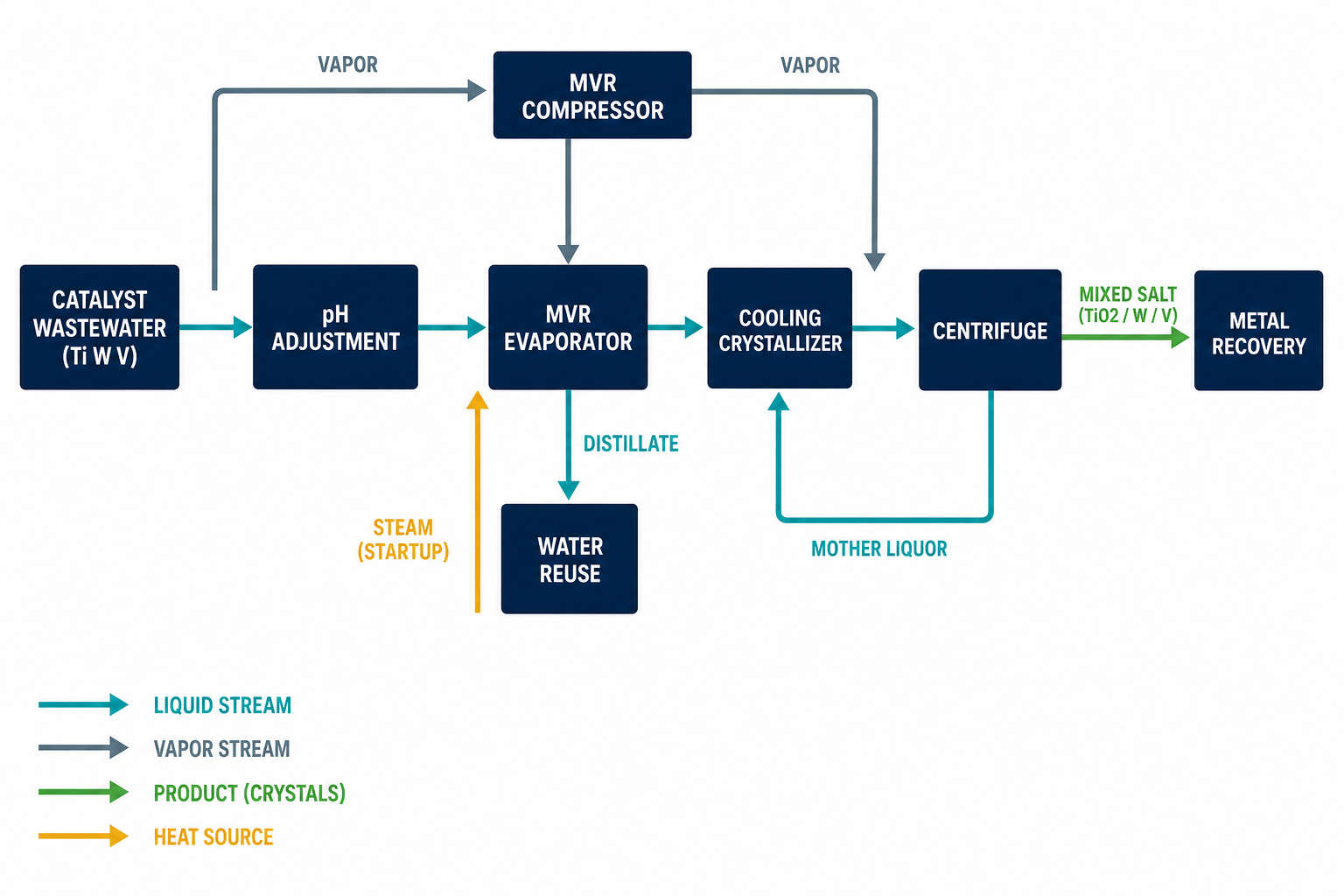
- Equalization and screening. Batch rinses and blowdowns are blended in an equalization tank to damp concentration spikes; hydrocyclones or settling remove the coarse fraction of titania fines that would foul heat-transfer surfaces.
- Chemical conditioning. pH is adjusted to protect downstream metallurgy and, where ammonia is significant, free ammonia is stripped or the pH window is managed so it reports to the condensate in controlled, treatable quantities.
- MVR forced-circulation evaporation. The clarified liquor concentrates in a mechanical-vapor-recompression evaporator; titanium or high-alloy stainless construction handles the chloride-rich, metal-bearing brine.
- Crystallization. Near-saturated brine passes to a forced-circulation (or DTB) crystallizer where salt solids grow to centrifugeable size under controlled supersaturation.
- Solids dewatering and drying. A pusher or peeler centrifuge dewaters the salt; a dryer conditions it for stable storage or shipment to a metals-recovery partner.
- Mother-liquor management. A bleed of mother liquor controls impurity build-up; it is either recycled to the front end or solidified with the product stream.
- Condensate polishing and reuse. Condensate passes ion exchange or reverse osmosis polishing as required, then returns to mixer washdown, scrubber make-up or cooling duties.
| Stream characteristic | Illustrative behavior | Design response |
|---|---|---|
| Dissolved salts | High and batch-variable | Equalization; evaporation tolerant of wide TDS range without dilution |
| Vanadium / tungsten | Dissolved, permit-limited to low mg/L or below | Total retention in brine and crystal phase; concentrated for recovery |
| Suspended TiO2 fines | Sub-micron, scaling-prone | Pre-separation plus high circulation velocity and clean-in-place design |
| Ammonia | Present from calcination and regeneration chemistry | Stripping or pH-window control so condensate stays reusable |
| Organics (binders, lubricants) | Refractory, foaming | Demisters, antifoam dosing, mother-liquor purge |
Illustrative stream behavior compiled from published catalyst-plant practice and stated design assumptions — not customer or project data.
| Process Module | Candidate Equipment Types | Selection Rationale | Indicative Operating Envelope |
|---|---|---|---|
| Equalization & fines removal | Equalization tank; hydrocyclones or settling | Damps batch spikes; removes coarse titania before heat transfer | Set by batch swing and fines load |
| Chemical conditioning / ammonia | pH adjustment; stripping column | Protects metallurgy; controls ammonia route to condensate | pH window per liquor chemistry |
| MVR forced-circulation evaporation | FC evaporator in titanium or high-alloy stainless | Handles chloride-rich, metal-bearing brine without boiler dependency | Wide TDS tolerance, a few thousand mg/L to near-saturation |
| Crystallization | Forced-circulation or DTB crystallizer | Grows salts to centrifugeable size under controlled supersaturation | Set by salt system and BPR |
| Dewatering & drying | Pusher or peeler centrifuge; dryer | Conditions metal-bearing residue for recovery shipment | Per residue classification |
| Condensate polishing | Ion exchange or RO polishing | Brings condensate to reuse quality | Per reuse specification (ammonium, metals, conductivity) |
Configuration, materials, and operating ranges depend on actual feed, temperature, pressure, corrosion review, fouling behavior, utilities, and project capacity.
Key Design and Operating Considerations
Temperature and vacuum control
The evaporation temperature must match the chemistry of the liquor: run too hot and organics carbonize and bake onto tube walls, insulating the exchanger and raising energy consumption; run too cold and capacity suffers. Operation under vacuum lowers the boiling point, cuts thermal degradation risk and keeps volatile species inside a closed, capturable system. Tight control of both temperature and pressure is what separates a stable crystallizer from a fouling problem.
Materials of construction
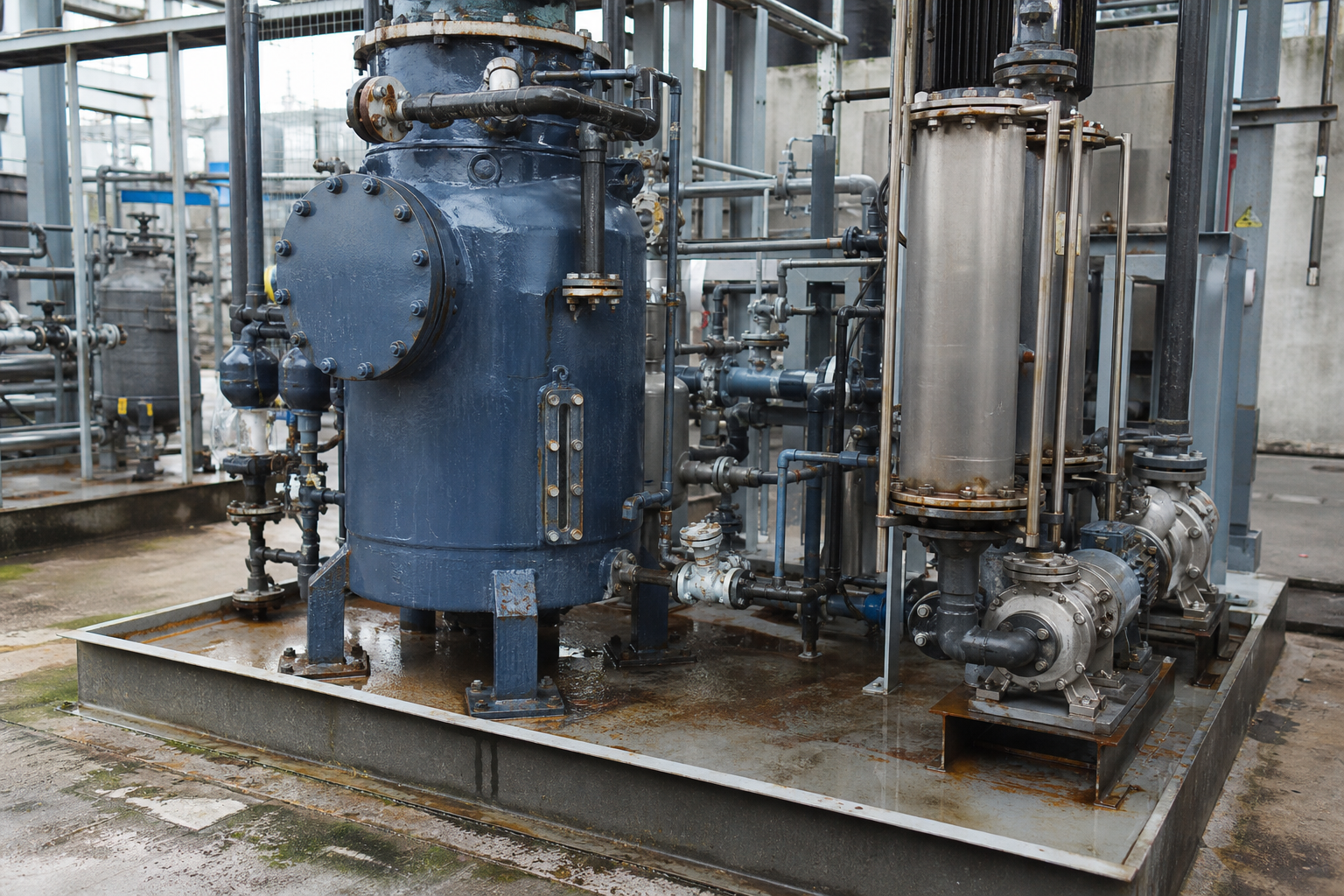
Chloride-bearing, metal-laden brines are aggressively corrosive at evaporation temperatures. Wetted parts in titanium or suitable stainless grades, with polymers or FRP in cooler vapor service, are the standard answer; under-specifying metallurgy shows up within months as iron contamination of the salt product and premature exchanger failure.
Entrainment and foam control
Binder organics and fine solids stabilize foam; droplet carryover contaminates the condensate with vanadium and salt. Dual-stage demisting, generous vapor-space sizing and standby antifoam injection are inexpensive insurance for condensate quality.
Crystal and fines management
Fine titania seeding unwanted nucleation and vanadium-bearing scale are the two chronic fouling modes. High forced-circulation velocities, scheduled chemical cleaning, and a disciplined mother-liquor purge keep the boiling point rise and viscosity from creeping upward over long campaigns.
| Configuration | Strength for this duty | Watch-outs |
|---|---|---|
| MVR forced circulation | Electrically driven, no boiler dependency; low operating cost at medium–large scale | Higher capital; compressor requires clean vapor |
| Multi-effect (MED) forced circulation | Robust where live steam is already available | Cooling-water demand; higher steam cost |
| Falling film (concentration stage only) | Gentle, efficient pre-concentration of dilute rinses | Not suitable as the crystallizing step for fouling liquors |
For most catalyst-plant capacities, hybrid designs win: a falling-film concentrator raises dilute rinse water toward saturation economically, and a forced-circulation MVR crystallizer finishes the job. Our MVR evaporation, forced-circulation and falling-film technology pages detail the underlying configurations, and the energy cost comparison tool quantifies the MVR-versus-multi-effect operating delta for your own tariff situation.
Turning the Residue Into a Vanadium and Tungsten Feedstock
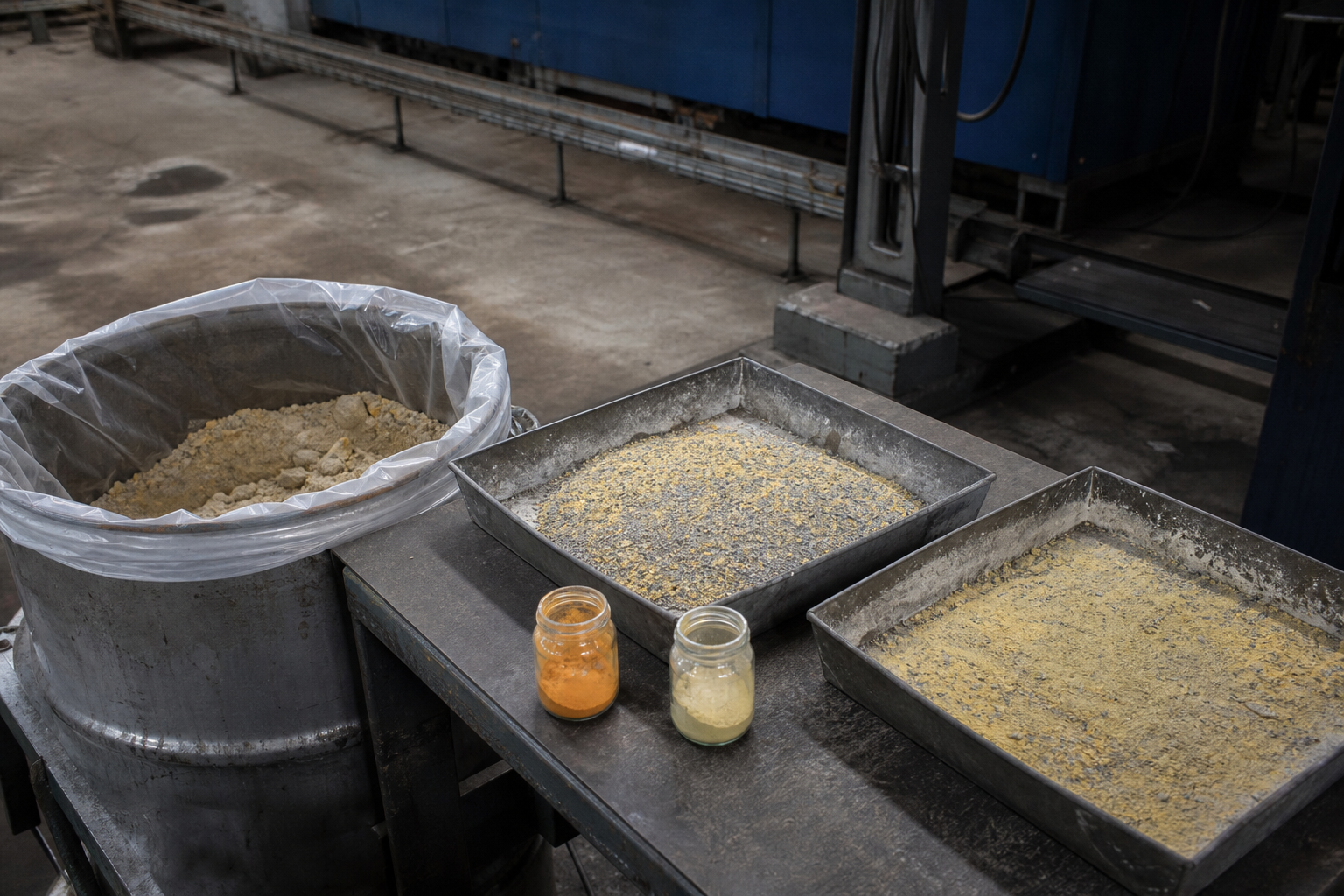
The salt cake that leaves the centrifuge is not ordinary product salt: it carries most of the feed vanadium and tungsten, often at concentrations far above those of primary ore streams after long campaigns of accumulation. This creates a genuine circular-economy loop — the residue can be shipped to vanadium recovery circuits (roasting or leaching routes) rather than stabilized and landfilled, shrinking the plant’s hazardous-waste manifest volume dramatically and partially offsetting operating cost with metal value. Where salt purity allows, separated sodium streams can additionally be considered for industrial reuse; where they do not, co-crystallized mixed salt is simply managed as a controlled metal-bearing residue. The salt separation and resource recovery line describes the crystallization strategies used when salt quality or split specification matters, and the drying and packing line covers conditioning the solids for sale or transfer.
Delivering the Plant
Because catalyst-plant flows are typically modest compared with refinery or coal-chemical duties, skid-mounted modular construction usually wins on schedule and commissioning risk: the evaporation-crystallization train is fabricated and tested off-site, then set and hooked up in a short outage window. Wider zero-liquid-discharge context for the power and steel sector, including FGD wastewater and the ash-based streams described in our steel sintering dust salt recovery and MSWI fly ash washing solutions, is covered under the high-salinity ZLD program and the power, steel and FGD industry page.
When This Route May Not Fit
Thermal ZLD is not automatic for every catalyst plant. Very small flows carrying little vanadium or tungsten value are cheaper to accumulate and haul as hazardous waste than to crystallize on site. Without an ammonia-management step, free ammonia follows the condensate and the reuse loop fails its specification. If no vanadium or tungsten recovery circuit will accept the residue, the salt cake remains a controlled hazardous solid and the circular-economy economics collapse into pure compliance cost. Sites with neither reliable power nor live steam cannot host MVR or multi-effect trains respectively. And feeds dominated by binder organics with extreme foaming behavior need pretreatment before any evaporator is asked to boil them.
What Must Be Verified
Validation focus: a stream-by-stream analysis with batch-to-batch swing — V, W, As, chloride, ammonia, titania fines, and pH — because equalization, metallurgy, and crystallizer sizing all follow from it. The residue must be classified early (hazardous waste versus metal-bearing feedstock) and matched to an accepting recovery circuit’s grade specification. A corrosion review across the chloride-temperature envelope fixes titanium versus high-alloy selection before budgets stick. Foaming behavior needs an actual test, the ammonia split between brine and condensate needs quantification against the reuse target, and the 95%-removal / 90%-reuse figures cited above must be re-verified on this project’s own feed.
Frequently Asked Questions
Can the condensate really be reused inside the catalyst plant?
Yes. Evaporative condensate starts essentially free of dissolved salts and non-volatile metals; a polishing step selected on the specific residuals (ion exchange for trace ammonium or metals, RO where lower conductivity is needed) brings it to mixer-washdown, scrubber make-up or cooling quality. Reuse rates above 90% of throughput are commonly reported in comparable ZLD duties.
Is the recovered salt sellable as a product?
Not usually as commodity salt. The crystal phase carries vanadium and tungsten, so its value lies in metals recovery, not in salt purity. Its advantage over the original wastewater is volume: metals are concentrated into a small, dry, shippable solid.
MVR or multi-effect for a catalyst plant?
MVR suits sites without spare boiler capacity and tolerates electricity-driven economics; multi-effect suits sites with low-cost live steam. For the batchy, medium-scale flows typical of catalyst manufacturing, MVR forced-circulation crystallizers are the most common modern selection.
How is ammonia handled?
Free ammonia is volatile and will report partly to the condensate. Plants either strip ammonia upstream, dose to hold it in a non-volatile form, or polish the condensate — the choice depends on the ammonia load and the reuse specification.
What about spent-catalyst regeneration wastewater specifically?
It is the same evaporation duty with a harder feed: arsenic and alkali salts from poisons add to the brine load. The principles are unchanged — phase change captures everything non-volatile — but metallurgy selection and residue classification deserve extra engineering attention.
Evaluating SCR catalyst wastewater closure? Send the stream analyses (V, W, As, chloride, ammonia, solids), volumes and batch pattern, and the residue disposition options — in exchange you will receive a first-pass screening of the evaporation-crystallization train, metallurgy class, and recovery route your feed supports.