
What This Page Covers
Producing battery-grade lithium hydroxide monohydrate (LiOH·H2O) profitably comes down to two unit operations: energy-efficient concentration of the purified liquor and controlled crystallization of the final salt. Plants that have replaced triple-effect evaporation with mechanical vapor recompression (MVR) report 50–80% reductions in evaporation operating cost (industry-reported range, not a project guarantee), and modern Draft Tube Baffle (DTB) crystallizers routinely hold impurity levels below the 10 ppm threshold that high-nickel cathode manufacturers impose. This page explains the process route, the engineering decisions that determine purity and crystal quality, and the numbers to expect when evaluating a system.
Why LiOH Concentration and Crystallization Are Technically Demanding
The commercial push for LiOH comes from high-nickel cathode chemistries such as NCM 811, which require lithium hydroxide rather than lithium carbonate in the precursor synthesis. For refineries in North America and South Korea, the competitive question is no longer capacity but operating cost (OPEX) and batch-to-batch purity consistency.
Three technical constraints make LiOH service unusually demanding. First, lithium hydroxide is a strong alkali: hot, concentrated LiOH attacks standard stainless steels and leaches metallic ions into the product, which is fatal for battery-grade specifications. Second, the impurity budget is extremely tight — cathode producers typically specify individual metallic contaminants below 10 ppm, so every contact surface, gasket, and weld is a potential contamination source. Third, crystal size distribution (CSD) matters commercially: older batch crystallizers produce inconsistent CSD, and off-spec material must be re-processed at full cost.
Traditional multi-effect evaporation compounds these problems. It requires continuous fresh steam — exposing the plant to fuel price volatility — and its cooling tower load adds water consumption. Where industrial steam costs have fluctuated significantly — Ontario, Quebec, and South Korea are frequently cited — multi-effect systems have become a financial liability rather than a conservative default.
The Process Route: From Purified Liquor to Battery-Grade Crystals
A complete LiOH evaporation and crystallization line follows a logical sequence, and each stage exists to protect the next one:

- Feed preheating. The purified liquor is preheated against hot condensate (with live steam in the final stage where used) to recover sensible heat, typically bringing feed from ambient to near the effect’s boiling temperature.
- MVR concentration. Water is evaporated in a falling-film or forced-circulation MVR train until the liquor nears crystallization saturation. A centrifugal compressor recompresses secondary vapor as the heating medium for the same effect — latent heat recirculates instead of leaving through a condenser.
- Crystallization. The near-saturated liquor enters a DTB- or Oslo-type growth crystallizer, where supersaturation is generated and consumed under control, growing uniform coarse crystals.
- Thickening and solid-liquid separation. The slurry passes through a thickener before centrifugation. Mother liquor overflows to a tank and recycles to the evaporator; only a small purge controls impurity accumulation.
- Drying and packaging. Centrifuged crystals are dried (fluid-bed or air) and bagged under conditions preventing moisture pickup and metallic contamination.
The defining feature of the route is heat integration: because the compressor recycles latent heat, the only fresh steam consumed in normal operation is for start-up and for the final polish of feed preheating. Cooling water demand drops to a minimum because there is no large condenser load to reject.
| Process Module | Candidate Equipment | Selection Basis |
|---|---|---|
| Feed preheating | Plate or shell-and-tube exchangers on hot condensate | Sensible-heat recovery; steam trim where used |
| Concentration | Falling-film or forced-circulation MVR body + centrifugal compressor | Boiling behavior; power-versus-steam economics |
| Crystallization | DTB or Oslo growth crystallizer | Target CSD and attrition limits |
| Thickening & separation | Thickener + centrifuge | Slurry solids; recycle and purge control |
| Drying & packaging | Fluid-bed or air dryer; sealed bagging | Moisture and contamination prevention |
Note: configurations are indicative; selection depends on actual feed, corrosion review, utilities, and capacity.
MVR vs. Triple-Effect Evaporation: The Numbers That Matter
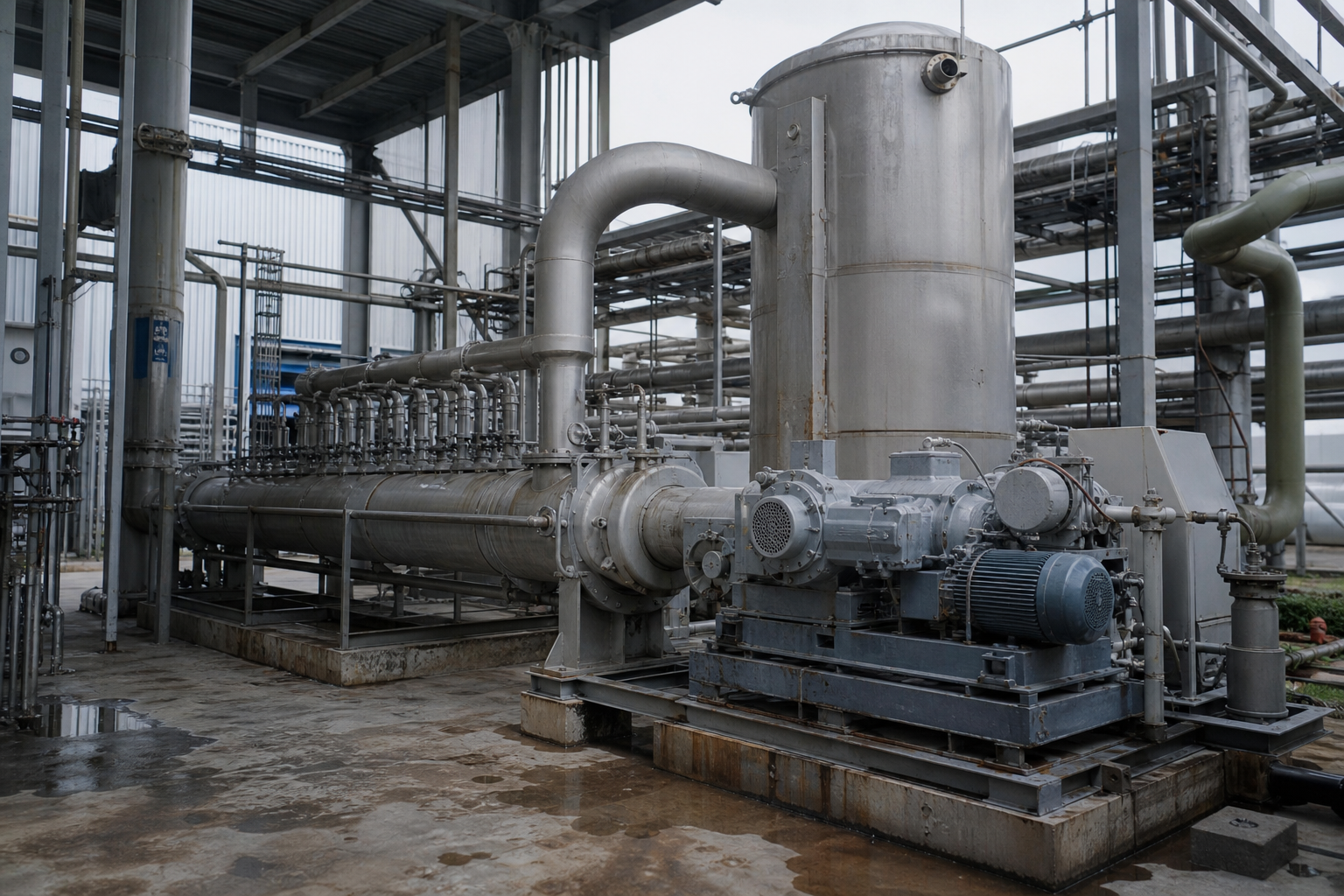
The comparison summarizes the operating characteristics driving the MVR business case in lithium refining. Electricity replaces steam, which is the entire point: a ton of water evaporated with 20–40 kWh of compressor power is almost always cheaper than one evaporated with 0.4 t of fresh steam.
| Parameter | Multi-Effect Evaporator (3-Effect) | MVR Evaporation System |
|---|---|---|
| Fresh steam consumption | ~0.4 t per ton of evaporation | Near zero (start-up only) |
| Electricity consumption | Low (pumps only) | 20–40 kWh per m³ of evaporation |
| Cooling water demand | High (cooling tower required) | Minimal |
| Carbon footprint | High (boiler emissions) | Low (electric-driven) |
| Operating cost vs. baseline | Baseline (100%) | 50–80% reduction |
Note: figures are published indicative ranges, not project guarantees; results depend on local energy prices, feed, and turndown.
Two boundary conditions decide. The site electricity-to-steam price ratio is primary: MVR wins decisively where steam is expensive relative to power — common where plants buy boiler fuel on the open market. The second is turndown and batch flexibility: MVR is designed for continuous 24/7 operation, and highly intermittent campaigns may prefer a hybrid arrangement.
Materials of Construction: Where Standard Stainless Steel Fails
Material selection is the most common failure source in LiOH service. Hot concentrated lithium hydroxide is highly alkaline; standard austenitic stainless steels corrode prematurely and — more damaging for battery applications — leach metallic contaminants into the liquor.
Published practice in recent LiOH projects is duplex 2205 or titanium for wetted parts in the concentration and crystallization circuit. Both resist alkaline stress corrosion and avoid the ion leaching that pushes trace metals above battery-grade limits. Gaskets, pump wetted parts, and instrument diaphragms need the same scrutiny: one unqualified component can contaminate an entire campaign.
The <10 ppm impurity standard is not achieved by materials alone. Automated PLC control monitors vacuum and solid-liquid ratio in real time, so upsets that spike impurities — foaming, carryover, condensate contamination — are caught within seconds, not discovered in the laboratory after packaging.
Crystallizer Design: Controlling Supersaturation for Battery-Grade CSD
Battery-grade LiOH is not merely a water-removal problem but a crystallization kinetics problem. The crystallizer must generate supersaturation gently and consume it on existing crystal surfaces, rather than nucleating fines that pass through the centrifuge and dry into dust.
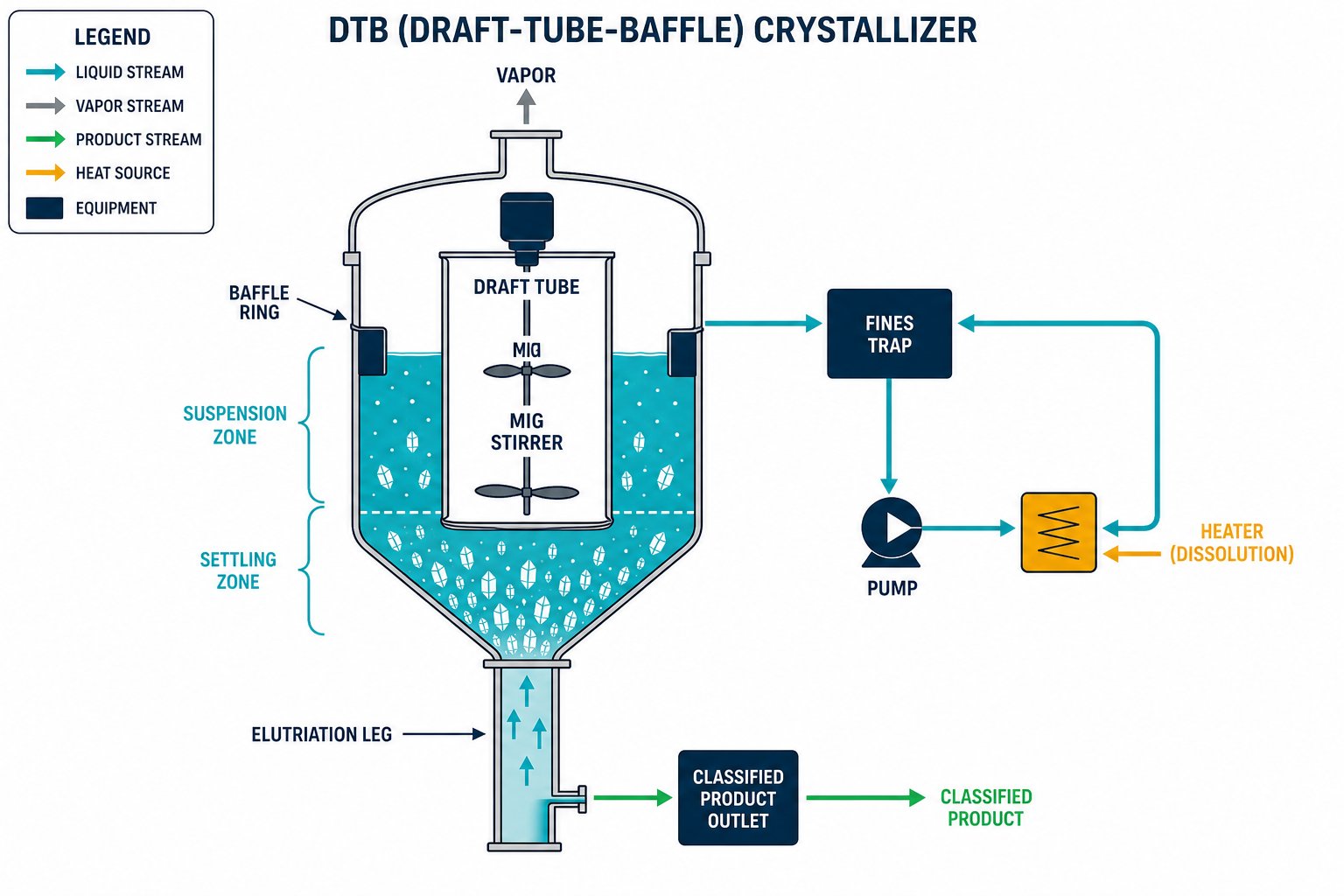
DTB (Draft Tube Baffle) crystallizers are the workhorse for LiOH, combining three functions in one vessel: a draft tube circulates slurry so crystals pass through the supersaturation zone repeatedly; a baffle section settles fines out of the upward stream for dissolution and recycle; and a clarified zone allows withdrawal of fines-free mother liquor. Oslo-type growth crystallizers, where crystals grow in a fluidized bed practically free of attrition, serve very large, uniform grain size priorities.
Correct supersaturation control yields a uniform, coarse crystal that centrifuges and dries readily: low mother-liquor retention translates directly into lower impurity carryover. Poor control produces uneven size, higher impurity retention, and re-processing cost.
Field Results from Recent LiOH Projects
The two examples below are external industry references from published reports by other suppliers — not EvapCryst projects or evidence of our delivery record; figures are indicative of those deployments, not guarantees for new builds. In one South Korean project, an aging three-effect system at a high-nickel precursor plant was replaced with a high-yield MVR unit; the operator reported a 65% reduction in monthly utility bills and a 15% increase in final product purity. The purity gain came jointly from reduced thermal cycling and tighter crystallization control, not from the evaporator alone — a useful reminder that the retrofit must be engineered as an integrated concentration-plus-crystallization system.
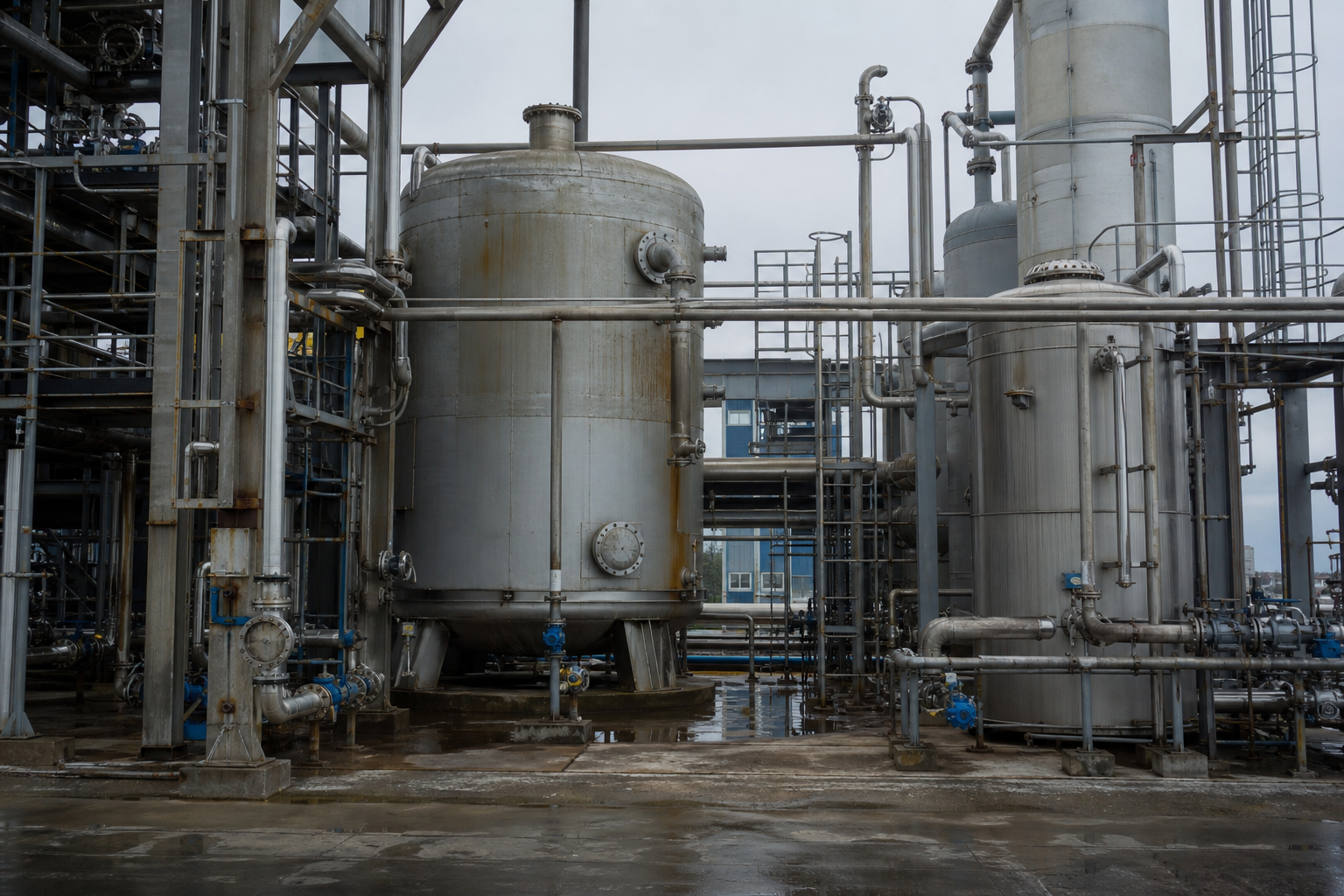
In a North American lithium brine project, a modular skid-mounted LiOH crystallization train was commissioned in a compact footprint for rapid integration into an existing facility while meeting local ZLD mandates. Skid delivery suits LiOH: it shortens erection time and allows factory qualification of high-purity welds and surfaces before shipment.
Water Balance, Mother Liquor, and ZLD Considerations
Because MVR recycles latent heat internally, the condensed distillate is a large, clean water stream, typically routed back to upstream washing, dissolution, or scrubber duties — materially reducing fresh water intake.
The mother liquor loop deserves explicit design attention. As crystals are withdrawn, soluble impurities — sodium, potassium, and carbonate species in particular — accumulate in the recycled mother liquor. The purge rate is a genuine optimization variable: too low, and impurities creep until product drifts out of specification; too high, and lithium yield leaves with the purge. Instrumented density and composition monitoring lets the purge track actual impurity accumulation rather than a fixed ratio.
Where permits require ZLD, the purge and vent condensates can be further concentrated and crystallized, leaving dry salt and recyclable water as the only outputs. Our zero liquid discharge solutions page details the end-of-pipe architectures used for this duty.
What to Specify When Evaluating a LiOH Evaporation-Crystallization System
Procurement teams should demand the following deliverables before award; each exposes a different class of design risk:
- A mass and energy balance simulation for your actual feed composition and capacity — not a generic datasheet. The electricity consumption per cubic meter of evaporation and the purge rate should both appear in this document.
- A full materials-of-construction schedule for every wetted part, including gaskets and instruments, with the rationale for each alloy choice.
- A crystallization basis of design stating the supersaturation control philosophy, fines handling, and expected crystal size distribution, with the control loops that enforce it.
- An OPEX comparison at your site’s actual steam and electricity prices, so the MVR business case is validated against local energy economics rather than generic averages.
- A contamination control plan covering weld qualification, surface finishing, and cleaning procedures for high-purity service.
Required inputs for screening: purified-liquor composition (LiOH strength and impurity profile), evaporation duty, site steam and power prices, and the customer’s CSD and impurity specification — enough to outline the concentration-plus-crystallization route.
Related Resources
- MVR Evaporation Technology — compressor selection, thermodynamic design, and energy balance fundamentals.
- DTB Crystallizer Design — how draft tube baffle geometry controls CSD in soluble salts.
- Concentration & Crystallization Solutions — the integrated process line architecture used across chemical products.
- Battery Materials Industry Solutions — evaporation and crystallization duties across the lithium battery supply chain.
- Sodium Sulfate Evaporation & Crystallization Solutions — the companion duty in sulfate-route lithium refining and high-salt wastewater.
When This Route May Not Fit
The MVR-plus-DTB route is not automatically the right answer for every LiOH producer. Where cheap steam is available under long-term contracts — some parks sell LP steam below MVR parity — a three-effect train remains defensible. Plants running short, intermittent campaigns lose part of the advantage: compressor trains are sized for continuous duty, and frequent stops add thermal cycling. Where feed liquor quality is unstable — upstream purification upsets carrying sodium, potassium, or sulfate into the circuit — no evaporator choice fixes a purification problem, and capital spent on the thermal island is wasted until that is solved. And projects with very small evaporation duties may find the fixed cost of a compressor train hard to justify against simpler steam-heated designs.
What Must Be Verified
Before this route is committed for design, the following must be verified on real data. A full feed characterization of the purified liquor — LiOH strength, sodium/potassium/carbonate/sulfate levels, and their swing over operating campaigns — because the impurity budget sets both purge rate and yield loss. An electricity-versus-steam price check at the site’s actual tariffs, since the 50–80% OPEX advantage is an envelope, not a property. Crystallization basis confirmation — target CSD against the customer’s specification, ideally supported by laboratory test work on the actual liquor. A materials and contamination review covering every wetted part, gasket, and instrument diaphragm against battery-grade limits. And where ZLD applies, a water-balance and purge-disposal study that closes the plant’s effluent question before the island is ordered.
Frequently Asked Questions
How much steam does an MVR LiOH evaporator consume compared with a triple-effect system?
A three-effect evaporator typically consumes about 0.4 tons of fresh steam per ton of water evaporated. An MVR system consumes near-zero fresh steam in normal operation — steam is needed only for start-up and final feed preheating — replaced by roughly 20–40 kWh of electricity per cubic meter evaporated. At most industrial steam and power prices this cuts evaporation OPEX by 50–80%.
Why can’t standard stainless steel be used in LiOH concentration?
Hot concentrated lithium hydroxide is a strong alkali that corrodes standard austenitic stainless steels and leaches metallic ions into the product. Because battery-grade LiOH specifications hold individual impurities below 10 ppm, this leaching alone can put the product off-specification. Duplex 2205 or titanium wetted parts are the established solution.
Which crystallizer type is used for battery-grade LiOH?
DTB (Draft Tube Baffle) crystallizers are the mainstream choice because they control supersaturation while circulating slurry through the growth zone, producing uniform coarse crystals with low mother-liquor retention. Oslo growth-type crystallizers are selected when maximum grain size and minimal crystal attrition are prioritized. Both are easier to centrifuge and dry than fines-rich product from uncontrolled batch crystallization.
Can an existing multi-effect LiOH plant be retrofitted to MVR?
Yes. A published South Korean retrofit at a high-nickel precursor plant (external industry reference, not an EvapCryst project) replaced a three-effect system with MVR and reported a 65% reduction in monthly utility bills plus a 15% purity improvement. The retrofit should be engineered as an integrated concentration-plus-crystallization project, since purity gains depend on crystallization control as much as on the evaporator itself.
How is the mother liquor handled, and does the plant need ZLD?
Mother liquor from centrifugation is recycled to the evaporator, with a small instrumented purge to control accumulation of sodium, potassium, and carbonate species. Clean MVR condensate is reused in washing and dissolution duties, shrinking the plant’s water balance. Where permits require it, the purge and vent streams can be further crystallized for full ZLD, leaving only dry salt and recyclable water as outputs.


