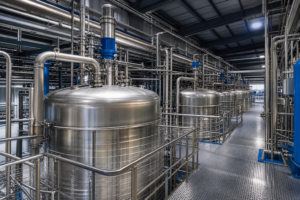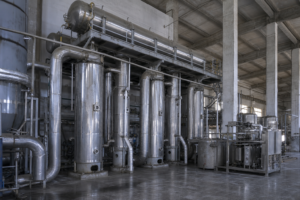
Plant protein and biological feed processing concentrates dilute, heat-sensitive streams — fermentation broths, protein extraction liquors, corn steep liquor, enzyme solutions and amino-acid mother liquors — into saleable powder or crystal products, and the evaporation step is where both product quality and operating cost are decided. To frame the duty: a well-configured line for a mid-scale biological feed plant (illustrative envelope for a 100 tons-per-day fermented feed line, constructed from published process practice and supplier performance data — not customer or project data) runs fermentation broth clarification into an MVR falling film concentrator operating at 60-80°C, lifting total solids from the few-percent range of a raw broth to 35-50% before spray or fluid-bed drying, at an energy consumption envelope of 15-30 kWh per ton of evaporated water (supplier-published indicative range; not a project guarantee). This page lays out the full process chain, the equipment choices at each stage, and the failure modes that separate a profitable feed line from a fouling liability.
Where Evaporation Sits in a Biological Feed Plant

Biological feed and plant protein products are made by fermentation or aqueous extraction, and both routes start with very dilute water-bearing streams. Evaporation is the bulk water removal workhorse between upstream clarification and downstream drying or crystallization; it typically accounts for the largest share of the plant’s thermal energy budget, which is why technology selection here dominates the opex of the whole line.
Typical Process Chain for Fermented Feed Products
1. Fermentation. Strains (Bacillus, yeast, lactic acid bacteria for biological feed; Corynebacterium for amino acids) convert carbohydrate substrate into biomass, protein and metabolites. The broth leaves the fermenter typically at only 2-8% dissolved solids.
2. Solid-liquid separation and clarification. Disc stack centrifuges or microfiltration remove cell mass and insolubles. For whole-cell feed products this step may be bypassed and the entire broth concentrated, which changes the evaporator duty significantly (higher viscosity, higher fouling risk).
3. Evaporative concentration. Clarified liquor is concentrated 5- to 10-fold in an MVR falling film evaporator. Low-temperature vacuum operation preserves protein functionality and avoids Maillard browning reactions that darken the product and reduce digestibility.
4. Downstream finishing. Depending on the product: spray drying for protein powders and feed ingredients, fluid-bed drying and granulation for feed additives, or crystallization for purified amino acids. The concentrate solids endpoint is set by what the dryer or crystallizer needs — spray dryers generally want 35-50% solids, while crystallizers need supersaturation instead.
Application Matrix: Streams and Their Requirements

The matrix below is an illustrative feed envelope assembled from published process practice for these stream families — use it to frame screening conversations, and confirm actual feed solids, impurity profile and swing by analysis before equipment selection:
| Stream | Illustrative Feed Solids (envelope) | Concentrate Target | Finishing Step | Key Evaporation Challenge |
|---|---|---|---|---|
| Amino acid fermentation broth (lysine, threonine, tryptophan) | 2-8% after clarification | 40-60% for spray drying; supersaturation for crystallization | Crystallization or spray drying | Viscosity rise, crystal seeding in tubing, chloride corrosion |
| Soy / pea protein extraction liquor | 2-10% protein | 12-20% before precipitation, higher for direct spray drying | Acid precipitation, spray drying | Protein denaturation above roughly 60-70°C, foaming |
| Corn steep liquor / starch hydrolysate | 5-15% | 45-60% | Feed blending or drying | High viscosity, browning at high temperature |
| Enzymate and yeast hydrolysate | 3-10% | 30-45% | Spray drying | Activity loss, fouling on denatured protein layers |
| Choline chloride and liquid feed additive carriers | varies | 50-70% | Blending onto carrier | Chloride stress corrosion — material selection |
Why MVR Falling Film Evaporation Is the Default Choice

Product Protection at Low Temperature
Proteins denature and Maillard reactions accelerate as temperature and residence time increase. Falling film evaporators give seconds of contact time under vacuum, letting the plant concentrate at 60-80°C — hot enough for efficient heat transfer, cool enough to keep functional proteins intact and the powder color light. Steam-driven systems pushing higher wall temperatures to compensate for poor heat transfer will visibly darken these products.
Energy Economics at Feed-Plant Scale
Published steam-economy references put single-effect evaporation of one ton of water at roughly 550-600 kg of live steam; a biological feed line that must remove several tons of water per ton of finished product would see its fuel bill dominate production cost. MVR evaporation cuts this to an electrical input in the supplier-published 15-30 kWh-per-ton indicative range by recompressing the evaporated vapor and recycling its latent heat, which is why industry-reported practice specifies nearly every new fermentation concentration line in the amino acid and feed sector as MVR. A worked comparison of this technology applied to amino acid products appears on our lysine, MSG and citric acid fermentation finishing page.
Hygienic Design and Cleanability
Feed and food-grade duty requires polished stainless surfaces (304/316L), full drainability, CIP (clean-in-place) circuits, and separator design that does not hold stagnant product. Falling film calandrias with well-designed distributors clean in place effectively, supporting the daily or per-batch CIP cycles typical of protein duty without opening the equipment.
Handling the Three Signature Failure Modes
Foaming. Protein-rich liquors foam aggressively; foam carryover contaminates condensate and can flood the compressor suction in MVR service. Countermeasures: oversized separators with demisters, low-velocity vapor ducts, mechanical foam destruction, and antifoam dosing compatible with feed regulations.
Viscosity wall. Plant protein liquors and hydrolysates show steep viscosity increase past roughly 40-50% solids depending on the product; beyond that wall, film distribution degrades, the heat transfer coefficient collapses, and dry-patch fouling begins. Countermeasure: stop the falling film stage at the viscosity wall and either finish in a forced-circulation stage or hand the final lift to the dryer, accepting slightly higher drying energy as the price of availability.
Fouling by denatured protein. Any local overheating event bakes a protein layer onto the tube wall that insulates the surface and invites the next layer. Countermeasures: guaranteed minimum wetting rates with feed-loss interlocks, tight delta-T control, and CIP triggered on measured heat-transfer degradation rather than the calendar.
Mother Liquor Handling in Amino Acid Plants

Where the feed line produces crystalline amino acids rather than dried broth, the evaporation system faces an additional duty: mother liquor. Centrifuge mother liquor still carries a meaningful share of the target amino acid plus the impurities accumulated per pass — sulfate or chloride counter-ions, other amino acids, pigments and residual sugars. Standard practice is to recycle a controlled fraction of mother liquor into the evaporator feed (enough to recover product value, not so much that impurity levels depress crystallization yield or contaminate crystal quality), and to purge the remainder — the purge stream itself is frequently concentrated further and sold as a low-grade feed ingredient rather than paid away as waste. The purge ratio is a live optimization variable: run too rich and crystal purity drifts; run too lean and yield bleeds into the purge. Evaporators on this duty see higher viscosities and stronger corrosion classes than the main liquor train and are commonly specified as separate forced-circulation or falling film bodies with duplex materials rather than sharing the main train.
Condensate and Water Balance
A biological feed plant evaporates several times more water than the product it ships, so the condensate stream is a process stream, not an afterthought. Clean condensate from the evaporation of clarified liquors is typically reused as fermenter cooling make-up, CIP water, substrate preparation water or cooling tower make-up, directly reducing the plant’s freshwater permit load. Condensate quality is managed by keeping entrainment low (demisters and adequate separator sizing) and by routing the first fractions and any high-COD periods (start-up, product changeover, whole-broth duty) to the wastewater plant instead of the reuse tank. Plants under strict discharge limits extend the same train into a zero-liquid-discharge arrangement, evaporating the final wastewater stream to recover transportable solids.
Integration with Drying and Solids Handling
The concentrate endpoint is a negotiation between evaporator and dryer. Pushing evaporation one point further into solids usually saves dryer energy per kilogram of water — but past the viscosity wall it costs evaporator availability. Modern lines therefore concentrate to the highest pumpable solids and finish in drying and packing systems (spray dryers for powders, fluid-bed dryers with internal heat exchangers for granules) that are matched to the concentrate rheology, bulk density target and flowability the feed customer specifies. Waste heat from dryer exhaust can in turn preheat evaporator feed, recovering a few percent of overall plant energy at negligible additional complexity.
Process Modules and Candidate Equipment
| Process Module | Candidate Equipment Types | Selection Basis | Module Function |
|---|---|---|---|
| Upstream feed handling | Feed tanks, condensate-fed preheaters, filtration/clarification interface | Feed solids and solids-load variation | Buffers and preheats liquor; protects the evaporator from insolubles |
| Evaporation | MVR falling film calandria with separator and compressor (anti-surge control); multi-effect train where steam is favored | Energy price, temperature ceiling, scale | Bulk water removal at protein-safe temperature with vapor recompression |
| Controls | PLC/DCS with concentration closed loop (density or conductivity), CIP sequencing, compressor protection | Product changeover frequency, unattended operation | Holds concentrate endpoint and protects compressor and film wetting |
| Downstream interface | Concentrate buffer tank, dryer feed pumping, condensate reuse routing | Downstream dryer or crystallizer requirement | Decouples evaporation from drying; returns clean condensate to process |
| Utilities | Electrical power and cooling water (pure MVR); optional steam tie-in for multi-effect phases | Site utility portfolio | Removes boiler dependency for the evaporation duty |
Configuration, materials and operating envelopes above are potential considerations; actual selections depend on feed composition, temperature, pressure, corrosion review, fouling behavior, utilities and project capacity.
For capacity phases where steam is already available and electricity is expensive, the same flowsheet can be executed as a multi-effect falling film train; for a deeper discussion of the equipment itself see our falling film evaporator solutions overview. Modular skid delivery — factory-assembled evaporator, separator, compressor and controls on one frame — is practical for small and mid-capacity lines and shortens site installation to utility tie-ins, an approach detailed on our modular plant page.
When This Route May Not Fit
MVR falling film concentration assumes dilute, pumpable, protein-bearing liquors and favors sites with affordable electricity. It may not fit when: steam is already available on site at low marginal cost while electricity is expensive, tilting the economics toward a multi-effect train; the product is so thermally fragile that even 60-80°C vacuum operation is objectionable, requiring lower-temperature (and costlier) schemes; capacity is very small or campaign-based, where a single-effect or batch evaporator is simpler than a compressor-driven line; the whole-cell product hits its viscosity wall at low solids, making direct drying from broth the cheaper overall energy balance; or chloride-rich additive systems push metallurgy into duplex or higher alloys that swamp the energy saving. In such cases a different evaporation configuration, not a bigger version of this one, is the honest answer.
What Must Be Verified
Before this route is fixed for your project, verify against your own liquor: the measured denaturation and browning onset of your protein system (not literature values), which sets the operating temperature ceiling; a viscosity-versus-solids curve on the real stream, which locates the falling film stop point; foaming tendency under vacuum, which sizes separators and demisters; chloride and pH excursion levels in additives and mother liquors, which decide the metallurgy class; electrical capacity and cooling water availability at the site for MVR operation; and the negotiated concentrate endpoint with the dryer or crystallizer vendor. Energy figures quoted on this page are supplier-published indicative ranges and illustrative envelopes — not a project guarantee.
FAQ
What solids content should the evaporator deliver to a spray dryer for feed protein?
Typically 35-50% depending on the protein source and its viscosity behavior; the optimum is the highest concentration at which the falling film still wets reliably, because every extra point of solids in the evaporator saves dryer energy.
Can whole fermentation broth be concentrated without clarification?
Yes, and it is common for biological feed products where the cell mass is part of the product, but the evaporator must be designed for the higher fouling load — higher circulation wetting margins, more conservative temperatures and shorter CIP intervals.
How does MVR change the utility footprint of a feed plant?
A pure MVR line needs electrical power and cooling water rather than a dedicated steam boiler for evaporation, which simplifies permitting for new builds and frees boiler capacity for sterilization and drying duty in expansions.
Which materials of construction are required?
316L is the baseline for protein and amino-acid duty; chloride-bearing additives such as choline chloride or ammonium-chloride-rich mother liquors push selection toward duplex stainless or higher alloys, decided by a chloride and pH excursion review.
How is product color protected during concentration?
By keeping temperature low (vacuum operation at 60-80°C), residence time short (falling film rather than recirculating boiling), and excluding hot spots through distributor quality and delta-T control — the same measures that prevent protein denaturation fouling.
To move from this screening framework to a grounded process direction, share your stream type and feed solids, throughput target and product form — EvapCryst returns a first-pass process-direction screening for your case.