EvapCryst logo

Drying & Packing Systems for Salt & Crystal Production

The line that turns wet crystal into bagged product: centrifuge dewatering, drying, screening, conditioning and packing — engineered as one train downstream of your evaporative crystallizer, sized from 10 t/d pilots to 1,000 t/d plants.

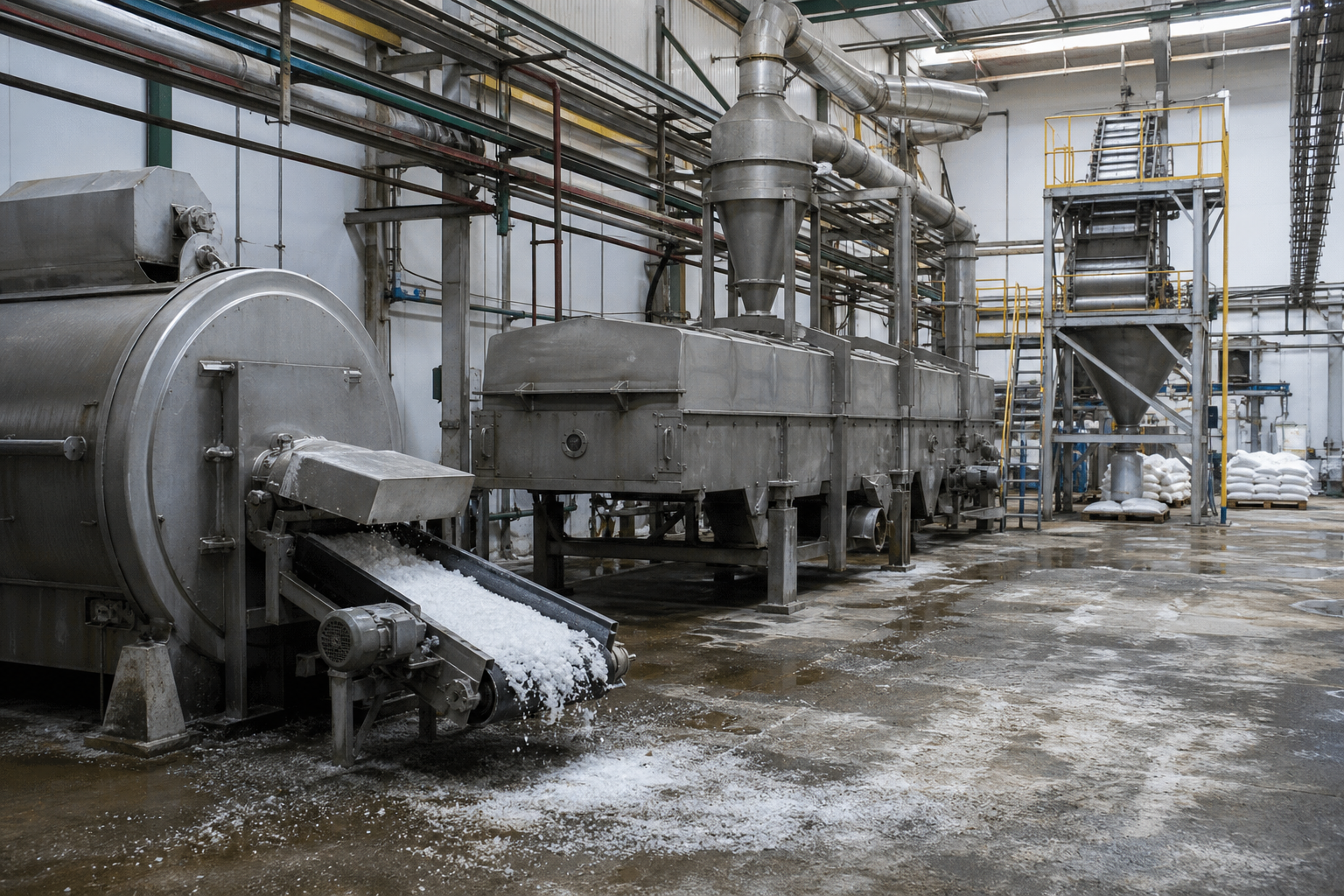
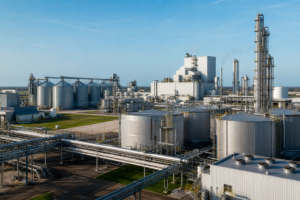
Drying and packing system for evaporated salts and crystal products
At a Glance

The Downstream Line in Four Numbers

Reference ranges from published salt-plant and dryer data on NaCl and inorganic salt systems.

Line Capacity
3–30 t/h
typical salt refining & packing line throughput; full-line plants span 10–1,000 t/d
Moisture After Drying
≤0.3–0.8%
final salt product, fluid bed or rotary duty after centrifuge pre-dewatering to 3–5%
Dryer Styles Covered
4 + 2
fluid bed, flash (airflow), rotary and tube-bundle dryers — plus disc-film and agitated thin-film for ZLD residues
Packing Range
150 g–1 t
small retail bags through 1–50 kg industrial bags to 1-tonne bulk bags from one screening-and-packing section
System & Process Flow

From Crystallizer Discharge to Packed Product

One continuous train: dewater, dry, screen, condition, pack — with mother liquor and dust loops closed back into the system.

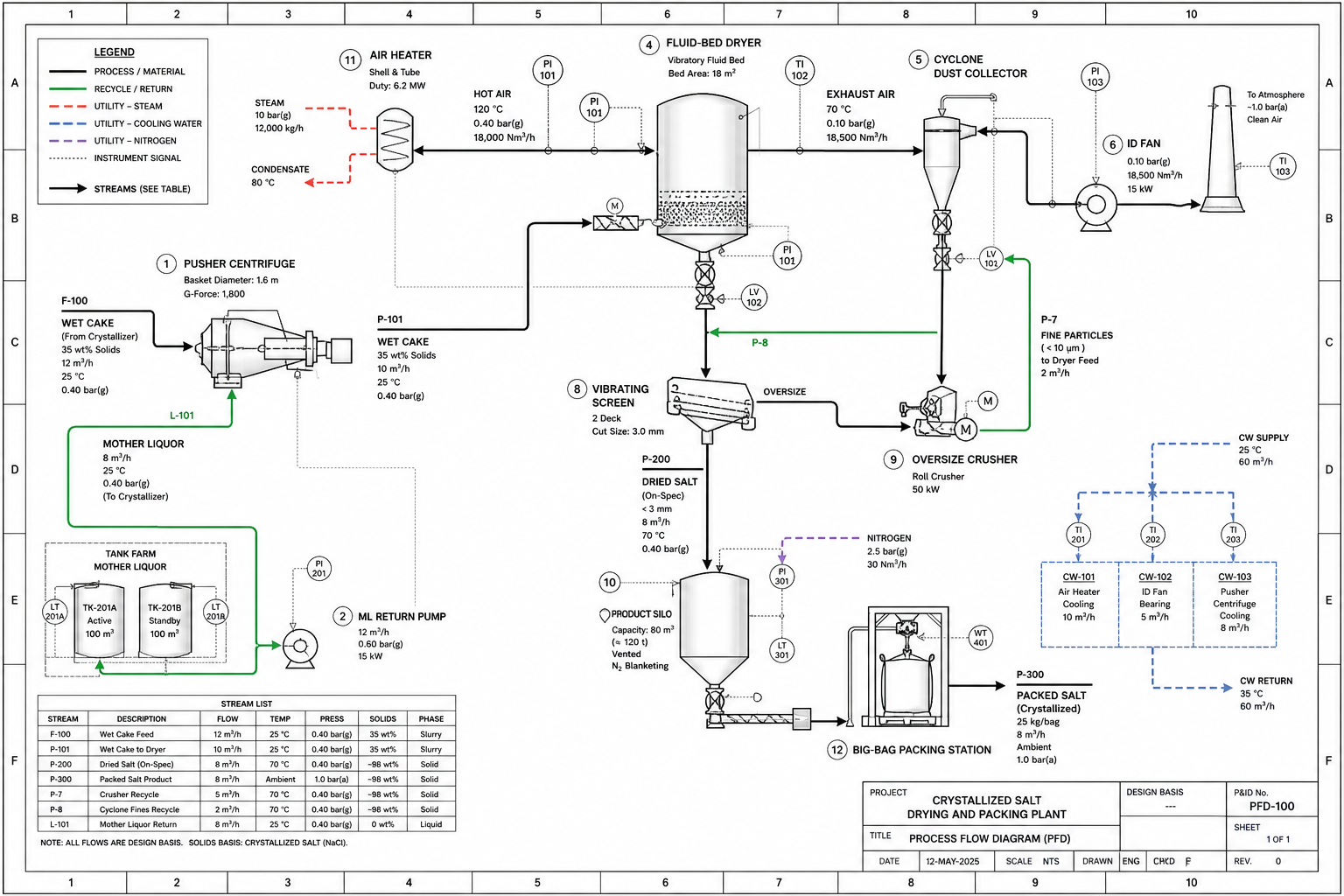
Simplified Drying & Packing Line Diagram

Crystallizer discharge → Pusher / peeler centrifuge (3–5% cake moisture) → Fluid bed / flash / rotary dryer → Multi-deck vibrating screen → Conditioning (iodine / anti-caking) → Silo → Bagging (1–50 kg / 1 t)

Mother liquor returns to the crystallizer; dryer exhaust passes a cyclone / dust collector; oversize recirculates through a crusher — nothing leaves the line except packed product and clean air.

Salt drying and packing PFD: pusher centrifuge, fluid-bed dryer with air heater and cyclone, vibrating screen, product silo and big-bag packing station
01
Centrifuge Dewatering
Two-stage pusher or peeler centrifuges take the crystal slurry to 3–5% cake moisture (optimized 2–2.5%) — every point removed here shrinks the dryer.
02
Drying
Fluid bed for salt, flash for heat-sensitive organics (0.5–3 s residence), rotary or tube-bundle for high tonnage — selected by crystal size and heat tolerance.
03
Screening & Conditioning
Multi-deck vibrating screens grade the product; oversize returns through a crusher. Iodization and anti-caking dosing for food-grade lines.
04
Packing & Closed Loops
Silo buffering, then 1–50 kg bagging and 1 t bulk. Mother liquor recycles as saturated brine; dust collection protects yield and the hall.
Line Composition

Core Modules vs. Optional Modules

A complete salt line runs 20–26 major equipment items; what is core and what is optional depends on feed and product grade.

Core Modules

  • Feed hopper & metering screw from crystallizer / slurry tank
  • Pusher or peeler centrifuge (dewatering to 3–5%)
  • Dryer — vibrating fluid bed, flash (airflow), rotary or tube-bundle
  • Air heater, cyclone / dust collector & exhaust fan
  • Multi-deck vibrating screen with oversize return
  • Product silo, bagging machine (1–50 kg / 1 t bulk bags)
  • PLC / HMI line control with interlocks & remote diagnostics

Optional Modules

  • Salt washing & refining front end (countercurrent wash with saturated brine)
  • Crushing & grinding (jaw / roll crusher) for rock or lake salt feeds
  • Iodine / anti-caking dosing for food-grade salt
  • Metal detection & magnetic separation (food safety)
  • Disc-film or agitated thin-film dryer side-train for ZLD mother liquor
  • Nitrogen-inerted closed loop for oxidizable organic products
  • Heat recovery from dryer exhaust to combustion / process air
Technical Specifications

Equipment Envelope Across the Line

Aggregated from published supplier data on salt, crystal and slurry drying equipment — indicative ranges for preliminary sizing, not a process guarantee.

Line SectionParameterRange / RatingCondition
Whole lineSalt refining & packing capacity3–30 t/hindustrial salt refining lines, SS304/316L construction, 380/480 V
Full plant capacity10–1,000 t/dcrushing-to-packing salt plants, installation area 200–3,000 m²
Product purity / moisture≥99.0–99.5% NaCl · ≤0.3–0.8% H₂Oafter washing, centrifuging and drying
Dewatering — pusher centrifugesModel rangeHR400–HR10005 models; two-stage pusher, continuous, wash & mother liquor separated
Basket / speed / g-factor337–920 mm · 650–2,200 r/min · 236–1,145outer basket; separation factor
Throughput & driveup to 20 t/h · 11–55 kWHR630 on sea salt; push stroke 40–50 mm at 30–80 /min
Feed suitability>0.08 mm · >40% solidscrystal size and slurry concentration
Dewatering — peeler centrifugesModel rangesPPCC 600–1,600 mm · PPCS 21–1,923 L7 wall-through / 8 siphon models, batch, PLC + VFD
Load & speed & power26–2,400 kg · 950–2,600 r/min · 15–200 kWPPCS siphon series; +40–60% capacity vs. plain horizontal
Pharma executioncGMPnitrogen blanketing, CIP, hygienic wall-through design
Drying — fluid bed & rotarySalt discharge moisture≤0.3–0.8%vibrating fluid bed or rotary dryer after 3–5% cake
Tube-bundle dryer series400–1,600 m² · 2.5–4.5 kgH₂O/m²h · 30–160 kW10 models (MGZG400–1600), 7–11 r/min, indirect steam heated
Drying — flash (airflow)Residence time0.5–3 sinstant low-temperature drying — no decomposition / discoloration
Energy & execution−30% vs. tray oven · 304/316L polisheddirect gas–solid heat transfer; GMP food / pharma contact surfaces
Drying — ZLD side-trainsDisc-film (MVR) dryers80–90% thermal efficiency · ≤1% residue H₂Oenergy −45% vs. conventional; slurry to powder in one step
Vacuum low-temp / rake dryers32–45 °C · 15–90% feed H₂Orake auto-reverses every 5–8 min; for heat-sensitive, scaling feeds
Slurry / drum dryers2–4 up to 50 gal/hZLD end-of-train dewatering of evaporator bottoms & concentrated slurry
Screening & packingScreeningmulti-deck vibratinggrade separation with oversize return to crusher
Packing150 g–1 tretail sachets, 1–50 kg bags, 1-tonne bulk bags

Ranges aggregate published specifications from multiple equipment suppliers (salt line contractors, centrifuge and dryer manufacturers, ZLD system builders); figures are indicative for screening and must be verified against your feed, crystal size distribution and utility set.

Dryer Selection

Which Dryer for Which Crystal

The dryer is the energy center of the line — pick it by crystal size, heat sensitivity and tonnage, not by catalog.

Dryer TypeResidence / HeatBest ForWatch-outs
Vibrating fluid bedminutes · hot airWashed salt, inorganic crystals after centrifuge — the default for 3–30 t/h salt linesneeds pre-dewatered feed; dust collection required
Flash (airflow)0.5–3 s · low tempHeat-sensitive organics: starch, glucose, pharma intermediates, organic saltsfeed must be dispersible, non-sticky, fine
Rotary / tube-bundleindirect steam heatHigh tonnage, granular feeds; tube-bundle to 1,600 m² area, low wearlarger footprint; crystal attrition in rotary drums
Disc-film (MVR)continuous · mechanical vapor recompressionZLD mother liquor & residues to ≤1% moisture, −45% energyfor slurry / waste duty, not product salt
Vacuum rake / low-tempbatch · 32–45 °COxidation- and scaling-prone, high-value batches (15–90% feed moisture)batch logic; smaller throughput per unit

Temperature and residence figures follow published dryer data for the listed duties; final selection needs your crystal breakage test and heat-sensitivity data.

Reference Configurations

Three Plant Sizes, Three Layouts

Published salt-plant layouts scale the same process train across three installation-area classes.

CONFIG A · COMPACT
10–50 t/d Pilot & Small Plant
Single dryer line with pusher centrifuge, one-deck screening and a single bagging head. Countercurrent wash omitted on clean feeds. Installation area class 200–600 m².
10–50 t/dsingle fluid bed dryer, compact layout
CONFIG B · STANDARD
100–300 t/d Industrial Salt Plant
Full washing & refining front end with metal detection, HR630-class centrifuge, vibrating fluid bed with cyclone recovery, multi-deck screening and multiple bagging heads. Area class 600–1,500 m².
100–300 t/dclosed-loop wash + metal detection standard
CONFIG C · LARGE
400–1,000 t/d High-Capacity Line
Heat recovery on dryer exhaust, parallel screening lines and multi-station packing (bags + bulk) with warehouse dispatch. Area class 1,500–3,000 m². Centrifuge and dryer trains run in parallel duty.
400–1,000 t/dheat recovery, multi-screen, multi-pack
Reference Installations

What These Lines Achieve on Site

Anonymized configurations reconstructed from published supplier project data.

SALT REFINING & PACKING
Industrial Salt Line, 3–30 t/h
Complete refining-to-packing line: 8-step process from feed washing to iodization, 26 equipment items including vibrating fluid bed dryer, cyclone dust recovery and automatic bagging with brine recirculation. NaCl loss held under 10% across the line.
NaCl loss <10%90-day delivery class, CE / ISO 9001 build
SEA SALT DEWATERING
Seawater Salt, 20 t/h Centrifuge Duty
Two-stage pusher centrifuge (HR630 class) dewatering sea-salt slurry ahead of the dryers: 560/630 mm baskets, continuous full-speed filtering, washing and discharge with mother liquor kept separate from wash.
20 t/hcrystals >0.08 mm at >40% solids, SKF-bearing machine
ZLD MOTHER LIQUOR DRYING
Mixed-Salt Residue to ≤1% Moisture
MVR disc-film drying side-train converting high-salt, high-COD mother liquor to handleable solid in one step: 80–90% thermal efficiency, distillate COD removal up to 99%, PLC-attended 24 h operation on 316L/2205/2507 or titanium wetted parts.
≤1% H₂O · −45% energyvs. conventional evaporation-based drying
Positioning & Evidence

This page aggregates published supplier specifications and project data (salt plant contractors, centrifuge and dryer manufacturers, ZLD system builders) into an engineering screening view. All names are withheld; configurations are described generically. Figures are indicative ranges for preliminary line sizing — final selection requires your feed analysis, crystal size distribution, moisture targets and site utilities.

FAQ · Engineering Answers

Drying & Packing Questions We Answer Most

Recurring questions from engineers specifying the downstream line.

QDo I need a centrifuge before the dryer?

On salt and crystal lines, almost always. Mechanical dewatering to 3–5% cake moisture (2–2.5% optimized) in a pusher or peeler centrifuge removes water at a fraction of the thermal cost of drying — skipping it substantially raises the dryer’s evaporation duty and fuel bill.

QWhich dryer should I choose for salt: fluid bed, flash or rotary?

Washed inorganic salt at 3–30 t/h is standard vibrating-fluid-bed territory. Flash dryers suit heat-sensitive organic crystals (0.5–3 s residence, no discoloration); rotary and tube-bundle dryers carry high tonnage with indirect steam heat and low attrition — tube-bundle units reach 1,600 m² of heat area.

QHow dry can the final salt get?

≤0.3–0.8% residual moisture is the published range for fluid-bed / rotary salt lines; refined washing plants report 0.3–0.5%. For ZLD mixed-salt residues, disc-film dryers reach ≤1% — handleable, landfill-free solids.

QCan the line meet food or pharma grade?

Yes — 304/316L polished contact surfaces with GMP executions, iodine / anti-caking dosing, metal detection and magnetic separation. Peeler centrifuges ship in cGMP wall-through execution with nitrogen blanketing and CIP.

QWhat packing formats does one line cover?

Published lines bag from 150 g retail sachets through 1–50 kg industrial bags to 1-tonne bulk bags, fed from a common screening-and-silo section with PLC interlocks and remote diagnostics.

QHow is salt loss controlled during washing?

Washing runs with saturated brine in countercurrent so the brine dissolves no additional NaCl; published lines hold total NaCl loss under 10% across washing, centrifuging, drying and screening.

Drying & Packing in the Field — Case Studies & Technical Guides

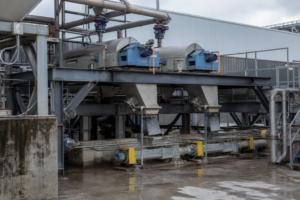
Crystal dewatering bay with horizontal decanter centrifuges on elevated steel frame
Technology

Centrifuge Selection for Crystal Dewatering

Centrifuge selection decides residual moisture (3-8% on salt), dryer energy and product quality. This guide covers decanter structure, pusher vs peeler vs decanter selection, separation factor benchmarks, wash design, back-flush

Read More »

Specifying a Drying & Packing Line?

Send us the crystal size distribution, cake moisture, target final moisture, capacity and packing format. We will return a dryer-selection and line layout with indicative equipment list — not a brochure.

Request a Proposal

Send your feed characterization (TDS, COD, main salts, viscosity), throughput and product targets — we respond with a preliminary process route within two business days.