Industrial salt is produced three ways — solar evaporation of seawater, mining of rock salt deposits, and solution mining that dissolves deep salt layers into brine — and it is refined along two routes: mechanical washing plants that upgrade raw salt to 97–99% NaCl, and vacuum recrystallization that dissolves, purifies, and re-crystallizes salt into PDV (pure dried vacuum) grade at >99.5% NaCl with <0.1% moisture. Which route fits your plant depends on feedstock quality and target grade; which energy backbone — multi-effect evaporation (MEE) or mechanical vapor recompression (MVR) — depends on local steam-versus-electricity economics. This guide walks the full process chain with the parameters that actually drive yield and operating cost.
Three Ways Salt Reaches the Plant
Solar evaporation
Seawater contains roughly 3.5% dissolved salts, dominated by NaCl. Solar saltworks concentrate seawater through a series of evaporation ponds until brine reaches saturation and salt crystallizes on pond floors. It is the cheapest energy source available — free sunlight — but the product is wet, impure, and seasonal, and coastal weather dictates output.
Rock salt mining
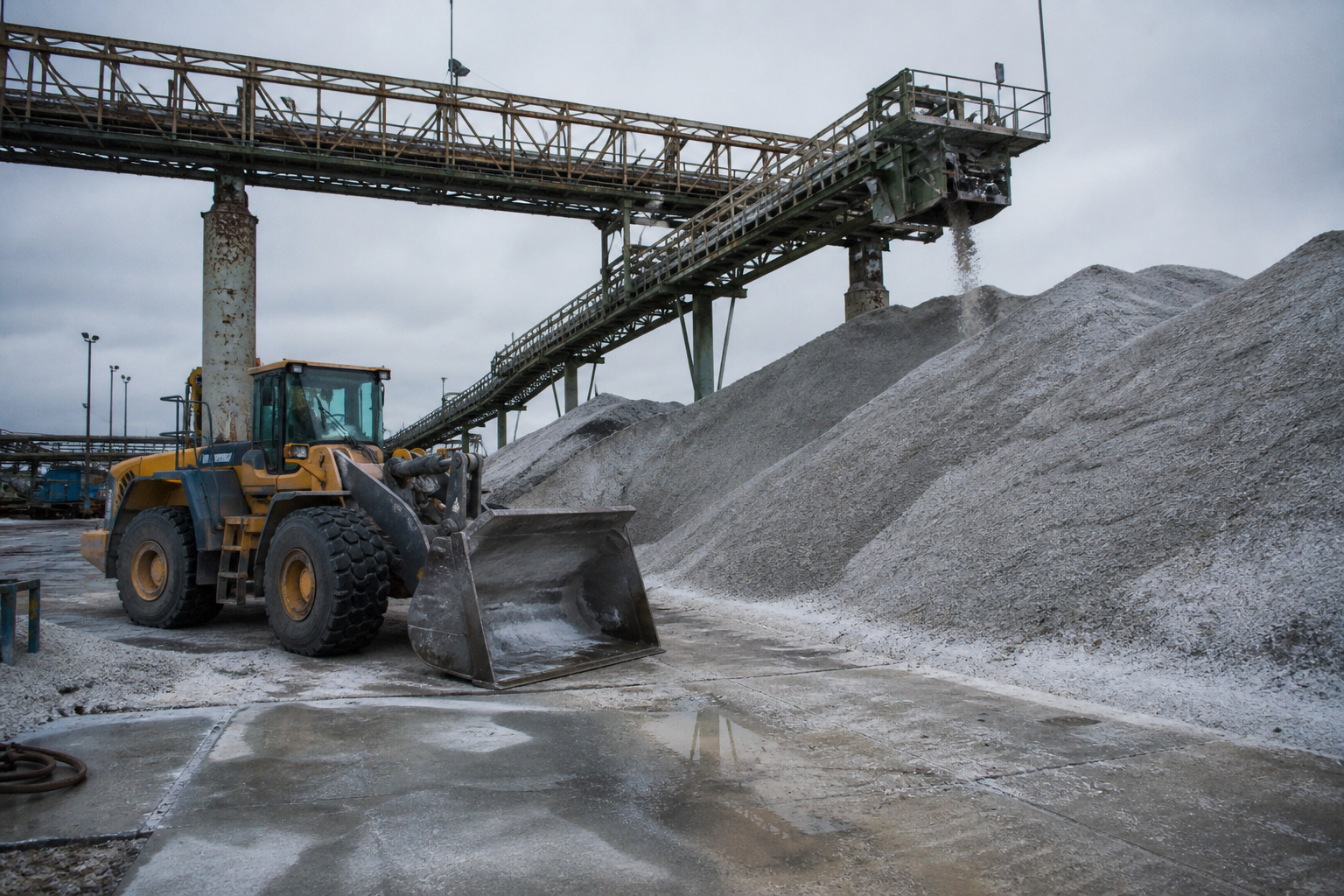
Geological salt beds are mined directly, typically by drill-and-blast, producing dense rock salt blocks that are crushed and refined at the surface. Mined salt is usually cleaner than solar salt but arrives as hard, high-density lumps that shape the crushing equipment selection downstream.
Solution mining
Water is injected through wells into deep salt formations, dissolving the layer in place; the resulting brine is pumped back to the surface and fed directly to vacuum evaporators. Solution mining leaves the surface landscape undisturbed and skips the crushing and washing stages entirely, because the salt arrives already dissolved and can go straight to brine purification.
For scale: published industry statistics for 2025 place the three largest producers at China with roughly 53 million tonnes, the United States with roughly 42 million tonnes (Great Lakes solar salt, Michigan solution mining, Louisiana salt domes), and India with roughly 30 million tonnes.
Raw Salt vs. PDV Vacuum Salt
The commercial gap between raw and refined salt is wide, and it is the reason a refining plant exists at all:
| Property | Raw salt (solar / rock) | PDV vacuum salt |
|---|---|---|
| NaCl purity | ~96% | >99.5% |
| Moisture | ~4% | <0.1% |
| Ca / Mg hardness ions | High, variable | Residual <10 mg/L after brine purification |
| Insolubles (clay, sand) | Surface-bound | Essentially removed |
| Processing route | Physical washing only | Dissolution + chemical purification + recrystallization |
Mechanical Refining: Five Steps to 97–99% NaCl
A mechanical salt refinery crushes, washes, dewaters, dries, and screens raw salt into a sellable grade. Most project failures trace back to poor process design rather than individual machine quality — and every upstream weakness (oversize lumps, excess fines, dirty wash brine) amplifies cost through every downstream stage.
Step 1: Crushing
Crushing reduces large crystals or lumps to a controlled particle size. Equipment choice follows the feedstock: roll crushers suit solar salt and produce a uniform granulation, while hammer mills or wet mills handle the dense blocks typical of rock salt. The failure mode to avoid is over-crushing — excess fines dissolve in the wash step or are carried away with wash water, which is a direct loss of saleable yield.
Step 2: Washing
Washing removes mud, clay, and both soluble and insoluble impurities. A well-engineered wash module combines three units in series:
- Screw washer — a spiral conveyor in brine that abrades surface dirt off the crystals;
- Stirred wash tank — high turbulence dissolves Ca and Mg salts and keeps suspended solids from settling back onto the salt;
- Hydrocyclone — separates dense salt crystals from the lighter impurity-laden phase and enables wash-water recovery.
One detail separates professional plants from loss-making ones: washing is done with saturated brine, not fresh water. Saturated brine cannot dissolve more salt, so the crystals survive the wash intact. Fresh water quietly dissolves the product.
Step 3: Dewatering
Wet salt typically leaves the wash plant at 30–50% moisture. A pusher centrifuge brings it down to 3–5% — and because mechanical dewatering is far cheaper per kilogram of water than thermal drying, this stage is the single largest energy lever in a mechanical plant. Every point of moisture removed by the centrifuge is water the dryer does not have to evaporate.
Step 4: Drying
Industrial salt specifications typically call for 0.1–0.5% final moisture. Two dryer types dominate:
- Vibrating fluid bed dryers blow typically 120–180°C hot air through a perforated plate; vibration prevents dead zones, crystal shape is preserved, and the gentle handling makes fluid beds the default choice for food-grade and premium salt;
- Rotary drum dryers are rugged and tolerate load fluctuations, which suits bulk industrial salt where crystal aesthetics matter less than uptime.
Energy discipline matters here: each extra increment of moisture entering the dryer raises drying energy consumption by roughly 15–20%, so a well-set centrifuge directly shrinks the fuel bill. In dry, hot climates with lenient quality targets, some plants even replace mechanical drying with natural sun-curing — an option worth pricing before the dryer is ordered.
Step 5: Screening and packing
Sieving removes oversize and undersize fractions to meet granulation consistency, and the product goes to automated packing — multihead weighers, valve-bag fillers, and robotic palletizing for consumer packs, 25–50 kg bags, or jumbo bags.
Vacuum Recrystallization: The Thermal Route to >99.5%
Mechanical washing cleans surfaces; it cannot remove the Ca and Mg hardness locked inside the crystal structure or dissolved in interstitial brine. When the target is PDV-grade purity, the salt must be dissolved and re-grown — see the overview of industrial crystallization practice for the underlying crystal-growth principles.

Brine preparation and chemical purification
Raw salt is dissolved into a typical 25–28% brine, then purified by the two-alkali method:
- Ca²⁺ + Na₂CO₃ → CaCO₃↓ (calcium carbonate precipitate)
- Mg²⁺ + 2NaOH → Mg(OH)₂↓ (magnesium hydroxide precipitate)
The precipitates are removed by settling and filtration. Modern plants dose the reagents with flow-metered, sensor-controlled precision of about ±2%, holding residual Ca/Mg below 10 mg/L. The payoff is concrete: unpurified hardness has been reported to scale evaporator heating surfaces by 3–5 mm within two weeks of operation, degrading heat transfer and inflating steam and power consumption.
Vacuum evaporation and crystallization
Under vacuum, brine boils at 70–80°C — low temperature protects crystal quality and cuts heating demand. Forced circulation maintains a typical 2.5–3.8 m/s velocity through the heater, keeping crystals suspended and preventing tube-wall deposition. Stable temperature control (a hallmark of MVR systems) avoids sudden supersaturation spikes that trigger nucleation storms. The result is a uniform crystal population of 0.3–1.2 mm.
Separation and washing of crystals
Crystallizer slurry typically carries 20–25% solids. A two-stage pusher centrifuge dewaters it, with a clean-brine rinse sprayed in the second stage that lifts purity another 0.2–0.3 percentage points to ≥99.5% NaCl — while keeping crystal breakage below 1% and cake moisture below 3%. Downstream, the vibrating fluid bed finishes drying to below 0.05% moisture for food and most chemical specifications; for the wider drying-and-packing picture, see the salt drying and packing line capability page.
MEE vs. MVR: Choosing the Energy Backbone
Most existing vacuum salt plants run multi-effect evaporation because it is mature, stable, and easy to operate; most new plants and retrofits now evaluate MVR to cut long-term operating cost. The comparison (typical published values):
| Parameter | MEE (4-effect typical) | MVR |
|---|---|---|
| Steam consumption | ~0.45 t steam per t salt | ~0.02 t per t salt (start-up only) |
| Electricity consumption | Low | 35–40 kWh per t salt |
| Cooling tower | Required | Not required |
| CAPEX | Lower | Higher |
| Best fit | Cheap or CHP steam; expensive electricity | Steam above ~$20/t with reasonable power price |
MVR’s economics rest on a single compressor doing the lifting that four evaporation effects and a cooling tower otherwise do; its risk profile rests on the compressor’s manufacturing quality. If you are weighing this decision as part of a wider equipment shortlist, the evaporator selection guide works through the full framework.
Assembling a Complete PDV Line
A full PDV production line typically comprises: titanium or stainless-steel MVR evaporator bodies; an elutriation (washing) leg on the crystallizer that classifies and controls crystal size; two-stage pusher centrifuges; a vibrating fluid-bed dryer; brine purification tanks with filtration; and conveying plus automated packing under PLC/SCADA control.
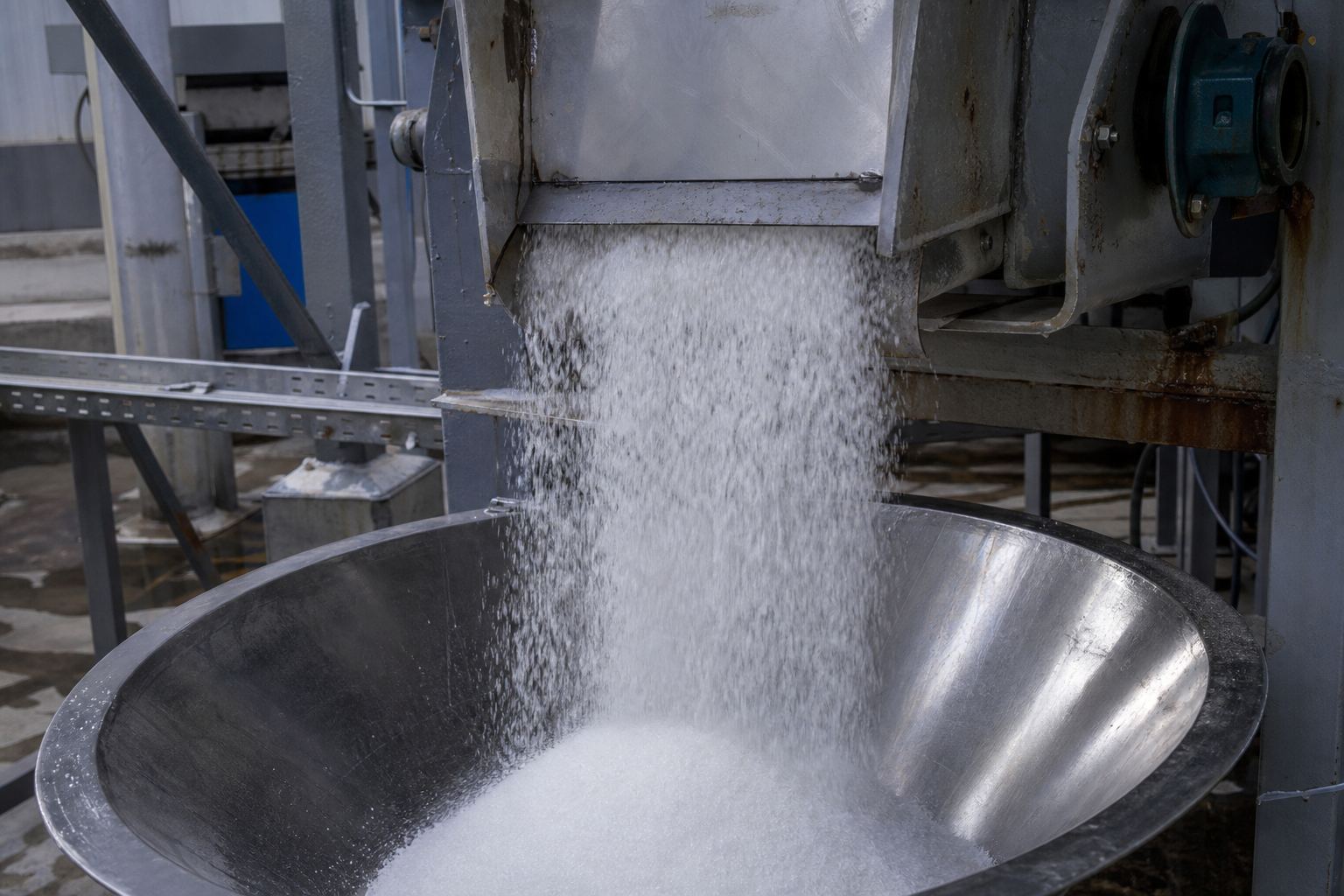
An externally reported Central Asia project illustrates the decision logic: with rock salt feedstock and a local energy structure favoring steam, the plant selected MEE despite MVR’s lower OPEX elsewhere. After optimizing crystallizer type, circulation pattern, operating level, salt-leg dimensions, and discharge geometry, the line started up at >99.5% purity with crystal size stable around 0.8 mm and fully automated operation. Energy structure — not fashion — should pick the evaporator; salt recovery and salt separation strategy then set the product quality.
Iodization, Anti-Caking, and Food-Grade Compliance
Post-drying finishing turns refined salt into regulated consumer and food-industry product:
- Iodization — most national regulations mandate 20–40 mg iodine per kg of salt, dosed as potassium iodate or iodide immediately after drying;
- Anti-caking agents — magnesium carbonate, ferrocyanides, calcium silicate, or sodium aluminosilicate are dosed before packing to prevent hygroscopic caking;
- Dust collection — protects both worker health and equipment from corrosive salt dust;
- Hygiene — food-grade lines add HACCP-compliant materials, CIP capability, and segregated handling.
FAQ
What is PDV salt?
PDV (pure dried vacuum) salt is produced by dissolving raw salt, chemically purifying the brine, and re-crystallizing under vacuum, then centrifuging and drying. It exceeds 99.5% NaCl with under 0.1% moisture — the standard grade for food, pharmaceutical, and high-purity chemical applications.
When should I choose mechanical refining instead of vacuum salt production?
Choose mechanical washing when raw salt is reasonably clean and 97–99% NaCl meets your market — it costs much less to build and run. Choose vacuum recrystallization when the feedstock carries high Ca/Mg or insolubles, or when the product must reach >99.5% purity. The two routes can coexist: mechanical plants often feed dissolution plants.
Why is washing done with saturated brine instead of fresh water?
Saturated brine cannot dissolve additional NaCl, so product crystals pass through the wash intact. Fresh water dissolves several percent of the salt it touches — lost yield that compounds across every tonne processed.
What happens if brine is not purified before evaporation?
Calcium and magnesium hardness precipitates on heating surfaces. Unpurified brine can lay down 3–5 mm of scale within two weeks, cutting heat-transfer efficiency and driving up steam and electricity consumption until cleaning interrupts production.
Is MVR or MEE better for a new salt plant?
There is no universal answer: MEE (roughly 0.45 t steam per t salt) wins where cheap steam or CHP exists and electricity is expensive; MVR (roughly 0.02 t steam plus 35–40 kWh per t salt, no cooling tower) wins where steam costs exceed about $20/t and power is reasonably priced. Size the decision to your site’s energy contract, not the technology trend.